

The fastest way to improve Domain Authority is to earn more high-quality backlinks from unique referring domains. Everything else, from internal linking to cleaning up toxic links, works by making that backlink growth count for more. Below are 8 tactics that move the score, plus what to skip and how long to expect results to take.
What Is Domain Authority (and Why Does Yours Feel Stuck)?
Domain Authority (DA) is a score from 1 to 100, created by Moz, that predicts how likely a website is to rank in search results compared to other sites. It is not an official Google ranking factor. It is a third-party estimate built mostly from your backlink profile.
If your DA has sat at the same number for months while sites that look weaker keep climbing, that is not a bug. DA is relative and logarithmic. Moz scores every domain in its index against every other domain. Your score can drop even when your own backlink profile has not changed, because other sites gained links faster. It also means the climb gets harder as you go: moving from DA 20 to DA 30 takes far less link equity than moving from DA 70 to DA 80.
The current model behind the score, sometimes called DA 2.0, replaced Moz’s older linear formula with a neural network trained on Moz’s own Link Explorer index, which the company has reported at more than 35 trillion links, plus real Google SERP data and spam-detection signals. That is why two audits of the same site weeks apart can show slightly different numbers even when nothing on your end changed: the model itself keeps learning from a moving link graph, not just from your backlinks.
- DA ranges from 1 to 100; new websites usually start near 1
- Moz calculates and owns DA using its own Link Explorer index
- Google flat-out does not use DA to rank websites, and Google’s own ranking systems weigh relevance, expertise and usability instead
- Scores shift as Moz recrawls the web, even without changes on your end
- The only lever that reliably moves DA is earning more high-quality referring domains
Domain Authority vs. Domain Rating vs. Authority Score

Moz, Ahrefs and Semrush each built their own version of this idea, and the names get used almost interchangeably in SEO conversations. Moz calls its metric Domain Authority. Ahrefs calls its metric Domain Rating (DR). Semrush calls its metric Authority Score. All three sit on a roughly 1-to-100 scale, but they are separate, non-interchangeable scores built from separate web indexes, so the same site can post three different numbers. Comparing your domain metrics across tools only works when you stick to one metric at a time.
| Metric | Creator | Scale | Calculation Basis | Free Checker |
|---|---|---|---|---|
| Domain Authority (DA) | Moz | 1-100 | Moz Link Explorer index; a machine-learning model built primarily on referring-domain quantity and quality | Moz Domain Authority Checker |
| Domain Rating (DR) | Ahrefs | 1-100 | Ahrefs index; backlink profile strength only, weighted by the authority of linking domains | Ahrefs Website Authority Checker |
| Authority Score | Semrush | 1-100 | Semrush index; link power, estimated organic traffic and spam signals combined | Semrush Authority Score Checker |
None of the three is more correct than the others since each reflects the coverage of its own index. Pick one metric and stick with it inside a single analysis. Mixing DA and DR comparisons in the same outreach list produces numbers that were never meant to line up.
A related but separate score worth knowing: Page Authority (PA), also from Moz, predicts how well a single page (not the whole domain) is likely to rank. A page on a lower-DA site can still carry a high PA if that specific page has earned a lot of direct links, so use DA to vet a site as a link source and PA to check whether one particular page on that site is strong enough to pass real value.
What’s a Good Domain Authority Score?

There is no universal good score. DA is a relative metric, so a 30 is strong against competitors averaging 20 and weak against competitors averaging 55.
| DA Range | Typical Profile |
|---|---|
| 1-20 | New or very small sites with few referring domains |
| 21-40 | Growing sites with a developing backlink profile |
| 41-60 | Established sites with a solid link presence in their category |
| 61-80 | Strong authority sites with extensive backlink profiles |
| 81-100 | Major brands, national media and other high-authority platforms |
Instead of chasing a specific number, pull the DA of the 3 to 5 sites that currently rank for your target keywords and aim to match or beat the median. That comparison, not a flat threshold, is what actually tells you whether your score is doing its job. If you are unsure how much link building that takes, how many backlinks you need to rank depends more on your competitors’ profiles than on any fixed number.
Benchmarking against real ranking pages holds up under scrutiny too. Ahrefs ran its own analysis across more than 200,000 domains and found that Domain Rating, its equivalent of DA, correlates with how many keywords a site ranks for and how much organic traffic it pulls in. That is why comparing your score against the sites you are trying to outrank is more useful than comparing it against a universal cutoff.
How Domain Authority Is Calculated
Moz calculates DA with a machine-learning model built on data from its Link Explorer index. The model weighs the number of unique referring domains pointing at your site, the quality of those referring domains (links from high-DA sites count for more), and your spam score, which can suppress DA when a backlink profile looks manipulated.
Because DA is normalized against every other indexed domain, your score can move even without any change to your own links, if enough other sites in Moz’s index gain or lose ground first.
How to Check Your Domain Authority
You can check DA for free with any of these:
- Moz’s free Domain Authority checker: look up any domain and see DA, PA, and referring-domain count
- MozBar browser extension: shows DA and PA for every page you visit
- Ahrefs Website Authority Checker: free, no login, shows DR alongside referring domains and estimated traffic
- Semrush Authority Score checker: free, shows Authority Score alongside backlink and traffic data
For screening a long outreach list, most of these tools also offer a bulk checker that returns scores for a whole batch of domains at once. The free tiers are enough for occasional lookups, but they cap out fast: Moz’s free account limits MozBar to a handful of lookups a day and holds back Spam Score and full link-metric detail behind a paid Moz Pro plan, so a heavy outreach or link-audit workflow usually needs at least one paid seat somewhere in the stack.
How to Improve Domain Authority: 8 Tactics That Actually Move the Score
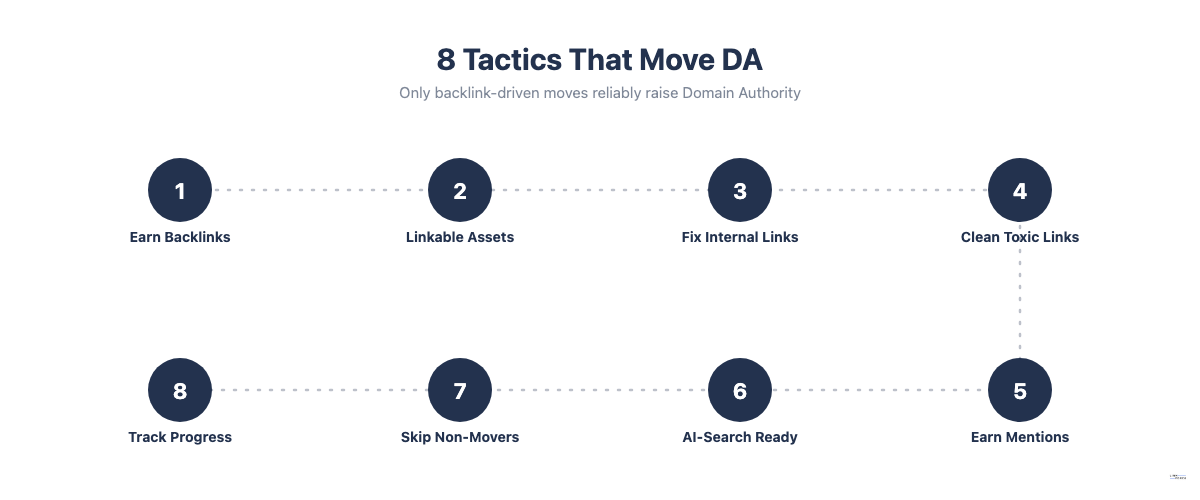
Everything below is off-page SEO work, since DA cannot be moved from inside your own site alone. Work through these roughly in order, since the first two build the referring-domain base everything else protects or redistributes. That base is worth prioritizing on its own merits, separate from DA: a large-scale ranking factors study by Backlinko found referring-domain count had the strongest correlation with Google rankings of any factor tested, and pages in the top 3 results averaged close to 4 times more referring domains than pages ranked 4 through 10.
1. Earn Backlinks From Higher-Authority, Relevant Sites
Every DA gain traces back to this. A single link from a trusted, topically relevant site does more for your score than a dozen links from low-authority, unrelated ones. For the full breakdown of what separates one from the other, see our guide on what makes a good backlink. Two approaches earn links reliably: guest posting on established sites in your niche, where each published piece adds a new referring domain to your profile, and digital PR, where you pitch data-led stories or original research to journalists and bloggers so a single placement on a high-authority outlet can move the needle on its own.
2. Publish Linkable Assets and Original Research
Content earns links when it gives other sites a reason to cite it instead of writing their own version. Three linkable asset formats work best: original research and data studies, free tools or calculators, and guides that go deeper than what already ranks. Each saves the linking site the work of producing that value itself. Keep the asset current, too. A stale study stops earning new citations even if it still ranks fine on its own.
3. Fix Your Internal Linking
Internal links do not create new authority, but they decide how the authority you already have (sometimes called link juice) gets distributed across your site. A page with zero internal links pointing to it, an orphan page, is hard for Google to find and hard for it to rank, no matter how strong your domain-level backlink profile is.
Start by linking from your highest-authority pages into the pages you most want to rank. Then connect your content into pillar-and-cluster groups: a broad pillar page links out to narrower cluster pages on the same topic, and each cluster page links back to the pillar, which signals topical depth instead of a scattered set of unrelated posts. Keep anchor text natural and varied rather than repeating the same exact-match phrase everywhere, and avoid stacking multiple links to the same destination on one page, since that dilutes the value each individual link passes. Run a periodic crawl to catch orphan pages and broken internal links, and prioritize reconnecting any orphan that already has external backlinks or search impressions, since those are the ones with the most stranded value.
4. Clean Up Toxic and Broken Links
Two different problems live under this tactic, and both hurt DA in different ways. Spammy or manipulative inbound links can suppress your score directly, since Moz’s model factors in spam signals when it evaluates your referring-domain profile. Broken links, both inbound and internal, waste crawl budget and hurt the user experience that keeps visitors (and the links they might otherwise create) on your site.
For broken link building, find dead links on relevant pages elsewhere in your niche, build a replacement resource that covers the same ground, and let the site owner know their link is broken and what to swap it for. For your own toxic inbound links, use Google Search Console to identify suspicious referring domains first. Google’s Disavow Links tool is still live and still works, but Google’s own current guidance limits it to two situations: you are under an active manual action for unnatural links, or you have strong, specific evidence that one is coming. It is not meant as routine housekeeping for a normal backlink profile, so reach for it only when one of those two conditions actually applies to you.
5. Earn Mentions, Reclaim Unlinked Ones and Get Listed in Relevant Directories
Not every mention of your brand comes with a link, and some of the easiest DA gains come from converting the ones that don’t. Use a brand-monitoring tool to find unlinked mentions, then ask the publisher to add one, since they have already decided you are worth mentioning. Respond to journalist queries through services like HARO, Qwoted or SourceBottle to earn editorial links from news sites. Resource pages and curated link pages in your industry work the same way; look for one where a relevant listing genuinely fits. Directory listings still carry weight too, and prioritize ones tied to your actual business category over generic web directories. A LinkedIn Company Page is one of the easiest wins in this category: it is free to create, it carries real authority of its own, and the link back to your site counts toward your profile with almost no outreach required.
6. Structure Content So AI Search Engines Can Cite You
Backlinks and citations no longer come only from other web pages. AI systems like ChatGPT and Claude now crawl and cite sources directly, and getting cited there is close cousin to earning a link: it puts your domain in front of readers who might otherwise never find you.
Two separate categories of AI crawler exist, and they matter differently. Training crawlers, like OpenAI’s GPTBot and Anthropic’s ClaudeBot, crawl in bulk to build model training data and respect robots.txt directives. Real-time search crawlers, like OpenAI’s OAI-SearchBot and PerplexityBot, index continuously to answer live queries and are far less forgiving of slow pages or redirect chains, since a single extra hop can knock a page out of a generated answer entirely. Check your robots.txt to make sure you are not blocking the search-specific bots even if you choose to block the training-only ones, and keep your most important pages on fast, crawlable, JavaScript-light templates so both traditional and AI crawlers can actually read them.
7. Skip Tactics That Don’t Move DA
Knowing what to leave alone saves as much time as knowing what to do. None of the following move DA on their own:
- Publishing more blog posts without a matching link-acquisition push
- Improving on-page SEO, site speed, or internal linking in isolation, without also earning new referring domains
- Growing social media followers or social shares
- Buying backlinks, which outright violates Google’s guidelines and can trigger manual penalties on top of doing nothing for DA
8. Track Your Progress and Set a Realistic Timeline
DA is a lagging metric, and Moz recrawls the web on its own schedule rather than in real time. After you earn a meaningful cluster of new referring domains, expect 3 to 6 months before you see the first noticeable movement, and 6 to 12 months or longer before the full gain shows up in your score. Track your referring-domain growth with a periodic backlink audit rather than watching the DA number day to day. Because the scale is logarithmic, a brand-new site can see fast early jumps that a well-established site simply will not get, so measure your own progress against your own starting point instead of someone else’s timeline.
Domain Authority Limitations and Common Misconceptions
Knowing what DA cannot tell you matters as much as knowing how to move it.
- DA is not a Google ranking factor. Google does not use Moz’s Domain Authority in its ranking algorithm. Google has confirmed it has its own internal quality signals that cover similar ground, but those are separate systems, not DA.
- DA is not the same as PageRank. PageRank was a Google algorithm. DA is a Moz prediction model built by a different company for a different purpose.
- DA is not a fixed score. It shifts as Moz updates its algorithm and recrawls the web, sometimes moving thousands of sites at once even when your own backlink profile hasn’t changed at all.
- A high DA does not guarantee rankings. DA only captures backlink strength. Google’s algorithm also weighs on-page relevance, content quality and user experience, so a DA 60 site with thin content can lose to a DA 35 site with real topical depth.
- Link farms and private blog networks can inflate DA temporarily. When you’re vetting a site as a link source, check organic traffic and spam score alongside DA to catch a manipulated profile before you rely on it.
Domain Authority FAQ
How do you improve domain authority?
You improve domain authority mainly by earning more high-quality backlinks from unique referring domains, since that is the one input Moz’s model weighs most heavily. Internal linking, toxic-link cleanup, and AI-search visibility all support that core lever rather than replacing it.
What is a good domain authority score?
There is no single good score, because DA is relative to your competition. A 30 is strong if the sites ranking above you average 20, and weak if they average 55, so compare your score to your actual competitors instead of a fixed number.
How long does it take to increase domain authority?
Increasing domain authority typically takes 3 to 6 months to show noticeable movement and 6 to 12 months or longer for significant, measurable growth, since Moz recrawls the web on its own schedule rather than updating scores in real time. A brand-new site can see faster early jumps than an established one, because the scale is logarithmic.
Does domain authority affect my Google rankings?
Not directly, and this one is non-negotiable: DA is not a Google ranking factor. Sites with high DA tend to rank well because they usually have the same strong backlink profiles that Google’s own algorithm does value. DA correlates with ranking ability. It does not cause it.
What is the difference between domain authority and page authority?
Domain Authority measures the overall strength of an entire website. Page Authority measures the ranking strength of one specific page on that site. Use DA to judge whether a site is worth pursuing as a link source, and use PA to check whether the particular page you want a link from can pass meaningful value.
Can cleaning up toxic links improve my domain authority?
It can, but only in specific cases. Google’s Disavow Links tool still works in 2026, though Google’s own guidance reserves it for an active manual action or a strong, specific suspicion that one is coming, not as routine maintenance for an otherwise healthy backlink profile.
Does internal linking affect domain authority?
Internal linking does not create new authority on its own, but it determines how the authority you already have flows through your site. Fixing orphan pages and building pillar-to-cluster links helps your strongest pages pass more value to the pages you actually want to rank.