

When you look at an SEO report and see a backlink count and a referring domain count that tell completely different stories, the numbers are not broken. The two metrics measure different things, and understanding that difference is essential to building a link profile that actually improves your rankings.
A website might have 2,000 backlinks but only 40 referring domains. A competitor might have 300 backlinks from 290 different sites. The first profile raises questions. The second looks healthy. The difference between referring domains and backlinks comes down to counting individual links versus counting unique sources. This guide explains what each metric counts, how that difference affects SEO, and which number to focus on depending on where you are in your link-building strategy.
What Is a Backlink?
Quick definition: A backlink is a hyperlink from one website to a page on another website. Each individual link counts as one backlink, regardless of whether the same website sends ten more.
A backlink is a hyperlink from one website that points to a page on another website. Every time an external web page includes a link to your content, that is one backlink. Ten pages on the same website each linking to you equals ten backlinks.
Backlinks signal relevance and authority to search engines. When a credible web page links to your website, it passes link equity to the linked page. This equity contributes to how Google evaluates your page’s trustworthiness and ranking potential for relevant queries.
Not all backlinks carry the same weight. Two variables matter most:
- Dofollow vs nofollow: Dofollow links pass link equity from one website to another. Nofollow links were historically ignored by Google, but since 2019 Google treats nofollow as a hint rather than a directive. A natural backlink profile includes a mix of both.
- Contextual vs non-contextual: A link embedded in the body of a relevant article on a website carries more weight than a sitewide footer link. Context tells search engines why one website is linking to another.
Anchor text also matters. The visible words that form the clickable link signal topical relevance, but an over-optimised anchor profile across a backlink set raises spam signals. Natural anchor text variation across your backlink profile is the standard to aim for.
What Are Referring Domains?
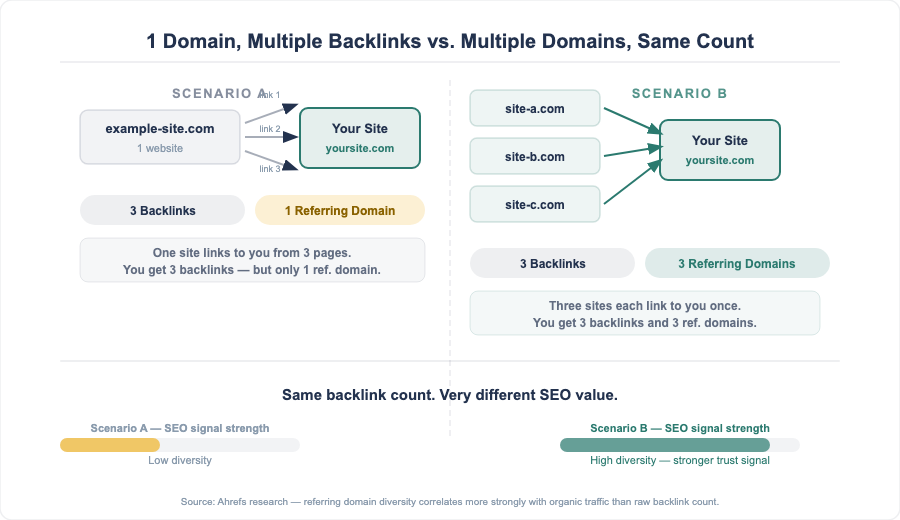
A referring domain is any unique website that links to your site at least once. If one website links to ten of your pages, that is ten backlinks but still one referring domain.
Referring domain count measures how many distinct websites link to you, not how many total links exist. This distinction is the whole point.
To make it concrete: if website A links to you from its homepage, its blog, and three product pages, that is five backlinks from one referring domain. If five different websites each link to you once, that is also five backlinks but five referring domains. From a search engine perspective, the five independent endorsements are far more valuable than five from one source.
Why? Because concentrated backlink profiles are easier to manufacture. A site owner can add fifty links from a single website they control. Earning fifty backlinks from fifty independent websites is much harder to fake. That difficulty is part of what makes domain diversity a strong trust signal, and why referring domains tend to correlate more closely with organic traffic than raw backlink counts.
Ahrefs’ analysis of over one billion web pages found that referring domain count correlates more strongly with organic search traffic than backlink count. The pattern makes intuitive sense: more unique websites vouching for your content means broader editorial endorsement.
The Difference Between Backlinks and Referring Domains
| Feature | Backlinks | Referring Domains |
|---|---|---|
| What is counted | Every individual link from another website to yours | Unique websites that have at least one backlink pointing to your site |
| Can increase without the other changing | Yes, one website can add multiple new links | No, a new link from an existing domain adds a backlink, not a new referring domain |
| Primary SEO signal | Page-level authority and topical relevance | Site-level trust and link diversity |
| High count from few domains | Common pattern in manipulated or spammy profiles | Red flag: suggests artificial link concentration |
| High count from many domains | Strong signal of broad editorial coverage | Strong signal of a natural, authoritative link profile |
A large gap between your backlink count and your referring domain count is a signal worth investigating. A website with 5,000 backlinks from 80 domains is showing a very different link acquisition pattern than a website with 5,000 backlinks from 3,000 domains.
Why the Difference Between Backlinks and Referring Domains Matters for SEO
Search engines weight link diversity heavily as a quality signal. The difference between backlinks and referring domains becomes practically important in several connected ways:
Link velocity and source patterns: A sudden spike in backlinks from one website looks artificial. Gradual growth in referring domains from many different websites looks like organic content discovery. Google reads the velocity pattern, not just the total count.
Anchor text distribution: When a website’s backlinks come from diverse referring domains, anchor text naturally varies across them. When links come from a small cluster of domains, anchor text repetition is more likely, which can trigger over-optimisation signals.
Spam detection: Google’s Penguin algorithm specifically targets concentrated, low-diversity backlink profiles. A high ratio of backlinks to referring domains, especially from low-quality websites, is one of the clearest patterns Penguin is designed to catch.
Traffic correlation: Because referring domain diversity is harder to manufacture than raw backlink count, it serves as a better proxy for actual editorial endorsement. Sites with strong referring domain counts tend to rank more reliably and attract more organic traffic than sites with similar backlink counts but fewer unique sources.
The practical implication: 100 backlinks from 80 different relevant websites is a stronger SEO asset than 100 backlinks from 5 websites, even if the 5 websites have higher authority scores.
Which Metric Should You Prioritize?
Both metrics matter, but they answer different questions. Which one to focus on depends on where your site is in its growth and what outcome you are optimising for.
| Situation | Focus on |
|---|---|
| New or low-authority domain | Referring domains (build site-level trust) |
| Referring domain count lags competitors | Referring domains (close the diversity gap) |
| Backlink-to-domain ratio above 20:1 | Referring domains (reduce concentration risk) |
| Need stronger page-level authority for one URL | Backlinks (contextual placement quality) |
| Competing keyword needs deep topical link signals | Backlinks (page-specific authority transfer) |
When to Focus on Referring Domains
Prioritise growing your referring domain count when:
- You are building site-level authority for a new or low-authority domain
- Your referring domain count is significantly lower than your main competitors
- Your backlink-to-domain ratio is already high, indicating link concentration risk
- You need to report link-building progress to a client in a way that shows diversification
The goal here is trust-building at the domain level. A diverse referring domain profile signals to search engines that many independent websites find your content valuable enough to link to.
When Backlinks Take Priority
Focus on individual backlink quality and placement when:
- You need to strengthen a specific high-value page, not just your domain overall
- You are targeting a competitive keyword where top-ranking pages have strong contextual backlinks to that exact URL
- Your referring domain diversity is already solid and page-level authority transfer is the remaining gap
One warning sign to watch for: if you are running a link-building campaign and your referring domain count is not rising alongside your backlink count, investigate. A healthy outreach campaign adds new domains consistently. If the same ten websites keep sending new backlinks while no new domains appear, the profile is concentrating rather than diversifying.
How to Check Backlinks and Referring Domains
Every major SEO platform shows both metrics, but they differ in index size, freshness, and what you can do with the data:
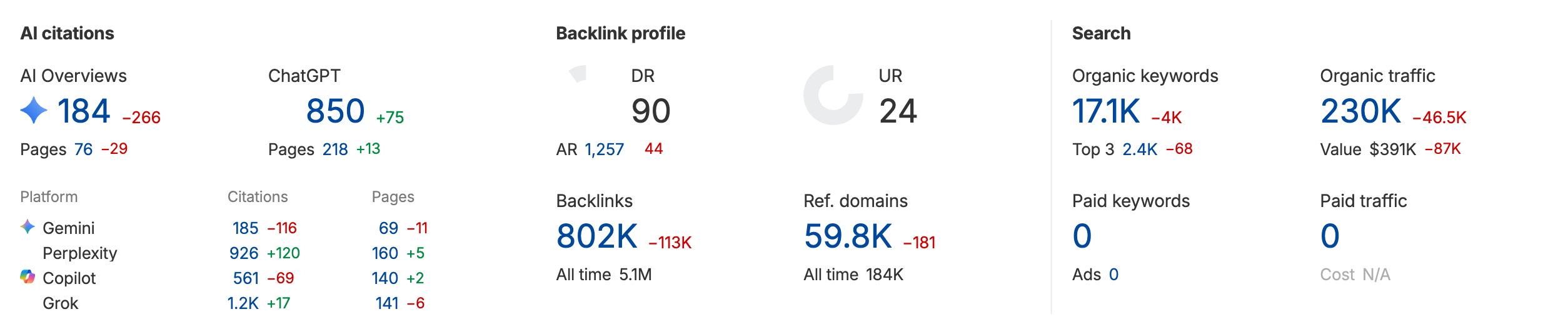
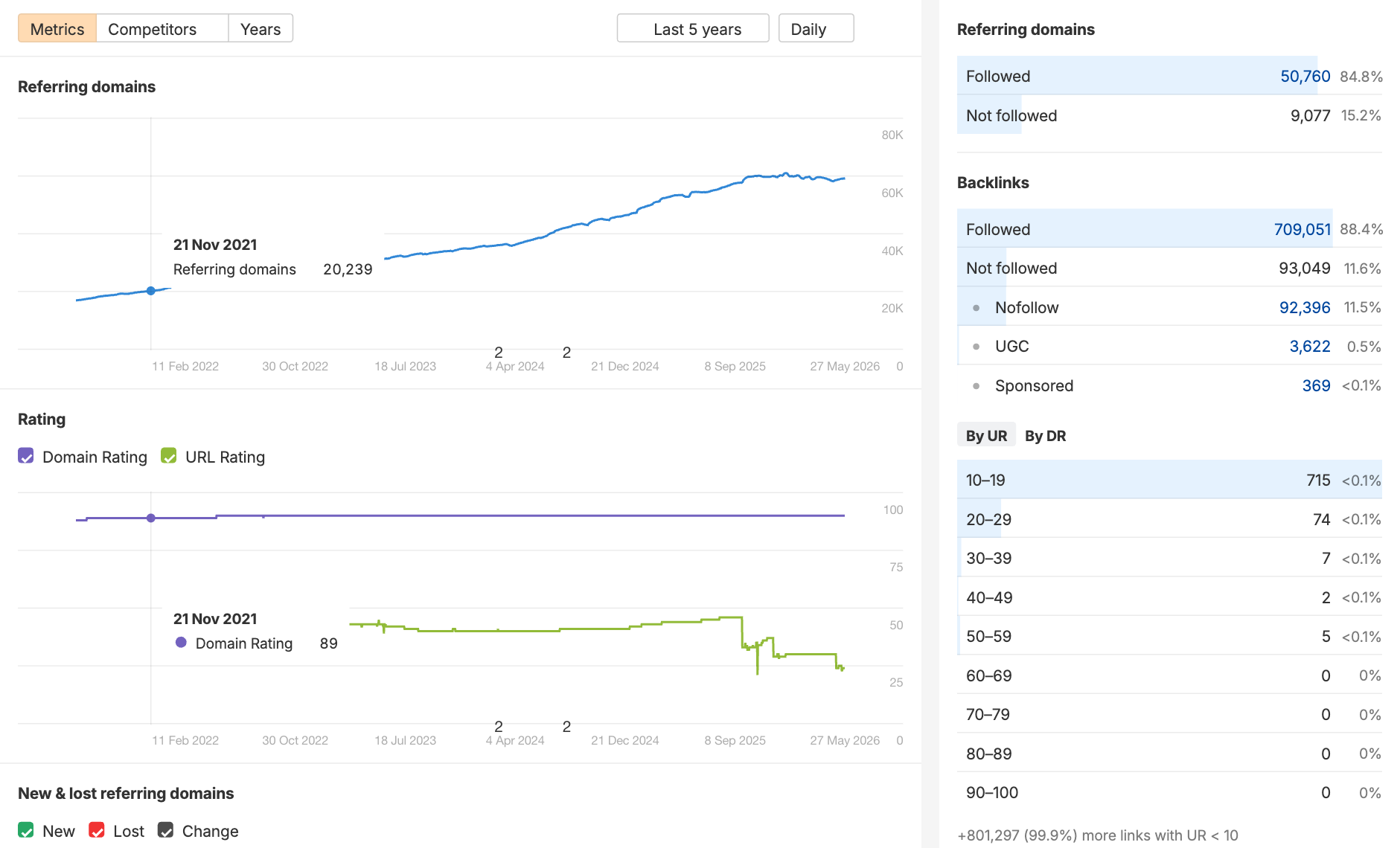
- Ahrefs Site Explorer: Enter any website URL and see referring domain count and total backlink count on the Overview tab. Historical trends make it easy to spot drops or spikes in referring domains over time.
- SEMrush Backlink Analytics: Similar coverage. The Referring Domains graph and Authority Score make it useful for competitive comparisons between websites.
- Moz Link Explorer: Shows Domain Authority and linking domain counts. Smaller index than Ahrefs or SEMrush, but free for limited queries.
- Google Search Console: Shows backlinks Google has discovered for your website, but only a sample, not a complete count. Treat GSC’s referring domain data as directional rather than definitive.
For the most complete picture, use Ahrefs or SEMrush as your primary source and GSC as a secondary sanity check.
How to Build More Referring Domains
Once you understand that referring domain diversity drives rankings more reliably than backlink volume, link-building strategy shifts. These four tactics specifically grow referring domain count rather than just backlink count:
Create Link-Worthy Assets
Content that earns natural backlinks from diverse websites tends to be original and hard to find elsewhere. Original research, proprietary data studies, interactive tools, and comprehensive guides attract links from independent websites that want to reference the resource. Each new website that links to a study or tool adds a new referring domain. A linkable asset built once can accumulate referring domains for years.
Guest Post on New Domains
Guest posting adds referring domains reliably, but only when treated as a diversity exercise rather than a volume exercise. Ten guest posts on the same host website adds ten backlinks and one referring domain. One post each on ten different relevant websites adds ten referring domains. The second approach builds a far stronger link profile. Focus on guest blogging on sites you have not yet earned a backlink from.
Use Digital PR and Earned Media Coverage
Newsworthy content, including original data, expert commentary, product launches, and industry surveys, gets picked up by journalists and bloggers who link independently. A single well-placed story in a relevant trade publication can generate five to fifteen new referring domains within days. Platforms like HARO connect you with journalists who need expert sources, creating an earned-media backlink from a website you likely could not approach through standard outreach. See our guide to digital PR for a full workflow.
Audit Competitor Backlink Gaps
Run a domain gap analysis in Ahrefs or SEMrush to find websites that link to your competitors but not to you. These websites have already shown they link to content in your niche. A targeted outreach campaign to that gap set is more efficient than cold outreach to unknown domains, and every successful placement adds a net-new referring domain. For the full prospecting process, see our guide to link prospecting.
Conclusion
The difference between a backlink and a referring domain is not just technical. It reflects two different ways of measuring trust. Backlinks count every individual link a website has received. Referring domains count how many distinct websites endorsed it.
For most sites at most growth stages, referring domain diversity is the stronger ranking signal and the better metric to optimise for. A broad, diverse backlink profile from many independent websites is harder to fake, harder to penalise, and more likely to track with sustainable organic traffic growth.
Track both numbers, but when you are deciding where to direct outreach effort, prioritise adding new referring domains over getting more backlinks from sources already in your profile.
For a deeper look at how to analyse your full backlink profile, see our backlinks analysis guide.
FAQ
What is the difference between a backlink and a referring domain?
A backlink is a single link from one web page to another. A referring domain is the unique website where that link lives. One website can send multiple backlinks to your site, but it only counts as one referring domain no matter how many individual links it contains.
Is it better to have more backlinks or more referring domains?
Referring domain diversity typically carries more weight as an SEO signal than raw backlink count. A website with 500 backlinks from 400 different referring domains generally ranks more reliably than a website with 500 backlinks from 5 domains, assuming similar content quality and relevance.
Can too many backlinks from one domain hurt your rankings?
A highly concentrated backlink profile, where many backlinks come from very few domains, can trigger spam signals. Google’s Penguin algorithm targets sites with repetitive, low-diversity link patterns. This is especially true if the linking websites are low-quality or unrelated to your niche.
Do nofollow backlinks count toward referring domain totals?
Yes. A nofollow backlink from a website still adds that website to your referring domain count in tools like Ahrefs and SEMrush. Whether those links pass equity to your website is a separate question. Google treats nofollow as a hint and may pass partial equity depending on context.
How do I know if my backlink-to-referring-domain ratio is healthy?
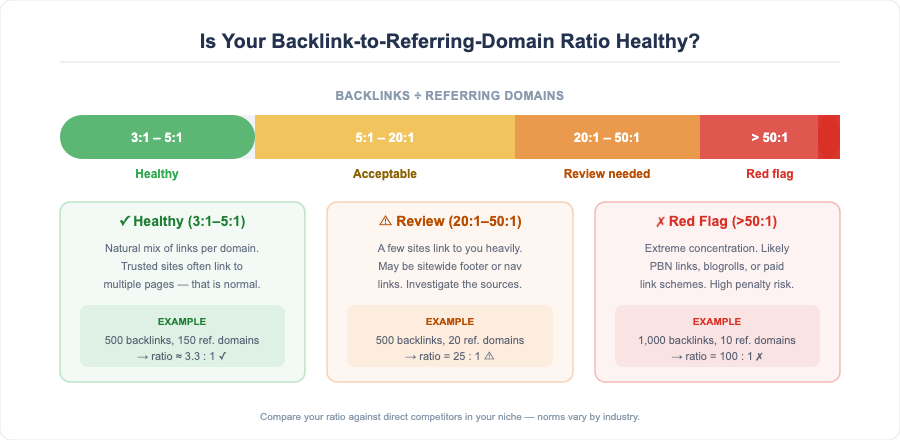
A healthy ratio typically falls between 3:1 and 5:1, meaning three to five backlinks per unique referring domain. A ratio above 50:1 suggests a small number of websites are linking to you heavily, which search engines may view as unnatural. A few patterns to watch for: if you have 10 referring domains but 1,000 backlinks, it usually means those ten websites are linking to you heavily through sitewide footer links, blogroll links, or a private blog network, which is a red flag. A 1:1 ratio is rare for established websites; it is perfectly natural for a trusted website to link to multiple pages of yours over time. Compare your ratio against direct competitors in your niche rather than an arbitrary benchmark.