

Domain metrics are third-party scores that estimate how strong and trustworthy a website is, based mainly on its backlink profile. The best-known examples are Domain Rating from Ahrefs, Domain Authority from Moz, and Authority Score from Semrush, all built around the same underlying idea of website authority. All three run on a 0-100 or 1-100 scale. None are official Google ranking factors. But all three correlate with how well a site tends to rank, which is why marketers, link builders, and domain buyers treat them as a quick shorthand for overall strength.
This guide breaks down every major domain metric side by side, explains what actually counts as a "good" score in your specific niche, and gives you a practical checklist for evaluating any domain, not just the metrics vendors want you to look at.
What Are Domain Metrics?
Domain metrics are proprietary scores, built by SEO software companies, that summarize how authoritative a website looks based mostly on its backlink profile. The three most commonly cited are:
- Domain Rating (DR) from Ahrefs
- Domain Authority (DA) from Moz
- Authority Score from Semrush
Two more metrics round out a complete picture: Trust Flow and Citation Flow from Majestic, plus URL Rating, Ahrefs' page-level companion to DR. Higher numbers mean a stronger link profile relative to the rest of the web.
It is worth saying clearly upfront: none of these are metrics Google publishes or confirms using. Google has said it uses "a sitewide score that maps to similar things," but has never named Domain Rating, Domain Authority, or Authority Score as an actual ranking input. They are industry-built approximations, not ground truth. That does not make them useless. It means you should treat them as a directional signal, not a verdict.
The 5 Domain Metrics You Should Know (Comparison Table)
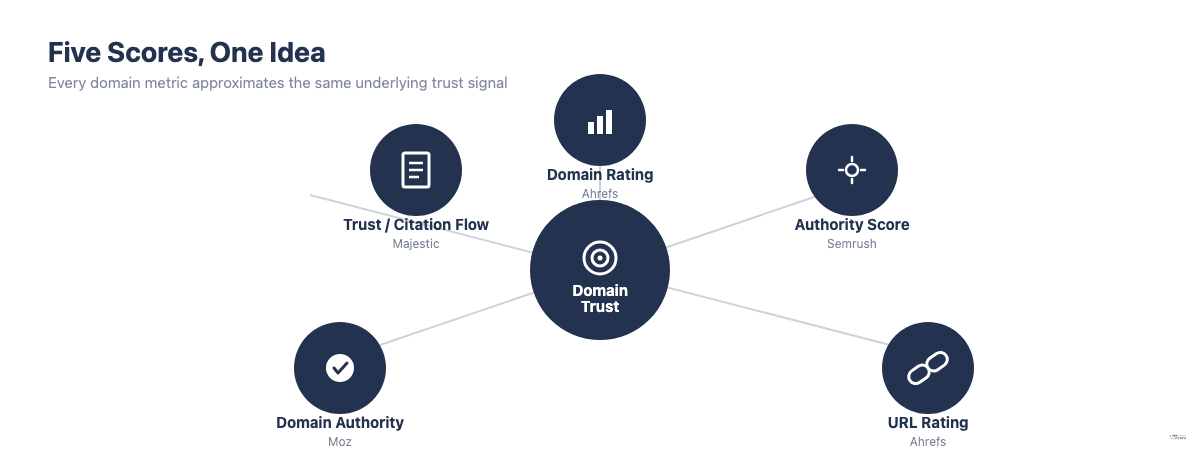
Every major domain metric measures a slightly different slice of the same idea: how much the rest of the web trusts a given site. The diagram below shows how the five metrics you are most likely to encounter all orbit that same underlying concept, before the full comparison table breaks down how each one is calculated.
| Metric | Provider | Scale | Primary Input | Update Cadence |
|---|---|---|---|---|
| Domain Rating (DR) | Ahrefs | 0-100 | Referring domains and their authority, weighted algorithmically | Daily |
| Domain Authority (DA) | Moz | 1-100 | 40+ signals from Moz's Link Explorer index, including link quantity and quality | Roughly monthly |
| Authority Score | Semrush | 1-100 | Backlink data, organic traffic, and 6 named spam-manipulation checks | Every two weeks |
| Trust Flow / Citation Flow | Majestic | 0-100 | Trust Flow weighs link quality from trusted seed sites; Citation Flow weighs raw link quantity | Continuous crawl-based updates |
| URL Rating (UR) | Ahrefs | 0-100 | Same methodology as DR, applied to a single page instead of the whole domain | Daily |
Domain Rating (DR) is calculated in five steps: Ahrefs counts the unique referring domains pointing at a site, assesses how authoritative each of those linking domains is, factors in how many other domains each linking site connects to, runs the result through a weighting algorithm, and plots the outcome on a 0-100 scale. According to Ahrefs' own methodology, DR deliberately excludes traffic, spam signals, and domain age. It is a pure backlink-strength score, which is why two very different sites can share the same DR while looking completely different in traffic or content quality.
Domain Authority (DA) was the original metric in this category. Moz introduced it. The score draws on more than 40 signals from Moz's own backlink index and a machine-learning model trained to predict how likely a page is to rank in Google search. Moz also publishes a companion Page Authority (PA) score for individual URLs, plus a Spam Score that flags domains sharing characteristics with sites that have been penalized or de-indexed.
Authority Score is Semrush's answer to the same problem. It is the only major metric that folds in real organic traffic data alongside backlinks. The score combines eight signals across three categories: Link Power (the quantity and quality of dofollow backlinks), Organic Traffic (estimated monthly search traffic based on keyword rankings), and six specific Spam Signals, including an unusually high share of dofollow referring domains, backlink-to-traffic mismatches, and multiple referring domains sharing the same IP address or network. This matters in practice: a site that bought its way to a large backlink profile without earning real traffic usually scores lower on Authority Score than it would on a backlink-only metric like DR.
Trust Flow and Citation Flow, from Majestic, split the same idea into two numbers instead of one. Citation Flow measures the raw quantity of links, while Trust Flow measures how close those links are to a set of manually vetted, trustworthy seed sites. Comparing the two is itself a diagnostic: a domain with high Citation Flow but low Trust Flow usually has a lot of low-quality or spammy links.
URL Rating (UR) is Ahrefs' page-level equivalent of DR. Google ranks pages, not domains, so a page with strong direct backlinks can outrank a page on a higher-DR domain that has never earned a link of its own. UR is the metric to check when you care about a specific page's link strength rather than the whole site's.
Paste any domain into the free Domain Rating Checker by LinkForce.
What Is a Good Domain Metric Score?
There is no single number that counts as "good" across every website. Ahrefs states it plainly: your score "is good if it's higher than or comparable to similar sites," and Semrush echoes the same idea, noting that "a score of 30 might be strong in a small niche and weak in a competitive one." Both companies are describing the same underlying truth: these are relative, competitive metrics, not fixed report cards.
That said, some general numeric anchors are useful as a starting point. For Domain Authority specifically, a score in the 40-60 range is generally considered good, and anything above 60 is considered very strong. A more granular read breaks into four bands: 1-20 covers new or low-authority domains that can rank for long-tail, hyper-niche keywords but struggle against high-volume terms; 21-40 covers growing sites competitive for local and specific niche topics; 41-60 marks a solid foundation competitive for broader, mid-difficulty industry keywords; and 61-80 marks highly authoritative sites that regularly win competitive national and industry-wide search terms.
Good Score Ranges by Industry
Finance and insurance sites average a Domain Authority around 58, nearly double the 25-28 average for local service businesses, because "good" depends heavily on what industry you are in. Highly competitive, high-trust verticals like finance and education naturally cluster around higher average scores than smaller, less competitive niches.
| Industry | Typical Average DA | Competitive Target |
|---|---|---|
| Local services | 25-28 | 28-40 |
| Blogs / content sites | 32 | 35-50 |
| E-commerce | 35 | 45+ |
| SaaS / B2B tech | 38 | 52+ |
| News / media | 48 | 55+ |
| Finance / insurance | 58 | 65+ |
| Education / government | 56+ | 60+ |
These figures are directional benchmarks compiled from industry-wide analysis, not a guarantee for any individual site. Treat them as a way to sanity-check where you stand relative to your specific competitive set, exactly as Ahrefs and Semrush both recommend.
Good Score by Google Ranking Position
There is also a well-documented relationship between average domain authority and search position, even though it is correlation rather than causation. Sites holding the first position on Google average a Domain Authority around 68, and the average across the entire top 10 typically falls between 51 and 71. That range is a useful reality check: if you are targeting a highly competitive keyword and your domain score sits well below the top-10 average for that query, ranking on authority alone is unlikely, and content and on-page strategy need to do more of the work.
Are Domain Metrics a Google Ranking Factor?
No. Domain Rating, Domain Authority, and Authority Score are not official Google ranking factors, and none of the companies that publish them claim otherwise. Ahrefs is explicit that DR is "not a Google ranking factor," and Semrush states plainly that "website authority is not an official metric used by Google, AI search platforms, or other search engines. It's a concept the SEO industry created to approximate a website's strength."
What does exist is correlation. An Ahrefs study covering 218,713 domains found a strong relationship between Domain Rating and keyword rankings, which suggests DR is a reasonable proxy for a site's organic traffic potential, even though it cannot prove Google is using DR itself as an input. Google's own spokespeople have repeatedly said the company does not use third-party domain authority metrics, while also acknowledging Google maintains "a sitewide score that maps to similar things" internally, without naming what that score is or how it is calculated.
The practical takeaway: treat domain metrics as a useful shorthand for backlink strength and general competitiveness, not as a lever you can pull directly. Chasing a higher DR or DA number for its own sake, without earning the underlying links and traffic that produce it, will not move rankings.
How to Check Your Domain Metrics
Checking domain metrics, whether through a dedicated website authority checker or a full SEO platform, matters in a handful of recurring situations, most of which come down to comparing your site, or someone else's, against a competitive baseline.
- Competitive benchmarking. Compare your domain's score against direct competitors targeting the same keywords to see where you stand in relative link strength.
- Vetting link prospects before outreach. Before pitching a guest post, link insertion, or partnership, check the target site's score to decide whether it is worth your time. A domain with an unusually high score but almost no organic traffic is often a red flag for a manipulated link profile.
- Screening inbound link offers. When someone pitches you a guest post or paid placement, run their domain through the same checks before agreeing.
- Auditing your own backlink profile. Pull the domains linking to your site and flag any with very low or suspicious scores, since these can occasionally trigger manual reviews or algorithmic distrust if the pattern looks unnatural.
- Tracking progress over time. Check your own domain every few weeks. A slowly climbing score across multiple metrics is a reasonable signal that link-building and content work are compounding, even though it should never be the only KPI you track.
A Practical Domain Evaluation Checklist
Vendor metrics are a starting point, not the whole picture, especially if you are buying, evaluating, or vetting a domain for something more serious than a quick outreach check. Experienced domain buyers and SEOs typically look at a broader set of signals alongside DR, DA, and Authority Score:
- Referring domain quality, not just quantity. A site with 200 referring domains from relevant, trusted sources is usually worth more than one with 2,000 domains from irrelevant or low-quality sites, even at the same DR or DA.
- Organic traffic estimate. A high authority score paired with near-zero estimated traffic is a common sign of a manipulated or purchased link profile.
- Domain age and history. Older domains are not automatically better, but a domain's registration history and past ownership can reveal whether it was previously used for spam or has changed hands repeatedly.
- Prior penalty history. Checking a domain's historical content through an archive tool can reveal whether it was previously penalized, de-indexed, or used for a completely unrelated, low-quality purpose.
- TLD and brandability. A country-code or unconventional top-level domain can affect trust and click-through rate depending on your market, independent of its authority score.
- Topical relevance. A domain with strong metrics but a link profile built entirely in an unrelated niche is weaker for your purposes than a lower-scoring domain with tightly relevant links and content history.
- Trademark and brand conflicts. Before committing to a domain, confirm it does not infringe on an existing trademark or closely resemble an established brand in your space.
Running through this checklist alongside the standard metrics gives a far more reliable read than any single score in isolation.
How to Improve Your Domain Metrics
Every major metric moves in response to the same underlying signal: earning links from new, relevant, trustworthy domains. Ahrefs' own research on referring domains found this to be the strongest correlating backlink factor for organic rankings across roughly 920 million pages studied, ahead of raw backlink count.
- Prioritize new referring domains over more links from the same domain. Once a domain has linked to you, additional links from that same site add little to no further lift to DR or DA. A single new referring domain is typically worth more than five additional links from a site that already links to you.
- Earn links through digital PR, original research, and data-driven content. Content that other sites want to cite naturally generates the kind of varied, high-authority backlinks that move every metric at once.
- Reclaim unlinked brand mentions. If other sites already mention your brand without linking, converting those mentions into links is one of the fastest realistic wins available.
- Keep your backlink profile clean. Avoid paid links, reciprocal link exchanges at scale, and private blog networks. These tactics create exactly the kind of unnatural patterns that Semrush's Authority Score and Google's own spam systems are built to detect, and they can suppress your score even while adding raw link volume.
- Publish content that ranks on its own. Ranking content earns organic traffic and, over time, organic backlinks, which is the only sustainable way to grow both traffic-aware metrics like Authority Score and backlink-only metrics like DR at the same time.
Growth in any of these metrics tends to be slow and compounding rather than immediate. A single strong month of link building rarely produces a visible jump; consistent link acquisition over several months is what moves the number.
800+ SaaS marketers swap partner, integration and content links. Free plan, no credit card.
Domain Metrics and the Domain Authority Pillar Page
Domain metrics are the measurement layer that sits underneath the broader concept of domain authority. If you want a deeper walkthrough of what domain authority means as a concept, how it is used strategically in SEO and link building, and how to build a long-term plan around it, see our complete guide to domain authority. This page focuses specifically on how the individual metrics are calculated and compared; the domain authority guide covers the bigger-picture strategy for building it over time.
Frequently Asked Questions
What is the difference between Domain Rating and Domain Authority?
Domain Rating (Ahrefs) is a backlink-only metric that ignores traffic, spam, and domain age. Domain Authority (Moz) draws on more than 40 signals, including link data and a predictive ranking model, giving it a broader but less transparent calculation basis. Both run on a comparable 0-100 or 1-100 scale, but the two numbers are not directly interchangeable for the same site.
What is a good Domain Authority score?
For most sites, a Domain Authority between 40 and 60 is considered good, and above 60 is considered very strong. The right target still depends heavily on your industry and direct competitors, since a DA of 30 can be excellent in a small niche and weak in a highly competitive one like finance or education.
Do domain metrics affect Google rankings directly?
No. Domain Rating, Domain Authority, and Authority Score are not official Google ranking factors. They correlate with rankings because they measure backlink strength, which Google's own systems also weigh, but Google does not use these specific third-party scores as an input.
How often do domain metrics update?
Update cadence varies by provider, since each vendor runs its own independent crawl and scoring pipeline. Ahrefs refreshes its live backlinks index every 15 to 30 minutes and dashboard-level Domain Rating and URL Rating figures every 12 hours, though a complete re-crawl of the entire backlink graph takes about two months. Semrush updates Authority Score approximately every two weeks. Moz updates Domain Authority on a slower cycle, typically around once a month.
Can a domain have a high score but still be low quality?
Yes. A domain can accumulate a high Domain Rating or Domain Authority through a large volume of backlinks while having very little real organic traffic or topical relevance. This is exactly why Authority Score's traffic and spam-signal weighting exists, and why a full evaluation checklist, not a single score, is the safer approach when vetting a domain.