

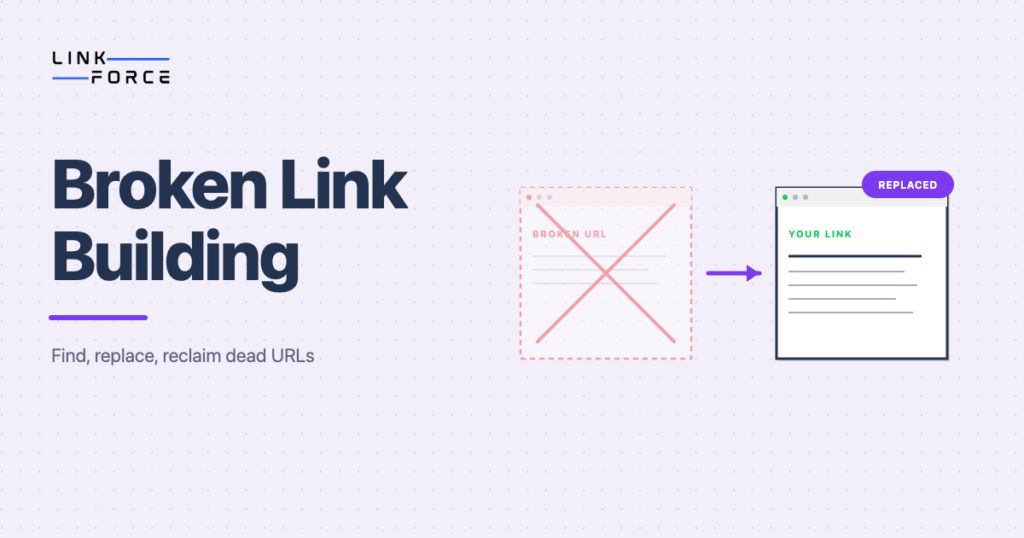
Broken link building is a link building tactic that identifies broken links on other websites — links pointing to pages that return a 404 error — and convinces webmasters to replace those dead links with a working link to your content. Tools like Ahrefs, SEMrush, Screaming Frog, and the free Check My Links Chrome extension make it practical to find broken link building opportunities at scale across resource pages, competitor sites, and Wikipedia.
The core appeal: instead of asking for a link with nothing in return, you’re alerting a webmaster to a broken page on their own site. That changes the pitch entirely. You’re fixing a problem they didn’t know they had, and offering your content as the solution.
What Is Broken Link Building?
Broken link building works by finding pages that link to content that no longer exists. When a guide, tool, or resource disappears — because the domain expired, the company rebranded, or the URL changed without a redirect — every page linking to it now hosts a dead link. Visitors who click get a 404 error. The webmaster has a broken page experience they probably haven’t noticed.
You identify those broken links, create or surface replacement content that covers what the dead page offered, and reach out to the site owner. The pitch: here’s the broken link, here’s what it used to cover, here’s my replacement. Webmasters accept this because fixing a broken link is genuinely in their interest. That makes broken link building different from most outreach tactics, where the benefit flows only one way.
Does Broken Link Building Still Work?
Yes — but with realistic expectations. Response rates on broken link building campaigns typically fall in the 5–15% range, with actual link placements converting at 3–10% of total emails sent. Send 100 well-targeted, personalized pitches and expect 3–10 placed links. That’s a modest absolute number, but each link comes from a page already willing to link to content like yours — which tends to mean genuine topical relevance and real authority.
The tactic remains viable because broken link building opportunities accumulate continuously. Every site that goes offline, every URL structure changed without redirects, every piece of content deleted to “clean up” a blog leaves behind orphaned backlinks. The supply of broken pages doesn’t dry up.
Broken link building produces the best results on resource-heavy pages at educational, industry, or .gov domains where content is rarely audited. Long-standing niche sites with older blog posts and resource page archives are also strong targets — especially when popular reference content from those archives has since been deleted and left behind orphaned backlinks.
The tactic is harder to justify on fresh content sites that actively audit and fix broken links, in very small niches with few content creators and limited resource pages, and on sites maintained by active SEO teams who catch and replace dead links quickly.
What Are the Benefits of Broken Link Building?
- White hat and penalty-safe. There’s no paid arrangement, no link scheme, and no footprint for Google to penalize. You’re earning a link by providing genuine value.
- Win-win pitch. You’re helping the webmaster fix a poor user experience on their own page. Even when they don’t swap the link, you’ve done them a favour. This lowers rejection friction compared to cold link requests.
- Prequalified demand. Every prospect you approach has already demonstrated willingness to link to content like yours. The link intent exists — you just need to give them a working alternative.
- Scalable with tools. Once the process is established, you can run broken link discovery across multiple competitors or topic clusters and batch outreach efficiently.
- Works with existing content. You don’t always need to create new pages. If you already have relevant content that matches what the dead page covered, you can pitch it directly without additional content investment.
For more on tactics that earn durable, penalty-safe links, see our guide to white hat SEO link building.
How to Find Broken Link Building Opportunities
There are five reliable methods for finding broken link opportunities. Use two or three depending on your niche, target authority level, and available tools.
Step 1: Find Competitors’ Dead Pages with Backlinks
In Ahrefs Site Explorer, enter a competitor’s domain, navigate to Pages > Best by Links, and set the HTTP code filter to “404 not found.” Results are sorted by referring domains — the top entries are dead pages with the most orphaned backlinks. Those are your best-value broken link building opportunities.
In SEMrush, use Backlink Analytics on a competitor’s domain and filter by status code 404. The Lost Backlinks report surfaces pages they recently took offline. SE Ranking’s broken link checker performs a similar scan and returns referring domains and anchor text for each dead URL.
This method works because these pages had proven link-earning potential. Now that they’re broken, every linking page is an open prospect. If you create or have better content on the same topic, you have a credible replacement to pitch to every site in that backlink profile.
For example: you run a content marketing blog and want links to your guide on editorial calendars. Enter a competitor like CoSchedule or ContentMarketingInstitute.com into Ahrefs Site Explorer, navigate to Pages > Best by Links, and filter for 404s sorted by referring domains. You might surface a deleted page — /blog/editorial-calendar-template/ — sitting at 43 referring domains. Each of those 43 pages already linked to the same topic you cover. That’s 43 pre-qualified outreach prospects from one five-minute query.
Step 2: Search for Dead Pages by Topic
Search for broken link building opportunities by topic rather than by competitor domain when you want to cast a wider net. In Ahrefs Content Explorer, enter your target keyword and add a filter for broken pages. This surfaces dead content across the web that people were linking to — not just from your direct competitors.
This method works well when entering a new niche, or when you want to identify broken link page patterns across a broader topic area rather than competitor-by-competitor.
For example: entering “link building” into Ahrefs Content Explorer and filtering for broken pages with 20+ referring domains returns dead content across the entire web — a deleted Moz primer on link velocity that once had 61 RDs, an expired Search Engine Land roundup of link building tools with 34 RDs, a shuttered SaaS company’s blog post about anchor text strategy with 22 RDs. Each dead URL comes with its full backlink profile, so you can immediately see which linking pages are worth approaching and what replacement angle to pitch.
Step 3: Find Broken Links on Resource Pages
Resource pages — curated lists of useful links on a topic — are the most productive broken link building target type. They were built to link out to resources, they rarely get maintained, and they tend to accumulate dead links over years. One resource page can hold 5–10 replacement opportunities.
To find resource pages, use Google search operators:
– intitle:"resources" "link building"
– inurl:"resources" SEO tools
– "useful links" content marketing site:.edu
Once you find a resource page, use the Check My Links Chrome extension (free) to scan the page instantly. It highlights every broken link in red so you can identify dead link replacements without manually clicking each URL.
For example: the search intitle:"resources" "link building" might return a curated resources page at a digital marketing university department — last updated in 2022, listing 16 tools and guides. Check My Links flags 5 of them in red. One is a dead link to an SEO glossary that previously had 28 referring domains. A single well-placed pitch replaces a dead link on a legitimate educational domain, not a directory.
Resource pages are worth prioritizing: the site has already curated content in your niche, and a broken link on a resource page is an implicit invitation. See our full guide to resource page link building.
Step 4: Find Broken Links on Competitor Websites
Scan competitor sites for the dead external links they currently point to — when those dead pages are on topics you cover, you have a pitch opportunity. The approach finds broken links that are actively sending traffic (or trying to) from credible industry pages.
Use Ahrefs Site Audit on a competitor’s domain and export the broken outlinks report — every external URL they link to that returns a 404. Screaming Frog SEO Spider crawls competitor sites and generates a full broken outlinks list with source page URLs, dead target URLs, and anchor text, all exportable to CSV. SEMrush Site Audit does the same and flags all outgoing 4xx errors.
When prioritizing these opportunities, focus on the competitor’s resource pages, tools pages, and integration directories — they link heavily to third-party content and accumulate the most dead links over time.
Step 5: Use the Wikipedia Dead Link Technique
Wikipedia articles in your niche cite external sources in their references sections. When those sources go offline, Wikipedia adds a “[dead link]” tag. Sites that independently linked to those same dead sources — or that would benefit from a live, citable alternative to what Wikipedia cited — are your prospects.
To find these broken link building opportunities: search Wikipedia for articles in your niche, scroll to the references section, and look for “[dead link]” tags. Note the domain and topic of each dead source. Then use Ahrefs Site Explorer to check who else links to those dead URLs — those domains are your outreach list.
This method surfaces high-authority targets because Wikipedia’s citations tend to come from credible, editorial sources.
Tip: Wikipedia’s [dead link] tags are editorial quality signals. For a source to earn a citation in Wikipedia, it had to meet editorial standards for credibility. When that source goes offline, the sites that independently cited the same source are high-authority editorial targets — not directories or link farms. They were referencing a real resource and would benefit from a live, citable replacement.
How to Vet Broken Link Opportunities
Not every broken link is worth replacing. A quick vetting pass before you write outreach emails saves time and improves your conversion rate significantly.
Check Link Quality
Before adding any prospect to your list:
- Domain Rating (DR) or Authority Score. Set a minimum of DR 40 as a baseline. Links from low-authority domains don’t move the needle enough to justify the effort.
- Organic traffic to the linking page. A dead link on a page with no organic traffic has minimal value. Check traffic estimates in Ahrefs or SEMrush before including a prospect.
- Dofollow vs. nofollow. Confirm the broken link was a dofollow link — nofollow replacements carry substantially less SEO value.
- Niche relevance. The linking page should be topically close to your content. A broken link on a tech page pointing to a marketing guide is a weaker opportunity.
Use Ahrefs Batch Analysis to run your full prospect list through a quality filter before writing a single email. Upload the dead URLs, sort results by referring domains, and remove anything below your DR threshold.
For example: a dead page on a well-known SEO blog about “types of backlinks” shows 94 referring domains in Ahrefs. After applying DR 40+, dofollow only, and organic traffic above 1,000 monthly visits, the qualified prospect list drops to 19 pages. That’s a far more manageable and higher-converting outreach batch than mailing all 94 — and skipping the low-quality 75 avoids the sender reputation cost of mass-emailing sites that won’t convert anyway.
Check Link Reasons (Deep vs. General Linkers)
Before writing your outreach pitch, understand why the site was linking to the dead page. This determines whether you send a targeted pitch or a general one.
Deep linkers linked for a specific reason — a particular process, statistic, definition, or methodology. The anchor text is specific and the surrounding content references particular information from the dead page.
General linkers linked as a broad reference. The anchor text is generic (“more information,” “this guide,” “this resource”) and the context doesn’t depend on specific content from the dead page.
Deep linkers need a targeted pitch that explains how your replacement matches the original’s specific angle. General linkers accept a broader pitch focused on overall quality and topical relevance.
The fastest way to tell them apart: read the anchor text and the sentence around the link.
- Deep linker: “According to [dead author]’s methodology for calculating crawl budget…” — a specific framework is being cited. Your pitch needs to address that framework directly.
- General linker: “For more resources on technical SEO, see this comprehensive guide…” — a broad reference. Any solid replacement on the same topic qualifies.
Use the Wayback Machine (archive.org) to retrieve what the dead page contained before writing your pitch. Search the URL at archive.org, browse available snapshots, and understand what the linker was originally referencing. This lets you match your replacement’s pitch to the original’s intent — not just its topic.
Tip: When you open the Wayback Machine snapshot, look for what made it linkable — a specific statistic, a downloadable template, a named framework. If 15 of 19 qualifying backlinks reference the same data point, that data point is what your replacement needs to address. Generic “covers the same topic” pitches fail with deep linkers; they were citing something specific and will notice if your replacement doesn’t have it.
Skip These Opportunities
Pass on immediately: sites with no new content in the past 2+ years; pages where dozens of broken links exist throughout (the owner has clearly abandoned maintenance); pages with no organic traffic; broken links in nofollow contexts or inside ad blocks; and any prospect where the backlink profile of the dead page shows anchor text patterns suggesting prior link scheme participation — over-reliance on exact-match commercial anchors, irrelevant keyword stuffing, or a high volume of low-quality inbound links all indicate the original page was earning links artificially.
How to Create Your Replacement Page
Before sending a single email, your replacement content must be genuinely better than the original — not just alive and vaguely relevant.
Understand What the Dead Page Offered
Use the Wayback Machine to retrieve the dead page. Enter the broken URL at archive.org and browse available snapshots. Pay attention to:
- The format: was it a how-to guide, a stat page, a tool, a template, a checklist?
- The depth: quick overview or comprehensive reference?
- What made it linkable: original data, a unique framework, a downloadable resource?
Your replacement must match the intent of the original page. If the dead page was a checklist, a long-form guide won’t feel like an equivalent replacement to deep linkers.
Make Your Page Better Than the Original
Once you understand what the original offered, improve on it:
- Simplify. If the original was dense and hard to follow, make yours cleaner and more scannable.
- Visualize. Add process diagrams, step-by-step visuals, or comparison tables the original lacked.
- Templatize. If the topic supports it, include a free template or worksheet. Downloadable assets increase the perceived value of the swap.
- Update. If the original had outdated statistics, old tool names, or stale examples, bring everything current.
The goal: give webmasters a reason to make the swap even when they weren’t already updating the page. For more on content that earns links, see our guide to linkable assets.
How to Do Broken Link Building Outreach
Outreach quality determines whether broken link building generates links or just generates effort. The email must be short, specific, and genuinely helpful — not a mass-blast template.
What to Include in Every Pitch
- Name the specific broken link on their specific page — not a vague claim about “your site having broken links.”
- Show you know what the dead page covered. This proves you actually looked, and it builds trust that your replacement is relevant.
- Offer your replacement as a natural match to what’s missing — not as a self-serving request.
- Keep it under 150 words. Long emails don’t get read.
- Make only one ask: the link swap.
- Include a screenshot or direct URL showing exactly where the broken link sits on their page. Webmasters shouldn’t have to hunt for it — removing that friction is the single easiest way to lift response rate.
For detailed outreach templates and subject line testing, see our guide to outreach emails.
Template 1 — Deep Linker Pitch
Use this when the site linked to the dead page for a specific reason.
Subject: Broken link on [Page Title]
Hi [Name],
I was reading your article on [Topic] and noticed the link to [dead page title] is returning a 404 error.
Looks like that page covered [specific angle — e.g., the process for X / a guide to Y]. I have an updated guide on the same topic: [Your URL].
It includes [one concrete improvement — e.g., updated 2026 data / a step-by-step workflow / a free template].
Here’s where I found the broken link on your page:
[screenshot]
Thought it might work as a replacement if you’re updating the page.
[Your name]
Template 2 — General Linker Pitch
Use this when the site linked as a general reference.
Subject: Dead link on [Page Title]
Hi [Name],
Your article on [Topic] has a broken link pointing to [dead URL] — it’s returning a 404.
Here’s where it appears on your page:
[screenshot]
I recently published a guide on [Topic] that covers [2–3 key areas]. A few reasons it might work as a replacement:
- [Improvement 1]
- [Improvement 2]
Link: [Your URL]
Happy to send more context if helpful.
[Your name]
Follow-Up and Timing
Send one follow-up 5–7 business days after the original email if you haven’t had a response. Keep it to two sentences: remind them of the broken link, restate the replacement offer. One follow-up is appropriate — two or more becomes spam and damages your sender reputation.
Tip: One follow-up only. A second follow-up shifts the dynamic from “I’m doing you a favour” to “I need something from you” — the opposite of the value-first frame you opened with. If there’s no response after one follow-up, move on. The outreach volume of broken link building makes individual non-responses irrelevant; conversion happens at scale.
For full outreach sequencing and campaign strategy, see our guide to outreach strategy.
Tools for Broken Link Building
| Tool | Primary use | Free tier |
|---|---|---|
| Ahrefs Site Explorer | Find competitors’ broken pages with backlinks; vet link quality in bulk via Batch Analysis | No |
| Ahrefs Content Explorer | Find dead pages by topic across the web | No |
| Ahrefs Broken Link Checker | Check any URL or domain for broken inbound and outbound links | Yes (limited) |
| SEMrush Backlink Audit | Find your own and competitors’ broken backlinks; track outreach pipeline status | Limited |
| Screaming Frog SEO Spider | Crawl competitor sites for outgoing broken links; exports source URL, dead URL, anchor text to CSV | Free (up to 500 URLs) |
| Check My Links (Chrome) | Scan any open page for 404s — highlights broken links in red instantly | Yes |
| Wayback Machine (archive.org) | Retrieve deleted page content before writing your pitch | Yes |
| BrokenLinkCheck.com | Fast online scanner for broken links on any domain — no installation required | Yes |
| Hunter.io | Find contact email addresses for outreach targets | Yes (limited) |
For a full comparison of link building tools by use case, see our guide to the best link building software.
Broken Link Building vs. Other Link Building Tactics
| Tactic | Effort per link | Scalability | Typical conversion rate | Best suited for |
|---|---|---|---|---|
| Broken link building | Medium | Medium | 3–10% | Replacing dead resources with proven link demand |
| Resource page link building | Medium | Medium | 10–20% | Evergreen reference content on active resource pages |
| Skyscraper technique | High | Low | Variable | Competitive high-DR targets where you can clearly outperform |
| Guest posting | High | Medium | High if accepted | Building brand authority alongside editorial links |
| Link reclamation | Low | Low | 70–85% | Recovering links you’ve already earned but lost |
Broken link building sits in the middle of the effort-to-reward curve. The key differentiator versus most outreach tactics is prequalified demand: you’re targeting pages that already demonstrated willingness to link to content like yours. The broken link is evidence that the link intent exists — you just need to provide a working replacement.
Related: Resource Page Link Building | The SEO Skyscraper Technique | Backlink Outreach
Is Broken Link Building Worth It?
Yes — when the conditions are right. If you have strong replacement content and are targeting pages with DR 40+ and real traffic, broken link building delivers quality editorial links at a realistic outreach volume.
Worth prioritizing when:
– You have existing content that could replace dead pages without new creation effort
– Your niche has older resource pages and guide archives with accumulated dead links
– You need topically relevant editorial links (not directories or aggregators)
– You want to complement resource page outreach and link reclamation on the same prospect pool
Deprioritize when:
– You don’t have content to replace what’s been deleted, and creating new pages just for this is your only option
– Your niche has very few older reference sites with established link history
– Your existing outreach is already converting at better rates with less effort
Realistic output: expect 1–3 quality link placements per 50–100 targeted outreach emails. Combined with resource page outreach and link reclamation, broken link building contributes meaningfully to a diversified link building program. For real campaign numbers, see our link building case study. Ecommerce stores get an above-average return here, since category pages sit on older resource-style URLs that accumulate dead outbound links over time; see ecommerce link building for how broken-link replacement fits alongside the other tactics that work for product and category pages.
Frequently Asked Questions
What response rate should I expect from broken link building outreach?
Most practitioners report 5–15% response rates on targeted, personalized campaigns, with actual link placements converting at 3–10% of total emails sent. Higher response rates come from specific personalization, stronger replacement content, and targeting resource pages over generic blog posts.
Do I need to create new content for every broken link opportunity?
No. If you already have relevant content that matches what the dead page covered, pitch it directly. You only need to create new content when the dead page covered a specific angle you don’t yet have — or when your existing page clearly doesn’t match the original content’s intent.
Is broken link building risky from an SEO perspective?
It’s one of the lower-risk link building tactics. The outreach is transparent, the value exchange is genuine, and links earned are editorial. The main risk is execution failure: mass-blasting impersonal templates can damage your sender domain’s reputation, and offering a weak or loosely related replacement page results in rejection. Done with proper personalization and topically matched content, there’s no meaningful penalty risk. Unlike link exchanges or guest post networks, broken link building requires no reciprocal obligation — so there’s no link scheme footprint to create.
Can broken link building work for SaaS or B2B companies?
Yes. B2B and SaaS niches — marketing, SEO, HR, finance, project management — have deep archives of older blog content and resource pages with accumulated dead links. B2B sites frequently link to vendor documentation, industry studies, and third-party tools that eventually change or break, creating high-authority opportunities. A particularly effective SaaS angle is finding pages that previously linked to a competitor’s deprecated feature page, integration guide, or API docs — and offering your equivalent resource as the replacement. SaaS companies that have pivoted or rebranded often leave behind deprecated subdomain pages that third-party guides continue linking to, representing high-value opportunities unavailable to most other link building tactics.