
Forum link building means earning backlinks by taking part in online discussion communities, usually through signature links, in-thread mentions, profile bios, or answers to questions. Done well, it adds a small but genuine layer of topical relevance and referral traffic to a site’s backlink profile. Done badly, it looks exactly like what Google already flags as spam. This guide covers what a forum link building service actually does, and what the links are really worth. It also covers whether the tactic still holds up against Google’s current guidelines, and how to tell a legitimate provider from one that’s really just selling you volume instead of value.
What Is Forum Link Building?

Forum link building is the practice of placing backlinks to a website inside online forums and discussion communities, usually through a signature line, a profile bio, a thread reply, or an answer to a question a real user asked. The links live inside user-generated content (UGC), which is why most forum software tags them “nofollow” or “UGC” by default rather than passing full ranking credit the way an editorial link on a news site would. Google itself recommends the rel=”ugc” attribute specifically for links inside forum posts and comments, so a site owner can tell search engines the link came from a community member rather than the publisher.
A forum link building service typically identifies forums relevant to a client’s niche, then creates or manages an account on each one. It posts original content or replies to existing threads in a way that naturally includes a link back to the client’s site. The word “naturally” is doing a lot of work in that sentence: it’s the line between a link that helps a site and one that gets it penalized.
For a broader look at how forum posting fits alongside other tactics, see guest blogging and targeted link building, two related approaches that share the same core risk: value to the reader has to come before the link.
The Main Types of Forum Links (and Which Ones Actually Help)
Not all forum links work the same way, and lumping them together is how a lot of buyers end up disappointed. Four placement types show up across almost every forum link building service, and they differ a great deal in how much SEO value they realistically carry.
Signature Links
A signature link sits in the block of text that automatically appends to every post a user makes on a forum. It’s the easiest type of link to acquire at scale, which is exactly why most forums either strip links from signatures entirely, mark them nofollow, or limit them to paid or verified accounts. Google has called out forum signature links by name as a link-scheme pattern when they’re used at volume for ranking manipulation. Treat this type as a branding and referral-traffic play, not a ranking lever.
In-Thread Contextual Links
In-thread contextual links are placed inside the body of a genuine reply to a thread, where the link supports a specific point the poster is making. This is the highest-value forum link type when it’s done honestly, because it mirrors how a real community member would actually cite a source. It’s also the slowest and most labor-intensive to produce at scale, since it requires reading the thread and writing a reply that adds something a moderator won’t delete.
Profile / Bio Links
Most forum platforms let members add a website link to their public profile. These links are almost universally nofollow and don’t carry much direct ranking weight, but they can still drive qualified referral clicks from people who read a member’s post history and want to learn more. Think of profile links as a low-risk, low-reward addition rather than a core tactic.
Q&A or Answer Links
Some communities are structured around questions and answers rather than open discussion threads. A link placed inside a genuinely useful answer to a real question tends to perform similarly to an in-thread contextual link: it survives moderation because it serves the reader, not because it serves the linker. The catch is the same one that applies everywhere in forum link building: the answer has to be good enough to justify the link on its own merits.
Is Forum Link Building Against Google’s Guidelines?
Whether forum link building breaks Google’s guidelines depends entirely on execution, not on the tactic itself. Google’s spam policies explicitly name forum comments and forum signatures used to insert links at scale as an example of a link scheme. That sits right alongside automated link-building software and large-scale guest-post link exchanges. The distinguishing factor isn’t whether the link sits on a forum. It’s whether the post exists to serve the community or exists to plant a link.
Most violations of this kind don’t trigger a manual action. Far more commonly, Google’s systems identify the pattern algorithmically and discount the ranking value of the links to zero, effectively wasting the money spent placing them without any visible penalty notice. A site that leans on templated, keyword-stuffed forum posts across hundreds of low-relevance communities is exactly the profile these systems are built to catch.
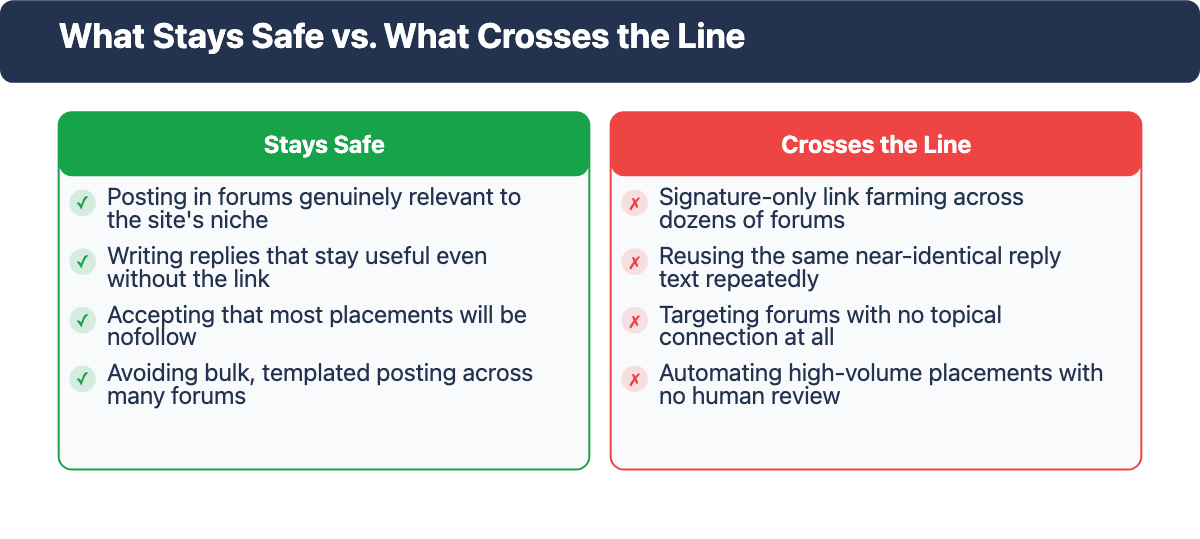
What stays safe, based on Google’s own published guidance and how legitimate providers operate:
- Posting in forums genuinely relevant to the site’s niche, where the account has a real history beyond link-dropping
- Writing replies and answers that would still be useful even if the link weren’t there
- Accepting that most placements will be nofollow, and treating that as normal rather than a sign the service failed
- Avoiding bulk, templated posting across large numbers of unrelated or low-quality forums
What crosses the line:
- Signature-only link farming across dozens or hundreds of forums with no real participation
- Reusing the same or near-identical reply text across many threads. Google’s own spam-policy documentation gives a worked example of exactly this pattern: a templated forum comment thanking the thread and signing off with a business name plus a string of keyword-stuffed anchor text, called out as low-value content created mainly to manipulate ranking signals.
- Targeting forums with no topical connection to the linking site just because they allow links
- Paying for or automating high-volume placements with no human review of relevance
How Much Does a Forum Link Building Service Cost?
There’s no official rate card for forum links since pricing is set independently by each agency or freelancer. Treat every number below as an industry benchmark rather than a fixed quote. Forum link building sits at the cheap end of the broader link-building market, mainly because most forum links are nofollow UGC rather than the dofollow editorial placements that command premium pricing. As a general benchmark, link building across all tactics in 2026 commonly runs $150 to $1,000 per link, with editorial placements on a moderately authoritative site (DA/DR 30-50) averaging roughly $350-$500. Links on sites with DR 60 or higher are frequently priced at $600 and up. Nofollow and sponsored-style links, which is the category most forum links fall into, typically cost 50-70% less than a comparable dofollow placement.
Applied to forums specifically, that general benchmark translates into two common pricing models, not official list prices:
| Model | Typical price | What it usually includes |
|---|---|---|
| Bulk/managed forum posting | Roughly $5-$50 per placement | Templated or semi-custom posts across a large list of forums, mostly nofollow, minimal manual vetting |
| Manual niche forum engagement | Roughly $1,500-$5,000+ per month | Hand-picked relevant forums, genuine account building, custom replies, slower and lower volume but higher survivability |
The pricing figures above are directional, not a quote. Pricing isn’t isolated for forum links specifically by any single primary source, and it varies by niche competitiveness, forum authority, and how much manual research and writing the provider actually does per placement. If a provider quotes a flat per-link price with no mention of forum relevance or account history, assume they’re running the bulk/templated model, whatever the marketing copy says.
How a Forum Link Building Service Actually Works
A legitimate provider’s process generally follows five steps, in roughly this order:
- Research and forum selection. The provider identifies forums that are topically relevant to the client’s niche and screens them for activity level, moderation standards, and whether links are permitted, nofollowed, or banned outright.
- Account and reputation building. Rather than posting immediately with a brand-new account, the provider builds a minimal posting history so the account doesn’t read as a link-dropping bot to moderators or to Google.
- Content creation. Replies, answers, or original threads are written to genuinely fit the conversation, with the link included only where it serves the reader.
- Placement and moderation survival. Posts go live, and the provider tracks which ones survive moderator review versus which get removed, since forum moderators delete obvious self-promotion regularly.
- Reporting. The client receives a list of live URLs, anchor text used, and whether each link is nofollow or dofollow, so what’s actually been delivered is verifiable rather than assumed.
If a provider’s stated process skips a step, especially account building or moderation-survival tracking, that’s a signal they’re optimizing for placement volume rather than link durability.
How to Evaluate a Forum Link Building Service (Without Getting Sold a Story)
Vendor comparison lists in this space have a structural problem. Several of the ones ranking on page one for this exact query are published by an agency that puts itself in the number-one spot on its own list. That’s not a neutral evaluation. It’s worth using a criteria-based checklist instead of trusting any single ranked list, including this site’s own link building services.
- Ask for forum-by-forum transparency, not a placement count. If a provider won’t name which forums it uses, or reports “50 forum links” with no URLs, you can’t actually audit what you paid for.
- Ask directly what percentage of links will be nofollow. A provider that claims most placements will be dofollow is either targeting low-quality forums that hand-code dofollow specifically to attract link buyers, or they’re overselling.
- Ask how accounts are built before posting. Same-day posting from brand-new accounts is the clearest sign of a templated, high-risk process.
- Ask what happens when a moderator removes a post. Reputable providers track and disclose removal rates; if a provider guarantees 100% survival, they’re not being straight about how forums actually moderate content.
- Check whether the sample posts they show you would survive without the link. If the link is the only reason the post exists, a moderator will eventually notice, even if it survives at first.
Is Forum Link Building Worth It for Your Site?
Forum link building is rarely a site’s primary link-acquisition channel. Providers that pitch it as one are usually pitching volume rather than durable authority. It tends to earn its place as a supporting layer inside a broader set of link building strategies, and fits best on three kinds of sites.
- Early-stage sites building initial topical relevance and referral traffic from communities where their actual customers spend time often get more value from forum participation than from expensive editorial outreach they can’t yet compete for.
- Niche or technical products with active, specific communities (developer forums, hobbyist boards, professional associations) can generate genuinely useful in-thread links because the product is a legitimate answer to questions people are already asking.
- Sites with an already-strong backlink profile from editorial and digital-PR links get comparatively little marginal benefit from adding nofollow forum links, since the gap they’re trying to close is authority, not community presence.
If the goal is direct ranking impact from a handful of high-authority dofollow links, forum link building isn’t the right tool for that job. If the goal is topical relevance, referral traffic, and a natural-looking, diversified link profile that doesn’t read as 100% paid placements, a carefully run forum program is a reasonable, low-risk addition.
Frequently Asked Questions
What is a link building service?
A link building service is a provider that acquires backlinks to a client’s website on the client’s behalf, typically through outreach, content placement, digital PR, or community participation such as forum posting. Services vary widely in method and link quality, from manual relationship-based outreach to bulk, templated placements.
How much does link building cost?
Across all link-building tactics, expect roughly $150-$1,000 per link in 2026, with editorial placements on moderately authoritative sites averaging around $350-$500 and links on higher-authority sites (DR 60+) commonly running $600 or more. Nofollow and forum-style links sit well below that range, typically in the $5-$50 per-placement territory for bulk providers.
How do forum owners make money?
Forum owners typically monetize through display advertising, paid membership tiers, sponsored threads, affiliate links, and in some cases by selling link placements directly to marketers. That’s one reason forum link building exists as a service category at all. As a rough benchmark, a forum with around 5,000 daily visits can realistically earn $150-$400 a month from display ads alone, and niche-brand sponsorships for a focused community commonly run $100-$1,000+ a month, though most forums make little to no money at all. Well-run forums often disclose or restrict paid link placements specifically so the community doesn’t start feeling like an ad platform.
Are backlinks still relevant in 2026?
Yes. Backlinks remain a top-3 Google ranking factor in 2026, but their role has narrowed. Modern ranking systems weigh link relevance and context far more heavily than raw link count, which is exactly why low-relevance, high-volume tactics like generic forum signature spam carry real risk instead of free upside.