

Directory link building means submitting your website to an online directory, a curated website that lists and categorizes other businesses or sites, in exchange for a backlink. Clutch.co’s a working example. A service provider fills out a profile, and the resulting listing includes a live link back to the company’s site. That link’s small on its own. But it’s real, it’s indexable, and it’s part of how search engines discover and understand new sites.
What Is Directory Link Building?
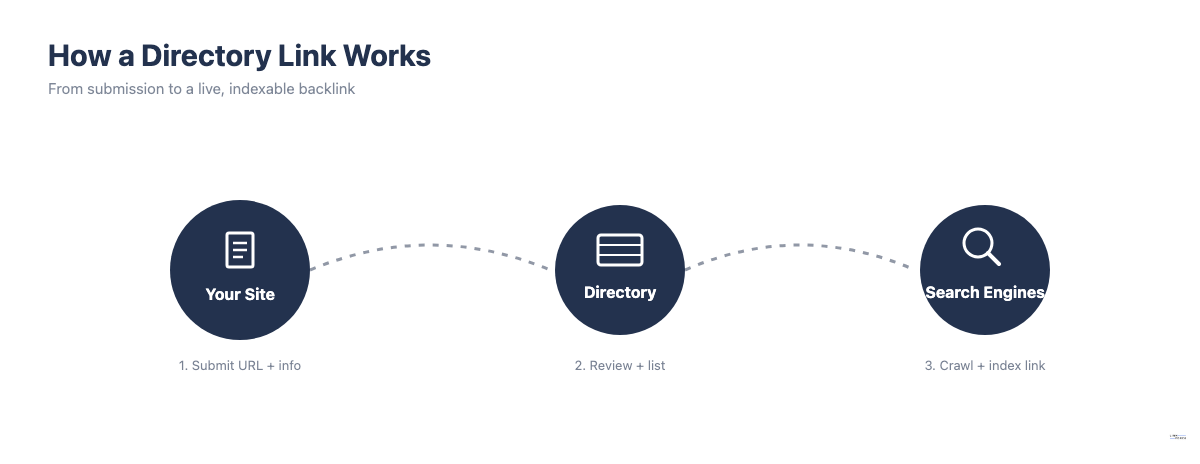
Most directory websites work the same way. You submit a URL, a short description and a category. If the directory approves the submission, your listing goes live with a link attached. The value of that link depends entirely on the directory’s own quality: its traffic, its editorial standards, its domain authority and how relevant it is to what you do. That part isn’t negotiable.
Does Directory Link Building Still Work for SEO in 2026?
Yes, directory link building still works, but only for a narrow slice of directories. Niche, local and well-moderated business directories with real traffic and an actual editorial review process still carry weight. Generic, mass-approval directory websites don’t. They stopped moving rankings after Google’s Penguin update in 2012 targeted manipulative link schemes, and directory spam was one of the most common patterns it caught.
The distinction that matters isn’t “directory versus no directory.” It’s quality versus volume. A listing on Clutch.co or Capterra sits next to real competitors, gets reviewed by a real audience and sends a legitimate relevance signal. A listing on a directory that approves every submission automatically sends almost no signal at all, and a pattern of links from directories like that can look exactly like the kind of manipulation Penguin was built to catch.
Directory links are rarely the whole strategy, and they shouldn’t be. Most SEOs treat link relevance as the top quality signal when picking a directory, ahead of raw traffic or domain authority alone, because a relevant link from a smaller directory beats an irrelevant link from a bigger one every time. Treat directory submissions as one input in a broader white hat link building program, not a replacement for it. If competitive keywords are the goal, editorial backlinks and resource page links typically outperform directory links by a wide margin.
Types of Link Directories (With Real Examples)
Link directories fall into five categories: general, business, niche, local and paid. Each one earns its place in a submission plan differently. The table below breaks down what each is actually good for.
| Directory Type | Best For | Typical Cost | Live Example |
|---|---|---|---|
| General directory | Broad brand visibility, low-effort baseline links | Usually free | Product Hunt (for new product launches) |
| Business directory | Service providers and agencies proving credibility to buyers | Free tier, paid upgrades common | Clutch.co |
| Niche directory | Industry-specific relevance signals and qualified referral traffic | Free to moderate paid tiers | Capterra (software) |
| Local directory | Local SEO, Google Maps visibility, NAP consistency | Usually free | Chamber of Commerce directories |
| Paid directory | Faster editorial review and stronger vetting standards | Flat fee or membership | Better Business Bureau accreditation |
General web directories are the broadest category. They list businesses across every industry with light or automated review, so the SEO value per link is small. They’re still worth a handful of submissions if the directory has genuine traffic and reasonable domain authority. Business directory listings, like Clutch.co, focus on service providers and agencies, and they double as a trust signal because buyers actually browse them before hiring. Clutch reports over a million monthly visitors and 350,000-plus listed providers, and that’s exactly the kind of real audience a directory link needs to matter.
Niche directories are, without question, the strongest category for SEO. A listing on a directory built specifically for your industry, such as Capterra for software companies, sends a relevance signal general directories can’t match, because the surrounding context tells search engines exactly what category your site belongs to. Local directories exist to support local SEO rather than national rankings. Consistent name, address and phone details across them help Google verify a business’s location, and a Chamber of Commerce listing is a common, low-cost starting point for this. Paid directories charge a fee, which filters out low-effort spam and usually means stricter editorial standards, though cost alone doesn’t guarantee quality. The Better Business Bureau’s accreditation process is a useful example: it involves an actual review of business practices, not just a form submission, which is why an accredited listing carries more weight than a free, unmoderated one.
Domain authority is worth checking for every directory type, but it shouldn’t be the only filter. A general directory with high domain authority and zero real visitors is still a weak link source. A smaller niche directory with modest authority but genuine industry traffic can send a far more useful signal.
How to Tell a Quality Directory From a Spam Directory
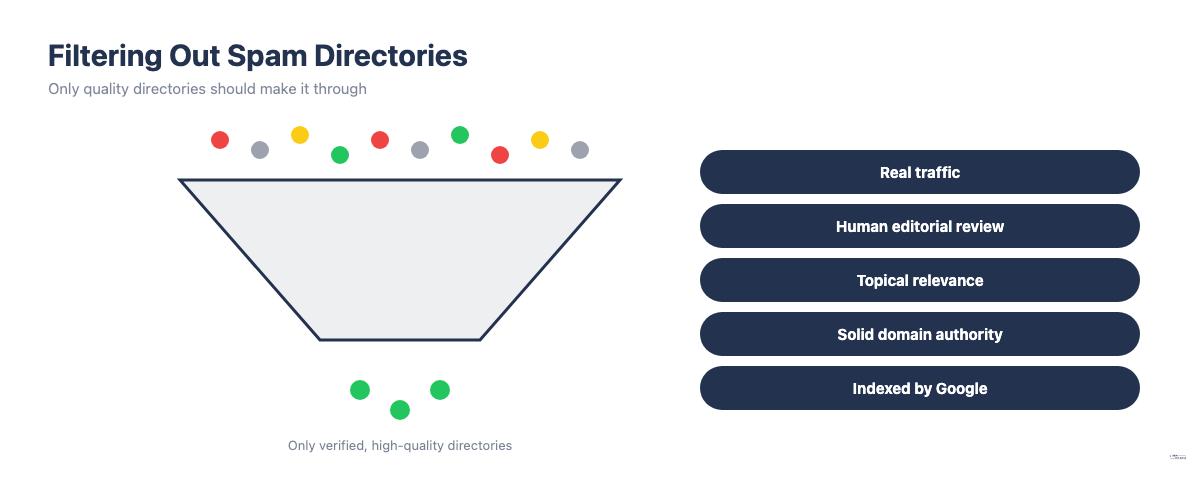
A quality directory has real organic traffic, a human editorial review step, solid domain authority and a category that actually fits your business. You’ll want to score any candidate directory against the criteria below before you submit anything.
| Criterion | What to check | Why it matters |
|---|---|---|
| Relevance | Does the directory focus on your industry or a closely related one? | Relevant links carry more weight than generic ones |
| Real traffic | Does the site show signs of active visitors, not just indexed pages? | A directory nobody visits sends almost no referral value |
| Editorial review | Are submissions checked by a person, or auto-approved? | Human review filters out link farms and keeps the neighborhood clean |
| Domain authority | Does the directory itself carry meaningful authority and trust? | Weak, low-authority directories pass very little link value |
| Indexation | Is the directory’s own homepage and category pages indexed in Google? | An unindexed directory can’t pass link value |
| Outbound link pattern | Does each page link out to a reasonable number of businesses, or hundreds at once? | Pages stuffed with outbound links dilute and can look spammy |
Watch for these red flags before you submit:
- The directory accepts every submission instantly with no review at all
- Listing pages link out to dozens or hundreds of unrelated sites
- The directory’s own homepage isn’t indexed in Google (check with a quick site: search)
- The site design looks abandoned, with broken categories or dead listings
- The directory exists only to sell backlinks, with no real visitor-facing purpose
- The directory requires a mandatory reciprocal link back from your own site in exchange for a listing
- The listing pages are cluttered with pop-ups, unrelated banner ads or heavy affiliate-link density
One of these on its own isn’t automatically disqualifying. Two or more together are a clear signal to skip that directory website entirely.
How to Submit Your Site to a Directory the Right Way
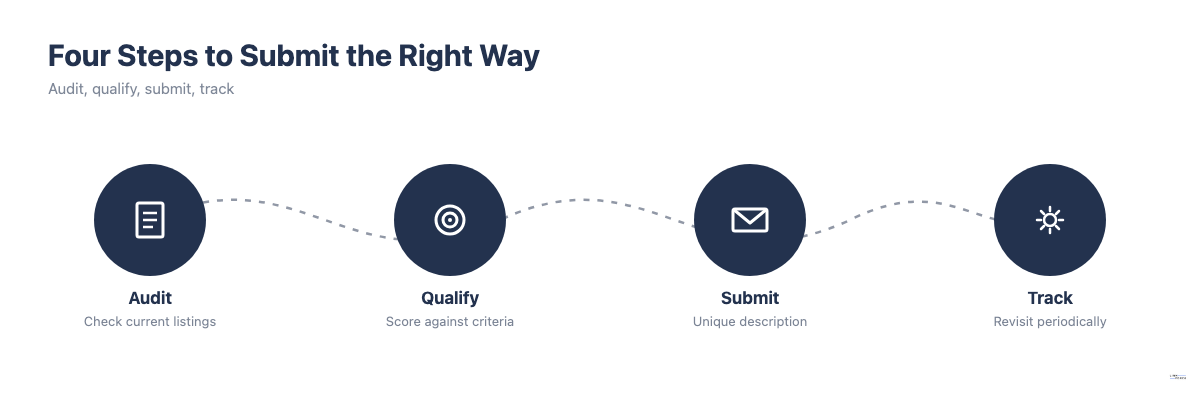
Submitting to directories works best as a four-stage process: audit, qualify, submit and track. Skip straight to submission and you’ll end up with a pile of low-value, unrelated listings that do more harm than good.
- Audit your current listings first. Search your business name and URL to see which directories already list you, since duplicate or outdated listings can create NAP inconsistencies that undermine local SEO.
- Qualify each candidate directory against the criteria table above before you submit anything. A quick check of relevance, traffic, domain authority and review process takes a few minutes and saves you from a wasted or even harmful listing.
- Submit with a unique description for every directory. Reusing the same paragraph across dozens of listings reads as duplicate content, so write a short, specific description for each one and pick the most accurate category rather than the broadest one.
- Track what you’ve submitted and check back periodically. Keep a simple log of which directories you’re listed on, then revisit it every few months to fix outdated details or drop listings from directories that’ve gone stale or shut down.
Spread submissions out over time rather than adding dozens of directory links in a single week. A sudden spike in referring domains from similar-looking directory listings is a pattern automated spam detection is built to notice, and it can undo the trust a slower, more deliberate approach would’ve built.
For most sites, a realistic pace is two to four quality directory submissions a month, prioritized by relevance and domain authority rather than by how many directory websites you can find. That pace is slow enough to look natural and fast enough to build a meaningful base of listings within a couple of quarters.
Where Directory Link Building Fits in a White Hat Link Building Program
Directory link building earns a small, steady place in a link building program, not the lead role. It’s fast, it’s mostly free and it’s genuinely useful for local SEO and baseline credibility. What it won’t do is carry a competitive keyword on its own.
For links that do more of that heavy lifting, look at citation link building, which extends the same directory-style listing approach into local SEO citations specifically, and resource page link building, which earns editorial placements on curated pages instead of automated directory listings. If your site already has strong original content, manual link building through direct outreach typically produces stronger, more relevant links than any directory can.
Directory submissions work best as the reliable, low-maintenance layer underneath a broader strategy. For the full picture of how directory links, editorial links and content-led tactics fit together, see the complete white hat SEO link building guide.
Frequently Asked Questions About Directory Link Building
Is directory submission free?
Most reputable directories are free to submit to, though some niche and paid directories charge a one-time fee or a membership rate for faster review or an accredited badge. Paid doesn’t automatically mean better, but it usually means stricter editorial standards than a free, auto-approval directory does.
How many directories should I submit to?
A focused list of 10 to 20 relevant, high-quality directories does more for a site than 100 generic ones, hands down. Prioritize directories that pass the quality criteria above, including real traffic and solid domain authority, over hitting a specific submission count.
Can directory links hurt my SEO?
Yes, a pattern of links from low-quality, auto-approved or spam-filled directories can hurt rankings, especially if it looks like a deliberate manipulation pattern. Stick to directories with real traffic and human review, and you’ll avoid that risk outright.
Do directory links help local SEO more than national SEO?
Local and niche directories generally help local SEO more directly, mainly through consistent NAP citations that support Google Maps and local pack rankings. National rankings for competitive keywords depend far more on editorial and content-led links than on directory submissions.
Should I use automated directory submission tools?
Automated bulk-submission tools tend to target the same low-quality, auto-approval directories that carry the most risk, so they work against the relevance and editorial-review standards that actually make a directory link worth having. Manual, selective submission takes longer, but it protects the link profile it’s supposed to build.
Does a directory’s domain authority matter more than its traffic?
No, real traffic and topical relevance usually matter more than a raw domain authority number on its own. A high-authority directory with no active visitors and no editorial review can still be a weak or risky link source, and it’s a trap plenty of sites fall into. A moderately authoritative niche directory with real industry traffic is often the better pick, no contest.