

Digital PR (also known as digital public relations) is now the top-performing link acquisition method for 34% of SEO professionals, nearly double the rate of guest posting. That shift reflects a fundamental change in how authority is built online: the most valuable backlinks come from journalists who chose to link to you, not from outreach that asks them to.
This guide covers what digital PR is, how it differs from traditional PR and link building, which strategies generate the best results, and how to run a campaign from start to first link.
What Is Digital PR?
Digital PR is the practice of earning editorial coverage and backlinks by making your brand genuinely newsworthy to journalists and online publications. Instead of asking someone to add a link to an existing page, digital PR creates a story or asset that publishers actively want to cover, and the links follow the coverage.
The core input is newsworthiness: original data, a surprising research finding, expert commentary on a breaking story, a creative campaign, or a useful tool that publishers cannot get anywhere else. When a journalist covers your survey results and links back to your site as the source, that is digital PR working as intended.
Digital public relations sits at the intersection of traditional PR and digital marketing. It applies PR’s storytelling instincts and media relationship skills to SEO goals: domain authority growth, keyword rankings, and increasingly, brand visibility in AI-generated search summaries.
What counts as newsworthy for digital PR purposes:
- Original quantitative data (surveys with 500+ respondents, analyzed datasets)
- Expert commentary that journalists can quote on a timely story
- Creative campaigns that make data visual, shareable, or surprising
- Research findings that contradict or confirm a widely held belief
- Tools or calculators that publishers can reference when covering a topic
Digital PR vs Traditional PR
Digital PR and traditional PR share the same foundation: making your brand worth covering. They diverge sharply on goals, channels, measurement, and SEO value.
| Dimension | Traditional PR | Digital PR |
|---|---|---|
| Primary goal | Brand awareness, sentiment, reputation | Backlinks, domain authority, organic rankings |
| Main channels | Print, broadcast, radio, trade magazines | Online publications, news sites, blogs, podcasts |
| Key output | Press mentions (often no link) | Editorial backlinks from high-DR domains |
| Measurement | Reach, impressions, advertising value equivalency (AVE) | Links earned, DR of coverage, referral traffic |
| Content type | Press releases, media briefings, events | Data studies, original research, creative assets |
| Timeline | Campaign-based, often short-term | Compounding: links earn rankings for months or years |
| Link value | Low (print has no link; online placements are often no-follow) | High (editorial, do-follow, contextual) |
Traditional PR still matters for brand crisis management, broadcast media relationships, and reaching audiences that do not live online. But for measurable SEO outcomes, digital PR delivers better ROI because every output (links, rankings, referral traffic, brand mentions) is directly trackable.
Digital PR vs Link Building
Digital PR and link building both produce backlinks, but they use different logic and produce links of different quality. Understanding the difference matters for planning a link strategy.
Link building encompasses every method of acquiring backlinks: outreach for guest posts, resource page requests, broken link replacement, editorial link insertion, and more. Many of these methods are transactional: you identify a site that could link to you, reach out, and request or negotiate a placement.
Digital PR is a specific type of link acquisition built on earned media logic. The link is a byproduct of genuine coverage, not the primary ask. A journalist links to your data study because it is newsworthy, not because you asked them to add a link.
Why digital PR links tend to be more valuable:
Digital PR links are premium backlinks secured through earned media: features in news outlets, industry publications, and authoritative blogs. They outperform transactional links for four reasons:
- Placement authority: Links come from news sites and industry publishers with Domain Rating (DR) 60-90+, not from mid-tier blogs that accept submissions
- Editorial context: The link appears inside a relevant article, not in a sidebar, footer, or link roundup
- Velocity: A single successful campaign can earn 20-100+ unique links within two to three weeks
- Permanence: Editorial links in archived news articles persist; they continue passing authority long after publication
Because these links are earned through genuine journalism rather than paid placements, search engines treat them as trustworthy, natural editorial endorsements. Google’s E-E-A-T framework (Experience, Expertise, Authoritativeness, Trustworthiness) explicitly rewards this type of third-party validation.
Digital PR and traditional link building are complementary. Digital PR generates high-authority links at scale; tactics like broken link building and resource page outreach add topical relevance and volume. A complete link strategy uses both. For an overview of the tools that support the full spectrum, see our guide to link building software.
How Digital PR Works: The Core Mechanics
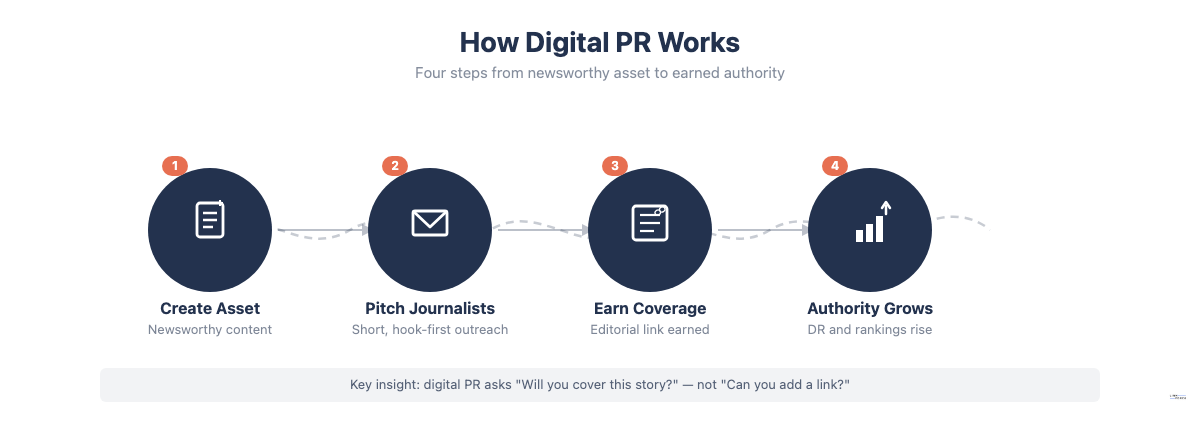
The mechanism behind digital PR is straightforward, but each step requires precision.
Step 1: Create a genuinely newsworthy asset
Every digital PR campaign starts with something a journalist has a reason to cover, independently, without being asked. The most reliable formats are original data (surveys, proprietary research, publicly available datasets analyzed from a fresh angle) and creative assets that make a complex topic visual, comparative, or surprising. The test: would a journalist cite this as a source even if you had never pitched them?
Step 2: Pitch to relevant journalists and publications
With the asset ready, the outreach team identifies journalists who cover adjacent topics and have written similar stories in the last 6-12 months. Good pitching is short (150-200 words), specific, and leads with the hook, not the brand name. The lead is the finding or the story; the brand is the source.
Step 3: Journalists cover the story and link back
When a journalist covers your data, they cite it with a link to the original publication. That link is editorial, contextual, and typically on a high-DR domain. No negotiation, no fee, no exchange: the link is earned because the content warranted coverage.
Step 4: Domain authority and keyword rankings move
The accumulated links raise the referring domain count and overall domain authority. Links from topically relevant publications also strengthen the specific keyword clusters you are targeting. A link from an industry publication passes both general authority and topical relevance simultaneously.
The key insight is the direction of the transaction. Traditional link building asks: “Can you add a link to this page?” Digital PR asks: “Will you cover this story?” The second question is considerably easier for a journalist to say yes to.
Digital PR Strategies and Content Types
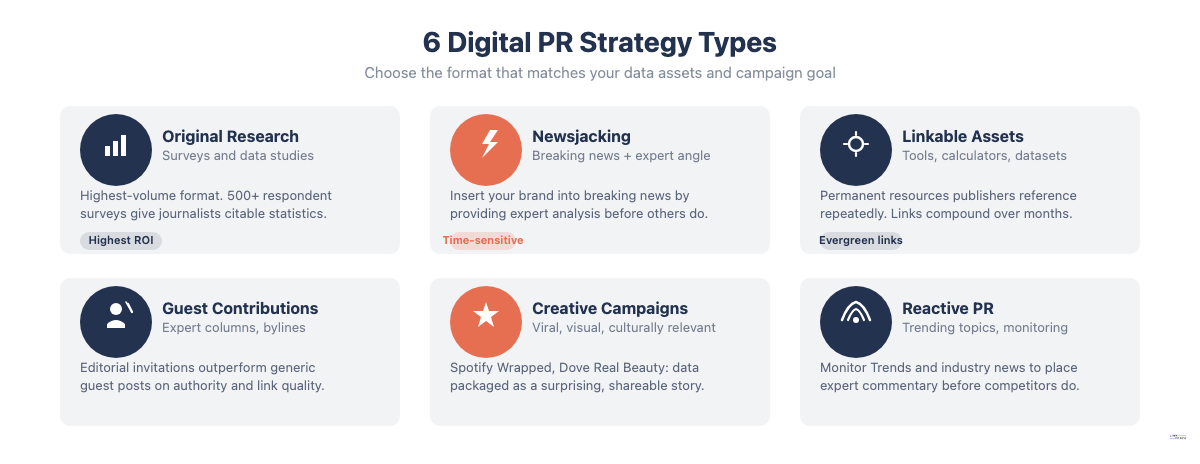
Different content types work for different brands, data assets, and campaign objectives. These are the six most reliable digital PR formats.
Original Research and Data Studies
Original research is the highest-volume, highest-consistency digital PR format. Commissioning a survey of 500+ respondents or analyzing a publicly available dataset to produce new insights gives journalists a statistic they can cite, and the brand becomes the source they link to.
The State of Link Building 2026 survey (500 respondents) is a representative example. The headline finding: 34% of SEO professionals rank digital PR as their best-performing method. It was picked up by dozens of SEO publications and linked to the original research. No link negotiation was needed. The data created the links.
What makes research consistently linkable: a surprising finding (not a confirmatory one), a clearly documented methodology, a sample size journalists respect (typically 500+), and relevance to topics their audience actively cares about. A finding that challenges conventional wisdom earns more coverage than one that confirms it.
Newsjacking and Expert Commentary
Newsjacking is the practice of inserting your brand into breaking news by providing expert analysis, fresh data, or a contrarian perspective before other sources have filed their stories. The timing advantage is critical: journalists filing within hours of a news event need fast, credible sources.
Oreo’s Super Bowl blackout tweet is the textbook case: when the lights went out mid-game, the brand published “You can still dunk in the dark” within minutes, earning national media coverage from a single post. The response was fast, relevant, and genuinely clever. Three conditions made it linkable.
Modern tools for newsjacking include HARO (Help a Reporter Out), Qwoted, and SourceBottle, which let brands respond to active journalist queries before competitors do. The goal is to be the expert source a journalist quotes on a timely story, which earns both a citation and often a backlink.
Linkable Asset Campaigns
A linkable asset is a tool, calculator, visualizer, or dataset that publishers find useful enough to reference repeatedly as new articles are written on the same topic. Unlike a one-time research study, a well-designed asset earns links continuously for months or years.
Examples: interactive cost-of-living calculators (earn links from regional publishers every time a journalist updates a cost story), salary benchmark tools, mortgage calculators, and carbon footprint trackers. The format works because the asset becomes the authoritative reference point, not a single campaign but a permanent resource.
For a detailed breakdown of what makes an asset genuinely linkable versus forgettable, see our guide on linkable assets.
Guest Contributions and Expert Columns
Contributing a bylined article to a trade publication differs from transactional guest posting. Editorial contributions (pieces commissioned or invited by an editor) carry more authority and produce more consistent do-follow links than guest posts submitted to sites that accept anything from anyone.
A guest post on a domain that accepts any submission carries less SEO weight than an invited expert column in a vertical publication with an active editorial team. Positioning for editorial contributions requires consistent expert visibility and a track record of cited research. The guest blogging guide covers how to build the profile that generates editorial invitations rather than transactional requests.
Creative Campaigns
Creative campaigns earn links and coverage through unexpected, visually compelling, or culturally relevant content rather than raw data. Spotify Wrapped is the canonical example: Spotify takes user listening data it already has and packages it as a personalized, shareable experience, generating millions of social shares and thousands of editorial references every December without running a single pitch campaign.
Dove’s Real Beauty campaign is structurally identical. A data-driven insight (only 2% of women describe themselves as beautiful) became a creative concept that earned sustained editorial coverage for years. The differentiating factor in both cases: the creative angle was genuinely surprising and the data was real.
The requirement for this format: the concept must be original and the angle must be surprising enough to justify a journalist writing about it independently. Without those two conditions, the campaign does not earn coverage.
Reactive PR and Trending Topics
Reactive PR involves monitoring Google Trends, social platforms, and industry news for emerging stories and then producing relevant data or expert analysis quickly, before competitors do.
The tactic works best when the brand has genuine data assets or subject matter expertise that makes their commentary distinctively valuable, not just a recycled take on what others have already published. Legislation changes, industry survey releases, and viral moments with relevant hooks are the highest-probability opportunities for reactive coverage.
How Digital PR Boosts SEO
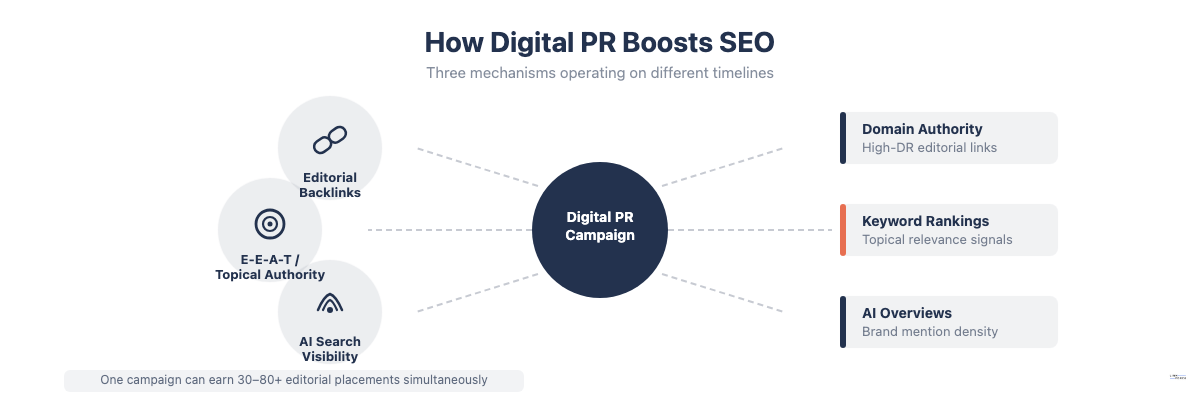
Digital PR improves search rankings through three distinct mechanisms that operate on different timelines.
Editorial backlinks from high-authority domains
Links from national news sites, industry publications, and authoritative blogs carry the strongest PageRank signals. A single link from a DR 80 news site typically contributes more to domain authority than dozens of links from mid-tier guest post sites. Because digital PR links are earned through editorial coverage rather than outreach negotiations, they consistently land on exactly these kinds of high-DR, high-trust pages.
Brand visibility in AI search also improves: AI systems like Google AI Overviews, Perplexity, and ChatGPT treat citations in authoritative editorial content as trust signals, making digital PR links doubly valuable in 2026.
Topical authority and E-E-A-T
Digital PR is one of the most direct ways to build the off-page signals that Google’s E-E-A-T framework measures. Each dimension of E-E-A-T is addressed specifically:
- Experience and Expertise: Placing brand experts in reputable publications, quoted by name and citing proprietary data, demonstrates genuine first-hand expertise to both readers and search algorithms
- Authoritativeness: Backlinks and mentions from high-DR websites and industry publications signal to Google that the brand is a recognized leader, not just a site making self-referential claims
- Trustworthiness: Consistent, positive coverage from reputable editorial sources builds a reputation that both readers and Google’s quality raters interpret as trustworthy
For YMYL (Your Money or Your Life) topics such as health, finance, and legal, digital PR is not a nice-to-have but a necessity. Google applies stricter E-E-A-T standards to YMYL content, and editorial citations from authoritative publications are among the strongest signals that a brand meets those standards.
Unlinked brand mentions and AI visibility
Unlinked brand mentions (editorial references to your brand name without a hyperlink) are critical for AI search visibility in 2026. AI systems like ChatGPT, Perplexity, and Google AI Overviews use text-based mentions to assess brand reputation, authority, and relevance in real time. They treat consistent editorial mentions as signals of legitimacy when generating answers to user queries.
Research from 2025 and 2026 consistently shows that branded web mentions correlate more strongly with AI search visibility than traditional backlinks alone. This matters because digital PR campaigns generate both simultaneously: when a journalist covers your research, they may include a hyperlink to your site AND reference your brand name multiple times across the article, making the authority signal considerably broader than the link count alone suggests.
For more on how this fits a complete SEO strategy, see our guide to white hat SEO link building.
Digital PR and AI Search Visibility
AI-generated search results from ChatGPT, Perplexity, Google AI Overviews, and Gemini surface brands differently than traditional organic results. They rely less on keyword matching and more on how consistently a brand appears as an authoritative source across the open web.
Digital PR aligns precisely with how AI systems build brand understanding.
Citation in editorial content: AI systems treat citations in authoritative editorial articles as authority signals. A brand cited as the source of original data across 50 publications is processed as a genuine expert on that topic, not just a brand that published a blog post.
Named expert positioning: When brand spokespersons are quoted by name across multiple publications, their individual expertise becomes part of the brand’s authority profile in AI training data and real-time retrieval. A named expert cited in 20 industry publications signals to AI systems that this person is genuinely knowledgeable in their field.
Volume and quality of mentions: The scale of digital PR: a single campaign can earn 30-80+ editorial placements, generating the mention density that consistently surfaces brands in AI-generated answers. ZUGU, for example, saw a 243% increase in AI-generated traffic following sustained editorial coverage from digital PR.
The practical implication: digital PR campaigns now serve two purposes simultaneously. The links earn traditional SEO value through domain authority and ranking signals. The editorial mentions build brand visibility in AI search. Brands that invest in digital PR in 2026 are building authority for both systems at the same time.
How to Run a Digital PR Campaign
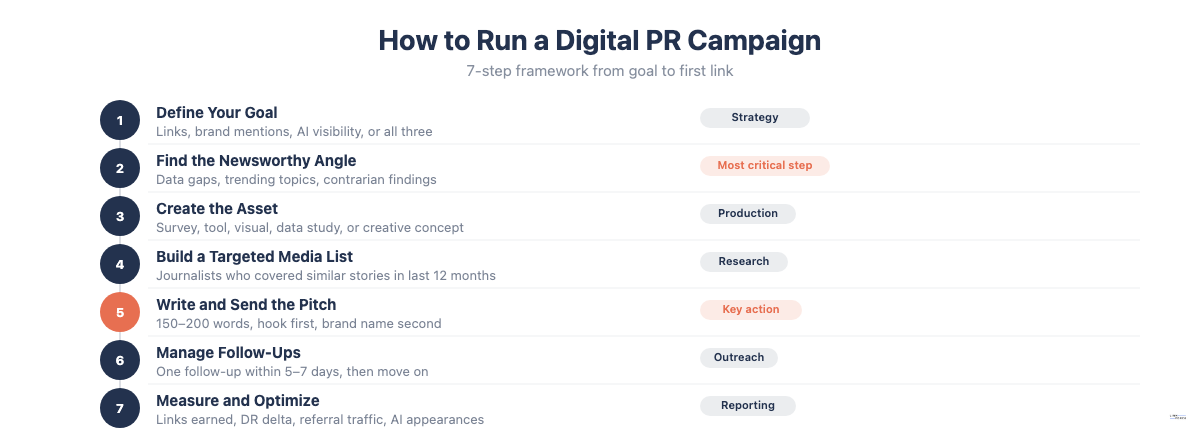
Step 1: Define Your Campaign Goal
Not all digital PR campaigns have the same objective, and the goal determines both the content type and the target publication list.
- Link acquisition: earning editorial backlinks to improve domain authority and keyword rankings
- Brand mentions: increasing authoritative editorial references to build brand visibility across the web
- Thought leadership: establishing key individuals as expert sources journalists will return to for future stories
- Direct referral traffic: generating high-intent visitors from relevant publications
A campaign targeting links needs shareable data that publications will cite. A campaign targeting thought leadership needs expert commentary placed in the publications your target audience reads. Define the goal first, then build the asset and outreach list around it.
Step 2: Identify the Newsworthy Angle
The most common reason digital PR campaigns fail is that the story is only interesting to the brand, not to a journalist or their audience. The test: could a journalist write a standalone article about this finding without ever mentioning your brand? If yes, it has genuine newsworthiness. If the answer is only interesting because of your brand, it does not.
Finding the angle often requires looking at your data from outside your own perspective. What would surprise a non-expert? What contradicts conventional wisdom? What does your data reveal that other sources cannot access? Creating a genuinely newsworthy asset starts with answering those questions honestly.
Types of angles that consistently earn coverage:
- A finding that contradicts what most people assume
- A ranking or comparison that lets people see where they stand
- A data point tied to a timely event or seasonal trend
- A regional breakdown of a national topic
Step 3: Create the Shareable Asset
The asset is the deliverable the journalist will reference and link to. Common formats by campaign type:
- Research report: 10-30 pages with documented methodology, findings, and charts, giving journalists full context for citation
- Data visualization: an interactive tool or infographic that makes a dataset navigable and shareable
- Survey results: quantitative findings on a relevant question (500+ respondents for credibility; 1,000+ for national coverage)
- Expert guide: a comprehensive reference that becomes the definitive page on a topic, earning links as new articles are written
Quality standards that directly affect coverage rates: clear and documented methodology, surprising findings (confirmatory data earns less coverage), clean visualization, and a press-ready summary that journalists can write from without reading the full report.
Step 4: Build a Targeted Media List

A digital PR media list is not a press release distribution list. It should include:
- Journalists at relevant publications who have covered comparable stories in the last 6-12 months
- Publications whose audience matches the story’s target demographic
- A tiered mix: national news publications (high reach, harder to land), industry verticals (higher relevance, better placement probability), and niche outlets (highest relevance, easiest to land)
Relevance beats reach. A story about workplace productivity earns better results when pitched to HR and business journalists who have covered productivity research before, not when blasted to a generic media list.
Step 5: Write and Send the Pitch
The pitch email should be 150-200 words, lead with the most surprising finding, and answer the journalist’s implicit question: “Why would my readers care about this today?”
Characteristics of pitches that earn coverage:
- Opens with the hook or data point, not the brand name
- States the finding in one sentence
- Explains why it is timely or relevant to what the journalist covers
- Offers an embargo or exclusive for very strong stories
- Closes with a clear call to action
For detailed guidance on outreach mechanics and pitch templates, see our guides on outreach emails, outreach strategy, and backlink outreach.
Step 6: Manage Follow-Ups
One follow-up email five to seven days after the initial pitch is standard best practice. A second follow-up is the maximum; beyond that, the story has typically been filed or passed on, and additional contact damages the relationship with that journalist for future pitches.
Step 7: Measure and Optimize
After the campaign, review performance against these metrics:
- Links earned: total new referring domains from coverage
- Link quality: average DR of the domains that covered the story
- Coverage volume: number of editorial articles that mentioned or linked to the campaign
- Referral traffic: direct sessions from editorial placements to the original asset
- Brand mentions: total unlinked references generated across the web
Use these findings to improve the next campaign: which angles performed better, which publication tiers converted, what pitch wording earned higher response rates. See our guide on link building reporting for a full KPI framework and reporting structure.
Measuring Digital PR Success
Primary KPIs:
- Backlinks earned: total new referring domains acquired from the campaign: the most direct measure of digital PR output
- Average DR of linking sites: quality proxy for the authority value of links earned; DR 60+ is the target threshold for meaningful domain authority movement
- Coverage volume: number of editorial articles that mentioned or linked to the campaign asset
- Referral traffic: direct sessions from editorial placements, visible in Google Analytics 4 as organic or direct referral sessions
Secondary KPIs:
- Brand mention volume: total references to the brand name, linked and unlinked, across the web
- AI search appearance rate: how often the brand appears in AI-generated answers for target queries (track manually in ChatGPT, Perplexity, Google AI Overviews)
- Keyword ranking movement: position changes for target keywords in the 60-90 days following a campaign
- Social shares: organic distribution of the campaign asset
What good campaign results look like:
Strong digital PR results in 2026 are defined by high-authority do-follow backlinks from publications with DR 60+, measurable organic ranking improvements, and brand mention increases, not just impression counts or coverage volume.
In practice: a well-executed campaign earns 20-50 unique linking domains at DR 50+. Standout campaigns reach 80-150+ links. Published case study benchmarks include Pyramid Eco (150+ high-authority backlinks from a single campaign), Age Care Bathrooms (£215,000 in revenue attributed to digital PR-driven link and traffic impact), and ZUGU (243% increase in AI-generated traffic from sustained editorial coverage). These represent top-end performance; a campaign generating 20-30 quality editorial links is already outperforming most other link acquisition methods on a cost-per-link basis.
Domain Rating improvement is a lagging indicator: the first significant DR movement typically appears 2-3 months after a major campaign, with sustained programs showing consistent growth after 6-12 months of regular campaigning.
Tools:
- Ahrefs or Semrush for backlink tracking and referring domain analysis
- Google Analytics 4 for referral traffic attribution
- Google Alerts and Ahrefs Alerts for brand mention monitoring
- Buzzsumo or Meltwater for coverage volume tracking across publications
FAQs
What is the difference between digital PR and SEO?
SEO is the broader practice of optimizing a website to rank in search results. It covers technical optimization, on-page content, and link acquisition. Digital PR is a specific link acquisition strategy within SEO. It earns the high-authority editorial backlinks that are among the most valuable inputs to SEO performance. Digital PR also generates AI search visibility signals (brand mentions, editorial citations) that traditional SEO tactics cannot directly create.
How much does a digital PR campaign cost?
Costs vary based on whether you run campaigns in-house or with an agency, and on the scale of the asset being created. A data study commissioned through a research firm and pitched by an experienced PR team might cost $5,000-$25,000 per campaign. In-house campaigns using proprietary data and existing media relationships cost significantly less. The right benchmark is cost-per-link or cost-per-DR, not total spend. A campaign earning 40 links from DR 70+ sites at $15,000 is typically more efficient than the equivalent volume from outreach-based methods.
How long does digital PR take to work?
Editorial links begin to appear 1-3 weeks after a successful pitch. The SEO value from those links (domain authority movement, keyword ranking changes) typically becomes visible in Google Search Console 60-90 days after a major campaign. Building a consistent digital PR program that delivers predictable results usually takes 6-12 months of regular campaigning.
Can small businesses do digital PR?
Yes, but the approach adjusts. Small businesses rarely have budget for commissioned research, but many have access to proprietary data (customer behavior, local market insights, niche industry expertise) that larger brands cannot replicate. Local digital PR, pitching findings to regional publications and local journalists, can earn high-quality links without requiring the scale of enterprise-level campaigns.
What types of content work best for digital PR?
Original data and research studies consistently produce the most links at the highest authority levels. Newsjacking generates fast results when the timing and expertise are right. Linkable assets generate links over a sustained period. The best format depends on your available data assets, your team’s speed, and whether your goal is volume or quality.
Is digital PR the same as link building?
No. Digital PR is a specific type of link acquisition built on earned media logic: creating content so genuinely newsworthy that publishers cover it voluntarily and link to it as a source. Traditional link building encompasses many other methods (outreach, guest posting, broken link replacement, resource page requests) that work through direct requests rather than earned coverage. Digital PR links tend to be higher-authority and more valuable per link. A complete link acquisition strategy typically combines digital PR for high-authority editorial links with other editorial link methods for volume and topical depth.
Where to Go From Here
Digital PR is the anchor of a modern link acquisition strategy. It earns the highest-authority links, builds brand visibility in AI search, and establishes the E-E-A-T signals that compound over time. It works best when connected to the full cluster of tactics and tools that support it.
If you are building a digital PR program for the first time, the adjacent topics that matter most:
- Digital PR agencies: what to expect from a managed service and how to evaluate providers
- Digital PR tools: the software stack for campaign research, outreach, and tracking
- PR outreach: the specific mechanics of journalist outreach at scale
- PR strategy: how to build a repeatable campaign calendar and digital strategy
- PR tactics: the specific execution methods within each campaign type
- Outreach marketing: how digital PR fits the broader outreach marketing ecosystem
LinkForce builds and executes digital PR campaigns that earn editorial links at scale.