

Most guides answer this question with “it depends” and leave you with nothing useful. This one does not. The number of backlinks needed to rank depends on your keyword’s competition level, your industry, and the quality of links you build. All three are measurable.
Before diving into numbers, one important correction: raw backlink count is not the primary metric that determines rankings. Referring domains (unique websites linking to you) correlate more strongly with Google rankings. One site linking to you 50 times counts less than 50 different websites each linking once. The rest of this guide works from that baseline.
What you’ll find here: competition-level benchmarks, a full industry breakdown, a five-step calculation for your specific situation, a quality framework that reduces how many links you need, and what AI Overviews mean for backlink strategy in 2026.
Why the Number of Backlinks Is the Wrong Question
Referring Domains vs. Total Backlinks
When researchers analyze what actually correlates with Google rankings, referring domains consistently outperform raw backlink count. A large-scale analysis of over one million US search results found that referring domains had a Spearman correlation of 0.255 with rankings. Total backlinks scored 0.248. Domain Rating, the metric many site owners optimize for, scored only 0.131.
The difference looks small but the implication is significant: ten links from ten different websites is better than ten links from one website, even if the total count is identical. Any backlink tool you use, including Ahrefs Backlink Checker, reports both metrics. Track referring domains as your primary planning number, not the raw backlink count.
Throughout this guide, all benchmarks refer to referring domains unless stated otherwise.
What the Data Shows About Backlinks and Rankings
Two large studies establish the baseline for understanding how many backlinks a website needs to rank. An analysis of 11.8 million Google search results found a clear positive correlation between referring domains at the page level and ranking position. A separate study of one million US SERPs found that the number one result has on average 3.8 times more backlinks than pages in positions two through ten.
That second finding matters for target-setting. Positions two through ten do not have dramatically more links than position ten. The top spot tends to be an outlier. Ranking in the top ten is achievable at a much lower referring domain count than ranking at position one.
One more number worth noting: approximately 95% of all indexed web pages have zero backlinks from external sites. Any external linking at all puts a page in the top 5% of the web by this measure.
What Google Says About Backlinks
Google has acknowledged that backlinks are one of the three strongest ranking signals, alongside content relevance and RankBrain. Google Search Central documentation confirms that links help Google discover new pages and assess how relevant and authoritative a page is within its topic area. Google also distinguishes between editorial links (earned naturally by publishing useful content) and manufactured links, which their guidelines and spam policies explicitly discourage.
The practical implication: not all links count equally in Google’s systems, and the quality weighting is intentional by design.
How Many Referring Domains Does Page One Actually Need?
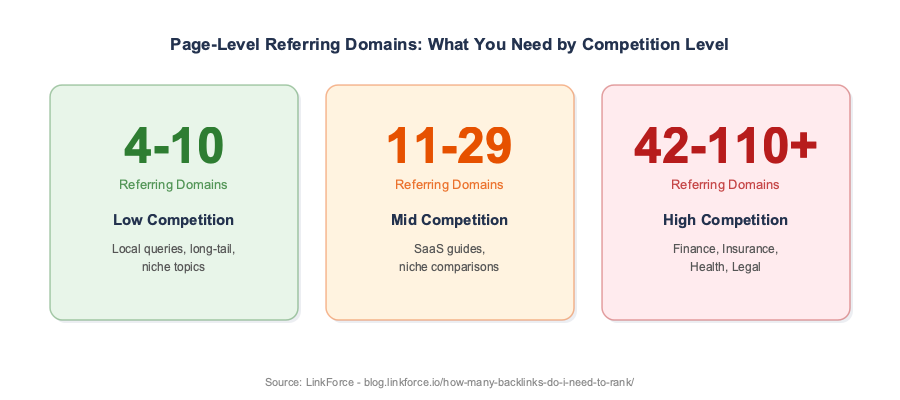
The number of backlinks needed to rank varies by competition level. Below are three scenarios drawn from real SERP data.
Low-Competition Keywords (4 to 15 RDs)
Low-competition keywords include local queries, long-tail informational phrases, and highly specific niche topics. Examples: “emergency plumber north-east Portland,” “best gluten-free bakery in Leeds,” or “how to repair a specific vintage camera model.”
Pages ranking on page one for these keywords typically have between 4 and 10 referring domains at the page level. A local service page often ranks in the top three with fewer than 8 referring domains, especially when the site has broad citation authority from local business directories and niche mentions. For new websites targeting long-tail terms, this range is achievable in the first year.
Mid-Competition Keywords (15 to 50 RDs)
Mid-competition keywords include SaaS product guides, niche commercial comparisons, and moderately contested informational topics. A guide targeting a software category typically competes against pages with 11 to 29 referring domains.
For this scenario, a page-level target of 10 to 15 referring domains is usually enough to enter the top five. The key variable is how evenly distributed the competition is. If two or three dominant pages hold 40 or more RDs and the rest cluster around 10, it is often possible to slip into positions four or five without matching the leaders, particularly if your content is more complete and better structured.
High-Competition Keywords (50 to 200+ RDs)
High-competition national terms in finance, legal, insurance, health, and some SaaS categories show the steepest backlink requirements. Pages ranking in positions one through five for queries like “best business credit card” or “debt consolidation loans” regularly have 42 to 110 or more referring domains.
At this level, page-level referring domains matter less than site-level authority. Google tends to favor sites with broad domain authority for highly competitive queries. Building links to the specific target page is only part of the equation. The domain needs hundreds or thousands of referring domains across its full backlink profile to compete reliably.
| Competition Level | Typical Page-Level RDs | Example Scenario |
|---|---|---|
| Low | 4 to 10 | Local service page, long-tail informational |
| Mid | 11 to 29 | SaaS guide, niche comparison |
| High | 42 to 110+ | National finance, insurance, health |
Backlink Benchmarks by Industry (2026 Data)
Generic competition levels help set initial expectations, but your specific industry shapes the benchmark more than any general rule. A 2026 study analyzing 1,462 domains across 15 industries found a 40x difference in the median referring domains required for page-one rankings between the most competitive and least competitive verticals.
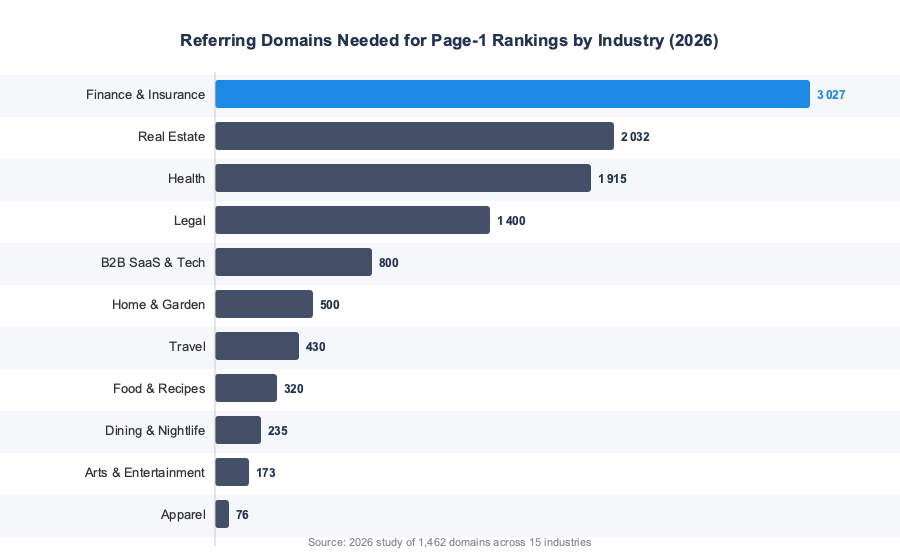
| Industry | Median Referring Domains (Page 1) |
|---|---|
| Finance and Insurance | 3,027 |
| Real Estate | 2,032 |
| Health | 1,915 |
| Legal | approx. 1,400 |
| B2B SaaS and Technology | approx. 800 |
| Home and Garden | approx. 500 |
| Travel | approx. 430 |
| Food and Recipes | approx. 320 |
| Dining and Nightlife | 235 |
| Arts and Entertainment | 173 |
| Apparel | 76 |
The spread within some industries is particularly large. For Computers and Electronics, the 25th percentile of page-one results sits at 262 referring domains, while the 75th percentile reaches 12,813. The bar varies enormously by subtopic even within a single industry category.
How to Read This Table
These figures represent median page-level referring domains for pages currently ranking on page one. They are not personal targets; they are benchmarks. Your specific target is determined by your competitor set for that exact keyword, not the industry median.
A SaaS company targeting a niche keyword with weak incumbent pages might need only 15 to 30 referring domains even though the industry median is 800. The five-step calculation process below shows how to find your specific number.
The industry table is most useful as a reality check when entering a new vertical. If you are moving from food blogging (approx. 320 RDs) into finance content (3,027 RDs), the backlink gap between your current profile and what is required for competitive rankings is a strategic consideration, not just a tactical one.
Link Velocity Benchmarks by Industry
Link velocity (how many new referring domains you acquire per month) is as important as total count. The same 2026 study found an average new referring domain acquisition rate of 48 per month for pages actively climbing the rankings. Industry variation is significant:
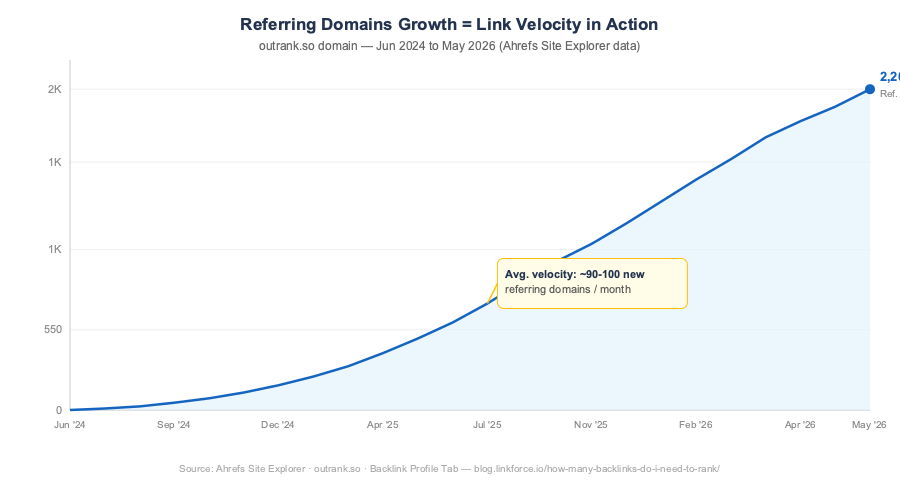
- Finance and Insurance: 101 new referring domains per month
- B2B SaaS: approximately 35 to 50 per month
- Travel: approximately 20 to 35 per month
- Apparel: 15 per month
A site that cannot sustain the velocity typical for its industry may still rank well if the existing link quality is high. Ten strong editorial links from topically relevant sites outperform 50 low-quality directory placements in terms of ranking effect.
How to Calculate the Number of Backlinks You Need (5-Step Process)
Industry benchmarks give you a range. This process gives you a specific number for your exact target keyword.
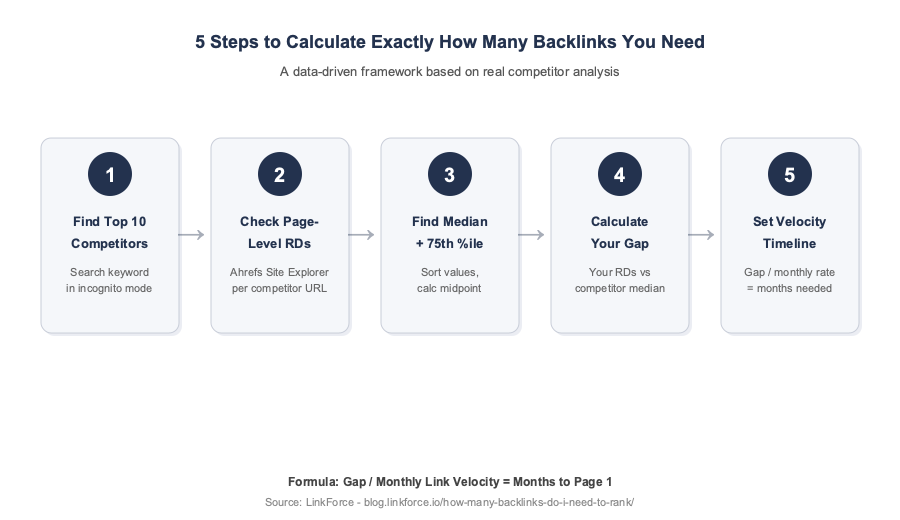
Step 1: Identify your top 10 competitors for the keyword
Search the keyword on Google and record every page in positions one through ten. Note both the domain and the specific URL.
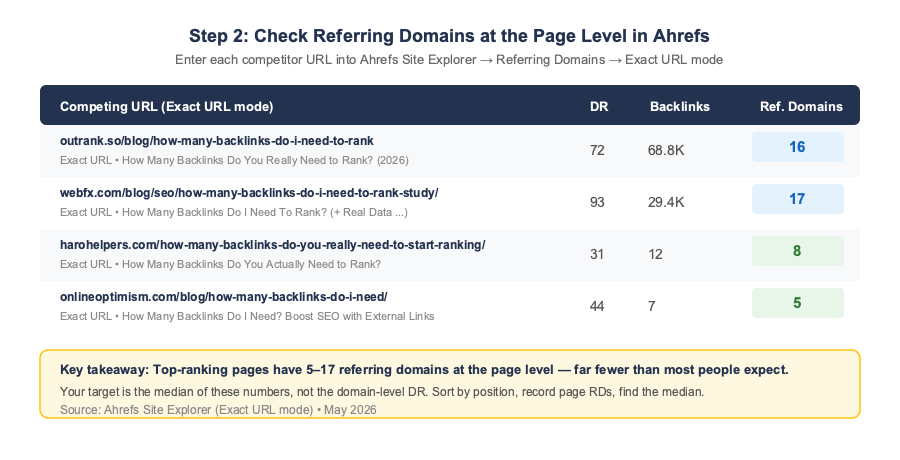
Step 2: Check referring domains at the page level
Use Ahrefs Site Explorer or a comparable backlink tool. Enter each competing URL and record the referring domain count for that specific page, not the domain. Page-level data is what matters: a competitor may have high domain authority overall while the competing page itself has only 12 referring domains.
Step 3: Find the median and 75th percentile
Sort your 10 competitor RD counts from lowest to highest. The median (middle value) is your baseline target to enter the top ten. The 75th percentile is your competitive target for aiming at the top three.
Step 4: Calculate your gap
Run your own target URL through the same tool. Subtract your current page-level referring domain count from the median of your competitor set. The result is the gap you need to close.
Step 5: Set a timeline based on realistic velocity
Divide the gap by a realistic monthly acquisition rate for your situation. For most small-to-mid-size sites doing systematic outreach, 2 to 5 new referring domains per month is achievable. Larger teams with digital PR budgets can reach 10 to 20 per month.
Worked Example: Mid-Competition SaaS Term
Here is a concrete example for a mid-competition SaaS keyword:
- Competitor page-level RDs: 6, 8, 11, 13, 14, 17, 19, 22, 25, 29
- Median: 15 to 16 referring domains
- 75th percentile: 22 referring domains
- Your current page-level RDs: 3
- Gap to median: 13 referring domains
- Gap to 75th percentile: 19 referring domains
- Realistic monthly velocity: 2 to 3 per month
- Estimated timeline to enter top 10: 4 to 7 months
- Estimated timeline to reach top 3: 6 to 10 months
This timeline assumes consistent outreach and competitive content quality. Links alone will not move rankings if the page does not meet the intent of the query better than competing pages.
Why Link Quality Reduces How Many Backlinks You Need
Quantity matters, but quality acts as a multiplier on the number required. A 2026 study of page-one backlink profiles found that 92.2% of all backlinks held by top-ranking pages were editorial (links placed voluntarily by content authors because the linked page added genuine value to their readers). Directory links and resource page listings made up less than 8% combined.
The practical implication: if your backlink profile consists mostly of low-quality directory submissions, you will likely need more referring domains than the benchmark to achieve the same ranking effect. A profile of editorial links from topically relevant, high-authority sites can achieve parity with fewer total links.
What Makes a Backlink High-Quality
Four factors determine link quality in Google’s ranking systems:
- Topical relevance: a link from a site in the same or adjacent niche passes more relevance signal than an unrelated domain, even one with high authority overall
- Linking page authority: check the URL Rating (UR) in Ahrefs rather than relying only on domain-level metrics; an editorial link from a strong page on a mid-tier domain can outperform a footer link on a high-DR domain
- Placement context: editorial body links placed in the main content of an article outperform sidebar, footer, and boilerplate mentions for the same domain
- Link attribute: dofollow links pass link equity directly; nofollow links carry minimal direct ranking benefit, though they can drive referral traffic and brand signals
For a detailed breakdown of link attributes and how Google processes them, see the guide to do follow and no follow links.
Quality Tiers in Practice
| Tier | DR Range | Context | Relative Ranking Value |
|---|---|---|---|
| Tier 1 | DR 60+ | Editorial, topically relevant | Highest: each link may substitute for 5 to 10 lower-tier links |
| Tier 2 | DR 40 to 59 | Editorial, broadly relevant | Strong, compounds reliably |
| Tier 3 | DR 30 to 39 | Mixed placement, weaker context | Useful, diminishing returns at volume |
| Low quality | Below DR 30 | Spam, PBNs, unrelated directories | Risk of negative signal at scale |
A profile built on Tier 1 and Tier 2 links will outrank a larger profile of Tier 3 links in most competitive situations. Before investing in acquiring more backlinks, audit the quality distribution of what you already have. The full backlinks analysis guide covers this audit in detail.
When You Can Rank With Fewer Backlinks Than Competitors
Competing pages do not always reflect the minimum threshold required to rank. There are genuine situations where fewer referring domains are sufficient.
Domain authority carries forward to new pages. If your domain has accumulated strong site-wide authority through years of link building, new pages on that domain can rank with fewer page-level links than a standalone competitor. An established domain ranking a fresh page is not the same effort as a new site trying to rank the same content.
Long-tail keywords with weak incumbents often have pages ranking by default, with no intentional optimization. A well-structured, intent-matched page can reach the top five for these queries with very few external links.
Strong on-page signals combined with E-E-A-T evidence matter for informational queries. Google rewards pages that demonstrate first-hand expertise and comprehensive topic coverage. A thin page with 30 links regularly loses to a thorough page with 10 links when the content clearly serves the reader’s actual question.
Internal linking from high-authority existing pages on your site substitutes for some external link building by passing equity to the target page. If you have existing content with strong backlink profiles, pointing internal links to your new target page is the fastest free lever available. The broader context for this is covered in the off-page SEO guide.
Local and geo-specific terms frequently have weak enough competition that a modest domain with good citation signals can rank without significant external links at the page level.
When More Backlinks Won’t Help You
Adding referring domains to a page with underlying problems is one of the most common ways link building budgets are wasted. More backlinks will not overcome these issues:
Thin content that does not match search intent is the most common blocker. If the page does not genuinely address what the searcher is looking for, links will not substitute for that gap. Google can and regularly does rank pages with fewer links when those pages clearly serve the user better.
Technical indexing problems prevent links from having any effect. A page with crawl errors, canonical misattributions, or a noindex directive will not benefit from links regardless of volume or quality.
Low-relevance links at scale can dilute topical authority signals rather than strengthen them. Building hundreds of links from unrelated niches reduces the relevance signal Google uses to understand what your page is an authority on.
No site-level topical depth matters for competitive terms. Google evaluates the topical authority of the entire domain, not just the target page. A site with one page on a subject and no supporting content cluster will struggle to break into the top five for competitive queries even with a strong page-level link profile.
Backlinks and AI Overviews in 2026
The growing presence of AI Overviews in Google search results changes the traffic math for backlinks without removing the need to build them.
Research shows that when an AI Overview appears for a query, the top organic result receives approximately 34.5% fewer clicks than it would in a standard SERP. That is a significant traffic reduction for the highest-visibility positions.
However, 76% of pages cited in AI Overviews come from the top-10 organic results. Being cited by an AI Overview first requires ranking organically, which still depends on backlinks. The goal of link building has not changed; the urgency of being in the top ten has increased.
The shift is also visible in AI-native search tools. ChatGPT is approximately 3.5 times more likely to cite pages from sites with 32,000 or more referring domains. This is a site-level metric, not a page-level one. Brand authority accumulated through consistent link building now directly influences visibility in generative AI responses, not just Google’s traditional search results.
What This Means for Your Backlink Strategy
Three practical adjustments worth making in 2026:
First, page-level link building remains the primary driver of organic rankings. Site-level referring domain accumulation additionally determines AI citation probability. These two targets can be built in parallel through the same outreach activities.
Second, topically relevant, high-credibility links carry more weight in both contexts than high link volume from unrelated sources. A link from a well-regarded industry publication helps both Google rankings and AI Overview inclusion more than a dozen generic directory links.
Third, if AI Overviews appear for your target keyword, your click-through rate will be lower even at position one. Build enough authority to appear in the AI citations as an additional visibility source alongside organic position.
How to Build the Backlinks You Need
Once you know your target, the practical question is which link building methods reliably close the gap for editorial content.
Guest posting on relevant publications is the most direct path to editorial links from topically relevant sites. The process involves identifying authoritative publications in your niche, pitching original topic ideas, and earning body links from your authored content. The complete process is covered in the guest blogging guide.
Digital PR campaigns (original data studies, surveys, and research reports) generate editorial links at scale because journalists and bloggers actively seek citable data. This method also builds site-level referring domain counts at a pace that generic outreach alone cannot match, improving both Google rankings and AI Overview citation probability.
Systematic link building outreach covers resource page link building, broken link building, and skyscraper-style replacement outreach. Each targets an existing linking intent and converts it into an editorial placement. For outreach templates and a step-by-step campaign structure, see the link building outreach guide. The broader toolkit of white hat tactics is covered in the white hat SEO link building guide.
Internal linking from your strongest existing pages is free, immediate, and underused. Identifying your highest-DR pages and adding contextual links to your new target page passes equity before a single outreach email is sent. The off-page SEO checklist includes a full internal linking audit as one of its core steps.
How Long Does It Take for Backlinks to Improve Rankings?
Newly acquired links typically take between one week and three months to be discovered and indexed by Google, depending on the crawl frequency of the linking site. High-authority sites with frequent crawl cycles index links faster.
Ranking improvements from new links usually become visible three to six months after consistent link building begins, not immediately. If you close the gap to the median referring domain count in your competitor set within three months, expect initial ranking movement in months four through six, with more stable positions by month nine.
Frequently Asked Questions
How many backlinks do I need to rank on page 1?
For low-competition keywords, pages ranking on page one typically have 4 to 15 referring domains at the page level. For mid-competition terms, the range is usually 11 to 30. For high-competition national terms in finance, health, or insurance, page-one competitors regularly have 50 to 200 or more. There is no universal number. Use the five-step competitor analysis process above to find the specific target for your keyword.
How many backlinks does a new website need to start ranking?
A new website can rank for long-tail keywords with minimal or zero external backlinks if the content clearly matches the search intent and competition is weak. For most keywords with meaningful search volume, new websites need 5 to 15 referring domains to the target page before expecting consistent top-ten rankings. The most efficient strategy is targeting low-competition long-tail terms first, building domain authority gradually, then progressing to more competitive terms.
Is 100 backlinks a lot?
Context matters more than the number. One hundred total backlinks from 100 different referring domains is a solid foundation for a growing site. One hundred backlinks from 5 domains, with each domain linking 20 times, carries significantly less weight. Always evaluate backlink profiles by referring domain count, not raw link numbers.
What is a good number of referring domains for a website?
At the domain level, 100 to 500 referring domains is competitive for most low-to-mid competition niches. Sites with 1,000 to 5,000 or more referring domains can compete across a broad keyword set. For an individual page, the right number is relative to the ten pages currently ranking for your target query. There is no single threshold that counts as “good” in isolation.
Do more backlinks always mean higher rankings?
No. More links improve rankings when they come from topically relevant, high-authority domains in editorial body placements. Large volumes of low-quality or irrelevant links have minimal positive effect and can dilute topical authority. Beyond a competitive threshold, additional links produce diminishing returns while content quality and on-page experience become the primary differentiators.
Can a website rank without any backlinks?
Yes, for some queries. Long-tail keywords with specific intent and weak competing pages often have top-five results with zero external backlinks. These are exceptions rather than the rule. For any keyword with meaningful competition, some external referring domains improve ranking probability. The practical approach is to target keywords where your site’s existing authority is already competitive before committing budget to pages that still lack content quality.
What counts as a high-quality backlink?
A high-quality backlink comes from a page that is topically relevant to your target keyword, has a URL Rating (UR) of 20 or above in Ahrefs, is placed in the editorial body of the content rather than a footer or sidebar, and is a dofollow link. Domain Rating above 40 is a useful proxy for domain-level strength, but a lower-DR site in exactly your niche can outperform a higher-DR site with no topical connection. Anchor text should be descriptive and natural. Over-optimized exact-match anchors create unnecessary penalty risk. The anchor text in Ahrefs guide covers how to read and optimize your anchor distribution.
How does existing domain authority affect how many backlinks a page needs?
A site with strong domain-level authority can rank new pages with fewer page-level links than a weaker domain targeting the same keyword. A new page on a high-authority domain may rank in the top five with 5 to 10 page-level referring domains, while a new standalone domain might need 20 to 30 to achieve the same position. This is why investing in site-wide link building through content and outreach compounds in value over time. The full relationship between individual backlinks and referring domains is explained at backlinks vs referring domains.