

A reciprocal link is a two-way link between two websites. Your site links to another site, and that site links back to yours. Simple as that. This guide covers what the term means, how the mechanic works, how it differs from a one-way link or a three-way exchange, and how to use it without triggering Google’s link spam policies.
What Does Reciprocal Link Mean?
A reciprocal link is a two-way link between two websites: your site links to another site, and that site links back to yours. Some call it a mutual agreement between two website owners, or a digital handshake, where each side links to the other. The arrangement can happen naturally. Two site owners both think the other’s content is worth pointing readers toward, or they set it up deliberately as an agreement between the two parties.
Reciprocal links are also called link exchanges or link swaps. The core idea stays the same in every version: two sites, one mutual link, no third party involved. That last part matters, because it separates a plain reciprocal link from the three-way exchange covered further down.
How Does a Reciprocal Link Work?
A reciprocal link works through a mutual agreement between two website owners: Website A places a link to Website B, and Website B places a link back to Website A. Site A adds a link to Site B somewhere in its content, and Site B adds a link back to Site A, usually in a related article, a resource page, or a partner list. Neither link needs to happen at the same moment. Search engines don’t require the swap to be instant, only that both links eventually exist.
A relevant example makes this concrete. An SEO blog publishes a guide on backlink outreach and links to a link-building tool’s blog post on email templates. That tool’s blog later publishes a piece on outreach metrics and links back to the SEO blog’s guide. Both links sit inside content that actually serves the reader, which is what keeps a reciprocal link useful instead of just a favor between site owners.
Anchor text plays a role here too. The words used in the link should describe what the destination page is actually about, not a stuffed keyword phrase. A natural reciprocal link reads like a normal citation, not a placement.
Reciprocal Link vs. One-Way Link vs. Three-Way Exchange
A reciprocal link, a one-way link, and a three-way link exchange are three distinct ways websites trade authority: a reciprocal link is a direct two-way swap, a one-way link carries no return link, and a three-way exchange routes the link through a third site to avoid a direct swap footprint. These three terms get mixed up constantly, so here is the distinction in one place.

- Reciprocal link: Site A links to Site B, and Site B links back to Site A. Two sites, one direct swap.
- One-way link: Site A links to Site B, and Site B never links back. Most natural backlinks work this way, which is also why search engines tend to trust them more than an obvious swap.
- Three-way link exchange: Site A links to Site B, Site B links to Site C, and Site C links back to Site A. No two sites link directly to each other, which hides the reciprocal pattern from a simple backlink check. This is also called an ABC link exchange, and it comes with its own execution and risk considerations that go beyond what a two-way swap needs.
A one-way link is generally the strongest signal to a search engine, because nothing was traded for it. A reciprocal link is not automatically a problem, but it does invite more scrutiny than a one-way link, and a three-way exchange usually exists specifically to reduce that scrutiny. For the full breakdown of link exchange types and when each one makes sense, see LinkForce’s guide to link exchanges in SEO.
Are Reciprocal Links Good or Bad for SEO?
Reciprocal links are neither inherently good nor bad for SEO, their impact depends on how they are executed. A small number of natural, relevant reciprocal links between related sites, kept as a small share of your overall backlink profile, rarely causes any issue. Large-scale, systematic link exchanges built purely to manipulate rankings are a different story, and Google treats them as link spam.
Google’s own spam policies name this pattern directly, describing excessive link exchanges and partner pages built exclusively for cross-linking as a form of link spam. The word “excessive” is doing the real work in that sentence. One relevant swap with a genuinely related site is not what the policy targets. A pattern of dozens or hundreds of reciprocal links, especially with unrelated sites or through a coordinated exchange network, is.
The practical risk is not a single warning label, it is a spectrum. A site with a handful of relevant reciprocal links has essentially nothing to worry about. A site running a large reciprocal linking scheme risks a manual action or an algorithmic devaluation of the links involved, which can mean the links stop passing any ranking value at all, or in more severe cases, a visibility penalty on the site itself.
How to Use Reciprocal Links Safely
You use reciprocal links safely by keeping them relevant, natural, and a small share of your link profile rather than the bulk of it. A few habits keep a reciprocal link on the safe, useful side of that spectrum.
- Link to sites your readers would actually want to visit, not sites you are only linking to because they agreed to link back.
- Keep the linked page topically close to what you publish. A gardening blog linking to another gardening resource reads as normal, a gardening blog linking to a payday loan site does not.
- Use varied, descriptive anchor text instead of repeating the same exact-match keyword phrase every time.
- Place the link where it fits the surrounding content naturally, not bolted onto the end of a paragraph for no reason.
- Keep the overall share of reciprocal links small relative to your one-way backlink profile. A link profile that is mostly reciprocal is the pattern search engines flag, not any single reciprocal link on its own.
How to Vet a Reciprocal Link Partner Before You Agree to a Swap
To safely vet a reciprocal link partner, confirm the site is genuinely relevant to your niche, carries real organic traffic, and is not openly selling links before you agree to a swap. Run every potential partner through the same short check.
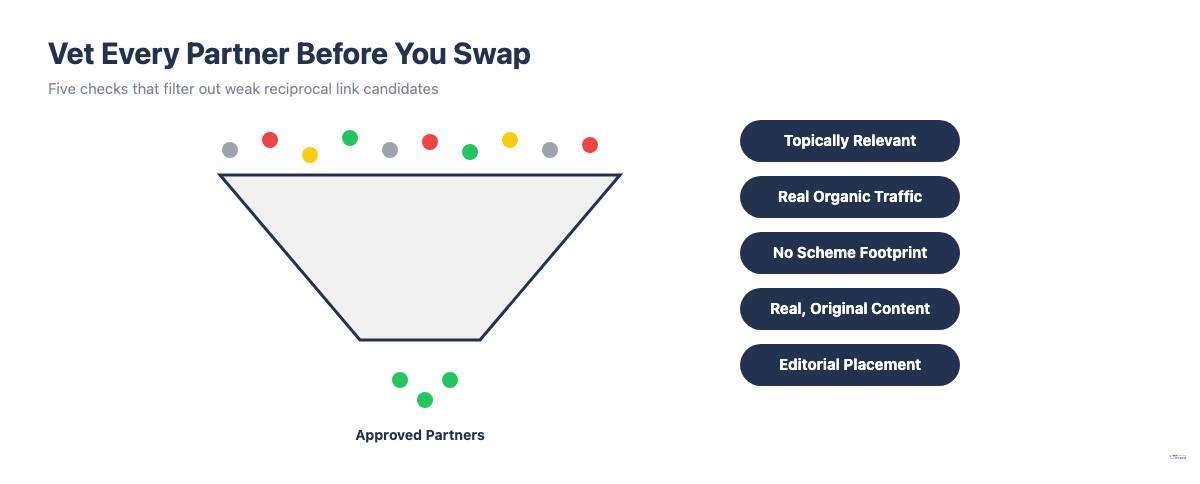
- Check topical relevance. Would this link make sense to a reader who has no idea a swap exists? If the answer is no, skip it.
- Check the site’s domain rating and traffic. A partner with reasonable authority and real visitors is worth more than a partner with neither, and a link from a site with no organic traffic is a weak signal regardless of the topic match.
- Look for a link scheme footprint. Sites that run large, obvious “links” or “partners” pages full of unrelated reciprocal links are a red flag. Linking there associates your site with the same pattern Google’s spam policies call out.
- Read a few of the site’s other articles. Thin, templated, or clearly AI-generated content with no real audience is a sign the link will not hold much value even if it technically exists.
- Confirm the link will sit in real content, not on a standalone “our partners” page with no editorial context around it.
A quick way to keep this organized across many potential partners is to track candidates, their domain rating, and their relevance notes in a single sheet or a link building workflow tool before reaching out, rather than deciding partner by partner from memory.
Reciprocal Link Meaning FAQ
Is a reciprocal link the same as a link exchange?
Yes, a reciprocal link and a link exchange describe the same two-way arrangement between two sites. Some people use “link exchange” more broadly to also include three-way and other multi-site swaps, while “reciprocal link” almost always refers to the direct two-site version.
Do reciprocal links still help SEO in 2026?
A relevant, natural reciprocal link can still contribute a small amount of link value, but it carries less weight than a one-way backlink because search engines know it was traded rather than earned. Building a link strategy around reciprocal links alone is not a strong approach on its own.
Can a reciprocal link get my site penalized?
A single relevant reciprocal link is very unlikely to cause a penalty on its own. Google’s spam policies target excessive, large-scale link exchange schemes, not isolated swaps between genuinely related sites, so the risk scales with volume and intent rather than with any one link.
What is the difference between a reciprocal link and a backlink?
A backlink is any link pointing to your site from another site, whether it was earned, paid for, or exchanged. A reciprocal link is a specific type of backlink where you also link back to the same site, which makes it a two-way relationship instead of a one-way citation.
Should I use nofollow on reciprocal links?
Most editorial reciprocal links between genuinely related content do not need a nofollow tag, since they are the same kind of citation link search engines expect to see. A nofollow tag makes more sense when the link is closer to a paid placement, a sponsorship, or part of a large partner page arrangement rather than a normal editorial reference.