

Around 74% of high-traffic websites have reciprocal links, according to an Ahrefs study of 140,000 domains. Link exchanges are far more common than most SEO guides admit — and far more nuanced than the black-hat framing suggests. This guide breaks down what link exchanges are, how the different types work, what Google actually says, and when they make sense (and when they don’t) for your link building strategy.
What Is a Link Exchange in SEO?
A link exchange — also called reciprocal linking or a link swap — is an arrangement where two websites agree to link to each other. Website A links to Website B, and Website B links back to Website A, with the shared goal of improving each site’s backlink profile and search engine rankings.
Link exchanges have been part of SEO since the early days of PageRank. The core idea is simple: a backlink from a relevant, authoritative site signals trust and relevance to Google, and mutual linking can help both parties build that signal faster than earning every link independently.
The practice exists on a spectrum. A natural exchange between two complementary businesses in the same industry is fundamentally different from coordinated mass-exchange schemes involving hundreds of unrelated sites. Most of the risk debate in SEO focuses on the extreme end, not the everyday version.
Types of Link Exchanges
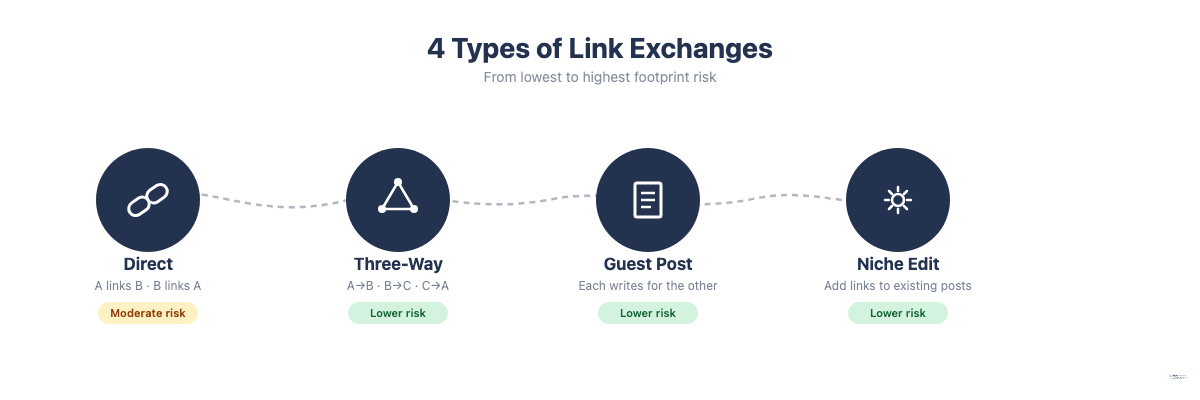
Not all link exchanges work the same way. The main types differ in structure, visibility, and risk profile.
| Type | How It Works | Risk Level | Common Use Case |
|---|---|---|---|
| Direct (A to B) | Site A links to Site B; Site B links to Site A | Moderate | Two complementary businesses |
| Three-Way | A links to C; B links to A; C links to B | Lower | Minimizing direct reciprocal footprint |
| Guest Post Swap | A publishes B’s article; B publishes A’s article, each with links | Lower-Moderate | Content collaboration between blogs |
| Niche Edit Exchange | A adds a contextual link to existing content on B; B does the same for A | Lower-Moderate | Less time-intensive than guest posts |
Direct Reciprocal Link Exchange (A to B)
The simplest form: two site owners agree to place a link to each other’s pages. One site links to a relevant article on the other, and the other reciprocates with a link back.
The key risk with direct exchanges is the visible A-to-B-to-A pattern in backlink graphs. If a large portion of your inbound links also appear in your outbound links, that pattern can look artificial to algorithmic review — especially at scale. Used selectively for genuinely related websites, the risk is minimal.
Three-Way Link Exchange
A three-way exchange breaks the direct reciprocal pattern. Instead of A linking to B and B linking to A, the structure looks like: A links to B, B links to C, and C links to A (or similar triangular arrangements).
This structure is more common among sophisticated link builders because it avoids the direct footprint.
A more advanced version of this idea is what SEO consultant Glen Allsopp calls a private influencer network, or PIN. Instead of one triangle, a whole group of sites in similar but not identical niches agree to link to each other indirectly over time. No single site sends an obvious A-to-B-to-A signal, but the group as a whole grows its authority together. Running a PIN takes ongoing coordination among multiple site owners, so it’s mostly practiced by established publishers with existing relationships rather than something a smaller site can set up overnight. For most readers, the three-way exchange above captures the same lower-footprint benefit without that coordination overhead.
Guest Post Swaps
Two site owners agree to each write a guest article for the other’s blog, with each article containing contextual links back to the author’s own site. Both parties get content and a link from a domain they don’t own.
Guest post swaps are widely considered the most legitimate form of link exchange because they generate real editorial content rather than a bare reciprocal link. The links appear in context, the content provides genuine value, and the practice is harder to distinguish from organic editorial contribution.
Niche Edit Exchanges
Instead of creating new content, both parties add contextual links into existing articles. Site A finds a relevant passage in an existing post on Site B and inserts a link to Site A’s content, and Site B does the same with Site A’s existing pages.
Niche edit exchanges are more efficient than guest posts because they don’t require writing new content. The link appears in established pages with existing traffic and authority rather than in newly published articles with no history.
Are Link Exchanges Against Google’s Guidelines?
Not inherently. The nuance is in Google’s specific language, which most summaries get wrong.
What Google’s Guidelines Actually Say
Google’s Spam Policies explicitly warn against:
“Excessive link exchanges (‘Link to me and I’ll link to you’) or partner pages exclusively for the sake of cross-linking”
The specific prohibitions under Google’s Spam Policies include:
- Excessive reciprocal exchanges — large volumes of mutual links with no editorial justification
- Paid link exchanges — paying for a link in exchange for a link back (this is a link scheme)
- Automated exchanges — using software or networks to generate reciprocal links at scale
- Exchanges with unrelated or spammy sites — links that provide no topical relevance or user value
The “Excessive” Distinction
The word “excessive” is doing most of the work in Google’s policy. Google doesn’t say all link exchanges violate guidelines — it says excessive ones do. That distinction matters.
Reciprocal links occur naturally. A business that references a supplier, a blogger who cites a peer, two companies that collaborate on a project — all of these create reciprocal link patterns without any gaming intent. Google acknowledges this reality.
What Google targets is the deliberate, high-volume manipulation of link graphs through mass exchange schemes — not the occasional mutual link between genuinely related sites.
The 74% data point is relevant here: if nearly three-quarters of high-traffic domains have reciprocal links, Google’s algorithm necessarily operates in a world where reciprocal linking is the norm. The question is about pattern and scale, not the presence of any reciprocal link.
Do Link Exchanges Work for SEO?
Yes, with important caveats.
What the Data Shows
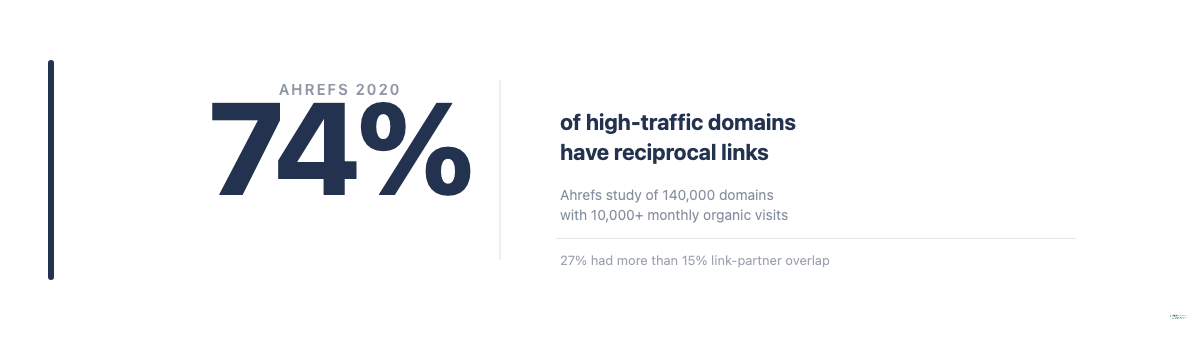
Ahrefs published a study in 2020 analyzing 140,000 domains with at least 10,000 organic visits per month — sites Google already considers authoritative enough to send significant traffic.
Key findings:
- 74% of those domains had reciprocal links
- 27% showed 15% or greater overlap between their inbound and outbound link partners
- Even Ahrefs itself found that 19% of their own link partners reciprocated links back to Ahrefs
74% of high-traffic domains have reciprocal links — Ahrefs Reciprocal Link Study, 2020 (study of 140,000 domains with 10k+ monthly organic visits)
One important caveat: the study was limited to sites with significant traffic. If a site was penalized for link exchange abuse and lost its traffic, it would no longer appear in the sample. The 74% figure reflects domains that weren’t penalized — it doesn’t confirm that all forms of link exchange are risk-free.
Why Quality Matters More Than Quantity
The data shows correlation, not causation. High-traffic sites have reciprocal links because they’re actively engaged in their niches — and niche engagement naturally produces mutual linking between relevant parties.
The practical implication isn’t “get more reciprocal links.” It’s that:
- A small number of relevant, contextual reciprocal links from topically related sites is normal and expected
- Quality (relevance, domain authority, editorial placement) matters far more than volume
- Any link exchange that adds topical relevance and editorial value to both sites is more likely to hold value than a bare transactional swap
When to Use Link Exchanges (and When to Avoid Them)
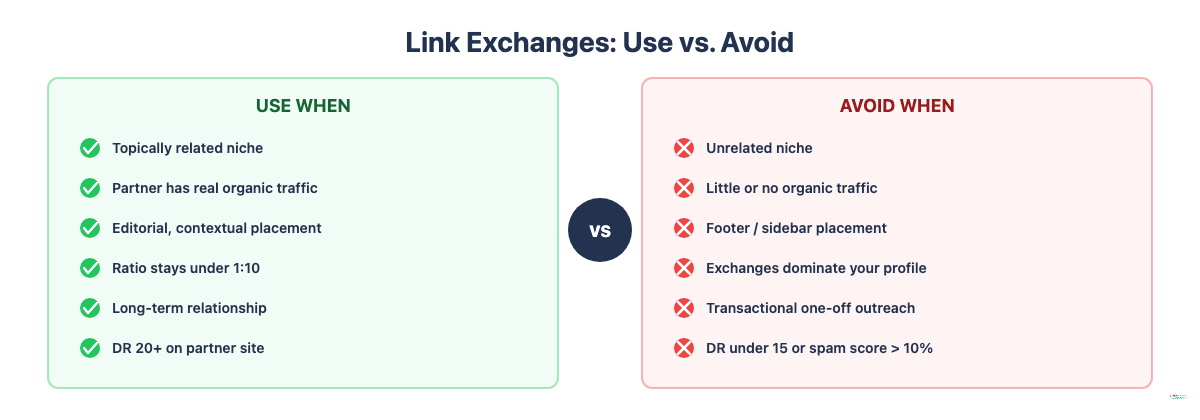
Link exchanges are not inherently good or bad — they depend on execution.
| Use When | Avoid When |
|---|---|
| The other site is topically relevant to yours | The site is unrelated to your niche |
| Both sites have real organic traffic | The site has little or no organic traffic |
| The link placement is editorial and contextual | The link is in a footer, sidebar, or link farm |
| DR is 20 or higher on the partner site | DR is very low (under 15) or artificially inflated |
| The ratio stays under 1 exchanged link per 10 natural links | Exchanges would dominate your inbound link profile |
| You’re building a long-term relationship | The outreach is clearly transactional and one-off |
| The linking page has existing content and traffic | The linking page was created specifically for the exchange |
When Link Exchanges Make Sense
Link exchanges are most defensible when they emerge from genuine professional relationships. Two SaaS products that serve adjacent markets and link to each other in context, two bloggers who regularly reference each other’s work, a consultant who recommends a vendor and receives a recommendation in return — these patterns are natural and produce real value for users.
The 1-in-10 ratio is a practical guideline: keep exchanged links to no more than 10% of your total inbound link profile. At that ratio, reciprocal links look like a normal feature of an active niche presence, not a manipulation campaign.
When to Avoid Link Exchanges
Avoid exchanges when the motivation is purely metric-gaming. Signs that an exchange is too risky:
- The partner site has a spam score above 5% in Moz or similar tools
- The partner site’s content is thin, low-effort, or unrelated to your niche
- The proposed placement is in a global footer, link roll, or dedicated links page rather than in editorial content
- The outreach message uses language about “mutual linking” or “link partnerships” with no reference to content value
- The volume of exchanges being proposed would create a visible cluster in your backlink graph
How to Vet a Link Exchange Partner
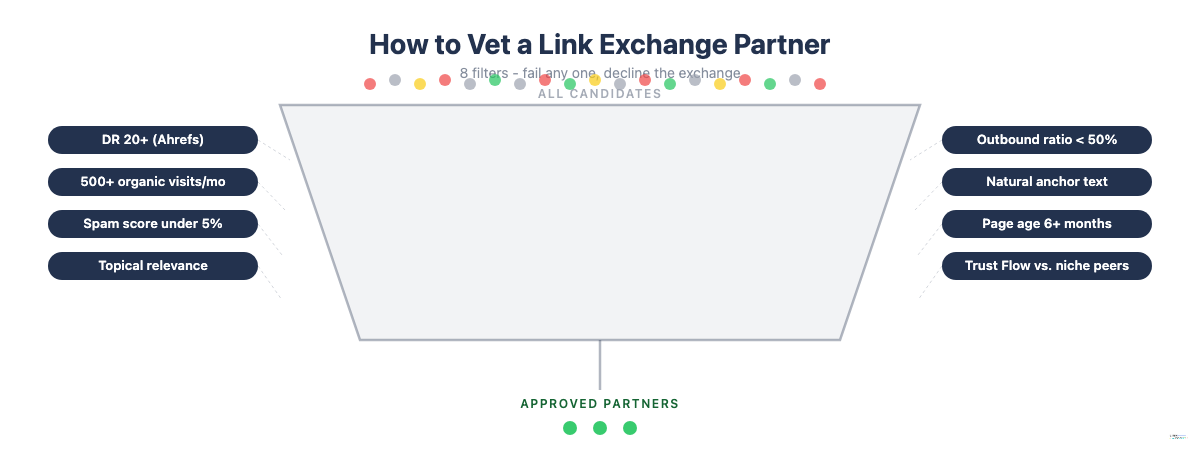
Before agreeing to any exchange, run the site through these checks:
| Metric | What to Check | Minimum Threshold | Red Flag |
|---|---|---|---|
| Domain Rating (DR) | Ahrefs DR | 20+ | Under 15 or recently inflated |
| Organic Traffic | Monthly organic visits (Ahrefs, Semrush) | 500+ visits/month | Under 100 or 100% branded traffic only |
| Spam Score | Moz Spam Score or similar | Under 5% | Over 10% |
| Topical Relevance | Does their main content match your niche? | Strong topical overlap | Completely unrelated niche |
| Outbound Link Ratio | Ratio of outbound to total links per page | Under 50% | Heavily outlink-heavy pages |
| Anchor Text Profile | Are their own backlinks natural and diverse? | Mixed anchors | Exact-match anchor spam |
| Page History | Does the linking page have existing content? | 6+ months old, active | Newly created for the exchange |
| Trust Flow (Majestic) | Link-quality score relative to Citation Flow | Trust Flow not far behind Citation Flow, and competitive with others in the niche | Trust Flow far below Citation Flow, or clearly weak versus niche peers |
Majestic doesn’t publish one fixed “good” Trust Flow number. It’s designed to be judged against direct competitors in the same niche and against the site’s own Citation Flow, since Trust Flow tracks link quality while Citation Flow tracks link quantity. A partner site whose Trust Flow lags far behind its Citation Flow usually means the links pointing at it lean toward low-quality or spammy sources, even if the raw link count looks fine.
Quick Reject Signals — decline immediately if any of these apply:
- The site is not indexed or has manual actions in Google Search Console
- The site’s backlink profile is mostly purchased links or link farm links
- The proposed linking page has no organic traffic of its own
- The contact person cannot clearly explain the editorial context for the link
Where to Find Link Exchange Opportunities
The most effective link exchange partners are ones you already have a professional relationship with or a genuine reason to reference.
Link Building Communities (Slack and Facebook)
Practitioner-facing SEO communities are the most active sourcing channel for link exchanges:
- Link Building Slack communities — search for invite links to “Link Building” or “SEO Link Building” Slack groups; these regularly have threads for mutual linking requests
- Facebook SEO Groups — groups like “SEO Signals Lab,” “The SEO Community,” and niche-specific SEO groups regularly include link exchange threads
- LinkedIn SEO communities — less common but exist for specific industries
When using community channels, vet every site before agreeing, even when the request comes from someone in a trusted group.
Competitor Backlink Mining
Identify your competitors’ backlinks and look for patterns of mutual linking. Sites that link to your competitors may be open to linking to you as well — and if they link to a competitor, they’ve already demonstrated relevance to your niche.
Use Ahrefs or Semrush to pull your competitor’s backlink profile, filter for sites that also receive backlinks from the competitor, and check which of those sites are good candidates for a cold outreach approach.
Cold Outreach
Direct outreach to site owners in your niche is the most targeted sourcing method. The key is leading with content value, not the link ask.
Example outreach message:
Subject: [Their site] + [Your site] — quick content idea
Hi [Name],
I’ve been following [their site] for a while — your piece on [specific topic] was particularly useful.
I recently published [your article with link] that I think would be a good fit for your [relevant section/article]. If you agree, I’d be happy to reference one of your articles in an upcoming piece I’m working on about [topic].
No pressure either way — just thought there might be a natural fit here.
[Your name]
Lead with genuine content value. The mutual linking framing should come second, not first.
How to Do Link Exchanges Safely: Step-by-Step
- Define your acceptance criteria first — set minimum thresholds for DR, traffic, and topical relevance before you start outreach. Applying criteria consistently is more defensible than deciding case by case.
- Vet every partner site — run each candidate through the vetting table above before agreeing. If a site fails any quick-reject signal, decline.
- Request and confirm the specific placement — agree on the exact page, section, and anchor text before you link. Vague agreements (“we’ll link to each other”) lead to low-quality placements.
- Use natural, varied anchor text — do not use exact-match keyword anchors in exchanged links. Use branded, partial-match, or descriptive anchors. Over-optimized anchor text in reciprocal links creates a visible pattern.
- Place links in editorial context — the link must appear within relevant paragraph content, not in footers, sidebars, or link lists. Editorial placement is the primary differentiator between a legitimate exchange and a link scheme.
- Consider the indirect structure where appropriate — for exchanges with partners who are also actively link building, consider a three-way arrangement rather than a direct A-to-B exchange to reduce footprint.
- Keep your exchange ratio in check — periodically audit your backlink profile. If more than 10% of your inbound links are reciprocal, reduce the volume before adding more.
- Monitor with backlink tools — set up Ahrefs or Google Search Console alerts. If a partner removes your link, you should remove theirs. Unilateral links from exchanges add no value and may look suspicious.
- Document your exchanges — keep a simple log of who you’ve exchanged with, what page each link is on, and when it was placed. This makes auditing straightforward and shows intent if questions arise.
- Do not use link exchange platforms — automated or semi-automated link exchange networks create visible patterns at scale and remove the editorial judgment that makes individual exchanges defensible.
Safety Checklist
Before placing any exchanged link, confirm:
- Partner site passes DR, traffic, spam score, and relevance checks
- Link placement is in editorial paragraph content (not footer/sidebar)
- Anchor text is natural, not exact-match keyword
- Link structure is not a direct mass-exchange footprint
- Exchange ratio in your profile is under 10%
- Agreement is documented
Link Exchange FAQ
Are link exchanges black hat SEO?
Not inherently. Black hat SEO refers to techniques that directly violate Google’s guidelines. Selective, relevant, editorial link exchanges between topically related sites are a gray area at worst. The black-hat version is mass automated exchange networks — not the occasional mutual link between two real businesses in the same niche.
Can I get penalized for link exchanges?
Yes, if done excessively or in violation of Google’s Spam Policies. However, documented cases of manual penalties for moderate, relevant link exchanges between real sites are rare. The risk scales with volume: a few selective exchanges carry much lower risk than participating in a large exchange network. The key phrase in Google’s policy is “excessive” — not “any.”
How many link exchanges is too many?
The practical guideline is a 1:10 ratio: no more than one exchanged link for every ten organic links in your inbound profile. If your backlink profile were audited, a small percentage of reciprocal links looks normal; a majority of reciprocal links looks like a manipulation pattern.
Are three-way link exchanges safer than direct exchanges?
Generally, yes. Three-way exchanges avoid the direct A-to-B-to-A footprint that’s easiest to identify algorithmically. However, they’re not risk-free — the triangular pattern is still identifiable if done at scale or with the same group of sites repeatedly. The same quality and relevance criteria apply.
What is the difference between a link exchange and a link scheme?
A link scheme is Google’s term for any arrangement designed to artificially manipulate PageRank or link signals, including paid links, large-scale reciprocal link networks, and automated linking programs. Not every link exchange is a link scheme — but every link scheme that involves reciprocal linking is an excessive link exchange. The distinction is intent, scale, and editorial quality.