

A partner ecosystem is a network of organizations with complementary products, services, or audiences that collaborate to create and deliver more value together than any one of them could alone. This guide covers what separates an ecosystem from a plain partnership, the three structural models an ecosystem can take, how to build one step by step, how mature ecosystems measure themselves, and the pitfalls that stall most programs before they get there.
What Is a Partner Ecosystem?
A partner ecosystem is a network of organizations, each bringing a complementary product, service, or audience, that work together on an ongoing basis to grow faster than any single company could on its own. Instead of one company trying to build every capability in-house, it plugs into a web of technology vendors, resellers, consultants, and marketing partners who each contribute a piece of the value a customer actually needs. It is one of several structured growth channels alongside link building for SaaS and outreach-driven marketing, and the three often reinforce each other in a B2B growth stack.
A useful way to picture it: a CRM platform’s ecosystem includes independent software vendors building integrations, consulting firms implementing the platform for enterprise clients, and technology partners extending its core features through APIs. None of those partners work for the CRM company. All of them help make the platform more valuable, and in return, they get access to a distribution channel and customer base they could not build alone.
How Is a Partner Ecosystem Different from a Partnership?
A traditional partnership is a one-to-one, often transactional relationship between two companies. A partner ecosystem is a many-to-many network where multiple organizations collaborate around a shared platform, audience, or goal, with rules and incentives that scale beyond a single deal.
The practical difference shows up in structure, not just semantics. A traditional partnership might mean two companies agreeing to refer customers to each other. A partner ecosystem means a company builds a repeatable program, complete with onboarding, tiers, and shared tooling, so that dozens or hundreds of partners can plug in using the same rules.
| Dimension | Traditional Partnership | Partner Ecosystem |
|---|---|---|
| Structure | One-to-one, bilateral | Many-to-many, networked |
| Scale | Fixed, usually one agreement at a time | Designed to add partners without renegotiating from scratch |
| Governance | Informal, handled case by case | Documented tiers, incentives, and onboarding process |
| Value creation | Direct referral or resale | Combined, integrated value across multiple partner types |
If your business has two or three partners you call on an ad hoc basis, you have partnerships. If you have a program other companies can apply to join, with defined benefits and expectations on both sides, you are building an ecosystem.
Why Partner Ecosystems Matter
Partner ecosystems are no longer a side channel for enterprise software vendors. A 2025 KPMG survey of more than 250 executives at large organizations found that 83% plan to expand their partner networks and 75% say partnerships are fueling growth, innovation, and agility. The same survey found the gap between ambition and execution: 71% of respondents struggle to align partners with strategic goals, and only 36% consistently measure partner performance.
That gap is the opportunity. Companies that treat their ecosystem as a real program, not a loose collection of side deals, capture value the majority of their competitors are still leaving on the table.
- Expanded reach. Partners give you access to leads, territories, and audiences you cannot reach through your own sales and marketing alone, lowering customer acquisition costs and shortening sales cycles.
- Shared expertise and faster innovation. Implementation, integration, and vertical-specific knowledge come from specialists instead of being built in-house from zero, and the exchange of ideas and technology across partners speeds up development beyond what one company’s roadmap could produce alone.
- Stronger customer retention. Integrated, ecosystem-delivered solutions solve more of a customer’s problem at once. Research firm Harte Hanks found that customers using partner integrations are 58% less likely to churn than those who are not.
- Lower cost and shared risk. Sharing infrastructure and jointly funding development spreads cost across the network instead of one balance sheet, and AppDirect’s research on ecosystem scale found that customers engage with roughly seven partners on average over the course of a project.
Types of Partner Ecosystem Models
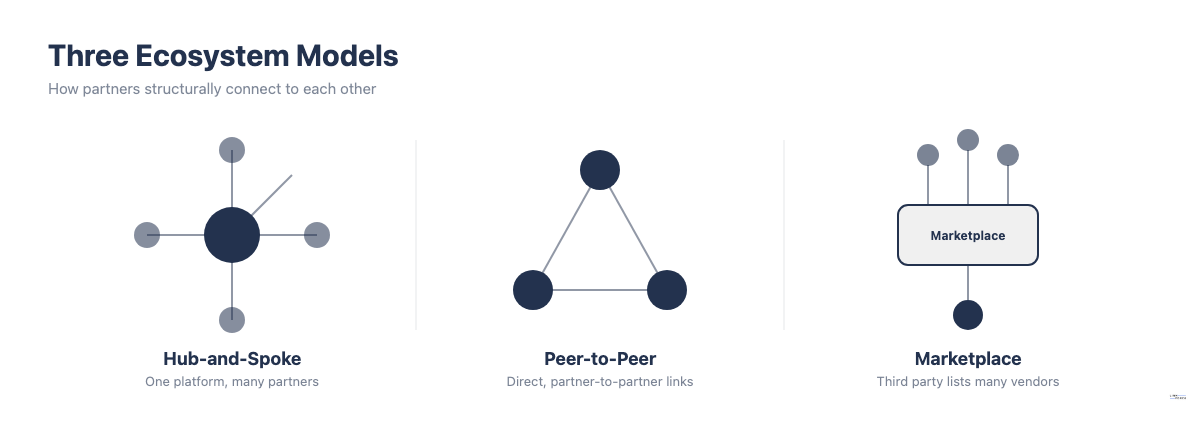
Not every partner ecosystem is built the same way. Before you write a partner program, it helps to know which structural model actually fits your business, because the governance, incentives, and tooling you need are different for each one.
Hub-and-Spoke
One company sits at the center as the platform, and partners connect to it through APIs, integrations, or resale agreements. Large software vendors run this model: the platform owner sets the rules, and partners build on top of or around the core product. This is the most common model among B2B SaaS companies because it keeps governance centralized while still letting the network grow.
Peer-to-Peer
A peer-to-peer ecosystem has no single company at the center. Two or more businesses with complementary but non-competing audiences collaborate directly, usually through co-marketing, joint content, or bundled offers. This model works well for companies that are too small to anchor a hub-and-spoke ecosystem but still want the reach benefits of a successful partner ecosystem. Content partnerships, where two brands co-create and cross-promote content to each other’s audiences, are a common peer-to-peer pattern and one of the more accessible starting points for a growing company.
Marketplace
A marketplace ecosystem is run by a neutral third party that lists multiple vendors’ products or services for a shared customer base to browse and buy. App marketplaces and integration directories are the clearest example. The marketplace operator sets the rules and takes a cut, but does not directly deliver most of the value; the listed partners do.
| Model | Structure | Best fit for |
|---|---|---|
| Hub-and-spoke | One central platform, partners plug in | Established SaaS or platform companies with a core product to extend |
| Peer-to-peer | Direct collaboration between comparable-size companies | Growing companies without the scale to anchor a hub |
| Marketplace | Neutral third party lists multiple vendors | Companies that want partner reach without building the program from scratch |
Common Partner Types in an Ecosystem
Most partner ecosystems, regardless of model, are made up of some combination of the following partner types.
Technology / ISV Partners
Technology and ISV partners are independent software vendors that build integrations, plugins, or complementary products using your APIs. This partner type extends what your core product can do without you having to build every feature yourself, which is why it is usually the first partner type a growing ecosystem adds.
Channel / Reseller Partners
Channel and reseller partners are companies that sell your product on your behalf, often bundling it with their own services or adding local support. This partner type gives you distribution in markets or verticals you could not efficiently reach with a direct sales team.
Agency / Consulting Partners
Firms that implement, customize, or manage your product for enterprise clients. These partners are especially important for products that need configuration or ongoing management beyond a simple self-serve setup.
Affiliate Partners
Partners who promote your product to their audience in exchange for a commission on resulting sales or signups. This is typically the lowest-friction partner type to onboard, since it requires no technical integration.
Co-Marketing / Content Partners
Partners who collaborate on shared content, joint campaigns, or audience cross-promotion rather than reselling or integrating your product directly. This is often the easiest entry point into ecosystem building for companies without an API or a reseller-ready product, and it overlaps heavily with digital PR tactics: co-created content earns coverage and links precisely because it comes from a real partnership, not a pitch.
How to Build a Partner Ecosystem
Building a partner ecosystem is a repeatable process, not a one-time deal. These six steps cover the sequence most successful programs follow, from defining who you want to work with through to keeping the program healthy over time.
- Define your goals and your ideal partner profile. Decide what you actually want from partners: pipeline, product reach, implementation capacity, or content distribution. Different goals point to different partner types, so this decision shapes everything that follows.
- Identify and vet potential partners. Look for organizations that serve a similar customer base without competing directly with you. Check their reputation, audience overlap, and whether their existing partnerships suggest they collaborate well.
- Design governance and incentives. Decide how partners get compensated (revenue share, referral fees, co-marketing funds), what tiers exist, and what is expected from each side. Undocumented, ad hoc incentives are one of the fastest ways an ecosystem stalls once it grows past a handful of partners.
- Enable and activate partners. Give partners the resources, training, and outreach they need to actually start referring, integrating, or co-marketing. A well-run outreach marketing and enablement process at this stage is often the difference between a partner who signs up and never engages, and one who becomes a real revenue source.
- Monitor performance. Track partner-level metrics from day one instead of waiting until the program is large enough that problems are hard to unwind. See the metrics section below for the specific numbers worth tracking.
- Iterate and improve. Retire partnerships that are not producing results, double down on the ones that are, and revisit your incentive structure as the program scales. A partner ecosystem is never “done” the way a one-off partnership deal is.
Partner Ecosystem Maturity Stages
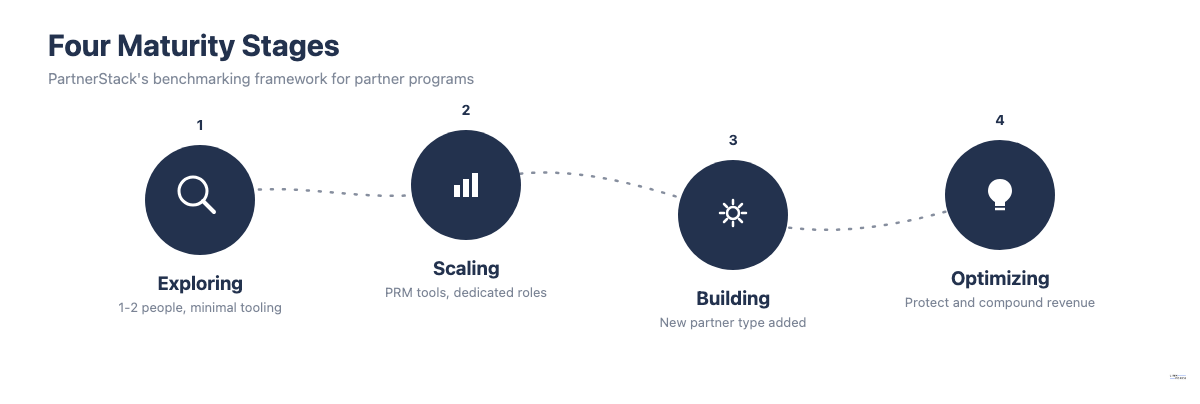
Most partner ecosystems move through four recognizable stages. PartnerStack’s benchmarking framework for program leaders names them Exploring, Scaling, Building, and Optimizing, and the pattern matches what most growing programs actually experience. Knowing which stage you are in helps you decide what to fix next instead of trying to solve scaling problems before you have solved basic structure problems.
Exploring
A team of one or two people experiments to figure out what works, with minimal tooling and reactive deal flow. Recruitment is broad rather than targeted. The defining question at this stage is whether early wins are repeatable, or just luck.
Scaling
The program moves from experimenting to replicating proven success. Teams add PRM technology and dedicated roles, and start to notice that a small share of partners, often the top 10 to 20%, drives the majority of partner revenue. Outbound recruitment and structured referral or ambassador programs replace ad hoc sign-ups.
Building
The program adds an entirely new partner type on top of an existing, working channel, for example layering technology partners onto an established reseller channel. Dedicated roles in partner marketing, operations, and enablement appear, and the team actively manages multiple partner motions at once to avoid channel conflict.
Optimizing
Multiple partner types run simultaneously as a strategic growth pillar rather than a side project. The focus shifts from generating new partner revenue to protecting and compounding it, through partner enablement, reduced churn, and cross-sell across the existing partner base.
Metrics and KPIs to Track
Only 36% of executives in the KPMG survey cited above say they consistently measure partner performance, which means most ecosystems are running without the data needed to know whether they are actually working. These four categories cover what a measured program tracks.
| Metric | What it measures | Why it matters |
|---|---|---|
| Partner-sourced revenue | Deals closed entirely through a partner’s involvement | Shows direct ROI on the partner program, separate from deals a partner merely influenced |
| Activation rate | Share of onboarded partners who complete at least one meaningful action (referral, integration, joint campaign) | Signup numbers mean little if most partners never engage after onboarding |
| Time-to-first-deal | Days between a partner’s onboarding and their first closed deal or referral | A long time-to-first-deal usually points to a gap in enablement, not partner quality |
| Partner satisfaction / NPS | How partners rate their experience working with your program | Low satisfaction predicts partner churn before revenue numbers show any decline |
Common Pitfalls That Stall Partner Ecosystems
- Misaligned incentives. If a partner’s compensation does not match the effort you are asking for, engagement drops off regardless of how good the underlying opportunity is. This is a direct symptom of the 71% alignment gap the KPMG survey identified.
- No clear ownership. Partner programs that sit across sales, marketing, and product without one accountable owner tend to drift, because no one is responsible for fixing what is not working.
- No measurement. Without partner-level metrics, underperforming partners keep receiving the same resources as top performers, and there is no data to justify expanding or cutting the program.
- Partner overload. Recruiting more partners than you can properly onboard and support dilutes the program’s quality. A smaller number of well-enabled partners consistently outperforms a large roster of neglected ones.
Tools and Technology That Support a Partner Ecosystem
McKinsey research cited by partner-management vendor Impartner forecasts that business ecosystems could drive around $80 trillion in annual revenue, roughly a third of total global revenue, by 2030. That scale is exactly why the tooling below has become its own software category rather than a side function of a CRM.
- PRM (Partner Relationship Management) platforms centralize partner onboarding, deal registration, training, and performance tracking in one system, replacing spreadsheets and email threads as the program scales.
- Partner marketplaces and directories give partners a place to list integrations or services and give customers a place to discover them, reducing the manual matchmaking a growing program would otherwise require.
- Co-marketing and campaign tools manage joint content, shared landing pages, and campaign attribution across partner-driven marketing efforts.
- Reporting and analytics tools turn raw partner activity into the metrics covered above and help solve revenue-attribution challenges when multiple partners influence the same deal, so performance reviews are based on data instead of anecdotes.
- AI-assisted matchmaking and forecasting is increasingly built directly into PRM platforms, using partner activity data to predict which partners are likely to under-perform or where a program has coverage gaps.
Partner Ecosystem FAQ
What is an example of a partner ecosystem?
A CRM platform’s ecosystem is a common example: independent software vendors build integrations, consulting firms handle enterprise implementation, and resellers extend the platform’s distribution into markets the platform owner cannot reach directly. Each partner type contributes a different piece of value around the same core product.
Who owns a partner ecosystem strategy?
There is no universal answer, but the programs that avoid drift usually assign one accountable owner, often in a dedicated partnerships or business development function, even when partner activity touches sales, marketing, and product. Without a single owner, the pitfalls described above tend to appear faster.
How long does it take to build a partner ecosystem?
A structured program with a defined process typically takes a few months to stand up. Reaching the “scaled” maturity stage, where partner-sourced revenue is a meaningful, tracked line item, usually takes a year or more of consistent recruitment, enablement, and iteration.
Is a partner ecosystem the same as a channel program?
A channel program, built around resellers and distributors, is one common structure a partner ecosystem can take, but it is not the only one. An ecosystem can also include technology, affiliate, and co-marketing partners that never resell your product directly.
Do small companies need a partner ecosystem?
Small companies rarely need a full hub-and-spoke program, but many benefit from a peer-to-peer ecosystem built around co-marketing and content partnerships with companies serving a similar audience. It is usually the lowest-friction way to start building partner relationships before a company has the scale to run a formal channel program.
How is a partner ecosystem different from just having customers refer you?
Customer referrals are unstructured and depend on individual goodwill. A partner ecosystem is a repeatable program with defined incentives, onboarding, and expectations, designed to produce results at a scale a referral-only approach cannot reach.