


A content partnership is an agreement between two or more parties to create, distribute or promote content together for shared benefit. That benefit usually shows up as backlinks, audience reach or brand credibility. The format ranges from a simple guest post exchange to a co-branded research report. It works best when both sides bring something the other lacks: distribution, expertise, or an audience the other hasn’t reached yet. Below are the main partnership models, when each one fits, and how to find and vet a partner as part of a wider partner ecosystem strategy.
What Is a Content Partnership?
A content partnership is a negotiated collaboration. Two or more parties combine effort, audience or expertise to produce content that serves both sides. Co-writing a guide, syndicating an article to a partner’s audience, trading guest posts: all of these count. The defining feature is that both parties contribute something to the content itself, not just money for placement.
That’s not the same as a brand partnership. A brand partnership is a broader business relationship that can include co-branded products, joint pricing or shared events with no content component at all. It’s also not the same as a paid or affiliate partnership, where one party compensates the other for placement or referrals rather than collaborating on the content. A content partnership can grow into either of those over time, but it starts as a content-first agreement between parties who both have a reason to make it work.
Why Content Partnerships Matter for SEO and Growth
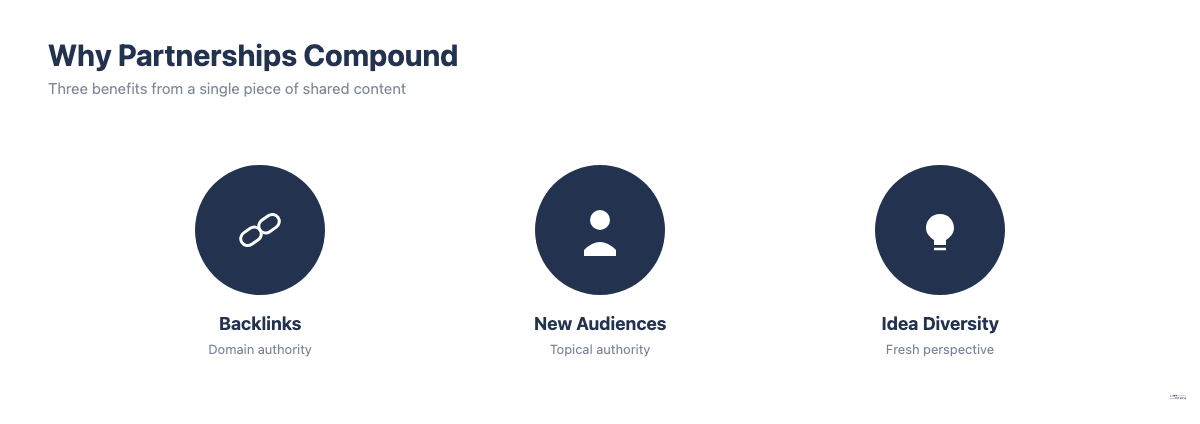
Content partnerships show up in nearly every SEO and growth playbook for one reason: they can produce a backlink, new audience exposure and brand credibility from a single piece of work.
Backlinks and Domain Authority
When your content appears on a partner’s site as a guest post, a syndicated article or a cited data source, it comes with a dofollow link back to your own site. That link passes a portion of the partner site’s domain authority signal to yours, which is one of the more reliable ways to improve organic rankings over time. Quality still matters. A link from a low-authority or spammy site passes very little link juice, and can even work against you, so the partner’s site is worth checking as closely as its content.
Audience Reach and Topical Authority
Every partner exposes your content to readers who don’t already know your brand. Do this across several partners in the same niche and something else starts happening: search engines and readers begin to associate your brand with that subject, which is topical authority in practice. One guest post rarely moves that needle alone. The effect compounds from staying visible across multiple relevant sites over time.
Content and Idea Diversity
Partnerships solve a problem solo content can’t: they bring in a second point of view. A partner’s data, customer stories or industry angle adds material neither side could produce alone, and the result is usually more useful to both audiences than anything either brand would have published solo.
Types of Content Partnerships
Most content partnerships fall into one of six models. None of them are mutually exclusive. A single partner relationship can move through more than one over time.

Co-Created Guides
Two parties write a single piece of content together, often a guide, checklist or comparison, and both publish it or link to it from their own site. This works best when the two brands serve the same audience with non-competing products. Each side can then speak to a part of the topic the other can’t cover as credibly: a payroll platform and an HR compliance blog, for instance, can co-write a hiring guide neither could cover as fully alone.
Content Syndication
One party republishes content that first appeared on the other’s site, either as-is or lightly adapted, with a canonical or attribution link back to the original. It’s a fast way to reach a second audience without producing new material. The catch: it only works if the syndicating site is reputable. A low-quality syndication partner adds little value and can create duplicate-content noise instead.
Guest Post Exchanges
Each party writes and publishes an article on the other’s site. It’s the most common entry point into content partnerships, since it needs no negotiation over shared assets, just an editorial swap. The risk is treating it as a pure link exchange instead of a genuine contribution. A guest post that reads like filler undermines both the relationship and the SEO value of the link.
Sponsored and Branded Content
One party pays the other to create or host content that promotes their product or service. Sponsored content is disclosed as paid placement. Branded content goes further, with the sponsoring brand actively shaping the narrative rather than just paying for space. Both still count as content partnerships when both sides contribute to the creative process, but the model shifts closer to plain advertising once the paying party stops having real input.
Data and Research Partnerships
Two organizations combine proprietary data, customer surveys or industry benchmarks into a single report, then promote it under a shared or co-branded byline. It’s underused compared to guest posts or syndication, but it tends to produce the strongest backlink and citation results. Journalists, analysts and other content creators actively look for original data to reference, and a report like “State of Remote Hiring 2026” built jointly by a job board and an HR software vendor gets cited in ways a standard blog post rarely does. This model works particularly well for companies with usage data, survey infrastructure or a customer base large enough for a statistically meaningful sample.
Joint Webinars and Events
Two or more parties co-host a webinar, panel or live event, then repurpose the recording, transcript or key takeaways into follow-up content for both audiences. It’s the most resource-intensive model here. Live coordination and audience promotion have to come from both sides. But it tends to build the deepest audience relationships of any model on this list, because attendees actively chose to spend time with both brands.
Content Partnerships vs. Content Marketing Partnerships vs. PR
“Content partnership” and “content marketing partnership” mean the same thing in practice: a direct, negotiated collaboration where two parties agree to create or share content together. PR, or earned media, is different. It’s coverage secured through a journalist’s or publication’s own editorial judgment, with no formal content-creation agreement between the parties involved. Put simply: a content partnership is something you negotiate and co-produce. PR is something you pitch, on the outlet’s terms, with no guarantee it runs at all.
Comparison Table: Partnership Type by Effort, Value, and Best-Fit Stage
These six models aren’t equally demanding. The right one depends on how much coordination effort you can commit and where your business stands right now.
| Partnership Type | Typical Effort | SEO / Audience Value | Best-Fit Stage |
|---|---|---|---|
| Guest Post Exchanges | Low | Medium | Early stage, first partnerships |
| Content Syndication | Low | Medium | Any stage, fastest to scale |
| Co-Created Guides | Medium | High | Growing, has a subject-matter angle to offer |
| Sponsored and Branded Content | Medium | Medium | Has budget, wants faster placement |
| Data and Research Partnerships | High | High | Has proprietary data or a large enough customer base |
| Joint Webinars and Events | High | High | Established audience on both sides |
How to Find and Vet the Right Content Partner
Finding a partner is the easy part. Finding one worth the coordination effort is where most content partnerships fail. Before reaching out, check a prospective partner against four criteria:
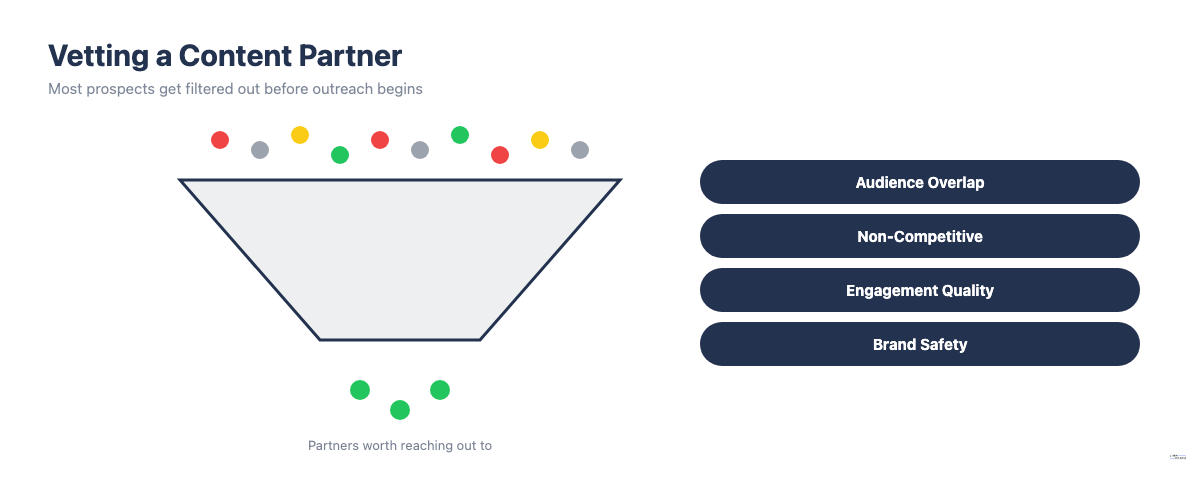
- Audience overlap. Their readers or customers should resemble yours closely enough that the content is genuinely useful to both audiences, not just a distribution favor.
- Non-competitive positioning. A direct competitor rarely makes a good content partner. Neither side wants to send traffic toward the other’s core product.
- Engagement quality, not just size. A smaller site with an active, responsive audience is often worth more than a larger one with high traffic and low engagement.
- Brand-safety and values alignment. Review their existing content and public reputation before committing. A partnership with a site that later runs into a controversy or quality problem reflects on you too.
Once a partner clears those four checks, a short discovery call or email thread is usually enough to confirm goals, formats and rough timeline before moving into outreach.
Outreach Basics: Starting the Conversation
Once you’ve identified and vetted a partner, the outreach message itself only needs to do three things: introduce who you are, state the specific content idea, and make the mutual benefit obvious in the first few lines. For the full set of ready-to-use templates, covering initial proposals, co-marketing invites, follow-ups and renewal check-ins, see the collaboration email template guide, built specifically for this kind of outreach.
Common Mistakes to Avoid
- One-sided asks with no reciprocity. Reaching out only to ask for a guest post slot or a link, with nothing offered in return, gets ignored by anyone who fields partnership pitches regularly. Lead with what you’re bringing, not just what you want.
- Skipping the brand-safety check. Partnering with a site or creator without reviewing their existing content and reputation first can tie your brand to a controversy or a quality problem you had no part in creating.
- Treating it as a one-time transaction. A single guest post or syndicated article rarely moves the needle alone. The partnerships that produce real SEO and audience gains are the ones that continue past the first placement.
- Letting the content go thin. A co-created guide or guest post written purely to justify the link reads as filler to both audiences, and it undermines the credibility the partnership was supposed to build.
FAQ
What’s the difference between a content partnership and a brand partnership?
A content partnership is specifically about co-creating or sharing content: guest posts, joint guides, syndicated articles. A brand partnership is broader and can include co-branded products, shared pricing or joint events with no content component at all. A content partnership can be one part of a larger brand partnership, but the two terms aren’t interchangeable.
Does affiliate marketing count as a content partnership?
Only when both parties contribute to the content itself. If one party simply places a tracked affiliate link inside content the other wrote entirely on their own, that’s an affiliate arrangement, not a content partnership. Plenty of real-world relationships blend both, starting as a content collaboration and adding an affiliate component later.
What’s the difference between sponsored and branded content?
Sponsored content is paid placement, disclosed as such, where the sponsoring brand has limited input beyond the payment. Branded content goes further: the sponsoring brand actively shapes the narrative, tone or creative direction alongside the publisher. Both can qualify as content partnerships, but branded content involves a deeper collaborative process.
How is a content partnership different from PR?
A content partnership is negotiated and co-produced by both parties in advance. PR, or earned media, is coverage secured through a journalist’s or publication’s own editorial decision, with no formal content-creation agreement and no guarantee of the outcome.
How many partners should we work with at once?
There’s no fixed number, but most teams do better running a handful of active partnerships well than spreading thin across many. A small group of well-matched, consistently active partners tends to outperform a long list of one-off placements. The compounding audience and authority effects need repeated exposure to build up.
How do we measure whether a content partnership is working?
Track referral traffic from the placement, the backlink’s presence and dofollow status over time, and any measurable lift in branded search volume or direct traffic afterward. A partnership worth continuing usually shows at least one of these moving in the right direction within a few weeks of publication.
Do content partnerships need a formal contract?
For a single guest post exchange, an email agreement is usually enough. For anything involving shared data, joint events or an ongoing series of collaborations, a short written agreement covering content ownership, usage rights and each side’s responsibilities protects both parties if the relationship ends.