

What Is a Link Profile? Definition, Components, and How to Analyze It
A link profile (also called a backlink profile) is the complete collection of external backlinks pointing to a website. Google, Ahrefs, and every major search engine use it to judge how authoritative, trustworthy, and relevant your site’s content is.
A strong link profile doesn’t just mean a large number of backlinks. The quality of those links, where they come from, what anchor text they use, and whether they accumulate at a natural pace all factor into how Google evaluates your site. A link profile that looks manipulated or concentrated can trigger algorithmic filters or manual penalties.
This guide explains what a link profile includes, what a healthy one looks like, how to check yours, and what to do when something’s off.
Key takeaways:
- A link profile is the complete set of external backlinks pointing to your site, not just a backlink count.
- Quality, diversity, anchor text balance, follow/nofollow mix, velocity, topical relevance, and freshness all shape how search engines read it.
- A profile that looks engineered or concentrated risks algorithmic filters or manual penalties, even when the raw link count looks strong.
- Ahrefs, Moz, and Semrush give you the data to check your own profile against these patterns, and Google Search Console does it for free.
What Makes Up a Link Profile? (The Key Components)
A link profile (also called a backlink profile) is the complete collection of all external backlinks pointing to a website. Search engines like Google use these links as votes of confidence to evaluate your site’s authority, trustworthiness, and ranking potential. A link profile isn’t a single metric: it’s made up of seven elements that search engines examine together.

1. Referring Domain Count and Diversity
The number of unique domains linking to your site matters more than how many backlinks you’ve got in total. One thousand links from a single domain carry far less weight than one hundred links from one hundred different domains. Diverse referring domains signal genuine authority, and that’s not easy to fake.
Referring domain diversity also means variety in domain type: news sites, industry blogs, directories, government domains, educational sites, and forums all pointing to you creates a more natural pattern than links concentrated in one category. If your site’s links come from just one or two source types, that’s usually a sign you haven’t diversified your outreach yet.
2. Backlink Quality
Not all backlinks are equal, period. A link from a high-traffic, topically authoritative site passes significantly more value than a link from a low-traffic, irrelevant site. Quality signals include:
- The page’s topical relevance to your content. Topical relevance measures how closely a linking page’s content aligns with your site’s topic. Search engines weight links from topically matched sources more heavily than links from unrelated niches, because a contextually relevant link signals genuine endorsement rather than accidental citation.
- The linking domain’s own backlink profile health. A linking domain’s backlink profile health refers to the overall quality, relevance, and safety of the external websites that link to that domain. When a site with a spammy or penalized backlink profile links to yours, the SEO value it passes gets diluted or even harmful.
- Whether the link is editorially placed. Editorial placement matters: a link inserted voluntarily by a writer without payment passes stronger signals than a paid placement or link exchange.
- The linking domain’s organic traffic. Organic traffic’s the most practical proxy for real authority. A domain with stable or growing search traffic demonstrates that algorithms already think it’s trustworthy.
- The surrounding context of the link itself. The paragraph or section immediately around a link carries its own weight, separate from the linking page’s overall topic. A link to your SEO tool sitting inside a paragraph that actually discusses SEO tooling passes more relevance than the same link dropped into an unrelated aside on an otherwise on-topic page.
Low-quality backlinks from link farms or private blog networks can harm rather than help. If Google’s algorithms detect that a significant share of your backlinks come from sites with no real content, no real traffic, and patterns consistent with manufactured link schemes, the value of those links drops to zero or triggers a negative scoring adjustment.
3. Anchor Text Distribution
Anchor text is the clickable text of a hyperlink. Search engines read it as a signal of what the linked page is about. A natural anchor text distribution across most healthy sites observed in SEO studies looks roughly like this:
- Branded anchors (your brand name): 40-60% of links
- Generic anchors (“click here”, “this article”, “read more”): 15-25%
- Partial-match anchors (containing part of the target keyword): 10-20%
- Exact-match anchors (identical to the target keyword): under 5-10%
- Naked URLs (www.yoursite.com): 10-20%
Exact-match keyword anchors should stay below 10% of referring domains; higher concentrations are a primary signal that link-building has been engineered rather than earned. When exact-match keyword anchors dominate the profile, it often signals a manipulative link-building campaign and can trigger over-optimization penalties. Independent SEO benchmarks outside our own observations converge on the same 10-20% naked-URL range and the same branded-anchor-dominant pattern, which is one reason this distribution has become an industry rule of thumb rather than a one-off observation.
4. Follow vs. Nofollow Ratio
Follow (dofollow) links pass link equity and ranking signals. Nofollow links include a rel=”nofollow” attribute that tells search engines they shouldn’t pass PageRank through the link.
A healthy link profile contains a mix of both. Most editorial backlinks are dofollow, but links from press releases, user-generated content platforms, forums, and social media are typically nofollow. A profile where 100% of links are dofollow from obvious editorial placements can actually look suspicious if it doesn’t have any nofollow links at all, since real-world link acquisition naturally produces both. Published link-building benchmarks generally recommend a majority-dofollow mix (commonly cited around 60% dofollow to 40% nofollow) while stressing that the exact split matters less than whether the overall profile still looks naturally acquired.
5. Link Velocity
Link velocity’s the rate at which your site earns new backlinks over time. A site gaining five to twenty backlinks per week from many different referring domains shows organic growth. A site that suddenly acquires two hundred links in a single week, especially from low-quality domains, raises a red flag with search engines.
Natural velocity follows the trajectory of your content output, PR campaigns, and industry events. Velocity spikes that don’t correspond to any visible activity or publication often indicate link scheme participation. Monitoring velocity monthly, not just during audits, gives you early warning before a problematic pattern becomes large enough to attract algorithmic scrutiny.
6. Topical Relevance of Linking Sites
Links from sites in the same or adjacent topic space carry more weight than links from unrelated niches. An SEO agency earning links from marketing blogs, digital PR publications, and SaaS review sites builds topical authority. The same agency earning hundreds of links from gambling or pharmaceutical domains would look unnatural and dilute relevance signals. Topical relevance is increasingly weighted as Google’s algorithms grow more capable of understanding semantic relationships between pages and sites.
7. Link Freshness (Link Decay)
Velocity measures how fast new links arrive. Freshness measures something different: how much scoring weight an individual link keeps as it ages. A link earned last month and a link earned seven years ago aren’t treated the same, even from the same domain at the same authority level.
A link on a page that stays current, gets updated, and keeps earning its own traffic holds its value. A link buried on a page nobody’s touched since it was published, on a site that’s gone stale, decays in relevance even though it technically still exists. A link profile built entirely from old placements can end up looking weaker to search engines than one with a steady mix of older, proven links and newer ones still coming in.
Practical takeaway: a healthy profile isn’t just diverse and high-quality at the moment you check it. It keeps earning new links at a sustainable pace so the whole profile doesn’t age out at once.
Why Your Link Profile Matters for SEO
Search engines can’t verify your site’s authority or trustworthiness by reading your content alone. Backlinks function as third-party endorsements. When many credible, relevant sites link to yours, it signals that your content is useful enough that others reference it. This endorsement signal has remained central to how Google ranks pages even as the algorithm’s evolved to incorporate hundreds of additional signals.
Your link profile matters for four reasons:
It directly influences rankings. Google’s core algorithms have used backlink data as a ranking factor since PageRank was introduced. While hundreds of signals now feed into ranking decisions, link authority remains among the most consistently measurable.
It builds or destroys trust. A diverse, natural-looking profile built through genuine content and outreach signals that your site earned its authority. A profile full of paid links or link scheme patterns signals the opposite.
A bad profile creates penalty risk. Google’s Penguin algorithm (now embedded in the core update cycle) targets manipulative link patterns. Sites with over-optimized anchor text distributions or large quantities of spammy backlinks risk ranking drops or manual actions from Google’s webspam team.
It reveals competitive gaps. Analyzing competitors’ link profiles shows where they earn their authority and identifies link opportunities you aren’t yet pursuing.
What Does a Healthy Link Profile Look Like?
A healthy link profile is diverse, natural in its growth pattern, and dominated by editorial links from relevant, credible sources. Each component below has a healthy pattern and a warning sign worth checking against:
| Component | Healthy Signal | Warning Signal |
|---|---|---|
| Referring domains | 50+ unique domains with low overlap | Most links from 1-3 domains |
| Backlink quality | Mostly DR 30+, real traffic | Heavy concentration of DR 0-10 sites |
| Anchor text | Branded + generic dominant, exact-match <10% | Exact-match anchors dominate (30%+) |
| Follow/nofollow | ~70-80% dofollow, 20-30% nofollow | 100% dofollow with no natural nofollow presence |
| Link velocity | Steady growth matching content output | Sudden spikes with no corresponding content or PR activity |
| Topical relevance | Most links from same or adjacent niches | Most links from unrelated or low-quality niches |
The healthy-versus-warning ranges above are patterns, not hard thresholds. A spike in velocity following a viral article is natural. A new site with 100% exact-match anchors and 95% dofollow links from low-quality directories isn’t. The key is whether the overall shape of the profile matches how a site in your niche would realistically grow through genuine content, PR, and relationships rather than through bulk purchasing. Independent link-building guides describe the same warning signs (heavy PBN presence, exact-match anchor concentration, and stale placements) as the main reasons a linking domain’s own profile drags yours down, which matches the pattern in this table.
Red Flags in a Link Profile (What to Watch Out For)
The following patterns consistently correlate with algorithmic suppression or manual penalties:
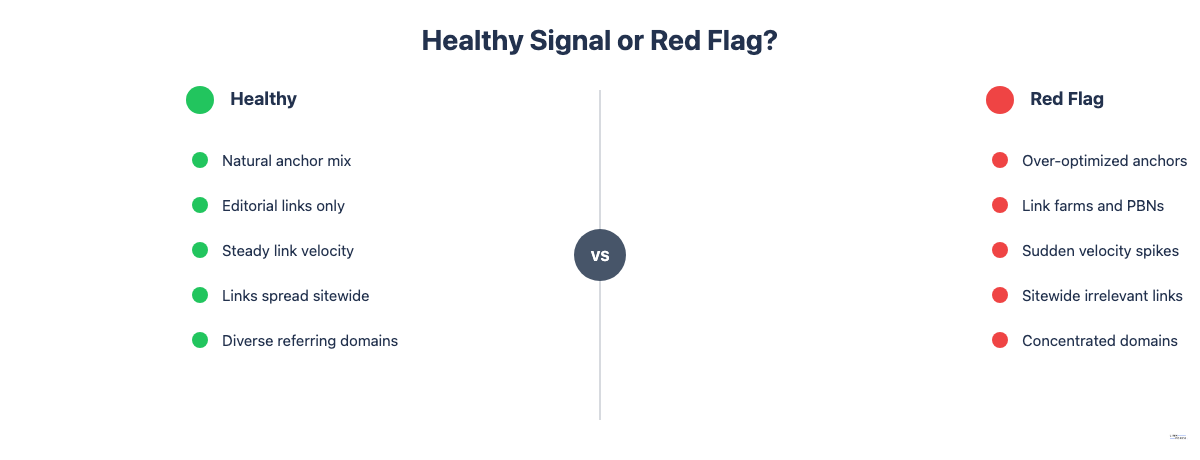
- Over-optimized anchor text: If 30% or more of your backlinks use your target keyword as exact-match anchor text, the distribution looks engineered. Google expects branded and generic anchors to dominate naturally occurring link profiles.
- Link farms and PBNs: Links from private blog networks, paid link directories, or sites with no real traffic or content are low-value at best and harmful at worst. These sites exist to sell links, and Google’s algorithms are trained to identify them.
- Sudden velocity spikes from low-quality domains: Acquiring a hundred or more links in a short window from newly registered or dormant domains that share IP blocks or hosting suggests a bulk link purchase.
- Sitewide links from irrelevant sources: Footer or sidebar links that appear on every page of an unrelated site generate thousands of backlinks from a single domain. These rarely pass meaningful value and can trigger algorithmic scrutiny.
- Heavily concentrated referring domains: If the vast majority of your backlinks come from fewer than five domains, even if those domains are high-quality, the profile looks artificially concentrated. Natural link acquisition produces diversity over time.
How to Check Your Link Profile (Step by Step)
If you’re wondering which tools give the most detailed picture, Ahrefs, Moz, and Semrush lead the pack. Ahrefs Site Explorer offers the most granular data including live link velocity charts, anchor text breakdowns, and referring domain quality filters, and pairing it with a full SEO backlink audit covers the rest of your off-site profile.
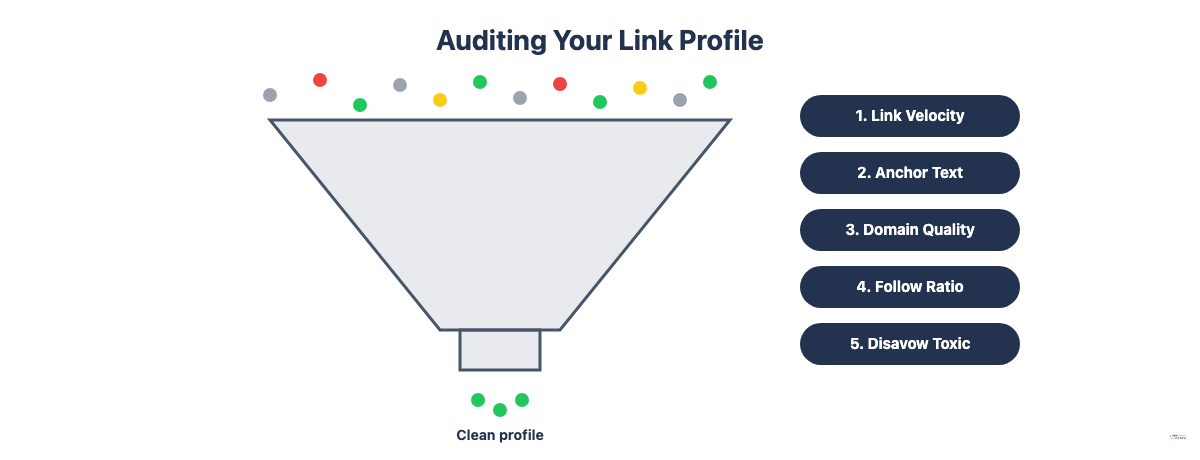
Step 1: Review Your Link Velocity
In Ahrefs Site Explorer, open the Overview and scroll to the Referring Domains chart. Look at the trend over the past six to twelve months:
- A steady upward curve with minor fluctuations is healthy; that’s the shape you want to see.
- Spikes that don’t correspond to a product launch, press mention, or content campaign deserve investigation.
- A sudden drop in referring domains may indicate that previously acquired links have been removed or noindexed.
Step 2: Audit Your Anchor Text Distribution
Navigate to the Anchors report in Ahrefs Site Explorer. Sort by the number of referring domains per anchor:
- Check what percentage of your referring domains use branded anchors versus exact-match keyword anchors.
- If exact-match anchors make up more than 10-15% of referring domains, assess whether those links were editorially placed or part of a scheme.
- Look for patterns in non-branded anchors that suggest a coordinated campaign.
Step 3: Assess Referring Domain Quality
In the Referring Domains report, sort by Domain Rating (DR) to identify your strongest and weakest source sites. Then filter for domains with low DR (under 10) and low organic traffic (under 100 monthly visits):
- A small percentage of low-quality referring domains is normal; it’s not what drags a profile down.
- If a large proportion of your source sites have no organic traffic and no real content, they’re likely part of a link scheme.
- Check whether high-DR links are topically relevant, not just high authority.
Step 4: Check Your Follow/Nofollow Ratio
In the Backlinks report, filter by link type (dofollow vs. nofollow). A natural profile has a reasonable mix. If 95-100% of your backlinks are dofollow and they all appear on clearly editorial pages, that’s often a good sign. But if the same ratio applies to obvious paid placements from low-quality sites, the follow status alone doesn’t save the link.
Step 5: Flag and Disavow Toxic Links
If you find links from confirmed spam domains, PBNs, or sites sending a pattern of manipulative links, use this workflow:
- Export the list of referring domains from Ahrefs or Google Search Console.
- Filter for low-DR, zero-traffic, irrelevant, or foreign-language spam domains.
- Attempt to remove links by contacting site owners where feasible.
- For links that can’t be removed, create a disavow file (domain-level where possible) and submit via Google Search Console.
Confirmed toxic links are non-negotiable: disavow them. Over-disavowing legitimate backlinks removes real ranking signals.
How to Improve Your Link Profile
Improving a link profile’s a long-term effort. There aren’t any shortcuts that work sustainably. These approaches produce durable, high-quality links:
1. Earn editorial backlinks through content. Data-driven articles, original research, comprehensive guides, and tools that fill genuine gaps attract natural citations. Other sites link to useful content because it’s what helps their own readers succeed.
2. Use digital PR. Press releases, media pitches, and newsjacking campaigns earn links from high-authority news and industry publications. These links typically come with branded anchors and real editorial context, and that’s exactly the kind of context search engines reward.
3. Build links from topically relevant sites. Prioritize outreach toward sites in your niche or adjacent niches. A relevant link from a DR 40 site in your industry is more valuable than an unrelated link from a DR 70 site.
4. Diversify your anchor text intentionally. When pitching link placements, don’t always request exact-match keyword anchors. Mix branded, partial-match, and generic anchors into your outreach templates.
5. Run regular link audits. Quarterly or biannual audits help you catch harmful link accumulation before it becomes a pattern that’s large enough to trigger algorithmic filters. Use Ahrefs or Google Search Console as your baseline.
6. Earn links through partnerships and co-marketing. Collaborations with complementary brands, jointly produced content, and co-authorship naturally produce links from relevant sites with genuine editorial discretion, and that’s hard to fake at scale.
For the specific analysis methods that inform link profile decisions, see the complete guide to backlink analysis. For the tactics that produce the highest-quality links, see the link building guide.
Frequently Asked Questions
What is a link profile in SEO?
A link profile is the full set of external backlinks pointing to a website. It includes every inbound link from external referring domains, along with attributes like the anchor text used, whether the link is dofollow or nofollow, the linking domain’s authority, and the rate at which links have accumulated over time. Search engines analyze link profiles to estimate how authoritative and trustworthy a site’s content really is.
Is a link profile the same as a backlink profile?
Yes, a link profile and a backlink profile are the same thing: both terms describe the complete collection of external links pointing to a domain or URL. Some tools use one term, others use the other, but there’s no meaningful difference between them.
Are profile links the same thing as a link profile?
No, profile links and a link profile describe two different concepts that happen to share a name. Your link profile is the complete set of backlinks pointing to your site, the topic of this guide. Profile links are a specific link-building tactic: backlinks placed inside the “website,” “about,” or “bio” fields of social media, directory, and community profiles you create yourself. Profile links can become one small input into your overall link profile, but building profile links is a deliberate outreach tactic, while your link profile is the full result of every backlink you’ve earned, however it got there.
How do I check my link profile for free?
Google Search Console’s Links report shows your most linked pages, top linking sites, and most-used anchor text at no cost. For more detail including domain authority scores and link velocity data, Ahrefs Webmaster Tools provides free access to Ahrefs’ backlink index for verified site owners. Moz and Semrush also offer limited free link checks.
How long does it take to build a healthy link profile?
There’s no fixed timeline for building a healthy link profile. It depends on your industry competitiveness, content quality, and outreach investment. Sites in low-competition niches can build a solid foundation in six to twelve months with consistent content and targeted outreach. Highly competitive industries may require two or more years of sustained effort. Steady, natural-looking growth matters more than a volume push over a short window.
Should I disavow all toxic links?
No, you shouldn’t disavow every toxic-looking link. Disavow only links from confirmed spam domains, known PBNs, or sites that sent a suspicious pattern of irrelevant or manipulative links. Google’s own guidance is to disavow only if you’ve got a manual penalty or believe your site is being actively targeted by negative SEO. Over-disavowing legitimate backlinks removes real link equity and can hurt rankings. When in doubt about a borderline link, leave it alone.