


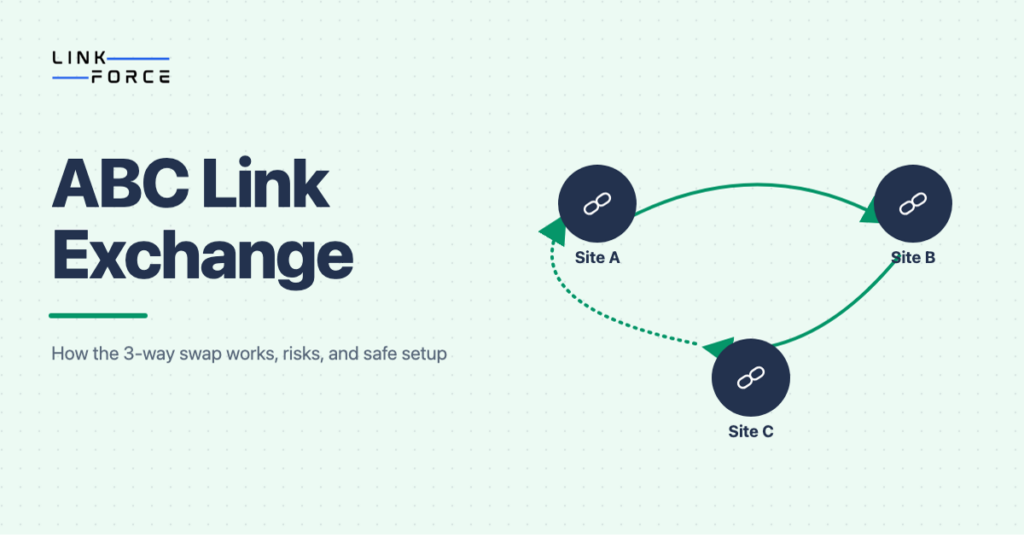
An ABC link exchange is a three-site link swap where site A links to site B, site B links to site C, and site C links back to site A. No two sites link directly to each other, so the swap avoids the obvious back-and-forth pattern that a direct reciprocal link exchange creates. It’s also called a three-way link exchange or a triangle link exchange, an indirect reciprocal link arrangement that’s one of the four link exchange types covered in our main link exchanges and SEO guide.
Reciprocal links of some kind already sit in roughly 74% of high-traffic backlink profiles, so the question most link builders actually face isn’t whether to touch reciprocal linking at all. It’s whether the three-way version is safe enough to use, and how to run one without quietly linking to yourself through a middleman. This guide covers the mechanics, whether it breaks Google’s rules, how detectable it really is, and the ownership check almost nobody runs before starting a swap.
What Is an ABC Link Exchange?

An ABC link exchange links three separate websites in a closed loop instead of two. Site A links to site B, site B links to site C, and site C links back to site A. Nobody links directly back to the site that linked to them, so a backlink audit of any single site shows only outbound or inbound links, never both directions to the same partner.
Compare that to a direct reciprocal exchange, where site A and site B link straight to each other. A reciprocal pair is easy to spot in a backlink tool: pull site A’s linked domains, pull site B’s linked domains, and the overlap jumps out immediately. A three-way loop spreads that same signal across three separate link graphs, which makes it a step harder to isolate, though not impossible, as the detection section below explains.
Reciprocal linking of some kind is more common than most site owners assume. An Ahrefs study of 112,440 top-ranking pages found that 43.7% carry some reciprocal links, and among 140,592 high-traffic domains, 73.6% had at least one reciprocal link in their profile. That doesn’t make every reciprocal arrangement safe. It means occasional reciprocal links, direct or triangulated, are a normal part of a healthy backlink profile rather than an automatic red flag on their own.
How Does an ABC Link Exchange Actually Work?
Most ABC exchanges run through guest posts or contextual links rather than plain link swaps. You publish a guest post on site B that links to site C. Site B’s owner publishes on site C, linking to site A. Site C’s owner publishes on your site, linking back to their partner, and the loop closes. Each placement looks like a normal editorial link because it sits inside real content, not a footer or a dedicated “partners” page.
Link equity still moves the same way it does in any backlink: the linking page passes a portion of its authority to the page it links to. What changes is the visibility of the pattern, not the mechanics of how PageRank flows. Some operators go further and stagger the publish dates across all three sites by a few days or weeks so the links don’t all get indexed in the same short window, which is one of the timing signals covered in the detection section below.
Operators sometimes extend the loop to four or five sites (often labeled ABCD or ABCDE chains) to spread the pattern even thinner. A longer chain adds coordination overhead and more points of failure, since every extra site is another partner who has to keep their link live, without meaningfully changing the risk calculus described next.
Is an ABC Link Exchange Against Google’s Guidelines?
Yes, an ABC link exchange can violate Google’s guidelines if its main purpose is to manipulate rankings, even though the three-way structure hides the direct back-and-forth pattern. Google’s spam policies name this outright: “excessive link exchanges (‘link to me and I’ll link to you’) or partner pages exclusively for the sake of cross-linking” are listed as a link scheme, right alongside buying links and running automated link-building programs.
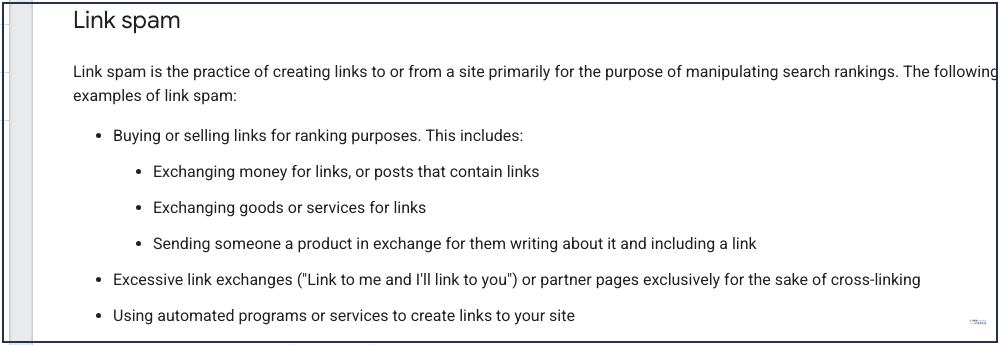
Google doesn’t ban every mutual link between two sites. A natural, occasional link between related businesses isn’t the target. What the policy flags is volume and intent: a pattern of exchanges built specifically to pass ranking credit rather than to help a reader. Splitting that pattern across three sites instead of two doesn’t change which category it falls into. It’s still an exchange built to manipulate rankings; it just takes an extra hop to see the loop.
Can Google Detect an ABC Link Exchange?
Yes, Google can detect ABC link exchanges, though it takes more sophisticated pattern analysis than spotting a direct reciprocal pair. Google’s link-spam detection runs through SpamBrain, its AI-based spam-prevention system, which keeps improving at finding coordinated link patterns rather than relying only on named, dated algorithm updates.
A three-way loop still leaves a footprint. A sudden new link connecting two previously unrelated domains is a signal on its own, and three of those appearing close together, in a closed loop, is a stronger one. Automated link-graph analysis can trace A to B to C to A the same way a human investigator would, just at a larger scale. A few patterns make a loop easier to catch:
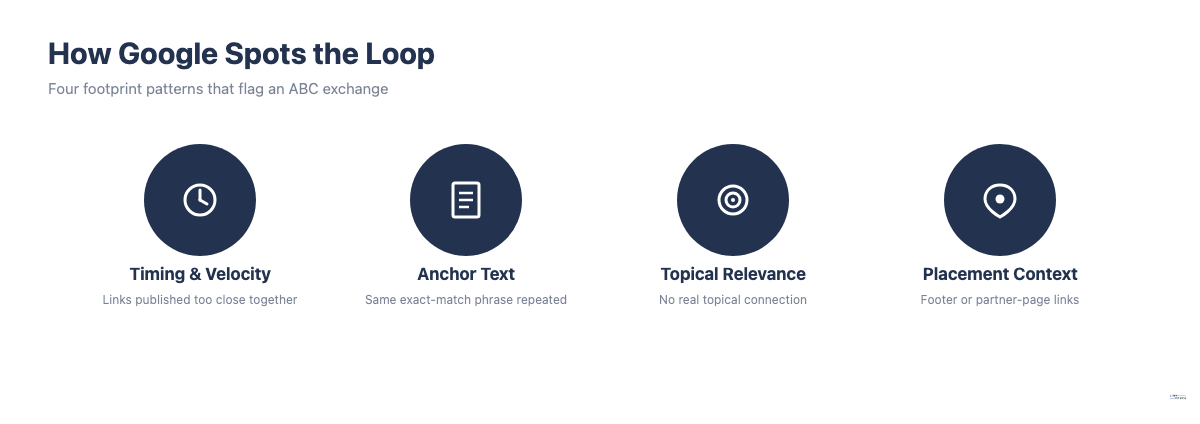
- Links published in a tight time window across all three sites, rather than spread naturally over weeks or months
- Anchor text that repeats the same exact-match keyword phrase across the loop instead of varying naturally
- Links between sites with no topical connection to each other, since a manipulative exchange doesn’t need relevance to work
- Placement in low-context spots, such as footers or dedicated partner pages, instead of inside real editorial content
None of this means ABC exchanges get caught every time. It means the format lowers the odds of detection compared to a direct swap; it doesn’t remove them.
ABC Link Exchange vs Other Link-Building Methods
An ABC exchange sits in the middle of the risk spectrum, safer than a direct reciprocal swap but still riskier than link-building methods that don’t depend on a reciprocal arrangement at all. The table below lines up the main options side by side.
| Method | Risk level | Detection difficulty | Effort | Scalability |
|---|---|---|---|---|
| Direct reciprocal exchange | Moderate | Low (easy to spot in any backlink tool) | Low | Low |
| ABC / three-way exchange | Lower-moderate | Moderate | Moderate (needs 2 coordinated partners) | Moderate |
| Extended ABCD+ chain | Lower-moderate | Moderate to high | High (more partners to coordinate) | Low (fragile, breaks if one site drops out) |
| Guest post swap (no reciprocal link) | Lower | High | Moderate | High |
A guest post swap without a reciprocal link back is the safest and most scalable option here because there’s no closed loop to detect in the first place. ABC exchanges earn their place for link builders who specifically need a workaround for reciprocal-heavy niches, not as a default first choice.
How to Verify Your ABC Exchange Partners Aren’t Secretly Connected
The biggest overlooked risk in an ABC exchange isn’t Google catching the link pattern. It’s building a “three-way” loop where two of the three sites are actually owned by the same person, which turns your careful workaround into an even more obvious footprint than a direct swap. Run these checks on every partner before you agree to a placement:
- Check hosting and IP overlap. Look up each site’s hosting provider and IP address. Two “independent” partner sites sharing the same IP block, especially a small shared-hosting range, is a strong sign of common ownership.
- Check the WHOIS registrant. Registrant privacy is common and not automatically suspicious, but matching registrant names, organizations, or registration dates across two supposedly separate sites is a red flag.
- Check for a shared Google Analytics or Search Console ID. If you can view page source or a public integration snippet, a matching tracking ID across partner sites means one person is running both.
- Check publish timing across the loop. If site B and site C both went live within days of each other, or both started publishing guest content in the same narrow window, treat that as a coordination signal worth asking about directly.
- Check anchor diversity across all three legs, not just your own link. A partner who uses the same exact-match anchor on every exchange they run is optimizing for keywords, not readers, and raises the detection risk for everyone in the loop.
None of these checks take more than a few minutes per partner. That’s not paranoia; it’s due diligence, and it catches the one failure mode that turns a moderate-risk tactic into a high-risk one: exchanging links with yourself through a middleman.
How to Set Up an ABC Link Exchange Step by Step
Find Complementary, Non-Competing Partners
Start with a competitor’s referring-domains report and pull sites that link to them but aren’t direct competitors of yours. For a three-way loop, you need two partners: one who fits your niche and one who fits your first partner’s niche, so all three sites stay topically connected without any pair of them competing for the same customers. Reviewing where your competitors already get backlinks is the fastest way to build that shortlist. Link-building Slack and Facebook communities also function as an informal link exchange group where operators arrange three-way swaps directly, though the ownership checks above matter even more in a group setting, since you’re vetting strangers instead of known contacts.
Vet Each Partner Before You Commit
Filter the shortlist by domain rating, traffic, and spam score, using the same bar as any other link partnership: reasonable authority, real organic traffic that isn’t declining, and a clean backlink profile. Run the ownership checks from the section above on anyone who clears this filter.
Find the Right Contact
Site-wide contact forms rarely reach the person who can approve a content placement. Look for the author byline on recent posts, check the About or Team page, or use an email-finding tool to get a direct address instead of a general inbox.
Send a Direct, Value-First Outreach Sequence
Lead with what you’re offering, not what you want. A short first email that proposes a specific placement, on a specific page, with a specific angle, converts better than a generic “let’s exchange links” pitch. Plan two or three short follow-ups spaced a few days apart before moving on.
Confirm Placement and Anchor Text Before Publishing
Agree on the exact page, the surrounding context, and the anchor text before either side publishes. Vary the anchor across your different exchange partners rather than repeating the same exact-match phrase, and make sure the link sits inside real content that would make sense even without the link.
Stagger the Publish Schedule Across All Three Sites
Don’t publish all three links in the same week. Spacing the loop out by a few days to a few weeks makes the pattern look like three separate editorial decisions instead of one coordinated push, and it’s a small step that meaningfully changes the timing footprint described earlier.
What Happens If Google Catches an ABC Link Exchange?
Getting caught can mean one of two things: an algorithmic devaluation or a manual action, and they play out differently. Algorithmic devaluation happens quietly. Google’s systems simply stop passing ranking credit through the flagged links, with no notification and no visible penalty, just a link that no longer does anything for you.
A manual action is more direct. A member of Google’s search quality team reviews the site, applies a penalty, and notifies you through Search Console under “unnatural links to your site.” Recovering from a manual action starts with removing the links you control and, where a partner won’t take a link down, using Google’s disavow tool to formally tell Google to ignore it. Once the unnatural links are addressed, you file a reconsideration request explaining what changed.
Either way, removing or disavowing a bad link doesn’t hand back the ranking boost it used to provide. That benefit is flat-out gone, not refunded. That’s the real cost of building a link strategy on a tactic that depends on not getting noticed.
Is an ABC Link Exchange Worth the Risk?
It depends on how much you’re relying on it and what else your backlink profile looks like. A handful of relevant, well-vetted three-way exchanges mixed into a broader link building network is a different risk profile than a backlink profile built mostly on exchange links. As a general ceiling, keep any form of reciprocal or exchange-based linking, ABC included, to a small share of your total backlink profile rather than a majority of it.
Established sites with strong existing authority and a diverse link profile can absorb an occasional three-way exchange with relevant partners more comfortably than a new site trying to build its entire footprint this way, and that footprint matters, since a Google penalty tends to fall hardest on sites whose link profile has little else to fall back on. If you’re weighing whether the coordination effort is worth it against safer, more scalable options like guest posting or digital PR, tools like LinkForce can help you find and vet those partners without doing the legwork manually.
ABC Link Exchange FAQ
Is an ABC link exchange safer than a direct reciprocal exchange?
Yes, an ABC link exchange is generally safer than a direct reciprocal exchange because it removes the obvious two-way pattern that backlink tools flag automatically. It isn’t risk-free, since Google’s link-graph analysis can still trace a closed three-site loop.
Is an ABCD or extended chain safer than a basic ABC exchange?
Not meaningfully. Extending the loop to four or five sites spreads the pattern thinner, but it adds more partners who each have to stay active and keep the link live, and a longer chain is still a closed loop that pattern analysis can trace, just with more hops.
How many ABC exchanges is too many?
There’s no official number, but treat reciprocal and exchange-based links, including ABC exchanges, as a small share of your total backlink profile rather than your main link-building method. A profile that’s mostly exchange links looks manipulative regardless of how the exchanges are structured.
What’s the difference between an ABC link exchange and a private blog network?
An ABC link exchange connects independently owned, real websites in a triangle for a link swap, while a private blog network (PBN) is a group of sites, often on expired domains, built or acquired by one owner specifically to link to a separate money site. The ownership-verification checks in this guide exist precisely to catch a partner who’s quietly running both sides of an exchange, which starts to resemble a small PBN.
Can I do an ABC link exchange with just one other partner if I have two sites myself?
You can, but verify it isn’t functionally a two-party arrangement wearing a three-party structure. Owning two of the three sites in the loop removes the independence that makes an ABC exchange different from a direct reciprocal swap in the first place, and it’s exactly the pattern the ownership checks above are built to catch.