

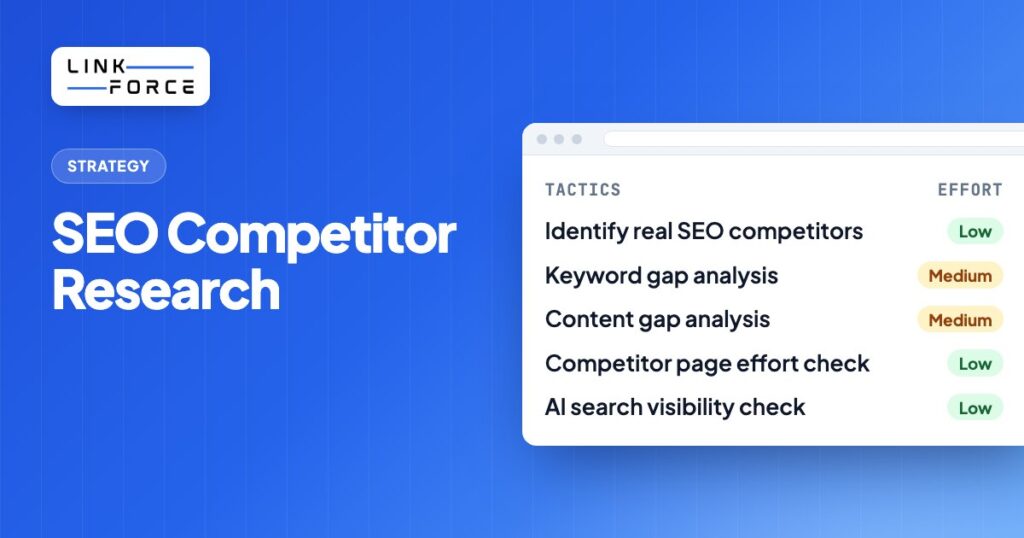
Most SEO teams check keyword rankings once a month and call it competitor research. That habit misses almost everything that actually moves organic traffic, and it's a habit that's easy to break. Real SEO competitor research covers more ground. It compares your keyword gaps, content gaps, backlink gaps, technical setup and AI-search visibility against the SERP competitors actually beating you. Then it turns what you find into a prioritized action plan.
This guide walks through the full process: identifying the direct competitors and SERP competitors that matter, running five distinct gap analyses and converting the results into work your team will finish. Every step works with paid tools, free tools, or a mix of both.
What Is SEO Competitor Research?
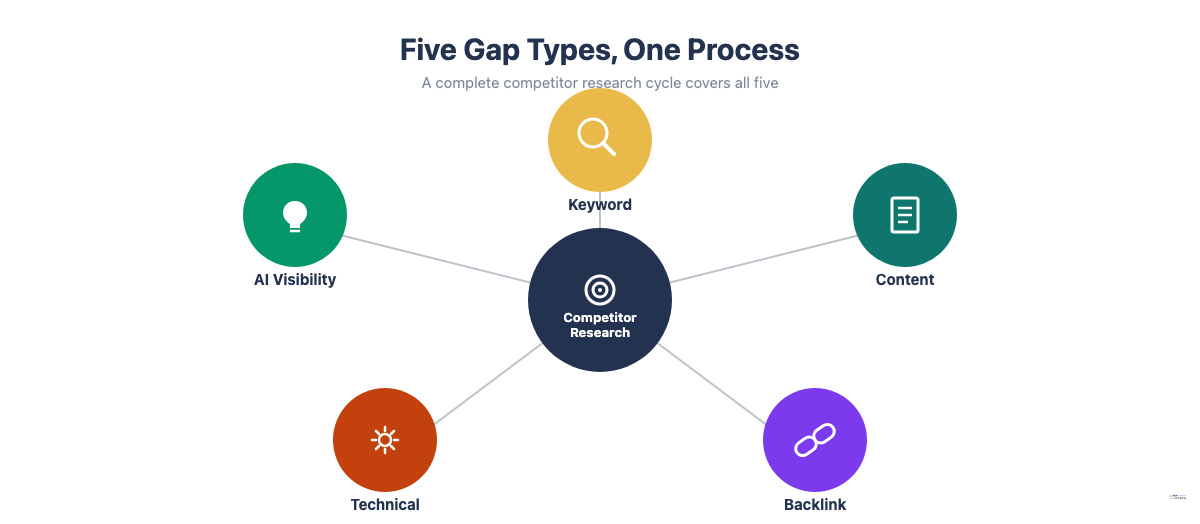
SEO competitor research is the process of comparing your site's rankings, keywords, content, backlinks, technical setup and AI-search visibility against the sites that outrank you, then using the differences to guide your own strategy. The goal isn't to copy what works for someone else. It's to find where you're losing ground, understand why, and close the gap faster than a blind rewrite ever could.
Five gap types make up a full process: keyword, content, backlink, technical and AI visibility. Skip any one of them and you're working from an incomplete picture. That's especially true now. AI Overviews and AI Mode answers pull traffic away from traditional blue links before a reader ever scrolls to your result, so a competitor who wins that space wins attention you'll never see in a rank tracker.
How to Identify Your Real SEO Competitors
Before you analyze anything, you need the right list of competitors. Most teams get this wrong. They list the companies they compete with for customers, then wonder why the SEO data doesn't line up, when really they're just tracking the wrong sites.
Start by searching your five to ten most important target keywords in Google and noting which domains show up repeatedly. Check the same queries in Reddit and in an AI assistant like ChatGPT, since both surfaces shape where buyers land before they ever open a search engine. A domain that keeps appearing across your priority queries belongs on your list, whether or not you've ever heard of the company. Aim for three to five competitors to track closely. Fewer than that and you'll miss patterns. More than that and the analysis gets too diluted to act on.
Direct Competitors vs. SERP Competitors
A direct competitor sells the same product or service to the same buyers you're trying to reach. A SERP competitor, sometimes called an organic competitor, ranks for the same keywords you want whether or not they sell anything close to what you sell. A media publisher can be a SERP competitor. So can a forum thread or a tool comparison site, even though neither one competes with you as a business.
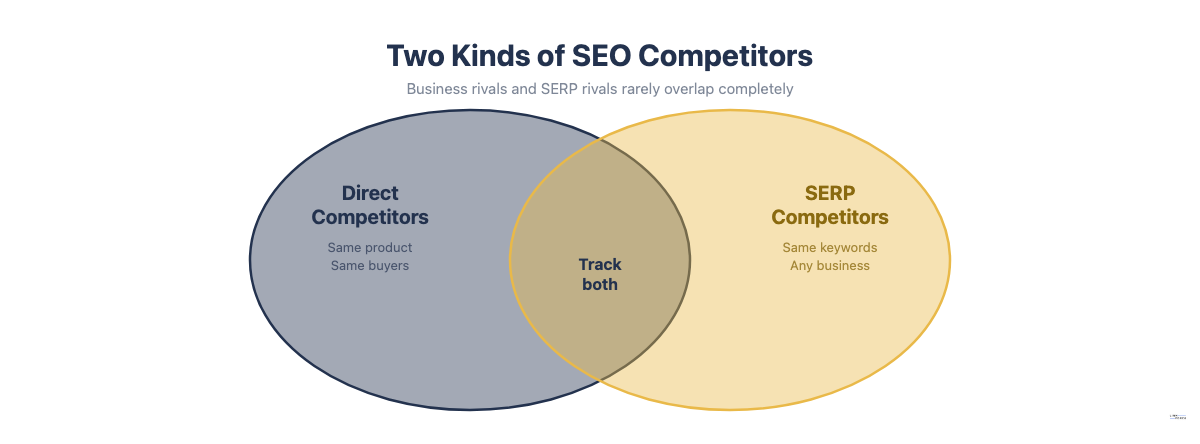
Both lists matter for SEO competitor research, and they rarely overlap completely. Your direct competitors show you what buyers expect from a site like yours. Your SERP competitors show you what Google rewards right now for the exact terms you're targeting. Track both, but keep them in separate columns when you analyze the data. The fixes each group suggests are often different.
Paste any domain into the free Domain Rating Checker by LinkForce.
How to Run a Keyword Gap Analysis
A keyword gap is a search term a competitor ranks for that you don't. Finding these gaps is usually the fastest way to spot real opportunity, since someone else has already proven the keyword can convert into traffic for a similar site.
Pull your competitor's ranking keyword list from a rank-tracking or keyword-research tool and compare it against your own. Filter the raw list before you act on it. An unfiltered keyword gap report is mostly noise:
- Keep terms where the competitor ranks in the top 10 to top 20 positions. Weaker rankings aren't proven opportunities yet.
- Filter by search intent. A keyword that fits a blog post is a poor fit for a product page, even if the competitor ranks for it on the wrong page type.
- Check relevance to what you actually offer. A high-volume term that doesn't match your product won't convert, even if you rank for it.
Once you've filtered the list, group the surviving keywords into topic clusters instead of treating each one as a separate target. A cluster of eight related terms usually points to one strong new page or section, not eight thin ones.
How to Run a Content Gap Analysis
A content gap is a subtopic, format, or depth level a competitor covers that your page doesn't. This differs from a keyword gap, because two pages can rank for overlapping keywords while covering the topic at completely different depths. A dedicated content gap analysis workflow in a tool like Ahrefs speeds this up once you're checking more than a handful of pages at a time.
Open your competitor's top-ranking page next to your own and compare them section by section. Note which subtopics they address that you skip. Note which questions they answer that you leave open, and which format choices they make, such as a comparison table, a worked example, or an embedded calculator. Word count alone tells you almost nothing here. A tighter page that answers more of the reader's real questions will usually beat a longer page padded with restated points.
How to Tell How Much Effort a Competitor Put Into a Page
Some pages rank because the content is genuinely strong. Others rank on domain authority alone, propped up by thin content that a determined competitor could beat quickly. A short checklist separates the two:
- Does the page have a table of contents or jump links, suggesting the writer expected a long, thorough read?
- How many original images, screenshots, or diagrams support the text, versus stock photos or none at all?
- How deep is the internal linking? Pages that route to several other relevant articles usually sit inside a well-built topic cluster, not a one-off post.
- Are there signs of updates, such as a visible last-updated date or references to recent events?
A page that scores low on all four signals but still ranks well is often a quick win. It's winning on authority, not quality. That means a genuinely better page from you can realistically take its spot.
How to Check a Competitor's AI Search Visibility
An AI visibility gap exists when a competitor gets cited in Google AI Overviews, AI Mode, or an AI assistant's answer for a query where your site never shows up. This gap type barely existed a few years ago. It's now one of the fastest-growing reasons a competitor captures attention before a reader ever reaches a traditional search result.
Start manually. Run your priority queries directly in Google and check whether an AI Overview appears, then note which sources it cites. Do the same in an AI assistant such as ChatGPT by asking the kind of question your buyers would ask, and see which brands come up unprompted. Many rank-tracking and visibility platforms now build this into their reporting, flagging the specific prompts where a competitor gets mentioned and you don't. That speeds things up considerably once you're checking more than a handful of queries.
Treat every gap you find the same way you treat a missing keyword. Ask what makes the cited source citable. Is it a clear, extractable definition? A data point? A comparison, or a direct answer positioned early in the content? Build that same clarity into your own page and you'll close this gap faster than most competitors expect.
How to Run a Backlink Gap Analysis
A backlink gap is a site linking to one or more of your competitors but not to you. These gaps are genuinely valuable, since they represent link sources that have already agreed to link to a page like yours. That makes outreach far easier than a cold pitch to a site with no prior connection to your niche.
Finding competitor backlinks starts with pulling the referring domains for two or three competitors and comparing the lists against your own backlink profile. Filter the raw list down to the sources actually worth pursuing:
- Prioritize domains linking to more than one of your competitors. A source willing to link to multiple sites in your space is more likely to link to a fourth.
- Filter by topical relevance before authority. A moderately authoritative site that closely matches your subject usually earns more ranking value than a high-authority site with no topical connection at all.
- Check whether the link is dofollow and whether the linking page still gets indexed traffic, since a stale, deindexed page passes little practical value even with strong domain metrics.
- Note the link type. A guest post, an expert quote roundup, or a resource-list mention each require a different outreach pitch, so group your findings by link type before you start contacting anyone.
A directory link from an unrelated niche adds little value even when the domain metrics look decent, so resist the urge to chase every entry on the list just because the raw referring-domain count looks impressive. Running a full backlink audit on your own site first makes the gap comparison sharper, since you'll know exactly which link types and sources you're already missing before you start prospecting.
800+ SaaS marketers swap partner, integration and content links. Free plan, no credit card.
How to Audit a Competitor's Technical SEO
A technical gap covers infrastructure advantages that don't have anything to do with content quality. Page speed, crawlability, structured data and mobile rendering all count. A competitor can win rankings purely on technical execution, even when their content is only average.
Run a competitor's key pages through Google's free PageSpeed Insights tool and compare load times against your own. Google's Core Web Vitals guidance sets the bar for Largest Contentful Paint, the measure of how fast the main content on a page becomes visible, at 2.5 seconds or less for a good score, measured at the 75th percentile of real page loads. Any competitor page landing well past that mark on a priority query is carrying a technical weakness worth noting. Check whether they use schema markup on product, review, or FAQ content, since structured data often influences which rich results and AI citations a page qualifies for. Scan for broken links, redirect chains and any pages that return errors instead of content. Confirm the site renders cleanly on mobile. A page that looks fine on desktop can still fail basic usability checks on a phone.
None of these checks require an enterprise tool. Google's own free utilities cover page speed and mobile usability outright, and a handful of browser extensions can spot broken links and check for schema markup in minutes.
How to Calculate Share of Voice Against Your Competitors
Share of voice measures how much of the total available visibility for your priority keyword set actually belongs to you versus each competitor. It combines ranking position and estimated click-through rate across the whole group, instead of judging one keyword at a time.
You can build a simple version yourself. Take your tracked keyword list, record each site's average position across all of them, and weight each position by a standard click-through curve. A set of number-three rankings is worth far more traffic than the same count of number-nine rankings, so raw position averages alone won't tell the real story. Add up the weighted totals for you and for each competitor, then express your total as a percentage of the combined pool.
The exact number matters less than the direction it's moving. A share of voice that climbs quarter over quarter means your gap-closing work is translating into real visibility, even in keyword sets where you haven't caught the leader yet.
How to Prioritize Findings and Turn Them Into an Action Plan
A competitor analysis that stays in a spreadsheet never helps anyone, full stop. The findings only matter once they turn into ranked work with an owner and a deadline attached.
Sort every finding by impact and effort. A quick win is high impact and low effort, such as a competitor ranking on weak content that a focused rewrite could beat within weeks. A bigger project is high impact but higher effort, such as building an entirely new content cluster to close several keyword gaps at once. Anything low impact belongs in a backlog, not this cycle's plan.
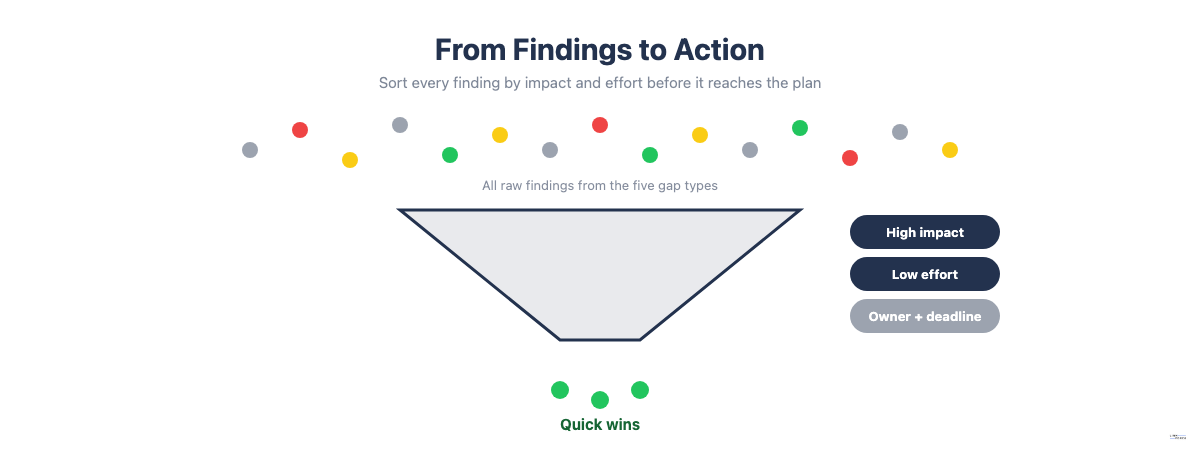
Set a recurring review, whether that's every two weeks or once a month depending on your team's size. At each review, assign a small, fixed number of items from each gap type: three keyword opportunities, three content gaps and three technical fixes, each with a named owner and a deadline. That's the part most teams skip, and it's exactly what keeps competitor research from becoming a one-time audit that gathers dust. Done this way, it turns into a habit that compounds every cycle.
SEO Competitor Research Tools Compared
You don't need every tool on this list, and you shouldn't try to buy them all at once. Pick one platform that covers keyword and backlink gaps well, then add free tools to round out technical checks and AI-visibility monitoring.
| Tool | Best For | Cost Tier | What Sets It Apart |
|---|---|---|---|
| Semrush | Full-suite keyword, content and AI visibility tracking | Paid | Broadest single-platform coverage across all five gap types |
| Ahrefs | Backlink gap analysis and referring-domain research | Paid | Deepest link-index data and gap-analysis templates |
| SpyFu | Historical keyword and PPC competitor data | Paid | Strong for tracking how a competitor's keyword and ad strategy changed over time |
| SE Ranking | Combined organic and AI-search visibility tracking | Paid | Built-in AI Overview and AI Mode mention tracking |
| Moz | Beginner-friendly competitive research and link data | Freemium | Simple interface for teams new to structured competitor tracking |
| Google Search Console | Your own ranking and click data as a baseline | Free | Directly from Google, no sampling or estimation involved |
| PageSpeed Insights | Technical and page-speed auditing | Free | Google's own scoring, used directly by the ranking algorithm |
| AnswerThePublic | Related-question and content-gap discovery | Freemium | Fast way to surface question-based content gaps |
If budget is the main constraint, Google Search Console plus PageSpeed Insights covers your own baseline and technical checks at no cost. A single month of a paid platform is usually enough to pull the keyword and backlink gap data you need for a full quarterly review.
Paid Tools Worth the Cost
If you're running competitor research on a regular cadence, a paid keyword and backlink platform pays for itself the first time it surfaces a gap you'd have otherwise missed for months. Semrush and Ahrefs cover the most ground. SE Ranking and Moz are reasonable choices if budget is tighter and you don't need the largest possible database.
Free and Low-Budget Options
You can run a genuinely credible version of this entire process without a paid subscription. Google Search Console shows your own performance baseline. PageSpeed Insights covers the technical audit. Manual search plus a spreadsheet handles keyword-gap spotting at a smaller scale, and Google Trends flags emerging competitors before they show up anywhere else. It takes more manual effort, no question, but a tight budget shouldn't stop you from doing this work.
Common Mistakes in SEO Competitor Research
Most competitor research fails for the same handful of reasons, and it isn't from a lack of data.
- Copying instead of learning. Matching a competitor's structure without asking why it works usually produces a weaker, derivative page instead of a better one.
- Chasing every keyword gap regardless of relevance. A long list of gap keywords means nothing if half of them don't match what you actually offer.
- Ignoring search intent mismatches. A keyword ranking on the wrong page type rarely holds. Even a temporary bump fades fast.
- Treating AI-search visibility as optional. Skip this gap type and you'll miss one of the fastest-growing ways buyers discover brands before they ever click a traditional result.
- Running one-off analysis instead of an ongoing cadence. A single audit goes stale within a quarter as competitors update their content and technical setup.
- Tracking too many competitors at once. Ten competitor profiles produce more data than any team can turn into decisions.
How Often Should You Repeat Competitor Research?
Run a deep, full competitor review quarterly, and pair it with lightweight monthly or biweekly monitoring for ranking shifts and new content from your core competitor set. The deep review catches structural shifts. The lighter check catches a competitor publishing something new before it's had months to compound.
Set alerts where you can, for new backlinks pointing at competitors and for ranking changes on your shared keyword set. Do that, and the biweekly check takes minutes instead of hours.
Frequently Asked Questions About SEO Competitor Research
How Many Competitors Should You Track?
Three to five competitors is enough for most sites. Tracking more than that spreads your analysis too thin to produce clear, actionable findings. Tracking fewer than three risks missing patterns that only show up when you compare several sites at once.
Is Competitor Research the Same as Keyword Research?
No, keyword research is one piece of a much larger competitor research process. Keyword research finds terms worth targeting. Competitor research goes further. It also checks content depth, backlinks, technical setup and AI-search visibility, and it compares all of that directly against the sites outranking you right now.
Can You Do SEO Competitor Research for Free?
Yes, you can run a solid competitor research process using only free tools, since Google Search Console and PageSpeed Insights cover your own baseline and technical audits at no cost. You'll need at least a trial or single-month subscription to a paid platform to pull full keyword and backlink gap data for competitors, since free tools rarely expose another site's complete ranking and link profile.
What Metrics Matter Most When Comparing Competitors?
Prioritize keyword overlap, referring-domain count, estimated organic traffic and share of voice across your priority keyword set. Those four numbers tell the real story. Vanity metrics like total indexed pages or raw domain authority tell you far less about whether you can beat a specific competitor for a specific query.