White Hat SEO Link Building: Tactics, Techniques, and Why It Matters
White hat link building is the practice of earning backlinks through methods that comply with Google’s search engine guidelines and focus on genuine editorial value. Unlike black hat approaches that manipulate rankings through schemes and purchased links, white hat SEO tactics build authority that’ll compound over time without putting your site at risk.
This guide covers what makes a link truly white hat, how it differs from riskier approaches, and 11 proven tactics you can use to earn links that actually move rankings.
What Is White Hat Link Building?
White hat link building is acquiring backlinks through strategies that follow Google’s Link Spam policies. A link qualifies as white hat when it’s editorially placed: the site owner chose to link because your content was relevant and valuable, not because you paid for the placement or gamed the system. Google’s guidelines define a natural link as one that was „not placed as part of an arrangement“ and „editorially given based on merit.“
White hat link building tends to move slower than black hat tactics. The payoff is stability. Links earned editorially don’t disappear after a search engine algorithm update, and they don’t carry the threat of manual penalties that can take months to recover from.
What Makes a Link „White Hat“?
Not every link from a high-authority site qualifies as white hat. A link earns that label when it meets four criteria:
- Editorial placement: the linking site chose to include it without payment or coercion
- Topical relevance: the linking page covers a subject related to yours
- Source authority: the linking domain is legitimate, gets real traffic, and isn’t part of a link network
- Natural anchor text: the anchor matches what a human editor would naturally write, not a keyword-stuffed phrase
If a link fails any of these criteria, it sits in gray or black hat territory regardless of the domain authority score of the source.
White Hat vs. Black Hat vs. Gray Hat Link Building
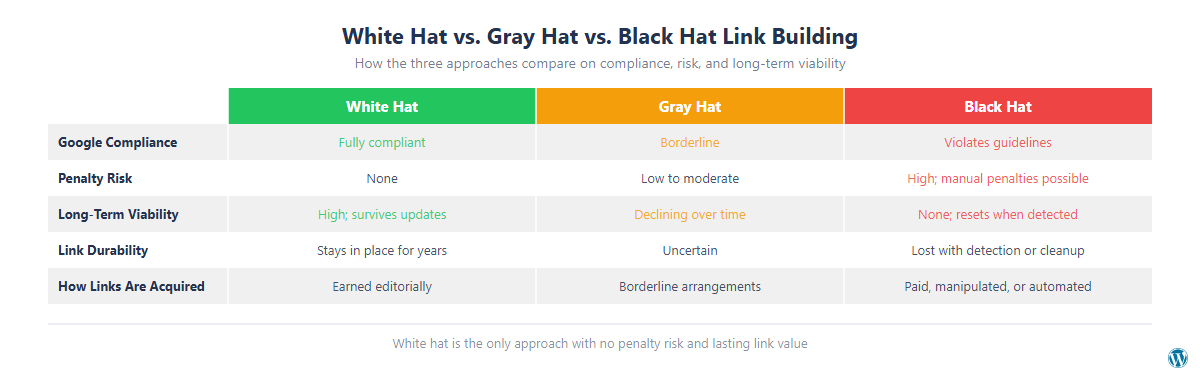
Link building tactics fall into three categories based on their compliance with search engine guidelines: white hat (safe, sustainable), gray hat (risky, borderline), and black hat (policy violations with penalty risk). White hat focuses on earning organic links through quality content. Black hat uses manipulative tactics that violate Google’s rules. Gray hat sits in between, using techniques that may not be explicitly banned today but carry real risk as Google refines its algorithms.
| Approach | Definition | Risk Level | Long-Term Viability |
|---|---|---|---|
| White hat | Adheres strictly to Google’s Webmaster Guidelines; links are editorially placed based on merit | None | High; survives algorithm updates |
| Gray hat | Not explicitly banned but operates in unclear territory; risks increase as Google refines its policies | Low to moderate | Declining; tactics that worked in 2018 are penalized in 2026 |
| Black hat | Violates search engine guidelines to artificially inflate site ranking; exploits algorithm weaknesses | High; manual penalties and de-indexing possible | None; results reset when detected |
Google’s Penguin algorithm, now part of its core algorithm, continuously evaluates link profiles for unnatural patterns. A manual penalty from Google’s spam team can suppress rankings for months. Recovering from one typically requires a full link audit, disavow file, and reconsideration request. This process costs far more time and money than white hat building would’ve required from the start. White hat tactics create sustainable, long-term search ranking improvements with virtually no risk of penalties.
Why White Hat Link Building Pays Off Long-Term
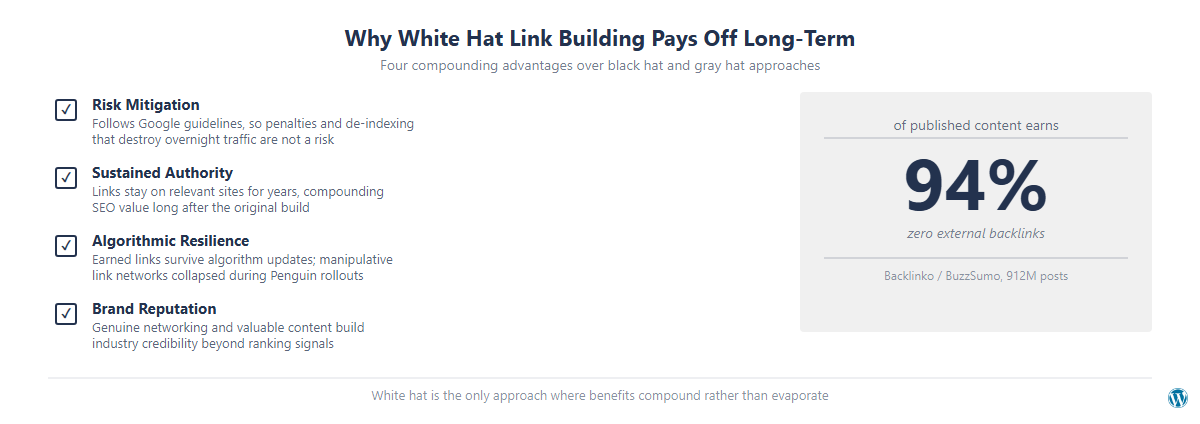
White hat link building pays off long-term by creating sustainable search engine authority through high-quality backlinks that last. 94% of all published content earns zero external backlinks, according to a Backlinko and BuzzSumo analysis of 912 million blog posts. The sites that earn links consistently are the ones building editorially, not through schemes. The compounding logic’s straightforward: a link earned from a strong publication three years ago still passes authority today. Black hat links bought for short-term gains tend to disappear during link cleanups or after penalties, and you’ll lose the link and the ranking benefit simultaneously.
Four specific advantages drive the long-term ROI argument:
- Risk mitigation: because white hat methods follow Google’s guidelines, they avoid the penalties or de-indexing that can destroy a site’s traffic overnight. Black hat sites that relied on manipulative tactics saw rankings collapse during Google’s Penguin rollouts; sites with clean editorial link profiles held position or improved.
- Sustained authority: links built via white hat methods, such as guest posting or original research, tend to stay on topically relevant websites for years, providing lasting SEO value. A single well-researched linkable asset can keep earning links long after publication.
- Algorithmic resilience: white hat links are natural or earned, making them less vulnerable to, and often rewarded by, frequent algorithm updates that penalize manipulative link networks.
- Brand reputation: these methods involve genuine networking and creating valuable content, which builds industry credibility beyond just ranking signals.
Long-form content (3,000+ words) earns 77.2% more backlinks than shorter articles, from the same Backlinko and BuzzSumo study. Depth signals to other writers and journalists that the piece’s worth citing, and each citation compounds the authority the page passes downstream.
How to Evaluate a Link Opportunity Before Building
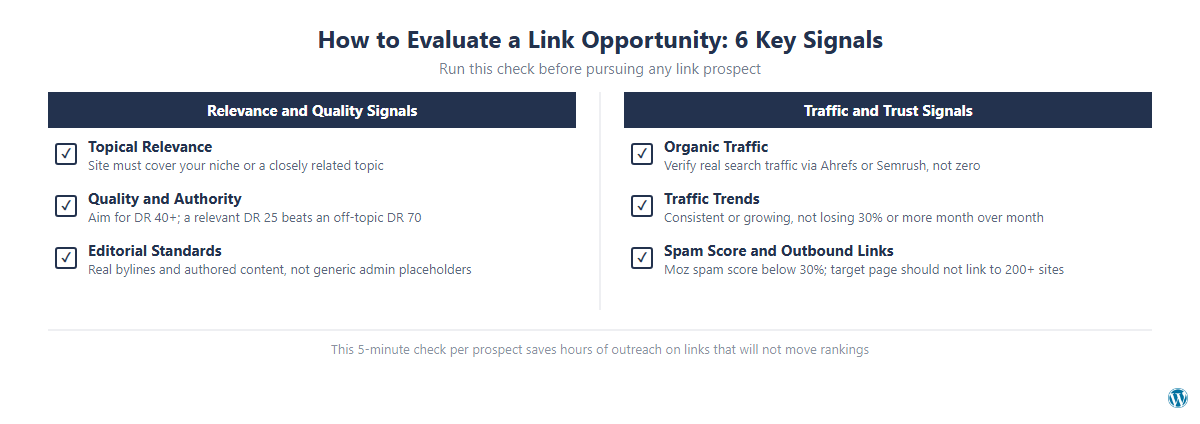
Evaluating a white hat link opportunity means ensuring the site is highly relevant to your niche, maintains real editorial standards, and offers genuine value to users, not just a link exchange. Key metrics include organic traffic, domain authority (using tools like Ahrefs or Moz), and a low spam score. A high domain authority number alone doesn’t guarantee the link will help, and some links can actively hurt.
Check these six signals before pursuing a link:
- Topical relevance: the site must cover topics in the same or a closely related niche to ensure the link is contextual and valuable to users. A link about „link building“ from a cooking blog carries weak signal regardless of the site’s authority.
- Quality and authority: verify domain strength using Ahrefs, Semrush, or Moz. Aim for DR 40+ as a general floor, but a DR 25 site in a highly relevant niche often beats a DR 70 site that covers everything.
- Organic traffic: use Ahrefs or Semrush to confirm the site gets real search traffic. A site with zero organic visitors passes no practical authority signal.
- Editorial standards: the target site should publish high-quality, authored content, which signals they care about quality and aren’t just selling links. Look for real bylines, not generic „admin“ placeholders.
- Traffic trends: check whether the site’s organic traffic is consistent or growing, not declining. A site that’s losing 30% of its traffic month over month is losing its own authority.
- Spam score and outbound links: check Moz’s spam score; anything above 30% warrants a manual review. Also check the outbound link count on the target page. A page linking to 200 other sites dilutes PageRank across all of them.
Running this check takes five minutes per prospect and saves hours of outreach on links that won’t move rankings. A dedicated link building tool can automate parts of this evaluation, including checking DR, organic traffic, and spam signals across a batch of prospects simultaneously.
Content-Led White Hat Link Building Tactics
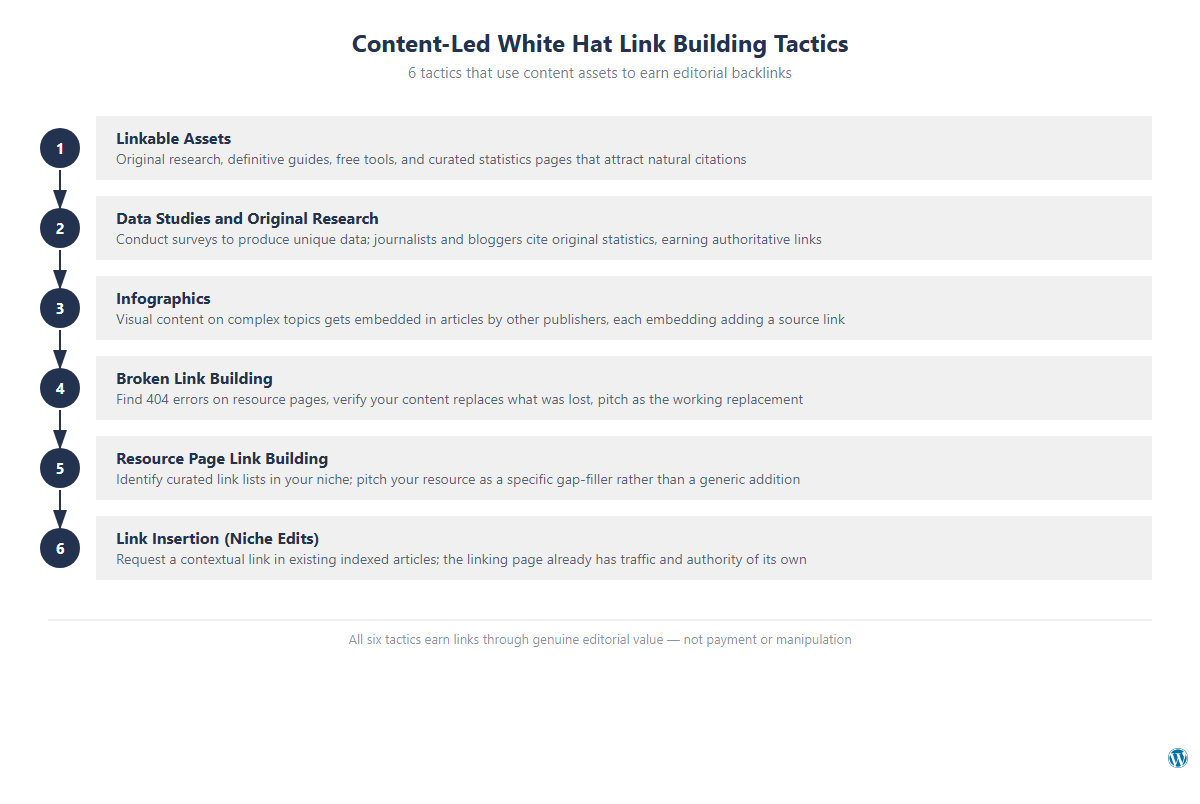
Content-led white hat link building focuses on earning high-quality backlinks through valuable, original, and shareable content rather than manipulation. These tactics require creating or owning an asset first. The asset is what earns the link. Key tactics include publishing original data, creating in-depth guides, designing infographics, and producing interactive tools, which are then promoted to relevant websites to earn editorial links that comply with search engine guidelines.
1. Linkable Assets
A linkable asset’s any piece of content designed to attract backlinks from other sites. The best linkable assets answer a question or provide a resource that journalists, researchers, and bloggers consistently need to reference. Producing comprehensive, go-to guides for a niche solves real problems, making them natural targets for editorial links.
The highest-performing formats include:
- Original research and studies: conducting surveys or industry research produces unique data that others want to cite, earning authoritative links
- Definitive guides: comprehensive, deeply researched articles that become a default reference for a topic
- Free tools and calculators: interactive calculators or specialized tools can attract high volumes of links and press coverage; a mortgage calculator or SEO audit tool gives users a reason to bookmark and share
- Curated statistics pages: aggregated data with proper attribution that becomes a go-to reference source
Topic selection matters as much as production quality. Choose topics that professionals in your industry regularly need to reference. The skyscraper technique (finding the top-ranking piece on a topic and building something demonstrably better and more current) is a reliable way to target proven linkable subjects, because you know the topic earns links from the existing piece’s backlink count.
Once your asset’s live, active promotion separates assets that earn ten links from assets that earn ten thousand. Email journalists who’ve recently written about the topic, notify industry bloggers who cite similar studies, and submit the piece to relevant newsletters and roundups. Passive discovery through rankings is valuable but slow.
2. Data Studies and Original Research
Journalists and bloggers consistently need statistics to support their articles. If you can be the original source of that data, links accumulate with every piece of content that cites you. Conducting surveys or industry research produces unique data that others want to cite, earning authoritative links from publications that wouldn’t otherwise cover your brand.
Creating original research doesn’t require a large budget. Survey platforms like SurveyMonkey, Pollfish, or YouGov let you run targeted surveys for a few hundred dollars. A well-designed survey of 500 people in your target industry can produce a data set you’ll be pitching for months.
Structure your research around questions where the answer isn’t already well-known. „How many marketers are increasing their link building budget in 2026?“ generates more interest than „what’s link building?“ because the former needs data that doesn’t already exist publicly.
Pitch the findings directly to industry journalists. Your pitch should lead with the most surprising or counterintuitive data point from your study. Keep the pitch to three sentences: the finding, why it matters, and a link to the full study.
3. Infographics
Creating easy-to-digest, informative visual content that others share in their own articles is a durable content-led tactic. Infographics remain one of the most shareable formats for earning backlinks from publishers who want to illustrate a concept without writing a new explanation. A clear, well-designed infographic on a complex or data-heavy topic gets embedded in other articles with a source link back to the original.
Effective infographic subjects include process diagrams (how something works step by step), comparison visualizations (platform A vs. platform B), and data summaries. Avoid generic designs that could apply to any industry. The more specific and authoritative the data, the more likely the infographic gets cited by serious publications.
Pitch the infographic to sites that have embedded similar visuals before. A search for „[topic] infographic“ shows which domains regularly publish embedded graphics, and those are your best outreach prospects.
4. Broken Link Building
Broken link building means finding dead links on other sites and proposing your relevant content as a replacement. The site owner benefits because a broken link creates a poor user experience. You benefit because you’ll earn an editorial link. Using tools like Ahrefs or Semrush to identify 404 errors on resource pages is the standard starting point.
The process has three steps:
- Find broken links: use Ahrefs‘ Site Explorer to look for broken outbound links on relevant domains, or use the Check My Links browser extension to scan resource pages for 404 errors
- Verify content relevance: check what the broken link originally pointed to (use the Wayback Machine) and confirm your content genuinely replaces what’s lost
- Send a concise outreach email: notify the site owner of the broken link, describe what you found, and offer your content as a working replacement; lead with solving their problem, not the link request
Response rates for broken link outreach run higher than generic link requests because you’re solving a problem the site owner already has. Resource pages and long-form guides accumulate broken links faster than regularly updated posts. Targeting older content (3+ years) on authoritative sites is often the most efficient starting point.
5. Resource Page Link Building
Resource pages are curated lists of tools, guides, or links on a specific topic. They exist specifically to link out to useful external resources, which means the site owner already wants to link. You just need to make the case that your content belongs on the list.
Find resource pages by searching Google for: [your topic] + „resources“, [your topic] + „helpful links“, or [your topic] + „recommended reading“. Before pitching, check the page’s outbound link count. A resource page with 20–40 links is healthy. A page with 150+ links has become a link directory, and a placement there carries less value.
Your pitch should give the site owner a specific reason your resource fills a gap on their list. don’t simply ask to be added. Instead, identify something that isn’t yet covered or explain why your resource is more current than what’s already listed.
6. Link Insertion (Niche Edits)
Link insertion means requesting a contextual link within an already-published article. Instead of creating new content, you find existing posts that discuss your topic without linking to a dedicated resource, then pitch your page as the natural destination for a link.
The advantage over guest posts is that the linking page already has SEO history; it has existing traffic and backlinks of its own. A contextual link in an established, indexed article often passes more authority than a link in a brand-new guest post.
Find insertion opportunities by searching for posts that cover your topic in depth but don’t link to your page. Use Ahrefs‘ Content Explorer or search Google with your primary topic phrase. Look for paragraphs that mention what your page covers. Frame the outreach around adding value to the reader: „I noticed your post on [topic] doesn’t link to any resource on [subtopic]: my article covers this in detail and your readers might find it useful“ lands better than a generic link request.
Content-Less White Hat Link Building Tactics
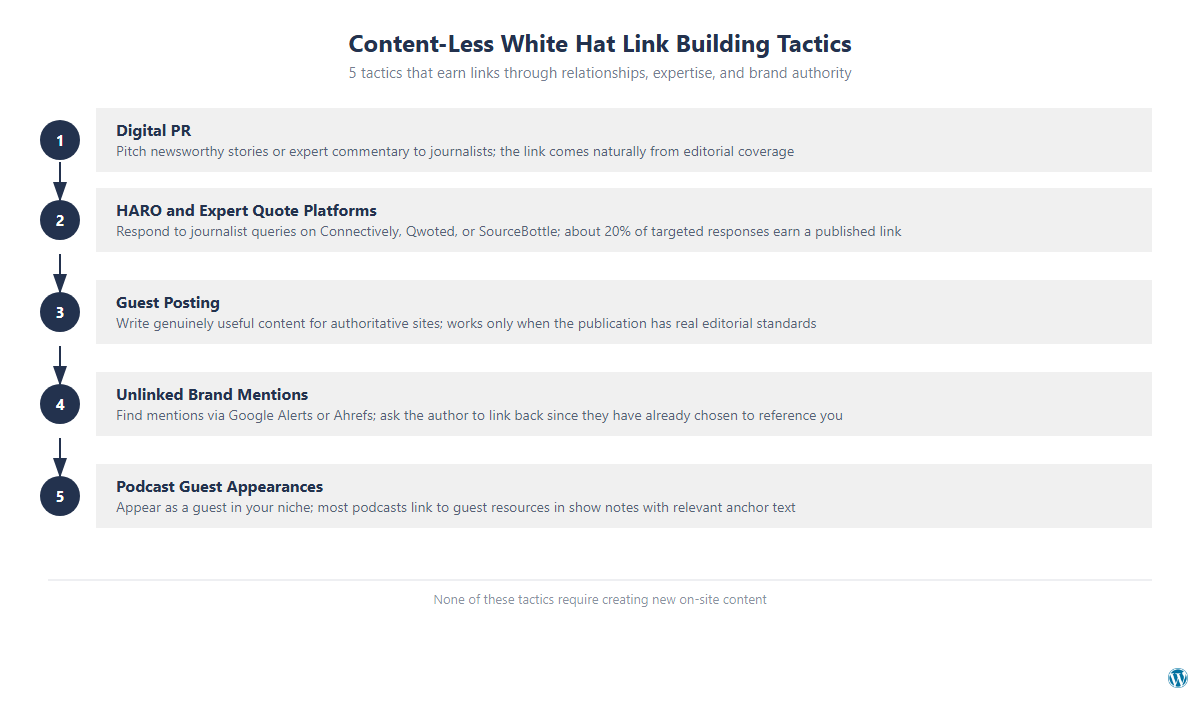
Content-less white hat link building focuses on building authority through relationship-based outreach, digital PR, and proactive monitoring rather than creating new on-site content. These tactics earn links through relationships, expertise, and what your brand already represents. Key approaches include HARO expert quotes, fixing broken links on resource pages, claiming unlinked brand mentions, and collaborating with partners.
7. Digital PR
Digital PR earns editorial backlinks from news outlets, industry publications, and blogs by pitching genuinely newsworthy stories or expert commentary. The link’s a natural result of coverage: the publication wrote about something interesting, and your company was the source.
Google’s John Mueller has directly endorsed digital PR as a valuable link-building approach: „I love some of the things I see from digital PR, it’s a shame it often gets bucketed with the spammy kind of link building.“ That’s a rare explicit endorsement from Google for any specific SEO tactic.
Effective digital PR campaigns usually fall into one of three categories:
- Data-driven stories: publish a study or survey that journalists want to cover (overlaps with linkable assets)
- Reactive pitching: when a news story breaks in your industry, pitch a relevant expert quote or counterpoint to journalists actively covering it
- Thought leadership placements: place an expert opinion piece or Q&A in industry publications
A meaningful share of press mentions come with nofollow links. Nofollow links pass limited direct PageRank benefit, but they contribute to brand visibility and often trigger followed links from secondary coverage. Treat nofollow placements as part of the PR flywheel, not a failure.
8. HARO and Expert Quote Platforms
HARO (now called Connectively), Qwoted, SourceBottle, and JournoRequest connect journalists with expert sources. When a journalist needs a quote or data point from someone in your field, they post a request. You respond. If they use your quote, you’ll earn a backlink from the publication. This builds authoritative backlinks from news sites without producing on-site content.
Response-to-feature rates run around 20% for well-targeted responses, meaning one in five focused replies results in a published quote and link. The qualifier is „well-targeted.“ Generic responses that don’t directly address the journalist’s specific question rarely get used.
Three practices that improve HARO results:
- Respond fast: journalists often have same-day deadlines; responding within two hours dramatically outperforms responding six hours later
- Be concise: give the direct quote or data point in the first two sentences, then offer context; journalists want a usable quote, not a full article
- Match the specific question: re-read the journalist’s query before sending; off-topic responses get ignored even when well-written
At scale, HARO’s most efficient with a dedicated process: set up email filters by topic category, assign response duties to a team member with domain expertise, and track which request types convert best for your niche.
9. Guest Posting
Guest posting (writing original articles for other sites in exchange for a backlink) remains one of the most direct ways to earn editorial links on specific anchor text. The approach works when the placement is genuinely editorial: you’re contributing useful content to an audience that cares about your topic, and the site maintains real editorial standards. Writing informative, high-quality articles for reputable industry sites builds brand authority and earns a relevant, natural link.
Find opportunities by searching for „[your topic] + write for us“, „[your industry] + guest post guidelines“, or „[your topic] + contributor guidelines“. Vet each site before pitching:
- Does the site have identifiable authors with real bylines, or generic „admin“ placeholders?
- Does the site publish content that would interest its readers even without your link?
- Does the site charge a fee to publish? Paid placements violate Google’s guidelines regardless of content quality.
- Do published posts get indexed and rank for anything?
Google’s March 2024 Spam Update increased scrutiny of low-quality guest post networks. The test is simple: if the publication would publish your article without the link, it’s an editorial placement. If the link is the only reason both parties are there, it isn’t.
Pitch a specific angle before writing the piece. A vague offer to „write about SEO“ gets ignored. A pitch that describes a specific, relevant argument with a clear hook for the site’s audience shows you’ve done the work before asking for anything.
10. Unlinked Brand Mentions
When someone writes about your brand, company, or product without linking to your site, that’s an unlinked mention. Use tools like Google Alerts or BuzzSumo to find instances where your brand is mentioned but not linked, then politely ask the author to turn the mention into a clickable link. Converting those mentions into links is one of the most efficient white hat tactics available, because the author already knows who you are and chose to reference you.
Find unlinked mentions using:
- Google Alerts: set up alerts for your brand name, product names, and key team members‘ names
- Ahrefs Content Explorer: search for your brand name across indexed pages and filter to pages that don’t already link to you
- Talkwalker or Mention: broader monitoring tools that catch mentions across news, blogs, and social platforms
When you find an unlinked mention, the outreach is direct: thank the author for the mention, reference the specific passage, and ask if they’d be willing to add a link so readers can learn more. The request’s easy to grant. They’ve already written about you, and adding a link takes seconds. Conversion rates on this tactic typically run higher than cold outreach for new placements.
11. Podcast Guest Appearances
Most podcasts publish show notes that include links to guest websites, books, tools, or relevant resources. Appearing as a guest on a podcast in your industry earns a backlink in the show notes, often with relevant anchor text. Beyond the direct link, podcast appearances build authority more broadly. Listeners who find the episode relevant often look up the guest independently, leading to organic links and mentions from people who discovered you through the show.
To land guest spots, identify 10–20 podcasts in your niche that regularly feature outside guests. Listen to two or three episodes of each to understand the host’s style and what their audience values. Then pitch a specific topic angle, not „I’d love to come on and talk about SEO“ but a focused argument or data-driven perspective that would serve the show’s specific audience. Engaging with the host on social media for a few weeks before you pitch meaningfully improves response rates.
White Hat Link Building Best Practices
White hat link building focuses on earning high-quality, relevant backlinks through organic, ethical strategies that adhere to search engine guidelines. Best practices include creating superior, linkable content, personalized outreach, guest posting on authoritative sites, and reclaiming broken links. The goal’s long-term authority, not instant rankings.
- Prioritize relevance over volume: ten links from topically relevant sites in your niche outperform a hundred links from unrelated blogs at similar authority levels
- Develop high-quality linkable assets: invest in original research, data reports, infographics, or comprehensive guides that naturally attract links; these compound across years, not weeks
- Vary your anchor text: a natural link profile includes branded anchors, generic anchors („read more“), URL anchors, and some keyword anchors; a profile that’s 80% exact-match keywords looks manipulated even if each individual link was earned editorially
- Build at a consistent pace: steady link acquisition signals natural growth; sudden spikes can trigger algorithmic scrutiny even when the links themselves are legitimate
- Never pay for links: the moment a financial exchange determines whether a link gets placed, it stops being white hat regardless of the publication’s quality
- Audit your backlink profile quarterly: toxic links from spammy sites can accumulate passively through scrapers and auto-generated content; reviewing and disavowing them proactively keeps your profile clean
- Personalize every outreach pitch: a pitch that explains why your content specifically helps a site’s readers gets a different response than a generic template; one minute of research per pitch shows
For brands running a targeted link building program, focusing on a niche link building approach within a specific topic cluster consistently outperforms a broad-reach strategy at equivalent effort levels. Tracking results with structured link building reporting makes it easier to identify which tactics produce the strongest links and where to concentrate outreach effort going forward.
Frequently Asked Questions
What Is White Hat Link Building?
White hat link building is the practice of earning backlinks through methods that comply with Google’s search engine guidelines. It means acquiring links editorially: a site links to you because your content’s relevant and valuable, not because you paid for the placement or manipulated the process. It’s the opposite of black hat tactics like link schemes or purchased link networks.
Is White Hat Link Building Slow?
White hat link building’s slower than black hat tactics in the short term, but the results compound rather than evaporate. Black hat links often disappear during algorithm updates or after manual penalties, resetting months of work. White hat links from legitimate publishers tend to stay in place and continue passing authority for years, making them more cost-effective over any 12-month horizon.
What Is the Difference Between White Hat and Black Hat Link Building?
White hat link building earns links through genuine editorial value and follows Google’s webmaster guidelines. Black hat link building manipulates search rankings through schemes like purchasing links, private blog networks, or automated link generation, tactics that directly violate Google’s policies and risk manual penalties or de-indexing that can suppress rankings for months.
Does White Hat Link Building Still Work in 2026?
White hat link building works better in 2026 than at any previous point, because Google’s consistently improved at identifying and discounting manipulative links. The tactics that manipulated rankings in 2012 are largely ineffective or penalized now. Editorial links from relevant, authoritative sources have held their value through every algorithm update, including Penguin, Helpful Content, and the March 2024 Spam Update.
How Many White Hat Links Do I Need to Rank?
There’s no universal number. The target depends on what competing pages for your keyword already have. A useful starting point’s checking the top three ranking pages for your target keyword in Ahrefs and noting their referring domain counts. Matching those top competitors‘ median referring domain count is a reasonable first milestone. Quality and relevance matter more than raw count: ten highly relevant links often outperform fifty from unrelated sites.