


Link juice is the SEO value that’s passed from one page to another through a hyperlink. The fastest way to get more of it is deliberate internal linking plus a steady stream of editorial backlinks, both aimed at the pages that need to rank most. This guide covers what link juice is, the six factors that decide how much of it a link passes and the concrete steps that increase how much of it reaches your priority pages.
Every link on the web carries a potential authority signal. Understanding what controls how much link juice gets passed, what blocks it and how to direct it toward your most important pages is one of the strongest foundations for building search visibility.
What Is Link Juice in SEO?
Link juice is the informal SEO term for “link equity.” It’s the ranking value that flows between pages through hyperlinks, and the concept goes back to PageRank, the algorithm Google co-founder Larry Page developed at Stanford in the late 1990s. PageRank treated every link as a vote: a link from page A to page B was page A endorsing page B. The more votes a page collected, and the higher-quality those votes were from authoritative sources across the web, the more likely it was to rank well in search results.
The term “link juice” stuck in the SEO community, and “link equity” became the more formal version practitioners use in client-facing writing today; Moz and other major SEO publishers now favor the equity framing. Google doesn’t expose a public score for either term, but the mechanism is well-documented in Google’s developer documentation. The underlying principle, that links transfer ranking signals between pages, is one of Google’s most confirmed ranking factors.
Every page that earns links builds up equity, and it’s not a one-time deposit. Every link that page sends elsewhere pushes some of that equity downstream. That flow is what practitioners mean when they say a page is “passing link juice.” Understanding link juice also helps you read your backlinks analysis correctly: the equity each link passes is what makes some backlinks far more valuable than others.
How Does Link Juice Work?
PageRank calculates the importance of a page based on the number and quality of links pointing to it. It isn’t only about receiving links, though. It’s also about distributing them, and that’s the half most SEOs overlook. When a page links out to multiple destinations, it divides its available equity among all those outbound links, so each destination gets a smaller share.
Think of it this way: a page with ten outbound links passes less link juice per link than the same page with two outbound links. That’s why link count on the source page matters as much as the source page’s authority.
The distinction between followed and nofollow links is the other key mechanism. A standard HTML link passes link juice by default. A nofollow link carries a rel="nofollow" attribute that tells Google not to pass PageRank through it. Google’s developer documentation describes nofollow as a hint rather than a hard directive, but for practical purposes, nofollow links don’t pass equity the way followed links do.
For years, some SEOs tried “link sculpting,” using nofollow on certain internal links to concentrate equity toward their most important pages. Google closed that loophole, and the tactic no longer works as it once did. The broader principle still holds, though: fewer, more intentional outbound links means more link juice passed per link.
Link juice is a core concept within off-page SEO, and it’s worth treating as its own line item in any link building plan. Every inbound link your site receives adds to your pages’ equity pool, and how much depends on the factors below.
What Passes Link Juice and What Does Not
Not every link passes value. Knowing which link types do and which don’t is the first decision point in any plan to increase link juice, because it tells you where to focus and where to stop wasting effort.
Passes link juice:
- Standard HTML dofollow links in the body of a page
- Editorial in-content links placed by the author of the linking page
- Links from pages with few total outbound links
- Authority links from topically relevant pages in the same niche
Does not pass link juice:
- nofollow links (rel=”nofollow”, rel=”sponsored”, rel=”ugc”)
- Links inside iframes that search engines can’t access
- JavaScript-rendered links on pages Googlebot can’t fully crawl
- Links from pages blocked in robots.txt
- Links in long redirect chains, where each additional hop dissipates equity
- Paid links without a sponsored tag (penalty risk, not link juice)
Redirect chains deserve specific attention, since they come up constantly once you start actively working on link juice. If page A links to page B, which 301-redirects to page C, some equity is lost at that hop. A single, direct 301 preserves most of the original page’s equity. A long chain from A to B to C to D loses meaningfully more at each additional step, wastes crawl budget and slows page discovery. Direct 301 redirects beat chains every time.
6 Factors That Determine How Much Link Juice a Link Passes
Not all links are equal. Six factors determine how much equity a given link passes, and each one is a lever you can influence when you’re choosing where to place a link or which sites to pursue for outreach.
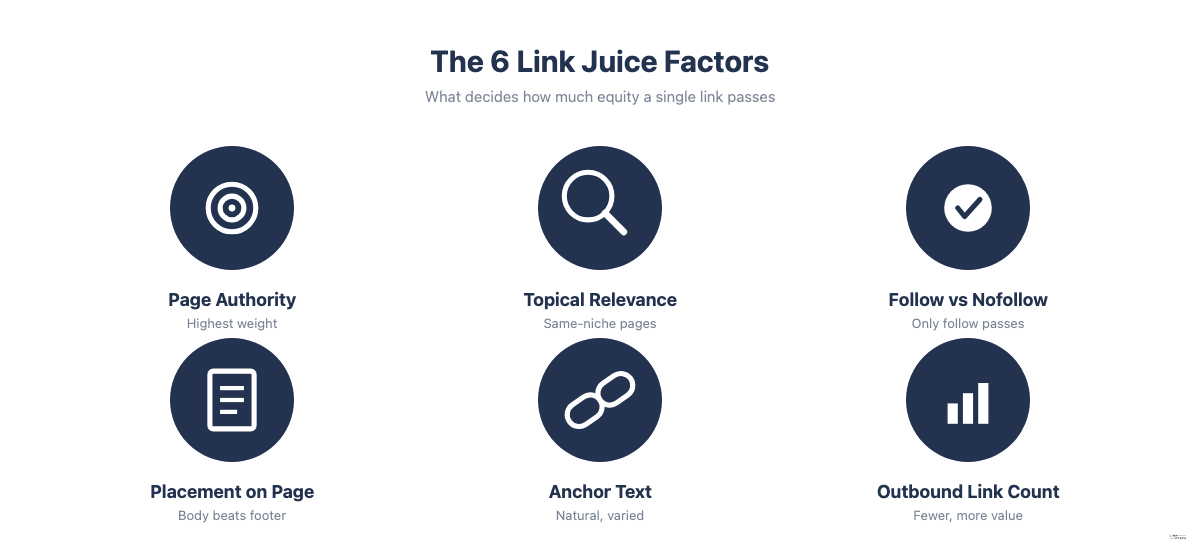
1. Authority of the Linking Page
That’s the most important factor of the six. A link from a high-authority page, measured by proxy metrics like Ahrefs Domain Rating (DR) or URL Rating (UR), passes far more equity than a link from a low-authority source. One authority link from a major news outlet or industry publication can pass more equity than dozens of links from low-authority sites.
There’s a subtlety here: it’s the authority of the specific linking page that matters, not just the domain. A link from a buried interior article on a high-DR site carries the authority of that page, not the entire domain’s score.
2. Relevance of the Linking Page
A link from a topically relevant page passes more meaningful equity. When a page about SEO tools links to your page about backlinks, that contextual vouching acts as a strong vote of confidence in your content’s subject matter expertise. Search engines use link context to understand what a destination page is about, which amplifies the topical signal of the equity transferred.
A cluster of authority links from topically related pages builds a coherent topical authority signal, and it’s a stronger signal than any single link on its own. Search engines use these interconnected links to determine that your website is an expert on a specific subject, and that signal compounds in ways random links from unrelated sources can’t match.
3. Link Type: Follow vs. Nofollow
Followed links pass link juice. Nofollow links, including those with rel=”sponsored” and rel=”ugc”, don’t pass equity reliably. When Website A links to Website B without restrictions, search engine crawlers follow the link and pass authority. That’s the default behavior for any standard HTML hyperlink.
Nofollow links from high-visibility pages still generate referral traffic and brand awareness, so they’re not worthless. They carry value beyond link juice, just not the PageRank transfer. For link building purposes, always aim for followed placements when the goal is building link equity.
4. Placement on the Page
Where on the page a link appears affects how much equity it passes, and this is one factor that’s easy to control. In-content links in the main body of an article pass more equity than links in footers, sidebars or navigation menus. A link buried in a site-wide footer reads as less intentional than a contextual link placed within the body of a relevant article.
Placement matters because Google treats editorial body links as more deliberate choices. A link an author chose to include mid-paragraph carries more weight than a link that appears in every page’s footer template.
5. Anchor Text
The anchor text of a link gives search engines context about the destination page. Keyword-relevant anchor text, used naturally and in proportion to overall anchor diversity, reinforces the topical signal of the equity being passed. Over-optimized anchor text, where every link to a page uses the exact same keyword, is a manipulation signal Google can penalize.
A natural anchor text profile typically includes branded anchors, partial-match anchors, generic anchors and naked URLs. No single anchor type should dominate.
6. Number of Outbound Links on the Source Page
A page distributes its available equity across all outbound links it contains, and that’s a fixed pool, not an unlimited one. A page with two outbound links passes roughly twice as much link juice per link as the same page with four links. Resource roundups with dozens of citations pass less equity per individual link than focused editorial pieces with only a few outbound references.
That’s why an authority link on a page with few outbound links is so valuable. Less dilution means more equity per link.
Does Link Juice Still Matter in 2026?
Yes, links remain one of Google’s core ranking signals. The framing has shifted, since “link equity” is now the preferred industry term, but the underlying mechanism is unchanged.
Google’s internal documentation, referenced in public statements and court proceedings, identifies links as a top-tier ranking factor. The algorithm has evolved to weigh link quality over quantity more than it did in PageRank’s early form, but the fundamental signal is still active.
The rise of AI-generated search results adds a new layer. AI Overviews still draw from pages with strong authority signals, so a page that has earned link juice is more likely to have its content surfaced in AI-generated answers and cited as a source. The channel through which authority matters has expanded, but the need for authority hasn’t shrunk.
The practical implication is straightforward: ten strong, relevant, followed authority links from topically relevant pages will outperform a hundred low-quality links. White hat link building strategies that earn genuine editorial placements are the only reliable path to sustainable link equity growth.
How to Distribute Link Juice With Internal Linking
Internal linking is the most controllable variable in your link juice strategy. External links are partially beyond your control, but internal links aren’t, which makes this the first place to focus if you want to increase link juice on a specific page without waiting on outreach to land.
The core principle: equity flows in through external links, then spreads across your site through internal links. If you don’t direct that flow deliberately, it distributes unevenly, leaving some pages equity-rich and others starved.
The pillar-cluster model is what’s worked best here. A pillar page covers a broad topic in depth. Cluster pages cover specific subtopics within that theme. Internal links from cluster pages to the pillar concentrate equity on your most important ranking target. Links from the pillar back to clusters then distribute equity to supporting content, reinforcing topical depth for the whole cluster.
Finding which of your existing pages already have the authority worth passing on doesn’t require a paid tool. Search site:yourdomain.com intext:"your target keyword" in Google to surface pages that already discuss the topic. Those pages are candidates for a contextual link to your target page, since they’re already topically relevant and can pass equity without reading as forced.
Practical rules for optimizing link juice through internal linking:
- Link from your highest-traffic and highest-authority pages toward your most important ranking targets
- Keep navigation menus lean, since every additional navigation link reduces the equity each navigation link passes
- Fix orphaned pages; pages with no internal links pointing to them receive no link juice from your site, regardless of how many external links they earn
- Use descriptive, keyword-relevant anchor text on internal links, not generic phrases like “click here”
- Audit your internal link structure using Ahrefs’ Best by Links report to find pages that have built up equity but aren’t passing it downstream
There’s no universal number for how many internal links a page should have. What matters more than a fixed count is intent: a page linking to two other pages passes meaningfully more equity per link than the same page linking to fifty, so trim links that exist only out of habit rather than because they help the reader or the target page.
How to Audit Your Link Juice Distribution
A practical link juice audit has three steps. First, use Ahrefs’ Best by Links report to identify which pages on your site have the most inbound link equity. These are your equity entry points. Second, open those pages and count their internal links. If a high-equity page has dozens of internal links pointing in multiple directions, the equity is diluting across too many destinations. Third, identify your pillar pages and confirm they’re receiving internal links from those high-equity entry points.
Run this audit once per quarter, since it’s not a one-and-done task. New content creates new equity sources, and old internal links go stale as site architecture changes. The goal is a continuous flow from high-equity entry points toward your most important ranking targets.
Do Redirects, Canonical Tags and Noindex Pages Pass Link Juice?
These three technical situations come up as soon as you start actively managing link juice instead of just reading about it, and getting them wrong quietly leaks equity you’ve already earned.
Does a 301 Redirect Pass Link Juice?
Yes, a 301 redirect passes most of the link equity that pointed to the original URL, though not all of it. Google treats a 301 as a strong signal that the new URL should inherit the old URL’s ranking signals, but some equity is still lost at the hop and more is lost with every additional hop in a chain. A single, direct 301 from the old URL straight to the final destination preserves noticeably more equity than routing through two or three intermediate redirects.
Does a Canonical Tag Pass Link Juice?
Yes, a properly implemented canonical tag consolidates equity from duplicate or near-duplicate URLs onto the canonical version. It’s one of the easiest technical fixes to get wrong without noticing. If you have several URL variants of the same page, such as with and without tracking parameters, a self-referencing or cross-referencing canonical tells Google which version should collect the ranking signals from links pointing at any of the variants. Get the canonical target wrong, and you can accidentally consolidate equity onto the weaker version of a page.
Does a Noindex Page Pass Link Juice?
Yes, in most cases a noindex page can still pass link juice through its own outbound followed links, as long as the page itself is crawlable and not blocked in robots.txt. Noindex only tells Google not to show that page in search results; it doesn’t stop the page from being crawled or from passing equity through the links it contains. Google hasn’t published an explicit statement confirming this behavior, but it’s the consistent practitioner consensus among SEOs who’ve tested it directly, so treat noindex and nofollow as two different controls rather than assuming one implies the other.
How to Earn More Link Juice From External Sources
Beyond internal linking, the only way to increase total equity flowing into your site is to earn more external links or to recapture link juice you’ve already lost.
Earn Editorial Backlinks From Authority Sites
The highest-quality link juice comes from editorial links placed in the body of topically relevant, high-authority pages. It’s worth prioritizing over volume-based tactics. Content that earns these authority links includes original research, comprehensive practical guides and visual assets like infographics that other publishers want to reference.
One reliable, repeatable version of this is the Skyscraper Technique: find a page that already attracts a lot of backlinks, publish something noticeably better, more current or more complete on the same topic, then reach out to the sites already linking to the older version and point them to yours. It works because you’re not asking someone to link for the first time. You’re asking them to upgrade a link they already decided was worth having.
Guest contributions on relevant industry publications are another reliable path. When you publish an expert piece on a high-DR domain and include a followed link back to your site, you earn link juice from the domain’s existing authority. Choose publications whose topical relevance reinforces the subject matter of your destination page.
Fix Broken Links and Reclaim Lost Juice
Any page on your site that previously had external links pointing to it and has since been deleted or changed URL is leaking equity, and it’s leaking silently until someone checks. When a linking page points to a 404 on your site, the link juice passed to that URL goes nowhere.
Audit your 404 pages using Ahrefs’ Best by Links filter. Find deleted or moved pages that still receive external links. Restore the content or 301-redirect the URL to the most relevant existing page. Either approach recaptures equity you’ve already earned but are currently losing.
Broken link building extends this principle to competitor sites: find broken links pointing to competitor pages, create replacement content and pitch the linking pages on updating their link to your version. It’s fresh link juice sourced from link profiles that already exist.
Reduce Link Juice Leakage
Review high-value pages for excessive outbound links, particularly on pages where every outbound link competes with your internal links for the available equity budget. Use nofollow on external links you don’t need to endorse. Fix redirect chains within your own site, since each hop in a chain reduces the link juice passed to the final destination.
Build Topical Authority Through Content Clusters
Topical authority multiplies the effect of link juice, and that’s the compounding return most sites underestimate. When you publish a cluster of interlinked articles around a topic, where each earns links and each links internally to the pillar, the cumulative equity effect is larger than the sum of individual links. External links to any page in the cluster flow through your internal link architecture to reinforce the whole topic.
A site recognized as a topical authority earns further authority links, gets cited by AI systems and ranks for the full range of queries within a topic. Internal linking and external link building compound each other when the content architecture supports them.
A Quick Checklist to Increase Link Juice
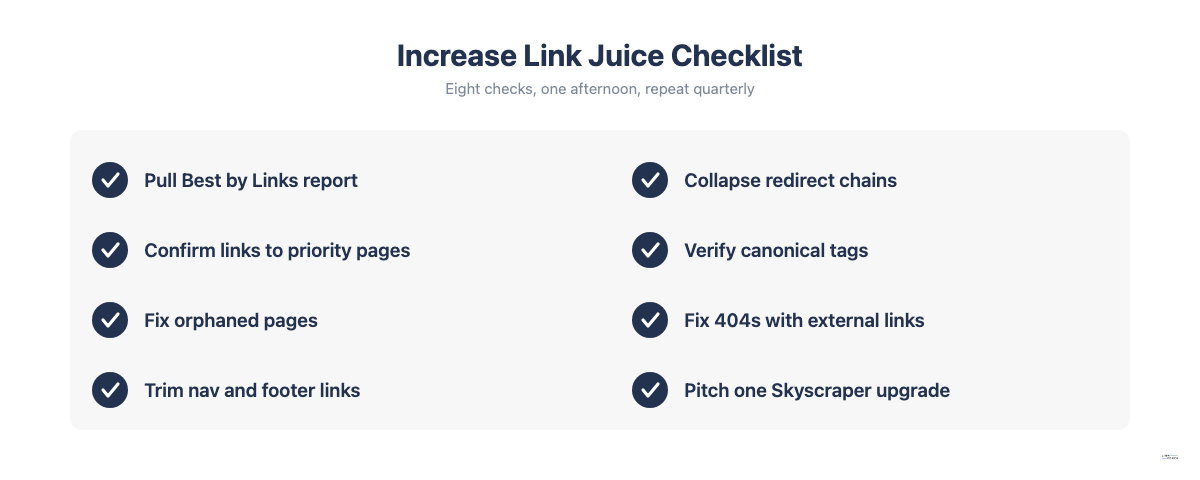
Use this as a working list rather than a one-time project, since it’s built to be repeated. Most sites can move through it in an afternoon and then repeat the audit steps quarterly.
- Pull your Ahrefs Best by Links report and identify your highest-equity pages
- Confirm those high-equity pages link directly to your priority ranking targets
- Fix orphaned pages that currently receive no internal links
- Trim navigation and footer links that dilute equity without helping users
- Check for redirect chains and collapse them to single, direct 301s
- Verify canonical tags point to the version of each page you actually want ranking
- Find and fix 404s that still carry external links, either by restoring the page or redirecting it
- Pitch one Skyscraper-style upgrade to sites already linking to a weaker competing page
Frequently Asked Questions About Link Juice
Is link juice the same as link equity?
Yes, link juice and link equity refer to the same concept. “Link juice” is the informal, practitioner-coined term, while “link equity” is the more formal equivalent preferred by Moz and increasingly common in modern SEO writing. Google itself uses “PageRank” in its developer documentation, and all three terms describe the same mechanism: the transfer of ranking authority from one page to another through hyperlinks.
Do nofollow links pass link juice?
No, nofollow links don’t pass meaningful link juice for ranking purposes under normal practitioner assumptions. Google’s official guidance describes nofollow, sponsored and ugc link attributes as a signal that PageRank shouldn’t flow through those links. It’s treated as a hint rather than an absolute rule, but the practical result for link building is the same: don’t count on a nofollow link to move your rankings.
Does internal linking really affect link juice?
Yes, internal linking is how you distribute link equity across your site after it flows in through external links. Pages with no internal links pointing to them receive no internal equity regardless of how many external links they’ve earned. Deliberate internal linking toward your most important pages is one of the most effective SEO actions entirely within your control.
How much link juice does a link pass?
There’s no public metric for exactly how much link juice a link passes. Google doesn’t expose PageRank scores, and third-party proxies like Ahrefs DR and UR only provide approximate signals. In practice, look at the linking page’s UR, its topical relevance, the number of outbound links on the page and whether the link is followed. Those four signals together give a reasonable read on a specific link’s equity value.
Can you lose link juice?
Yes, you can lose link equity in several common ways: when pages with external links pointing to them return 404 errors with no redirect, when redirect chains add unnecessary hops, when a site migration changes URLs without proper 301 redirects or when nofollow gets added to links that previously passed equity. Regular link audits with tools like Ahrefs help you find and recover lost equity before the loss compounds.