

The skyscraper technique is a link building method where you find content that has already attracted many backlinks, create a significantly better version, and reach out to the sites linking to the original to earn those same links. The idea is simple: instead of publishing something and hoping it gets noticed, you work with proven demand. It belongs to the broader category of white hat link building tactics that earn links through genuine editorial value rather than manipulation.
Brian Dean of Backlinko first described the approach in 2013. After publishing a comprehensive post and executing the technique on it, site-wide organic traffic doubled in 14 days — a 110% increase. The case study made the method widely known across the SEO community.
The name comes from architecture. Just as a developer doesn’t build on an empty lot but studies existing skyscrapers and builds taller, you study what’s already attracting links and build better.
The process has three steps: find content with many backlinks, create a materially better version, and reach out to the sites linking to the original.
Does the Skyscraper Technique Still Work?
Yes, the core logic still works — but the bar for “better” is significantly higher than when Brian Dean first described it, and mass outreach is much less effective.
Two things have changed. First, the technique has been widely adopted, which means site owners now receive a steady stream of outreach emails claiming “we made a better version of that page you linked to.” Most of these emails get ignored because they arrive in bulk and lack genuine improvement. Second, Google and AI search engines now assess content quality in ways that go beyond length. The modern standard is information gain: your content needs to cover topics, angles, or facts that the original doesn’t address — not just repackage the same material with more words.
The technique still works reliably when the content is genuinely better, the target links are from relevant sites, and the outreach is personal. When those conditions aren’t met, it fails as predictably as any generic link building tactic.
Benefits of the Skyscraper Technique
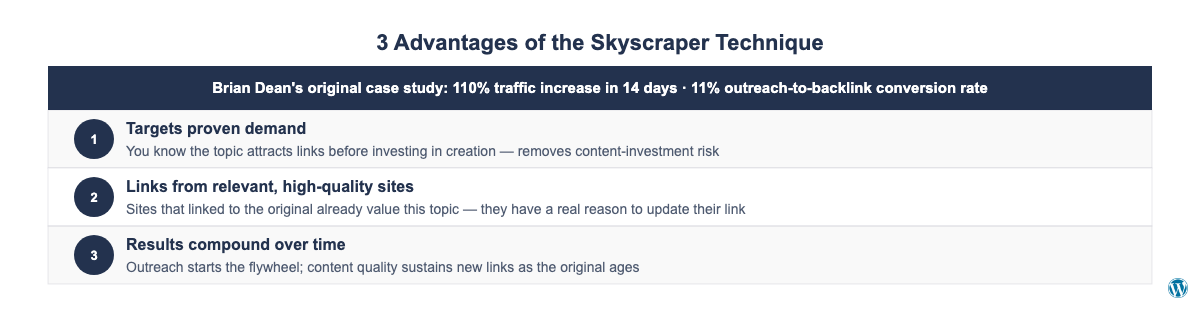
The technique offers three concrete advantages over starting from scratch. Brian Dean’s original case study showed site-wide organic traffic doubling in 14 days — the kind of result that’s possible because you’re building on proven demand, not guessing.
First, it targets proven demand. You’re not guessing whether a topic can attract links — you’ve already seen that it does. That removes a lot of content-investment risk.
Second, the links you earn come from relevant, high-quality sites. These sites already linked to content on this topic, which means they find it worth linking to. If your version is better, they have a real reason to update their link.
Third, the results compound. A well-executed skyscraper piece keeps attracting new links over time as the original content ages and other sites seek a better reference. The initial outreach gets you started; the content quality sustains it.
How to Use the Skyscraper Technique: 3 Steps
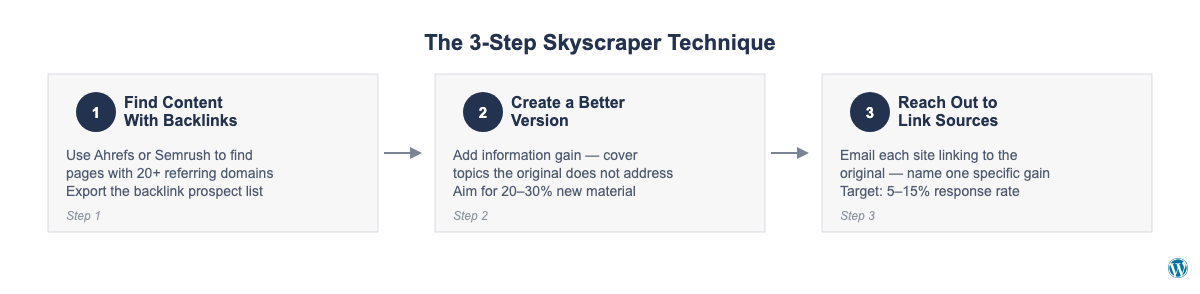
The original Backlinko case study converted 11% of outreach contacts into backlinks — the foundation is simple, but each step needs to be done correctly to reach that kind of result. Here’s the full process.
Step 1 — Find Content With Many Backlinks
Use a backlink tool like Ahrefs or Semrush to identify pages in your niche that have already earned a high number of referring domains. The referring domain count matters more than the raw backlink number — one domain linking 50 times counts less than 50 different domains each linking once.
Search for your target topic and filter results by referring domains. Look for pages with at least 20–30 referring domains. These are your linkable asset targets: content that has already proved it can attract links.
Relevance matters as much as backlink volume. A page with 100 referring domains in an adjacent niche is less useful than one with 30 referring domains in your exact space, because the sites linking to it are the same audience you need to reach.
Once you’ve found a strong candidate, export its backlink list. That list becomes your outreach prospect pool in Step 3.
Step 2 — Create a Materially Better Version
Don’t aim for longer — aim for more useful.
Backlinko’s original improvement taxonomy is still a good starting point: make the content longer if the original skips important details, more up to date if it relies on outdated information, better designed if it’s hard to scan, or more thorough if key subtopics are missing.
The modern standard adds one more dimension: information gain. Your content should cover topics, examples, data points, or angles that the original doesn’t address. Google and AI search systems now reward content that adds something genuinely new, not content that repeats what’s already ranking with extra padding. Aim for at least 20–30% of your coverage to be material that the original doesn’t have.
In practice, this means researching what the original misses. What questions does it leave unanswered? What has changed since it was published? What expert perspective, original data, or practical framework would make a reader choose your version over the existing one?
Step 3 — Reach Out to Sites Linking to the Original
Export the backlink profile of the original content and send personalized outreach emails to each linking domain.
A good outreach email follows a simple structure: acknowledge the page they link to, point to one specific thing your version does better, and ask if they’d consider referencing it. Here’s a basic template:
Subject: Re: [topic] resource on [their site name]
Hi [Name],
I noticed you link to [original URL] in your article on [their URL].
I recently published a more comprehensive guide on the same topic: [your URL]
It covers [specific thing the original misses — e.g., updated 2024 data, a new section on X, a practical template].
Thought it might be worth a mention. Either way, great piece.
[Your name]
Keep the email under 100 words. The more specific the improvement you name, the better the response rate.
The original Backlinko case study recorded 17 backlinks from 160 outreach emails — an 11% success rate. That was in 2013 before the technique became widely known. Today, a realistic target for a well-personalized campaign is 5–15%. Volume alone won’t get you there. The quality of your improvement and the specificity of your outreach are what move the needle.
Before you reach out, filter your prospect list. Skip domains that are clearly low-quality, that have changed topic since they linked, or where your content genuinely wouldn’t serve their audience. A shorter, cleaner list outperforms a longer, generic one.
Common Mistakes That Kill Skyscraper Results
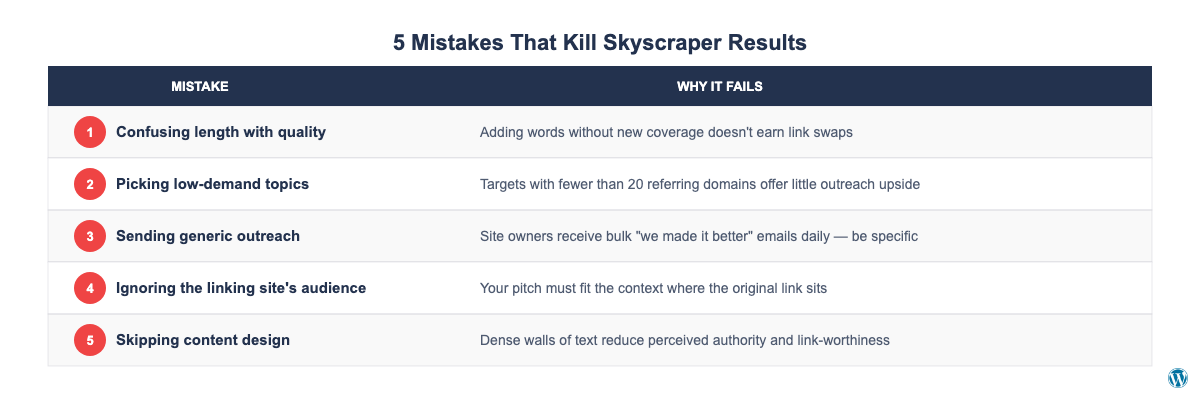
Most skyscraper campaigns fail because the “better” content isn’t actually better — it’s just longer.
These five mistakes account for most failures:
- Confusing length with quality. Adding 2,000 words to a 1,000-word post doesn’t make it better. If the new content covers the same ground with more text, it hasn’t earned a link swap. Search engines recognize content padding, and so do the editors you’re reaching out to.
- Picking a topic with low linking demand. Not all content earns links at scale. If the original page has 5 referring domains, there’s limited room to improve. Choose targets with enough linking interest to make outreach worthwhile — usually 20+ referring domains in a relevant niche.
- Sending generic outreach. “Hi, I made a better version of this page” with no specific reason to switch doesn’t work. Site owners get variations of this message daily. Your email needs to name something specific — a section you added, a tool you compared, a data point you corrected.
- Not matching the linking site’s audience. Before reaching out, look at the context of the original link. Is it embedded in a tutorial? An opinion piece? A roundup? Your pitch needs to make sense for where the link sits, not just for your topic.
- Skipping content design. Visual quality affects whether people link to content. A dense wall of text is harder to share than a well-structured page with clear headings, supporting visuals, and scannable sections. Design isn’t decoration — it affects perceived authority.
Frequently Asked Questions
What is the skyscraper technique in SEO?
The skyscraper technique is a link building method where you identify high-performing content with many backlinks, create a significantly better version, and contact the sites that link to the original to earn those same links. It was developed by Brian Dean of Backlinko and is one of the most referenced link acquisition frameworks in SEO.
Who invented the skyscraper technique?
Brian Dean of Backlinko developed and popularized the technique. He first applied it publicly in 2013, using it to double site-wide organic traffic in 14 days and earn 17 backlinks from 160 outreach emails.
How long does the skyscraper technique take to show results?
Most campaigns produce initial link placements within 4–8 weeks of outreach, assuming the content is strong and outreach is personalized. Broader traffic impact from those links typically follows over the next 2–6 months as new links are indexed and authority builds.
Is the skyscraper technique still effective in 2024 and 2025?
It still works, but the execution bar is higher than it was when the method was coined. The core logic — improve on a proven piece, reach out to known link sources — remains valid. What no longer works is treating “better” as “longer,” or treating outreach as a numbers game. When the content genuinely adds new information and the outreach is specific, the technique consistently delivers results.