

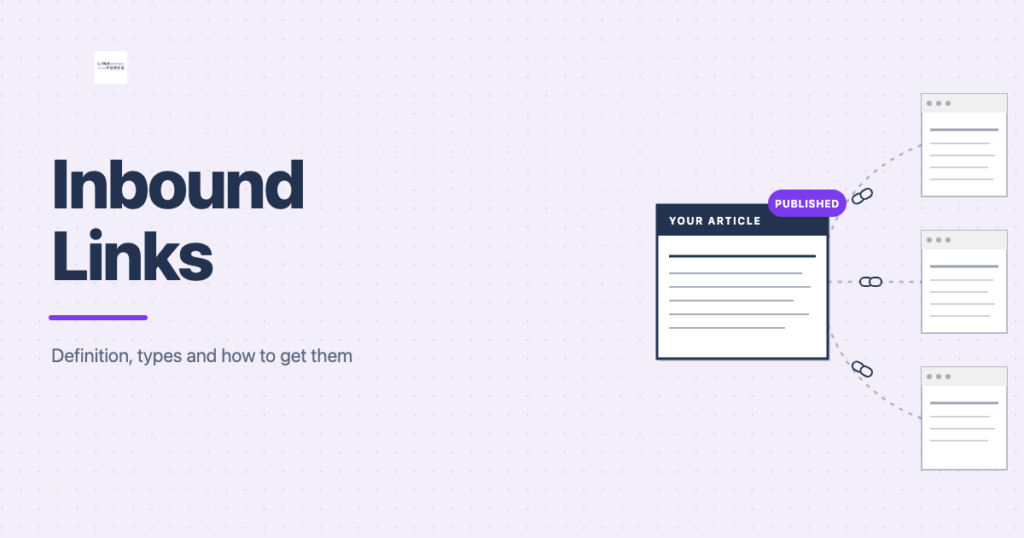
An inbound link is a link from another website pointing to your website. They’re also called backlinks, incoming links, or inlinks. If the New York Times links to your blog, that’s an inbound link to you. If you link to the New York Times from your site, that’s an outbound link from you and an inbound link to them.
Getting inbound links from authoritative, relevant websites is one of the most important things you can do to improve your search engine rankings.
What Is an Inbound Link?
An inbound link is a hyperlink on an external website that directs users to a page on your website. The term “inbound” describes the link from the recipient’s perspective: you’re the one receiving it.
Inbound links are also known as backlinks, incoming links, or inlinks. All four terms refer to the same thing. “Backlinks” is what you’ll see most often in SEO tools, while “inbound links” is common in marketing and analytics contexts.
Inbound Link vs. Outbound Link vs. Internal Link
These three link types look similar in HTML but serve different purposes:
| Link type | Direction | Example |
|---|---|---|
| Inbound link | From another website to your website | Forbes links to your article |
| Outbound link | From your website to another website | You link to a Wikipedia article |
| Internal link | From one page on your website to another on the same site | Your homepage links to your blog |
The same link can be inbound and outbound simultaneously, depending on perspective. If Forbes links to your article, that’s an outbound link for Forbes and an inbound link for you.
Why Are Inbound Links Important for SEO?
The diagram below maps the six key benefits that flow from a single strong inbound link.
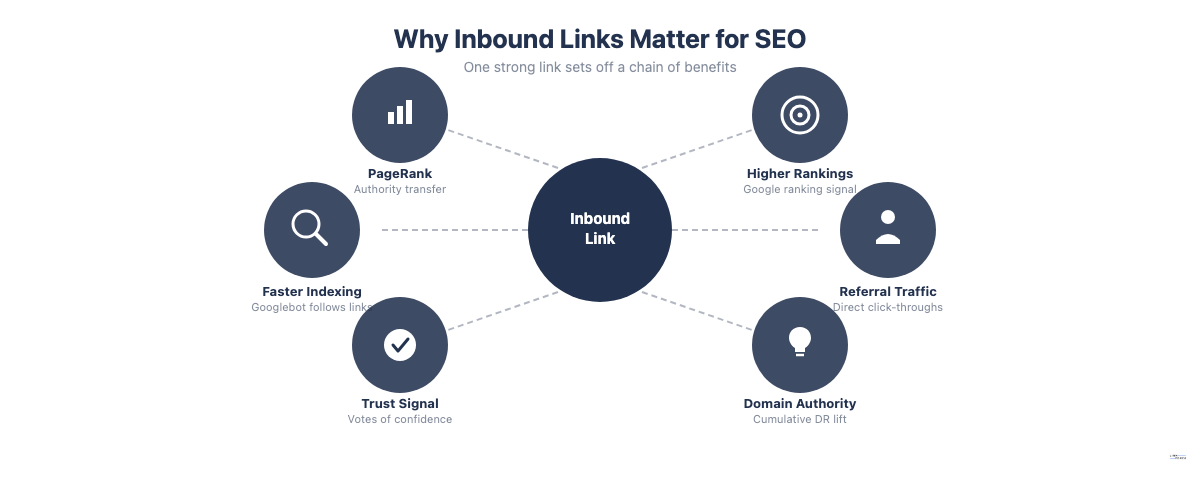
Inbound links are one of Google’s most important ranking signals. Google treats links from other websites as votes of confidence. The more authoritative those websites are, the more those votes count.
Google has stated: “If other prominent websites on the subject link to the page, that’s a good sign that the information is well trusted.” That’s the core logic behind how links influence rankings.
Inbound Links Pass PageRank
Every web page has a PageRank score, a measure of authority based on the quantity and quality of its inbound links. When a page links to your site without a nofollow attribute, it passes a portion of its PageRank to your page.
This transfer of authority, sometimes called “link juice,” explains why a single link from a high-authority website can move your rankings more than dozens of links from low-quality sites. Domain Rating (DR) in Ahrefs and Domain Authority in Moz are external approximations of this concept. They’re not perfect, but they’re useful proxies.
Inbound Links Drive Referral Traffic
Beyond rankings, inbound links are a direct traffic source. When a well-read website links to your page, their readers can click through to yours. That traffic is often highly qualified because the reader arrived through content they were already engaged with.
Referral traffic from strong inbound links can continue for years after the link was placed. That’s a real compounding return, and it’s one most people don’t account for when they think about link building.
What Makes a Good Inbound Link?
Not all inbound links help your SEO. Here’s what a good inbound link looks like:
- Authority – It comes from a website with a strong backlink profile of its own. High Domain Rating (DR) pages pass more PageRank than low-DR pages.
- Relevance – The linking website covers topics related to yours. A link from a marketing blog to your SEO tool carries more weight than a link from an unrelated cooking site.
- Natural anchor text – The clickable text should read naturally. A healthy anchor text distribution includes branded anchors (your company name), naked URL anchors, generic phrases like “click here” and partial-match keywords. Exact-match keywords in every anchor text looks manipulated to Google.
- Dofollow attribute – A link marked “nofollow” or “sponsored” tells Google not to pass PageRank. Links without these attributes pass full value.
- Natural placement – Links embedded in the body of relevant content carry more weight than links in footers, sidebars or link directories.
- Diversity – A healthy backlink profile contains links from different types of websites: blogs, news sites, directories, forums. A mix signals organic growth.
The single most important factor is authority combined with relevance. One strong, relevant inbound link from a trusted source outright outperforms ten links from low-quality or unrelated sites.
Types of Inbound Links
The funnel below ranks each link type by SEO value, from most to least impactful.
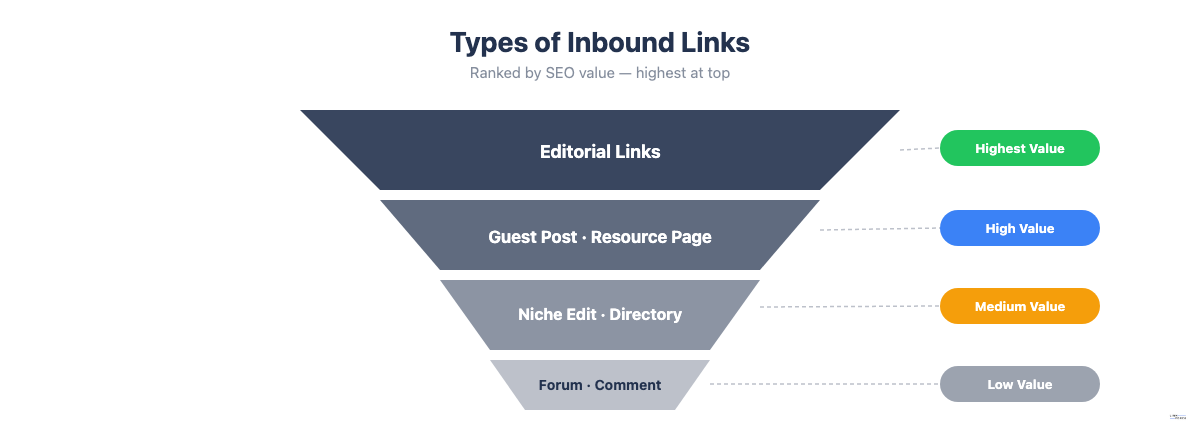
Inbound links aren’t all created equal. Understanding the types helps you prioritize which links are worth your time building.
| Link type | How it’s earned | Relative SEO value |
|---|---|---|
| Editorial link | A writer links to your content because it’s the best source on the topic | Highest |
| Guest post link | You write an article for another site and include a contextual link back | High |
| Resource page link | A curated list links to your content as a recommended guide or tool | High |
| Niche edit link | A link is added to existing published content on another site | Medium-high |
| Directory link | A business directory lists your site | Medium to low |
| Forum or community link | A discussion thread links to your page | Low |
| Comment link | You leave a blog comment with a link | Very low or nofollow |
How to Check Your Inbound Links
Checking your inbound links regularly tells you who’s linking to you, which pages are earning the most links and whether any harmful links have appeared.
Free option: Google Search ConsoleGo to Search Console, open your property and click “Links” in the left sidebar. You’ll see your top linked pages, top linking sites and anchor text distribution. It’s the most direct view Google gives you. This is the most direct data source because it shows what Google has actually indexed. Keep in mind that GSC shows a curated sample of your inbound links, not every link Google knows about. For comprehensive data, use a paid tool.
Paid tools for deeper analysis:| Tool | Key metrics | Cost |
|---|---|---|
| Ahrefs Site Explorer | DR, referring domains, anchor text, new/lost links | From $129/month |
| Semrush Backlink Analytics | Authority Score, referring domains, link types | From $139/month |
| Moz Link Explorer | Domain Authority, spam score, anchor text | From $99/month |
The main metrics to track are referring domains (the number of unique websites linking to you) and Domain Rating / Domain Authority (the overall authority of your backlink profile). A rising referring domain count generally correlates with ranking improvement over time. For a deeper look at what these metrics mean, see backlinks analysis.
How to Get Inbound Links
The six channels below cover the full range of link building tactics, from passive to active.
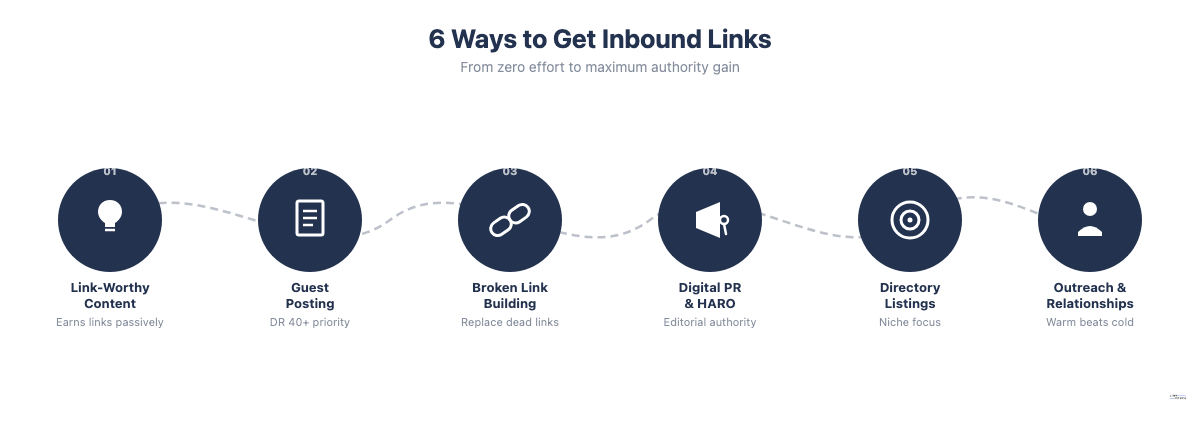
Link building is the process of actively earning inbound links. The most effective tactics give another website a reason to link to you, rather than trying to force or buy those links.
Create Link-Worthy Content
Content that earns links naturally includes original research, comprehensive guides, data-driven studies and tools that other writers want to reference. If your content is the most useful or authoritative page on a topic, writers will link to it without being asked. This is called link bait or linkable assets in SEO circles.
Guest Posting
Write an original article for a relevant blog or publication in your industry. Include one or two contextual links back to pages on your site that are helpful to the readers. Prioritize sites with a real audience and a Domain Rating above 40. When pitching, propose a topic that fits the host’s editorial calendar rather than sending a generic outreach email.
Broken Link Building
Find pages on other websites that link to a resource that no longer exists (a 404 page). Reach out to the site owner, point out the broken link and suggest your page as a replacement. It’s a systematic tactic rather than a one-off effort when you use tools like Ahrefs or Semrush to find broken outbound links at scale. See the broken link building guide for a step-by-step workflow.
Digital PR and Media Outreach
Create a newsworthy story, original data or research and pitch it to journalists and bloggers. When they cover your story, they link to your site as the source. A single placement in a major publication can earn dozens of secondary links as the story gets picked up elsewhere. Media outreach platforms like HARO (Help A Reporter Out) connect journalists with expert sources and are a fast path to editorial links from high-authority publications. The digital PR guide covers this process in more detail.
Directory and Resource Listings
Submit your site to relevant industry directories, professional association member pages and curated resource lists. Focus on directories that are selective and well-maintained. Generic link directories offer little value; niche directories in your field carry real weight.
Outreach and Relationship Building
Identify writers and editors who cover your topic regularly and build a genuine relationship before pitching. When you’ve got something worth linking to, a warm outreach is far more effective than a cold email. Respond promptly to journalist requests and contribute to industry conversations. These relationships compound over time.
When Do Inbound Links Hurt Your SEO?
Not all inbound links are good for you. Google’s Penguin algorithm, introduced in 2012 and now a continuous real-time filter, targets websites with unnatural or manipulative link profiles. Google’s AI-based spam detection system, SpamBrain, automates this further at scale, so it’s harder than ever to game.
Links that can trigger penalties or be algorithmically discounted include:
- Paid links that pass PageRank without a rel=sponsored or rel=nofollow attribute
- Links from private blog networks (PBNs) built purely to manipulate rankings
- Links from irrelevant, low-quality or spammy websites
- Reciprocal link exchange schemes (linking to each other purely for SEO benefit)
- Links with over-optimized, exact-match anchor text repeated across many sites
If you receive a manual penalty from Google, you’ll see a notification in Google Search Console under Security and Manual Actions. You can use the GSC disavow tool to tell Google to ignore specific links pointing to your site. Use it carefully. Disavowing good links by mistake can hurt your own rankings, so don’t target anything that isn’t clearly harmful.
For most sites, toxic links from random sources aren’t a major concern because Google already ignores most low-quality links algorithmically. If your site has a history of aggressive link-building campaigns, a regular backlink audit is worthwhile.
How Many Inbound Links Do I Need to Rank?
There’s no fixed number. The right answer depends on your target keyword and who’s currently ranking for it. That’s just how competitive link metrics work.
The benchmark to beat is the referring domain count of the pages sitting at positions 1 to 3 for your keyword. If those pages have 50 referring domains, getting 60 quality referring domains pointing to your page puts you in a competitive position. If they have 500, you have a bigger gap to close.
Use a tool like Ahrefs SERP Checker or Semrush to look up the backlink profiles of the top-ranking pages for your keyword before setting a link-building target. Quality matters more than quantity, without exception: 20 links from authoritative, relevant sites will outperform 200 from low-quality directories. The post on how many backlinks you need to rank goes deeper on this.
Frequently Asked Questions About Inbound Links
What is an inbound link in SEO?An inbound link is a hyperlink from an external website pointing to a page on your website. Search engines like Google use inbound links as trust and authority signals. They’re one of the strongest factors in how well your pages rank.
What is the difference between an inbound link and a backlink?There’s no difference. Both terms refer to the same thing: a link from another website to yours. “Backlink” is the term used most often in SEO tools. “Inbound link” shows up more in marketing and analytics contexts.
Are inbound links the same as outbound links?No. Inbound and outbound links are opposite concepts. An inbound link points toward your site from an external site; an outbound link points from your site to an external site. The same hyperlink is an inbound link for the receiving site and an outbound link for the linking site. Which one it is depends on whose perspective you’re using.
Do nofollow inbound links help SEO?Nofollow links don’t pass PageRank directly. Since 2019, Google has treated rel=nofollow as a hint rather than a strict directive, meaning high-quality nofollow links from authoritative pages may carry some indirect benefit for crawling and indexing. For link-building purposes, prioritize dofollow links, but nofollow links still provide referral traffic and contribute to a natural-looking link profile.
How do I remove a harmful inbound link?First, contact the site owner and ask them to remove the link or add a nofollow attribute. If that doesn’t work, use Google’s disavow tool in Search Console to submit a list of domains or URLs you want Google to ignore. Use disavow conservatively. Google already ignores most low-quality links algorithmically, and disavowing good links by mistake can lower your rankings.
What is the best way to build inbound links?The most reliable long-term approach is creating content that other writers want to reference, combined with proactive outreach. For faster results, guest posting on relevant, high-DR sites and digital PR campaigns that earn editorial coverage work consistently well. Broken link building is another underused tactic that converts reliably because you’re offering a direct replacement for a broken resource.