

Editorial Links: What They Are, Why They Matter and How to Earn Them
Most links you build through outreach are bought, pitched or traded. Editorial links are different. They’re placed by other publishers because your content earned them, not because you asked. This guide covers what editorial links are, why they’re worth pursuing and the specific editorial link building strategies that generate them.
What are editorial links?
An editorial link is a high-value, organic backlink voluntarily placed by a website owner or editor to reference your content because they find it valuable. These links are earned, not bought or traded, and are trusted by search engines like Google to indicate high authority, relevance, and credibility in SEO. They represent the most sought-after backlinks in link building because they signal genuine third-party endorsement.
They’re also called earned links, natural backlinks or editorial backlinks. The terms are interchangeable. What defines them isn’t where they appear but how they were acquired.
Five criteria confirm a link is truly editorial:
- No contact was initiated by your team
- The publisher controls the anchor text and placement
- Content quality drove the linking decision
- No payment or reciprocal arrangement was made
- The linking site maintains genuine editorial standards
If a link fails any of these, it’s not editorial, regardless of what the vendor or publisher calls it.
Editorial links vs. other backlink types
Not all backlinks carry the same weight, and the distinction matters more than most link builders admit. The table below shows exactly where editorial links differ from the alternatives.
| Factor | Editorial | Guest Post | Niche Edit | Paid Link |
|---|---|---|---|---|
| Who controls placement | Publisher alone | Shared | Publisher (post-outreach) | Advertiser |
| How acquired | Content earns it | Outreach and pitch | Outreach and request | Payment |
| Google-safe | Yes | Usually (with disclosure) | Risky without disclosure | No (violates Google guidelines) |
| Typical SEO value | Highest | Moderate to high | Moderate | Low (penalizable) |
Guest posts, niche edits and paid links all involve some form of outreach, pitch or payment. Editorial links don’t. The publisher found your content independently and chose to cite it. That’s what gives them their ranking value and zero penalty risk. Google’s link spam policies explicitly treat paid or artificially arranged links as violations regardless of where they appear on the page.
Why editorial links matter for SEO
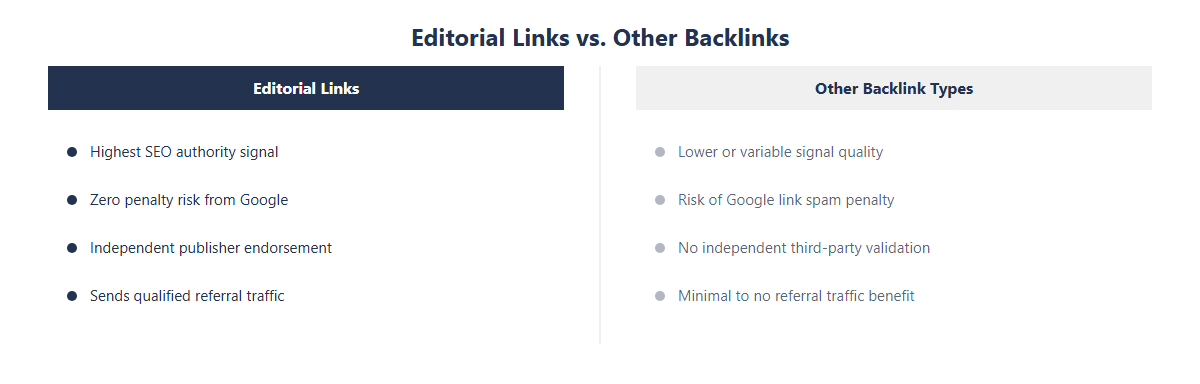
Google treats links as votes, and editorial links are the most credible votes you’ll earn. According to a Backlinko study of 11.8 million search results, pages ranking in Google’s top positions have 3.8 times more backlinks than those ranked below them. That correlation is strongest for independently earned, editorially placed links.
When a high-authority site links to you editorially, a portion of its trust flows to your page as link equity you can’t replicate through outreach or payment. Publications like the Wall Street Journal or TechCrunch aren’t reachable through traditional link building. The only way to earn a citation in their content is to publish something they find genuinely useful.
Beyond rankings, editorial backlinks carry real brand benefits. Being cited by well-known publications builds the “featured in” credibility that shortens buying cycles. Editorial mentions from respected outlets do more for brand trust than a year of directory submissions. High-traffic sources also send qualified referral visitors directly to your content, often converting better than cold traffic from paid channels.
There’s also the penalty risk difference. Reputable publishers vet their outbound links carefully. A citation from a high-standard source signals quality to Google precisely because those sites wouldn’t place it without genuine merit.
What content earns editorial links?
Not every piece of content earns editorial backlinks. The formats that attract them reliably have one thing in common: they’re useful enough that other writers reach for them when building their own arguments.
Original research and data
It’s the single strongest driver of editorial link building, without question. When you publish proprietary data, other writers cite it as a source. SEMrush’s annual State of Content Marketing report earned approximately 2,000 backlinks from 879 sites within months of publication. Sites with unique data and original research attract around 60% more backlinks than standard blog posts.
Free tools and calculators
Functional tools earn persistent links from the sites that recommend them. Influencer marketing platform inBeat built a fake follower calculator that Reader’s Digest cited in an article about fake Instagram accounts. One useful tool, no outreach required, produced a placement on a household-name site.
Comprehensive guides
Guides that cover a topic more thoroughly than anything else available become default reference points. Depth wins over breadth here, although volume is what most teams default to. A guide that answers every real question on a topic attracts citations from writers who’d otherwise have to explain the same concepts themselves.
Infographics
Well-designed infographics compress complex information into a shareable format. They earn links from the sites that embed them and credit the original source. They work best when the underlying data is solid and the visual design can stand alone without surrounding text.
Newsworthy content
Original surveys, expert commentary and timely analysis of emerging trends attract journalist mentions. If your content speaks to a developing story, you’ll see the chances of an organic citation increase sharply.
How to earn editorial links
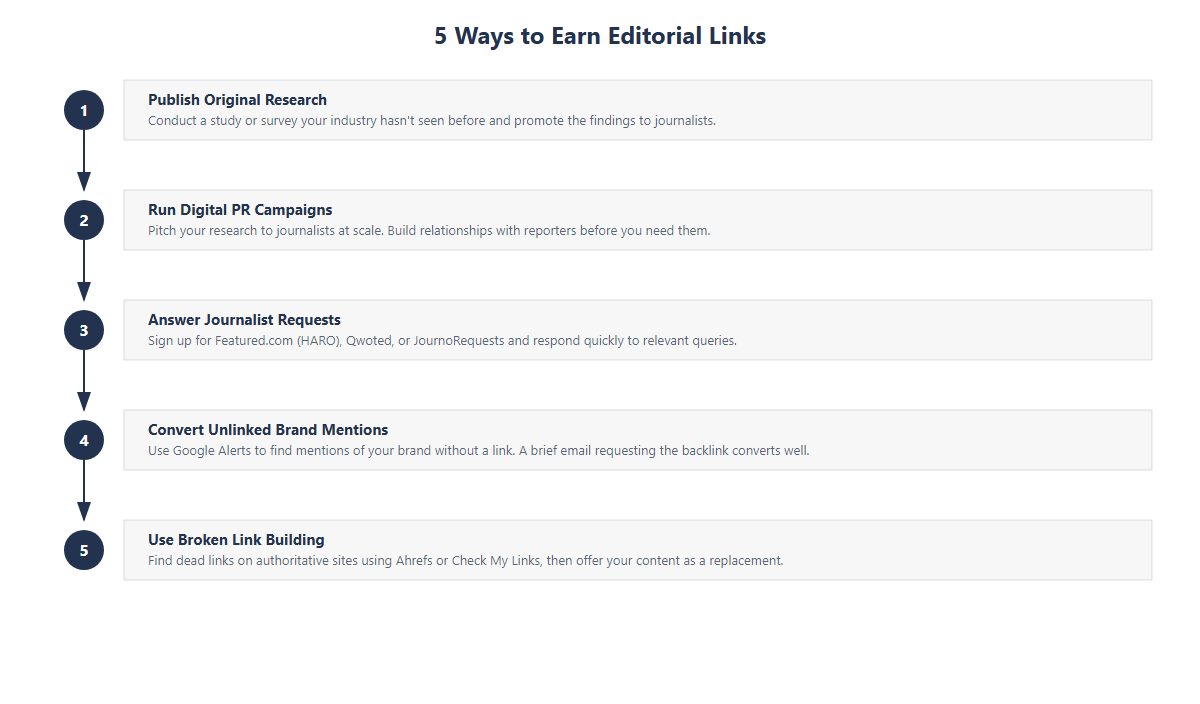
Creating linkable content is the foundation of any editorial link building strategy. Amplifying it’s what turns potential into actual links.
Publish original research
Conduct an original study, survey or data analysis in your field. Identify a question your industry hasn’t answered yet and publish the findings in a shareable format. Promote the data actively: share in relevant communities, pitch it to journalists covering your space and flag it to sites that already rank for the topic. One well-promoted study can generate dozens of editorial citations over its lifetime. For SaaS companies specifically, industry benchmark reports and product usage data studies are among the highest-converting content types for earning editorial backlinks. Our guide to link building for SaaS covers content-led approaches in more depth.
Run digital PR campaigns
Digital PR gets your research and ideas in front of journalists at scale. Write press releases targeting publications in your niche. Build relationships with relevant journalists before you need them. When you have something newsworthy to share, they’ll already know who you are. A single successful PR placement often triggers secondary mentions across dozens of other outlets. It’s a force multiplier for brand reach.
Answer journalist requests
Journalist query platforms connect you with reporters who need expert sources. HARO, now under new ownership at Featured.com after a brief shutdown in late 2024, remains the best-known option. Alternatives include Qwoted, JournoRequests and PressHunt. Sign up, filter for queries relevant to your expertise and respond quickly with specific, concise answers. They’re on deadlines, so the first useful response usually wins.
Convert unlinked brand mentions
Websites frequently mention brands without linking to them. Set up Google Alerts for your company name, key team members and product names. When you find a mention without a link, a brief polite email requesting the backlink converts at a high rate. The site already values you enough to mention you, so it’s a small ask.
Use broken link building
Find pages on authoritative sites that link to dead resources in your space. Tools like Ahrefs’ broken link report or the Check My Links browser extension surface these quickly. Reach out to the site owner, flag the dead link and suggest your content as a replacement. It solves their problem and earns you a placement you wouldn’t have found through standard outreach.
Common mistakes when pursuing editorial links
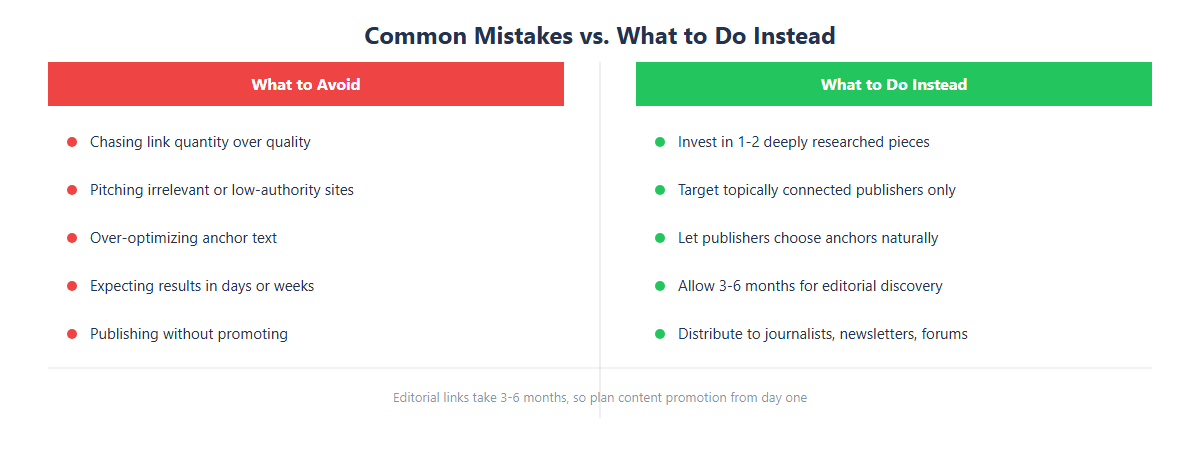
There’s one mistake that dominates: treating purchased or outreach-assisted placements as editorial links. Buying a link doesn’t make it editorial, regardless of how a vendor labels it. That distinction is non-negotiable.
Five mistakes to avoid:
- Expecting quick results. Editorial links typically take 3-6 months to appear after content publication. Links form after search engines index your content and other writers discover it during research. That timeline is built into the strategy.
- Chasing quantity over depth. One piece of genuinely original research attracts more editorial backlinks than 50 standard blog posts. Concentrate resources toward depth, not volume.
- Pitching irrelevant or low-authority sites. Targeting websites with no topical connection to your content wastes time and signals low editorial standards. Every site you pursue should have a genuine reason to cite your work.
- Over-optimizing anchor text. Consistently using exact-match keywords as anchor text looks manipulative to Google. Editorial links come with natural, contextual anchors chosen by the publisher, and that is exactly what gives them their value.
- Skipping content promotion. Great content that no one sees doesn’t earn links. Distribute through newsletters, social channels, community forums and journalist networks to make your content discoverable.
Frequently asked questions about editorial links
Are editorial links the same as natural backlinks?
Not exactly. Natural backlinks include any link placed without being solicited or paid for. Editorial links are a subset: they come specifically from content published by writers who chose to cite you because your content added value to their work. The terms are often used interchangeably, but editorial links imply a higher standard at the linking site.
Can you buy editorial links?
No. Purchasing a link makes it a paid link, not an editorial one, regardless of how it’s labeled. Some vendors market “editorial link placements” as a service, but these are paid placements that violate Google’s link spam policies. The editorial label describes how a link is earned, not where it appears.
How do I know if I have editorial links?
You’ll want a backlink audit tool like Ahrefs, SEMrush or Moz to review your backlink profile. Editorial links typically come from news sites, research roundups, industry blogs and guides with no prior outreach record on your end. Our link building software guide covers the best tools for auditing and monitoring your backlink profile. Sort by referring domain authority and look for citations in editorial content pieces rather than directories or profile pages.
What’s the difference between editorial links and guest posts?
A guest post is a link you placed yourself through outreach and writing. An editorial link is placed by a third-party publisher who chose to cite your content independently. The core difference is who initiated the relationship. Guest posts can be valuable, but they don’t carry the same independent endorsement signal that editorial links do.
How long does it take to earn editorial links?
That’s typically 3-6 months after your content is published and indexed. The timeline depends on how competitive your niche is, how actively you promote the content and whether you’ve built relationships with journalists or publishers in your space. Research-driven content and free tools tend to attract links faster than opinion pieces.