

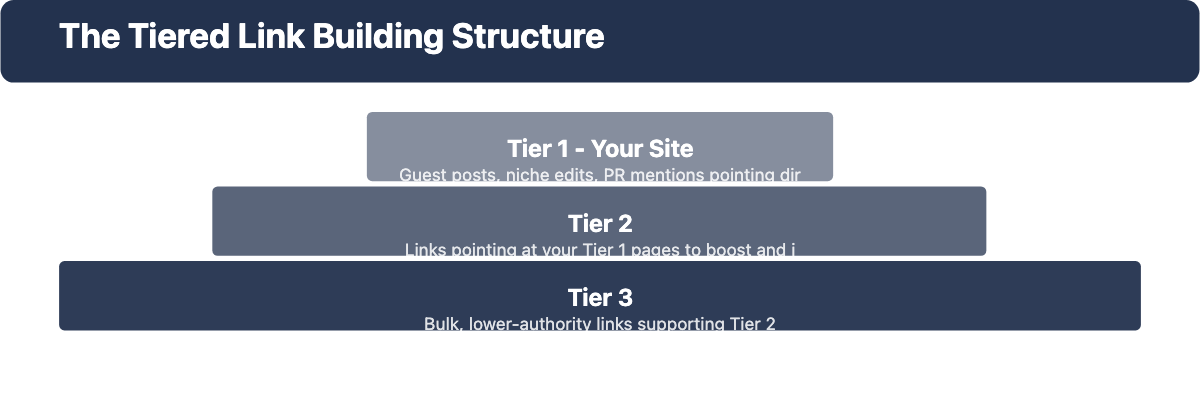
Tiered link building sorts backlinks into layers by what each link points at, not by what kind of link it is. It's sometimes described as a pyramid feeding authority up toward your "money site," your actual target domain. A tier 1 link points directly at your site. A tier 2 link points at the page that carries that tier 1 link. A tier 3 link points at a tier 2 page. The theory is that link equity flows down the chain, so strengthening tier 2 and tier 3 pages indirectly strengthens the tier 1 links that actually touch your own site. It's a real mechanic, but it's also one of the most commonly abused ideas in off-page SEO, and that's worth getting straight before you build anything. You don't need to understand graph theory to use it well, but you do need to know where it stops being useful and starts being risky.
What Is Tiered Link Building?
A tier 1 link is any backlink that points straight at a page on your own site, say a guest post or a link placed inside an existing article. A tier 2 link isn't aimed at your site at all; it points at that guest post or article instead. A tier 3 link points at whatever page carries the tier 2 link. The tiers describe position in the chain, not link quality or format: a guest post, a profile link, and a blog comment can each sit at any tier depending on what they point at.
| Tier | What it points at | Typical page types |
|---|---|---|
| Tier 1 | Your site directly | Guest posts, niche edits, digital PR placements, resource page mentions |
| Tier 2 | The page carrying a tier 1 link | Secondary guest posts, profile pages, forum threads, Web 2.0 properties (free blog platforms), social or syndication pages |
| Tier 3 | The page carrying a tier 2 link | Blog comments, directory listings, bookmark or Q&A sites, free web property pages |
Here's the practical reason this structure exists at all: a single tier 1 placement, on its own, often sits on a page with few other links pointing at it. A guest post you published last month probably doesn't have much pointing back at it yet. Tier 2 and tier 3 links exist to change that, without anyone touching the tier 1 page itself or needing the original publisher's cooperation again.
What Does a Tier 2 Link Actually Do for a Tier 1 Placement?
A tier 2 link does three things for the tier 1 page it points at. First, it gives search engine crawlers another path to find that page, which matters if the tier 1 page is new or poorly linked from elsewhere on its own site. Second, it supports indexing: a page search engines can't find is a page they can't index, and an unindexed page passes no value no matter how good the link on it is. Third, it passes along a small amount of link equity of its own, stacked on top of whatever authority the tier 1 page already had.
The underlying mechanic traces back to PageRank, the link-valuation model Google co-founders Larry Page and Sergey Brin described in their 1998 paper on the original Google prototype. In that model, a page's score depends on the score of the pages linking to it, and that value gets dampened at each step away from the original source, commonly cited at a damping factor of 0.85 in the original formulation. Applied to tiers, this means a tier 2 link's contribution to your tier 1 page is real but diluted twice over by the time it reaches your own site: once from tier 2 to tier 1, and again from tier 1 to you. Tier 2 and tier 3 links are a volume play on a weak signal, not a shortcut to a strong one, and anyone promising otherwise is overselling the mechanic. They also tend to use looser anchor text than a tier 1 placement, which keeps the anchor text profile around your money site looking natural instead of over-optimized toward one exact phrase.
The free Disavow File Generator formats domains and URLs for Google Search Console.
Why You Should Confirm the Tier 1 Page Is Indexed Before Building Tier 2
A link only counts once the page carrying it is indexed. Building tier 2 links toward a tier 1 page that search engines haven't indexed yet just wastes the effort; there's nothing live for those tier 2 links to support. If you don't own the tier 1 page, the quickest check is a site search for its exact URL; if you do, Google Search Console's URL Inspection tool will tell you directly whether the page is indexed and, if not, why.
If a tier 1 page has been live for several weeks and still isn't indexed, that's rarely something more tier 2 links will fix. It's usually thin content on the host page itself, no internal links pointing to it from the rest of that site, or a crawl problem with the host domain as a whole, three things worth ruling out before you spend any budget on the layer underneath it.
How Tier 2 and Tier 3 Links Are Actually Built
Tier 2 and tier 3 links get built on lower-cost, lower-authority pages than a tier 1 placement, because their job is to support in bulk rather than to carry weight individually. In practice that means a mix of the following, usually combined rather than used alone.
Guest Posts and Niche Edits
The same tactics used for tier 1 also work for tier 2, just aimed at a smaller or less selective set of sites: a guest post on a mid-authority blog, or a niche edit inserting a link into an already-published, topically relevant article. These produce the most durable tier 2 links, because the hosting page is real editorial content rather than a disposable property that might vanish next quarter.
Forum Profiles, Comments, and Directory Links
Forum signup profiles, blog comments on relevant posts, and business directory listings are the cheapest way to build tier 2 and tier 3 volume, the same low-cost tactics covered in more depth in our guide to forum link building. They're also the tactics most likely to end up as thin, low-value pages with little traffic or authority of their own, which is exactly the pattern search engines' spam systems are built to catch. We'll get to that in the next section, because it matters more here than most guides admit.
Social Shares and Content Syndication
Sharing a tier 1 placement on X or LinkedIn, or distributing it through a press release or content syndication service, creates tier 2 touchpoints that add visibility and occasionally earn a secondary pickup, even though most social links carry no direct ranking weight on their own. Treat syndication as a distribution tactic that sometimes produces a real tier 2 link, not as a link-building tactic you can count on by itself.
A practitioner thread on r/SEO describes a related pattern worth knowing about: building tier 2 "pages" out of free Google properties, a Google Site listing acquired links alongside embedded Maps, YouTube videos, and Sheets, rather than real content pages. It works in the sense that it creates a page that exists and links out. It doesn't work in the sense that a free, disposable, auto-generated page carries little weight to pass on, and it's a pattern that leans toward exactly the kind of low-value, manipulation-only page the next section covers.
Is Tiered Link Building Safe, or Does It Risk a Google Penalty?
Google's own spam policies define link spam as "the practice of creating links to or from a site primarily for the purpose of manipulating search rankings," and the policy explicitly names "using automated programs or services to create links to your site" and "creating low-value content primarily for the purposes of manipulating linking and ranking signals" as examples. Most tier 2 and tier 3 tactics, bulk forum profiles, mass blog comments, disposable directory listings, and automated link networks, fall inside that definition whenever their only purpose is to point at a tier 1 page rather than to exist as useful content in their own right. The policy doesn't carve out an exception for links several steps removed from your own site; it turns on intent, not on how many layers separate the link from your domain.
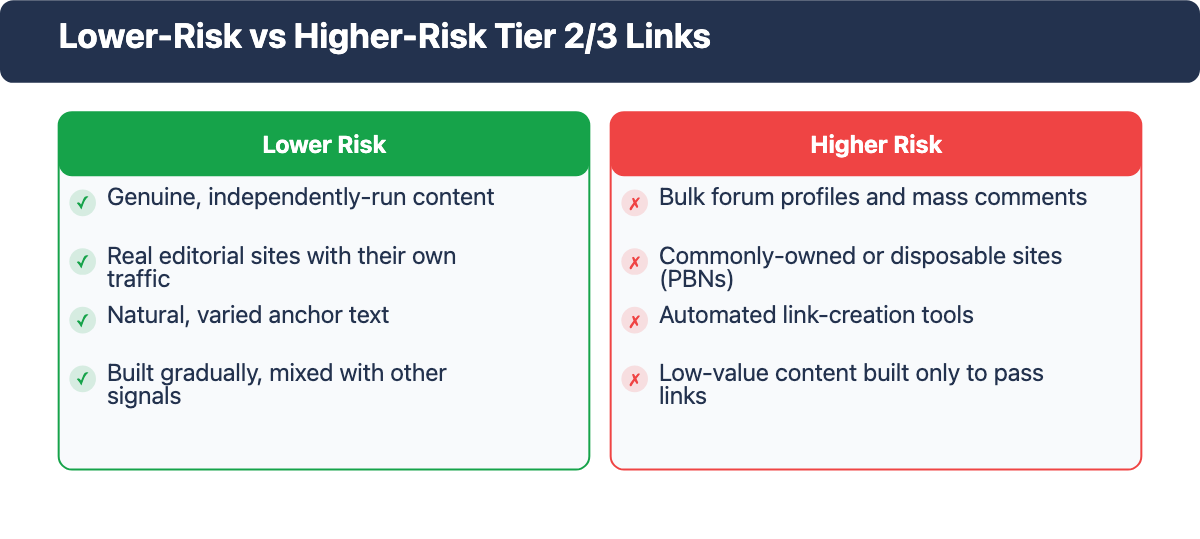
In practice, links built this way either get ignored outright by Google's automated systems with no benefit gained, or, in more aggressive cases, trigger an algorithmic devaluation or a manual action visible in Search Console. Algorithmic recovery after a devaluation typically takes months, and a manual action means a disavow-and-reconsideration process with no guaranteed timeline. None of this is a reason to avoid tiering as a concept. Frankly, it's a reason to be honest about what the lower tiers actually are before you build them at scale, and it's worth admitting that most teams don't check.
How This Differs From a Private Blog Network (PBN)
A private blog network is a set of sites under common ownership, often built on expired domains that already carry some authority, used specifically to manufacture links that look independent but aren't. Tiered link building and PBNs overlap heavily in practice because PBN sites are a common choice for tier 2 or tier 3 properties: a network of thin, commonly-owned sites linking into a layer of guest posts or niche edits. What matters to Google's policy isn't the tier structure itself but whether the linking pages are genuinely independent, useful content, or exist purely to pass links. A tier 2 guest post on a real, independently-run industry blog is a different proposition entirely from a tier 2 link planted on a site you or your vendor also happens to own.
Tiered Structures Need Upkeep, Because Pages and Links Don't Stay Put
A tiered link structure isn't a one-time build, even when every page in it is genuinely independent. Pew Research Center's May 2024 study of webpages collected between 2013 and 2023 found that roughly a quarter of all pages in that sample were no longer accessible by October 2023, and the rate varies sharply by page age: 38% of pages from 2013 were gone, compared with 8% of pages from 2023. The study checked close to 90,000 pages for each year in the sample.
Applied to a tiered structure, that means a meaningful share of your tier 2 and tier 3 pages will eventually go offline, get deleted, or quietly drop the link they were built to carry, usually with no notification when it happens. A tier structure built once and never revisited slowly loses whatever support it was providing, and you won't know unless you go back and check.
How to Audit the Tiered Links You Already Have
Work outward from your own backlink profile rather than trying to track every tier 2 and tier 3 page from day one.
- Pull a current list of the tier 1 pages linking to your site from a backlink checker tool of choice.
- Confirm each tier 1 page is still live and still carries the link; pages get updated or quietly removed without warning, and if you've lost one, it's a candidate for link reclamation rather than a write-off.
- Check whether each tier 1 page is indexed. An unindexed tier 1 page means any tier 2 links pointed at it are currently doing nothing.
- Map which tier 2 pages point at each tier 1 page, and spot-check a sample of them for the same two things: still live, still carrying the link.
Run this check periodically, not once. Given how many pages disappear or change over time, a tiered structure checked once at launch and never again will have real gaps within a year, and you'll have no way to know which links are still doing their job.
A Safer Way to Build Authority, Without the Tier 2/3 Risk
If the actual goal behind tiered link building is more durable authority, not lower-tier volume for its own sake, a white hat link building approach built on fewer, stronger tier 1 placements gets you there with far less exposure to a policy violation. Working with a link building service that sources genuinely independent, editorially-vetted placements, or a monthly link building program that compounds a small number of strong links over time, reaches a comparable outcome without needing to build, monitor, and eventually replace an entire second and third layer of disposable pages.

800+ SaaS marketers swap partner, integration and content links on LinkForce.
FAQ
What is tiered link building?
A way of organizing backlinks by what each link points at. Tier 1 links point at your site, tier 2 links point at the pages carrying tier 1 links, and tier 3 links point at tier 2 pages.
What is a tier 2 link?
A backlink that doesn't point at your own site, but at a page that itself links to your site (a tier 1 page). Its job is to help that tier 1 page get discovered, indexed, and lightly reinforced.
What is a tier 3 link?
A backlink pointing at a tier 2 page, one step further removed from your own site than a tier 2 link.
Is tiered link building safe?
It depends entirely on what the lower-tier pages actually are. Links built on genuine, independently-run content carry less risk; links built in bulk on thin, disposable, or commonly-owned pages fall inside Google's own definition of link spam and risk an algorithmic devaluation or manual action.
Is tiered link building the same as a private blog network?
No, but they overlap heavily in practice. A PBN is a specific setup of commonly-owned sites built to manufacture links; it's one common way tier 2 or tier 3 layers get built, but tiered link building itself is a structural concept that doesn't require a PBN to exist.
How do I check if my tier 1 page is indexed?
Search for the exact URL directly in the search engine, or use your search engine's own index-checking tools. Do this before spending any budget on tier 2 or tier 3 links aimed at that page.