
A private blog network, or PBN, is a group of websites under common ownership that exists to pass backlinks to a target site and boost its search rankings. PBNs can still produce a short-term ranking lift. But Google's SpamBrain system and its expired-domain-abuse policy clearly target the exact tactics PBNs depend on, so that lift is increasingly temporary. This article covers how a PBN is built, how Google finds and penalizes one today, and what a safer path to the same ranking goal looks like.
What Is a Private Blog Network (PBN)?
A private blog network is a set of websites, usually built on expired or auction domains with existing authority, that the same owner controls and uses to link back to a single "money site." The goal is to make those links look like independent editorial endorsements, when in reality every linking site exists only to pass authority to the target. Here's what separates a PBN from a normal guest post or a genuine partnership link: the network has no real audience or purpose of its own, and that's exactly why Google classifies link building built this way as a link scheme rather than a legitimate signal of relevance.
How a Private Blog Network Is Built
Most PBNs follow the same basic blueprint, and it isn't a complicated one: acquire domains with existing authority, host them so they don't look connected, publish content on each one, and interlink them to the target site with keyword-rich anchor text. The mechanics aren't complicated, which is also why PBNs really do leave a predictable trail for anyone looking closely, including Google.
How PBN Owners Choose Domains
PBN builders typically buy expired, closeout, or auction domains rather than registering new ones - they don't bother with a fresh domain because an expired one can carry years of accumulated backlinks and an established domain history. Before using one, careful operators check the domain's history with a tool like the Wayback Machine to confirm it wasn't previously used for spam, since a domain with a history of low-quality or unrelated content can carry a tainted reputation into the new network. Once acquired, the domain is restored or rebuilt with fresh content and pointed at the target site. If a domain's history is dirty, it isn't worth the risk.
The Footprint Signals That Give PBNs Away
A PBN is only useful if it goes undetected, but the same shortcuts that make a network fast and cheap to run also create a consistent set of "footprints," the signals that competitors, tools, and Google itself use to connect the dots between supposedly independent sites:
- Hosting overlap: Older or less careful PBNs often host multiple sites on the same IP address or hosting account, which is simple to check with a reverse IP lookup.
- Domain Authority patterns: Many PBN sites sit in a narrow, often low Domain Authority range, since they are built to pass links rather than to rank or attract traffic on their own.
- WhoIs ownership: Several linking domains registered to the same person, company, or hidden/privacy-protected registration can signal common ownership.
- Traffic data: Genuine publishing sites attract organic visitors; PBN sites usually don't get much real traffic outside the search engines that crawl them.
- Content quality: Thin, generic, or templated content repeated across several "independent" sites that all link to the same target is often the clearest tell of all.
No single signal proves a site is part of a PBN, but they're exactly what manual reviewers and automated systems look for when deciding whether a backlink is earned or manufactured.
The free Disavow File Generator formats domains and URLs for Google Search Console.
How Does Google Detect and Penalize PBNs?
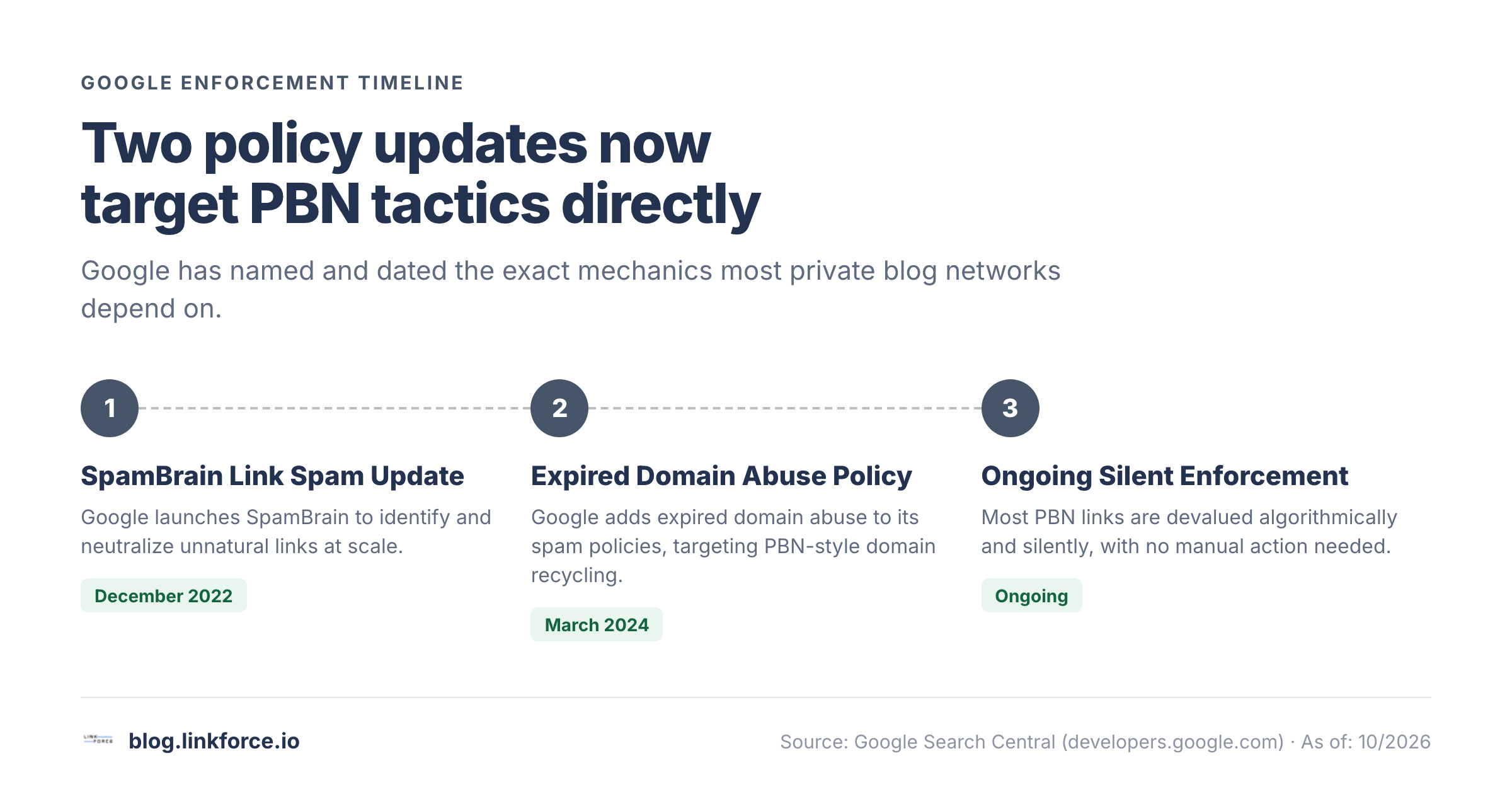
Google treats PBN-style links as link spam under its official spam policies. Two separate enforcement paths decide what actually happens to a page that relies on them, and they don't produce the same outcome. The timeline below shows the two named, dated policy actions behind that enforcement.
Algorithmic Devaluation vs. a Manual Action
Google enforces PBN links two ways: an algorithm that quietly discounts most of them, and a manual review that penalizes a smaller number directly. Since its December 2022 link spam update, Google has used an AI system called SpamBrain to identify and neutralize unnatural links at scale, including domains used primarily to pass links to other sites. When SpamBrain catches a PBN link, it usually doesn't penalize anyone - it just stops counting the link, so the ranking boost quietly disappears.
A manual action is a different and more serious outcome. A human reviewer at Google determines a site has unnatural links and applies a penalty directly in Search Console. That penalty can significantly affect rankings for the PBN sites and the target site alike. In practice, most PBN links don't trigger a manual action at all; they're just devalued algorithmically and silently. But a site that leans on them heavily, or gets reported, still risks the harsher manual-action outcome.
Expired-Domain Abuse: Google's Newest PBN-Relevant Policy
In March 2024, Google added "expired domain abuse" to its spam policies. The policy defines it as buying an expired domain and repurposing it mainly to manipulate search rankings, instead of serving the audience that domain previously had. Google's own examples describe cases like commercial content appearing on a site that once belonged to a nonprofit or a school, which is precisely the domain-recycling tactic most PBNs are built on. This policy didn't exist when many older PBN how-to guides were written, and it gives Google a direct, named basis for action against the exact acquisition strategy that makes a PBN possible in the first place.
Is a Private Blog Network Worth the Risk?
For most businesses, the honest answer is simply no, and it shouldn't take much convincing once you see the numbers. A PBN requires ongoing spend on domains, hosting, and content just to maintain a network that produces no direct traffic or brand value of its own. That entire investment can be neutralized overnight by an algorithm update or wiped out by a manual action, and there's no guarantee it won't happen. White-hat link building methods take longer to show results, but they build assets that don't lose their value just because a single link loses weight in the algorithm: real relationships, real referral traffic, real brand mentions.
Worth noting: several of the most detailed "how to build a PBN" guides online are published by companies that sell PBN hosting or PBN backlinks themselves, including guidance on how to make a network harder for Google to find. That's a direct financial incentive to downplay the risk, which is one more reason to weigh their claims against Google's own published policies rather than take them at face value.
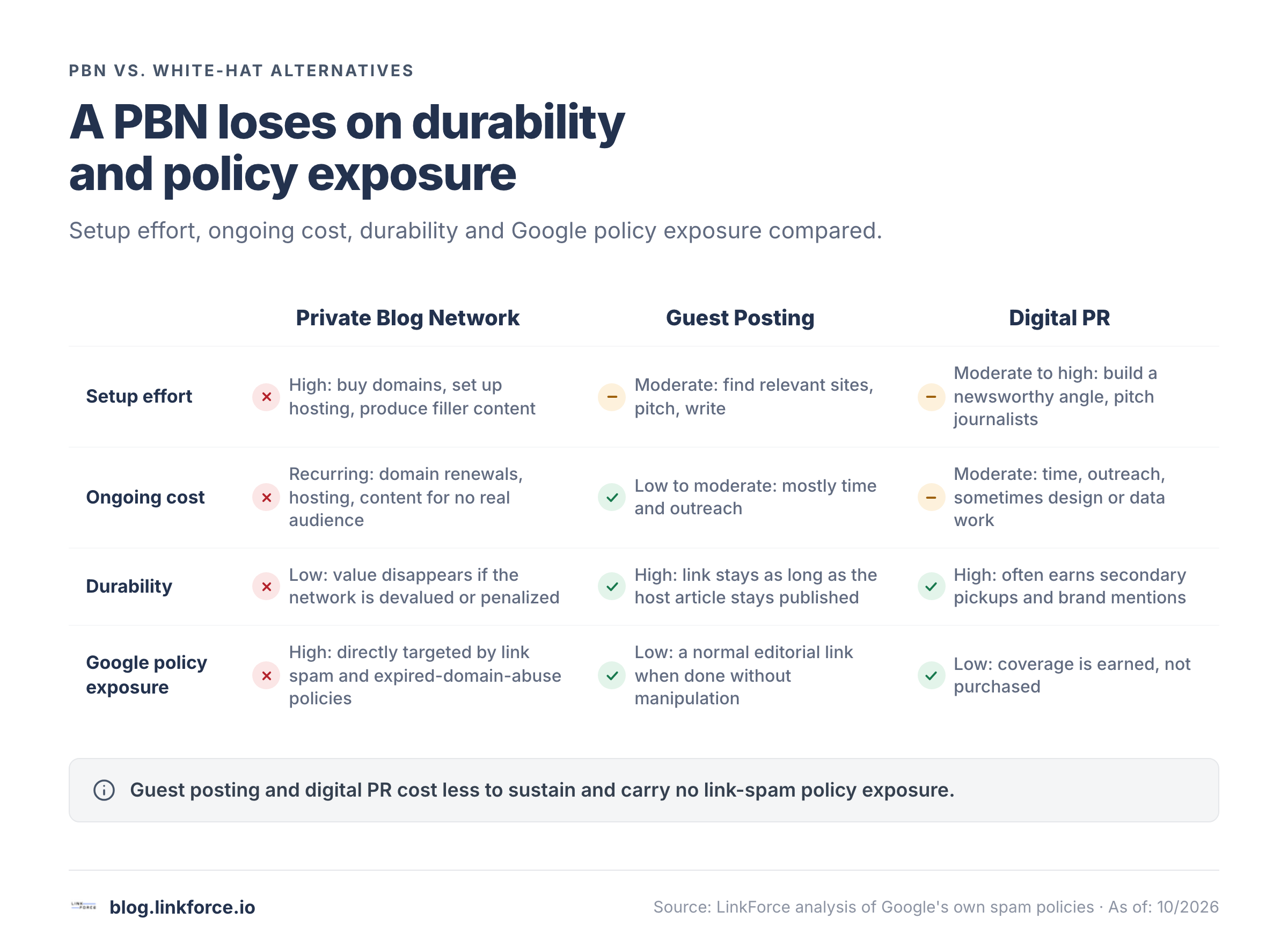
| Factor | Private Blog Network | Guest Posting | Digital PR |
|---|---|---|---|
| Setup effort | High: buy domains, set up hosting, produce ongoing filler content | Moderate: find relevant sites, pitch, write | Moderate to high: build a newsworthy angle or asset, pitch journalists |
| Ongoing cost | Recurring: domain renewals, hosting, content for sites with no real audience | Low to moderate: mostly time and outreach | Moderate: time, outreach, sometimes design or data work |
| Durability | Low: link value disappears if the network is devalued or penalized | High: link stays as long as the host article stays published | High: often earns secondary pickups and brand mentions beyond the first link |
| Google policy exposure | High: directly targeted by link spam and expired-domain-abuse policies | Low: a normal editorial link when done without manipulation | Low: coverage is earned, not purchased |
White-Hat Alternatives to a Private Blog Network
Guest posting, digital PR, broken-link building, and manual relationship-based outreach all build durable links without a PBN's policy exposure. Google's own AI Overview for this exact search already points the same way: if you are evaluating a PBN, the safer paths are auditing your existing backlink profile and building links the way Google's guidelines actually reward, which genuinely pays off over time.
- Guest posting on relevant, real publications. A well-placed guest post reaches an actual audience and earns its link through genuine editorial judgment, not a manufactured one. Our guest posting guide covers how to find sites worth pitching and how to pitch them.
- Digital PR. Earning coverage from journalists and industry publications produces links that no algorithm update can take away, along with brand mentions a PBN can't ever provide. See our digital PR guide for a practical approach.
- Manual, relationship-based link building. Outreach to real site owners for real, relevant placements remains the most durable way to build authority, and it's a skill that doesn't go stale. Our manual link building guide walks through the process step by step.
- Broken-link building. Finding dead links on relevant sites and offering your own content as the replacement earns a link through genuine value, not manufactured volume. Our broken link building guide covers the process.
- Audit your existing backlink profile. If you inherited a site with a questionable link history, or you're unsure whether past work included PBN-style links, start with our guides on how to find toxic backlinks and how to disavow backlinks in Ahrefs.
For the full picture of what a durable, policy-safe link building strategy looks like, see our white hat SEO link building pillar guide.

800+ SaaS marketers swap partner, integration and content links. Free plan, no credit card.
Private Blog Network FAQ
What is a private blog network (PBN) in simple terms?
In plain terms, a PBN is a set of "fake" independent websites that all funnel links to one real site, built to fool search engines into treating that real site as more popular than it actually is. They aren't really independent at all.
Are private blog networks still effective for SEO?
Some PBNs still produce a temporary ranking boost, which is why the tactic persists. But SpamBrain and the 2024 expired-domain-abuse rule now cut that boost short more often than not.
What are the risks of using a private blog network?
Two concrete outcomes, and neither's good: losing the benefit quietly, when an algorithm simply stops counting the link, or losing it publicly, when a human reviewer applies a manual action that can hit the PBN sites and the target site together.
How does Google tell a PBN apart from a normal backlink?
Honestly, no one signal's proof by itself - it's hosting overlap, a narrow Domain Authority band, shared WhoIs ownership, thin or templated content, and unusually low real traffic across several "independent" sites together that tip off a reviewer or an algorithm that a link wasn't earned.
What should I do instead of building a PBN?
Guest posting, digital PR, broken-link building, and manual relationship-based outreach - each one's covered with a practical guide in the section above.