
Outsourcing link building makes sense when your in-house team has run out of time, outreach relationships, or placement capacity, not simply because link building is hard. A link building agency, a freelance outreach specialist, or a full in-house team can all produce good results. The difference is which parts of the job each one should own, and that's not always obvious.
Many teams get this backwards, and it's an easy mistake to make. They outsource strategy and target selection, the parts that need the most business context, and try to keep cold outreach at scale in-house, the part that is hardest to staff well. This guide covers when outsourcing earns its cost, what to keep in-house regardless of who executes, what a hybrid setup looks like, what outsourced link building actually costs in 2026, the red flags that should end a vendor conversation, and what belongs in the contract before you sign. It's a lot to cover, but each piece matters.
Outsourcing Link Building Is a Decision, Not a Default
Four factors usually decide whether outsourcing link building is worth it: time, relationships, risk, and scale.
Link building's genuinely time-consuming. Finding relevant sites, vetting them, writing personalized outreach, and following up is closer to a full-time role than a side task. Strong placements also depend on relationships with editors and site owners built over months or years, not something a team can switch on the week a campaign needs links, and it doesn't happen overnight.
Link building done poorly carries real penalty risk. Low-quality guest posts, link farms, and pay-for-placement schemes with no editorial standards can hurt a site's SEO health more than a slower, cleaner approach helps it, and that damage doesn't undo itself quickly. And link building that needs to scale past a handful of placements a month usually needs either a bigger internal team or a specialized partner, because outreach volume grows faster than most in-house teams can staff for.
None of this makes outsourcing automatic, though. Outsourcing rarely makes sense if your team has never tried link building at all, has no SEO budget to spare, or is chasing link quantity over quality. In those cases, the fix is usually to build basic in-house capability first. It doesn't make sense to hand the whole function to a vendor on day one.
When Outsourcing Link Building Works
Outsourcing tends to pay off when most of these are true at the same time; it's rarely just one factor on its own.
- Your team has no existing relationships with relevant publishers or site owners, and building them from zero would take longer than your growth timeline allows.
- Nobody on the team has the bandwidth to run outreach as a near-full-time task. Link building competes with content and technical SEO, and it keeps losing.
- You need link volume beyond what one or two in-house people can realistically produce without cutting corners on vetting.
- You have budget for a quality-first provider, not just enough for the cheapest package available. Cheap and high-quality rarely coexist in link building, and that isn't going to change.
If only one of these is true, the stronger move is often to fix the underlying constraint (hire, train, free up time) rather than outsourcing the whole function. Outsourcing is a scaling decision for a team that already understands link building. It isn't a shortcut around one that hasn't tried it.
Paste any domain into the free Domain Rating Checker by LinkForce.
What to Keep In-House Even If You Outsource
Three things should stay under direct internal control, even when execution is outsourced.
Strategy and target selection. Deciding which pages need links, which keywords matter most, and which site types are worth pursuing requires business context a vendor will never have as completely as your own team does. A vendor can execute against a brief, but they shouldn't be writing the brief from scratch.
Brand and relationship judgment. Which sites fit your brand voice, which partnerships are worth nurturing past one placement, and which opportunities carry too much reputational risk aren't calls a single SEO metric can make for you.
Final quality control. Every placement a vendor brings back should get a human review before it counts as done. Does the surrounding content actually make sense? Is the anchor text natural? Does the site look legitimate only in a metrics dashboard, or also when you look at it yourself? Outsourcing execution doesn't mean outsourcing judgment about what gets approved.
The Hybrid Model: Outsource Execution, Keep Strategy In-House
Most teams that get outsourcing right run a hybrid model, not a pure in-house or pure hands-off setup. Outreach execution and placement logistics go to an outside partner. Target selection, final approval, and relationship ownership for the highest-value sites stay internal. They don't get handed off.
In practice, this looks like three roles. The internal team sets the target list, the success criteria, and the no-go list: sites, tactics, or anchor patterns that are off-limits. The outsourced partner runs outreach volume and handles the back-and-forth with site owners, delivering placements against that brief. The internal team reviews every placement before it counts as a win, and owns the relationship directly for the handful of sites that matter most long-term.
This splits the work by what each side does best. A specialized partner can run outreach at a volume that's hard to match internally. Your own team understands the business and the brand in a way no outside partner fully can. Neither side has to pretend it's good at the other's job.
What Outsourced Link Building Actually Costs in 2026
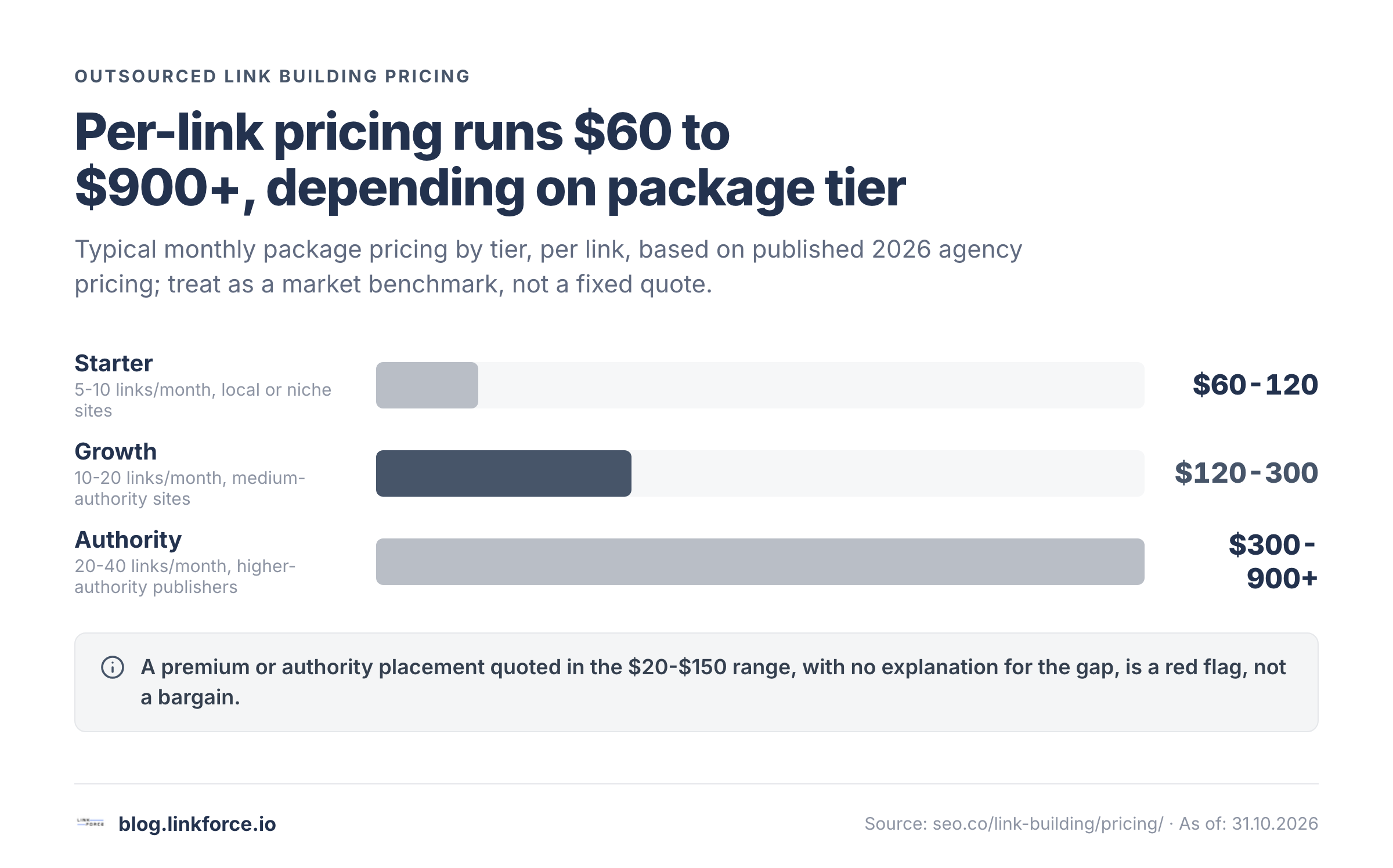
Pricing varies by package size and site authority, but published agency pricing in 2026 clusters into recognizable bands, so it's not as unpredictable as it looks. Treat every figure below as a market benchmark, not an official fixed price. Actual quotes vary by niche, vendor, and current demand, so don't expect every provider to land in the same spot.
A typical outsourced link-building package includes outreach prospecting, a vetted site list, content writing or editorial coordination for the placement, the link itself, and a results report. That's the full bundle most vendors quote against. Pricing scales with how much of that bundle, and how much site authority, you're buying.
By package size, monthly retainers tend to fall into three tiers, according to published pricing from link-building vendor SEO.co. Smaller packages (roughly 5-10 links a month) typically run $60-$120 per link on local or niche sites, a legitimate price point specifically for that smaller, lower-authority scope. Mid-size packages (roughly 10-20 links a month) run $120-$300 per link on medium-authority sites. Larger, authority-focused packages (roughly 20-40 links a month) run $300 to $900 or more per link on higher-authority publishers.
A separate way to benchmark price is by content and placement quality rather than package size. Premium placements with substantial original content and expert input run roughly $900-$2,500 or more. Mid-authority placements with standard editorial review run roughly $450-$1,200. Smaller niche or long-tail placements run roughly $200-$600. SEO.co itself flags a fourth, "avoid" band of roughly $20-$150 for a placement that claims to include real content and editorial review at that price. The difference between that risky band and the legitimately cheap small-package tier above is what you're actually buying: a small, niche Starter package at $60-$120/link is a known, disclosed scope; a "premium" or "authority" placement quoted at that same price, with no explanation for the gap, is the warning sign.
Whole-campaign pricing follows the same math. Published examples include a single researched link and article around $800, and a 10-link, 10-article campaign around $5,000. Buying ten placements as one coordinated campaign works out to roughly $500 per placement. That's cheaper per link than buying the same ten links one at a time, because outreach and vetting costs are shared across the batch.
Two independent reference points land in the same range as SEO.co's figures above. Growth Partners Media, a link-building agency, states a typical agency retainer in the $3,000-$10,000 per month range depending on volume and target quality, consistent with the per-link numbers once multiplied by a realistic monthly link count. Content resource Saynine separately puts a reasonable ceiling of roughly $300 for a single strong placement, which lands inside the niche/long-tail band and near the low end of the Starter package tier. It's a useful floor-side check.
Agency pricing shifts with site inflation and demand for higher editorial standards, so use these bands to sanity-check a quote and to track ROI against a market baseline, rather than to hold a vendor to one exact number.
Red Flags That Mean You Should Walk Away
Five signals reliably separate a legitimate link-building partner from one that costs more in cleanup than it saved in fees.
- Guaranteed rankings. No legitimate provider can guarantee a specific search ranking. Rankings don't depend on backlinks alone, they depend on far more than that. A guarantee is a sign of inexperience, or of a vendor managing expectations dishonestly.
- A quoted price that doesn't match the promised tier. A legitimately small, niche package can run $60-$120 per link, disclosed as exactly that. A "premium" or "authority" placement quoted in the $20-$150 range, with no explanation for why it undercuts the market this much, is strongly associated with private blog networks, link farms, or automated placement schemes that risk a manual action or algorithmic penalty.
- No transparency about link sources. If a vendor won't name the sites they place links on, won't share a sample of recent placements, or treats their site list as a trade secret, that opacity is the point. It isn't an oversight.
- Low-quality or AI-generated placement content. A link embedded in thin or obviously automated content carries less editorial weight, and it's more likely to get removed once the host site cleans up.
- Selling on raw authority metrics alone. A site chosen only for a high Domain Authority or Domain Rating score, with no attention to real traffic or topical relevance, is a red flag. Expired domains and metric-inflated sites are a known tactic for gaming these scores, and they don't carry real audience value behind them.
Client reviews and case studies are a weaker signal than they look. A provider can show five-star testimonials and a glossy case study while still selling the exact placements described above; reviews tell you whether past clients were happy with communication, not whether the links themselves are safe. Treat reviews as a tie-breaker between two link building services that already passed the five checks above, never as a substitute for them.
If a provider answers vaguely or gets defensive when you raise any of these five points directly, that reaction's itself useful information. Walk away before signing. Don't wait until after the first invoice.
What to Put in the Contract or SOW Before You Sign
Get these six points specified in writing before committing budget, not just discussed on a sales call.
- Reporting cadence and content. How often you'll receive a report, and whether it includes the live URL, anchor text, and traffic/relevance of each placement, not just a running link count.
- Link-removal and replacement policy. What happens if a placed link gets removed, the page gets deleted, or the site later gets deindexed. You don't want to find out after the fact. A credible vendor replaces or refunds. If they don't answer that clearly, it previews how disputes will go later.
- Full disclosure of methods and site selection criteria. How sites are chosen, whether outreach is personalized or templated at scale, and whether any placements involve paid or sponsored content that carries its own disclosure requirements.
- A realistic results timeline. Most credible providers frame meaningful ranking or traffic movement from new links in a 3-6 month window, not weeks. If a provider promises faster, durable results than that, question it; it probably won't hold up.
- A single point of contact and response-time expectations. Who you'll talk to when something goes wrong, and how quickly they're expected to respond.
- Exit terms. What happens to undelivered links, unused budget, and reporting access if you don't renew or you end the engagement early.
Getting these six points answered in writing before the first payment clears protects the engagement far more than any back-and-forth after it's already started.

800+ SaaS marketers swap partner, integration and content links. Free plan, no credit card.
Outsource Link Building FAQ
Is outsourced link building safe for SEO? It's as safe as the vendor you choose. Link building itself isn't risky, but low-quality, spammy, or manipulative placements genuinely are. The red flags above are the fastest way to separate a safe provider from a risky one before you commit budget.
How long until outsourced link building shows results? Most credible providers frame realistic movement in rankings or organic traffic from new links in a 3-6 month window, not days or weeks. Search engines need time to crawl, index, and factor in new links, and rankings don't respond to links alone; they weigh many other signals too.
Can I outsource only part of link building? Yes, and for many teams this is the stronger setup. The hybrid model above, outsourcing outreach execution while keeping strategy, target selection, and final approval in-house, buys the volume a vendor can deliver without giving up control over what represents your brand. You don't have to choose one extreme or the other.