

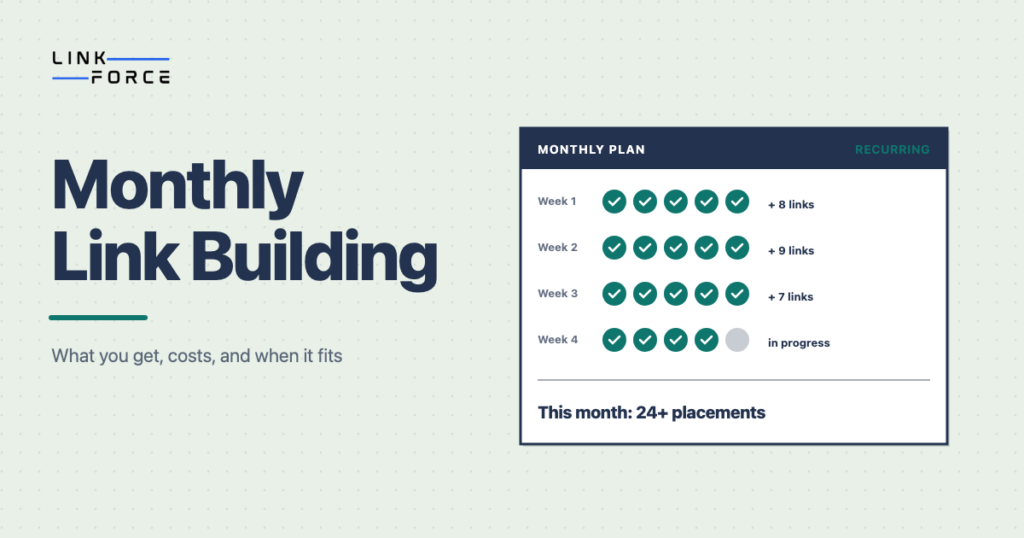
A monthly link building service is a retainer-based SEO arrangement where an agency acquires editorial backlinks to your website on an ongoing basis. Most professional campaigns run $3,000 to $10,000 per month and deliver 5 to 25 high-authority links through outreach, guest post placements and niche edits. Entry-level packages start around $500 to $2,000 per month. Here’s what you get, what it costs per link and how to know whether a retainer makes sense for your situation.
What Is a Monthly Link Building Service?
A monthly link building service is a recurring engagement where an SEO agency or specialist builds backlinks to your site each month at a fixed retainer fee. You get a steady flow of new referring domains added to your backlink profile instead of a one-off batch. Each new link raises your domain authority baseline. That means subsequent links get incrementally more powerful: a site at DR 40 extracts more value from the same placement than a site at DR 10. It’s a compounding effect, not a flat one.
One thing separates a retainer from a one-time campaign: link velocity. Search engines read a consistent monthly acquisition rate as natural growth. A sudden burst of 30 links followed by nothing can look manipulative, and it often does. Monthly services hold a steady pace instead, one that compounds without triggering algorithmic filters.
What’s Included in a Monthly Link Building Service?
Most reputable monthly services bundle five core deliverables: prospect research, personalized outreach, content creation, link placement and monthly reporting. Clients don’t manage individual steps. The agency runs the full acquisition workflow, and you don’t have to touch a single email thread.
Link Prospecting and Target Research
The agency identifies websites relevant to your niche that have the domain rating and editorial standards worth targeting. Each site’s manually vetted for organic traffic, topical relevance and editorial quality. Reputable agencies reject sites with Spam Scores above 10% or those that openly accept any paid link request, since those sites are signs of a link farm. That’s not a gray area. Competitor backlink analysis surfaces opportunities your rivals are already using.
Outreach and Relationship Management
Personalized outreach campaigns go to site editors and blog owners. A quality service runs manual outreach, not mass email blasts. They manage follow-ups, handle rejections and build the relationships that make placements possible. The best agencies pace placements deliberately across the month. That’s what keeps the acquisition rate looking natural instead of front-loading delivery.
Link Placement: Guest Posts, Niche Edits and Editorial Links
Most services deliver links through guest post placements (writing a new article for another site), niche edits (adding a link to an existing article) and editorial links (earning a mention through outreach). Typical deliverables run 5 to 20 links per month depending on budget tier. The exact mix varies by provider and niche, and it’s worth asking upfront which mix you’re paying for.
Monthly Reports and Link Tracking
Each month you get a report covering every link placed: the referring URL, anchor text, domain rating and live link confirmation. A transparent service delivers the report with no delays, full stop. For more detail on what good reporting looks like, see our guide to link building reporting. Some providers also include an anchor text strategy overview and a brief on upcoming outreach targets. That’s the baseline for a transparent report.
How Does the Process Work?
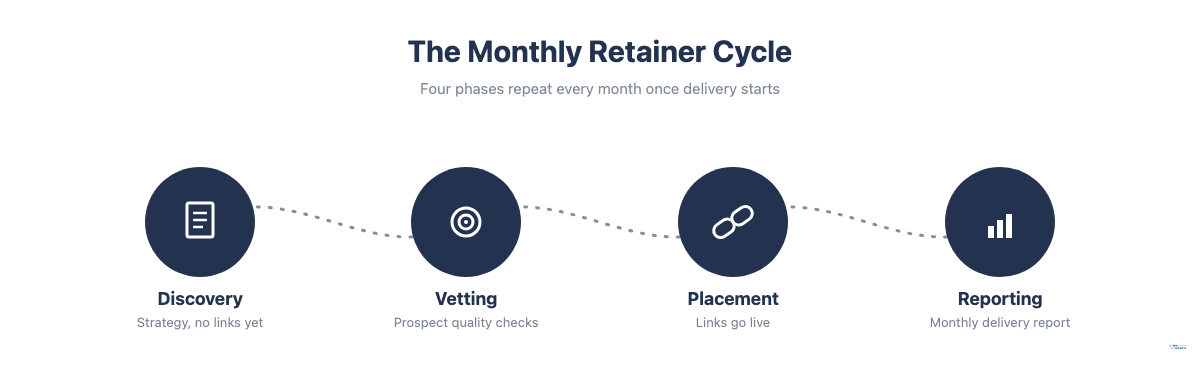
A monthly link building service runs through four phases: discovery and strategy, prospect vetting, content creation and placement, then tracking and reporting. That’s the standard shape most providers follow. The first month is setup. Steady link delivery starts in month two, and it doesn’t really slow down after that.
Month 1: Discovery and Strategy
The agency reviews your existing backlink profile, identifies link gaps versus competitors, sets anchor text targets and builds the initial prospect list. Expect few or no links delivered in month one. This ramp-up is standard practice, and it’s worth confirming before you sign. The ramp-up period runs 4 to 8 weeks for the first live placement.
Ongoing Months: Prospecting, Outreach and Placement
From month two onward, the agency runs rolling outreach campaigns. Sites get contacted, content gets written and submitted, then links go live on real pages. How many links land each month depends on the tier and how competitive the niche is. It’s rarely a fixed number.
Monthly Cycle: Delivery Review and Next Steps
At the end of each month, you get a delivery report. Most services include a strategy note on what worked, what’s pending and the plan for the next month. The best providers schedule a brief check-in too, to review results and adjust anchor text or target pages. That’s the whole loop, repeated.
Pros and Cons of a Monthly Link Building Service
A retainer isn’t automatically the right call just because it works well for other companies. Weighing the real trade-offs before you sign helps you decide whether the model fits your situation, or whether a different link building approach makes more sense.
Pros of a Monthly Retainer
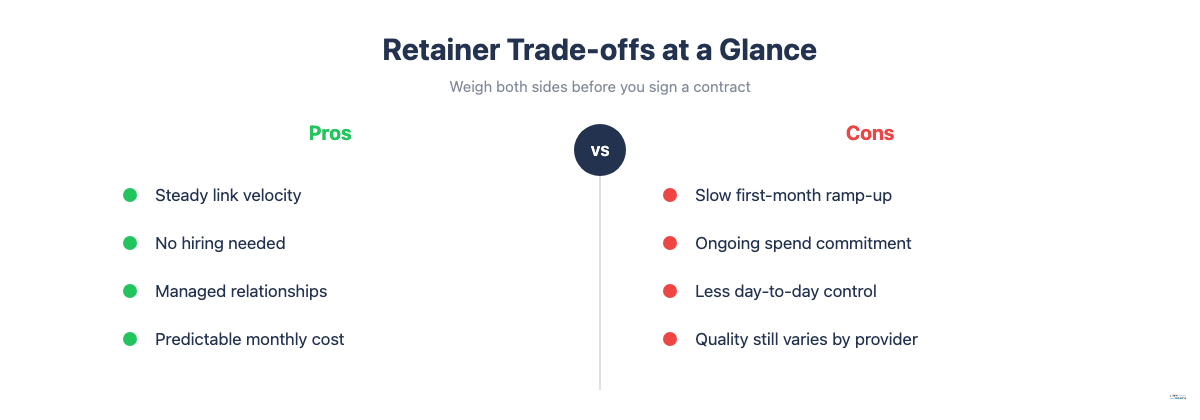
- Consistent link velocity. A steady monthly pace reads as natural growth to search engines, and it compounds as your domain authority climbs.
- No in-house hiring needed. You get outreach specialists, content writers and prospecting tools without building that capacity yourself.
- Ongoing relationship management. The agency handles rejections, follow-ups and renegotiation with publishers so you don’t have to.
- Predictable monthly cost. A fixed retainer’s easier to budget than paying per link on an ad hoc basis. There’s no invoice surprise at month end.
Cons of a Monthly Retainer
- Slow ramp-up. Most services deliver few or no links in month one while research and prospecting happen.
- Ongoing spend commitment. You pay every month, even in a slower placement month, for as long as the contract runs.
- Less day-to-day control. You’re trusting the agency’s judgment on which sites to pursue and how to word outreach.
- Quality still varies by provider. A retainer buys consistency of delivery. It doesn’t automatically buy consistency of quality. Vetting a provider still matters, and the checklist further down covers exactly how.
What Does a Monthly Link Building Service Cost?
Based on reported industry benchmarks, monthly link building services cost $3,000 to $10,000 per month for professional agency campaigns. Entry-level packages start at $500 to $2,000 per month. Enterprise or digital PR campaigns can exceed $25,000 per month. That’s the range most contracts fall into. Per-link cost is the more useful metric: reported benchmarks put the average around $200 to $600, with high-authority placements running well above that.
Pricing Tiers
| Tier | Monthly Cost | Links / Month | Avg. Per-Link Cost | Typical DR Range |
|---|---|---|---|---|
| Budget | $500 – $1,499 | 2 – 5 | $150 – $300 | DR 20 – 40 |
| Mid-tier | $1,500 – $3,000 | 5 – 10 | $250 – $450 | DR 40 – 60 |
| Premium | $3,000 – $6,000 | 8 – 15 | $350 – $600 | DR 50 – 80 |
| Enterprise | $6,000+ | 10 – 25+ | $400 – $1,000+ | DR 60 – 90+ |
All pricing figures are reported industry benchmarks based on publicly available data and agency pricing guides, not official list prices. Actual costs vary by provider, niche and link quality targets.
Per-Link Cost Breakdown
Ahrefs research puts the average niche-edit link at $361, while guest post links average a cheaper $78 because there’s no new content to write. Siege Media benchmarks a good long-term per-link cost at around $500 once you count outreach and content effort. Authority Hacker found guest post placements ranging from $150 on the low end to $1,000 for premium placements. DR 70+ links from real editorial sites cost $800 to $2,000+ per placement based on reported agency rates. If a service offers DR 60 links for $80 to $100, that price signals a link farm or PBN. It’s not a real editorial placement.
It’s worth putting that per-link math next to the alternative: doing it yourself. Industry salary benchmarks put a dedicated in-house link builder at $50,000 to $80,000 a year in salary alone. Add tools like Ahrefs or SEMrush plus benefits and management overhead. The fully loaded cost lands at $3,000 to $8,000 a month, close to what a mid-tier or premium agency retainer already costs. That’s why most companies below a certain size choose the retainer instead of hiring: the agency arrives with existing publisher relationships that a new in-house hire has to build from zero.
What Affects the Price
Several factors push the per-link cost up or down, and they’re not always obvious upfront:
- Niche competitiveness: Finance, legal and health niches cost more because publishers in those spaces are selective.
- Domain rating targets: Links from DR 60+ sites are harder to secure than DR 30 placements.
- Content requirements: Guest posts require original content, which adds writer cost. Niche edits are cheaper because no new content is needed.
- Setup fee: Most services charge a one-time setup fee of $300 to $500 in the first month to cover the initial strategy and prospect research. Ask about this upfront to compare providers on total cost.
How to Evaluate a Provider Before You Sign
The clearest way to judge a provider before signing a contract is to test their claims against real evidence, not a sales pitch. A handful of checks catch most weak providers before you commit a budget, and they don’t take long to run.
- Ask for three recent sample placements and verify each one. Confirm the referring domain has at least 500 monthly organic visitors, has been live for more than two years and covers more than one narrow topic.
- Run the samples through a spam-score check. Scores above 15 to 20 on Moz or Ahrefs point to a low-quality network regardless of the domain rating shown.
- Check anchor text variety across past placements. A provider using your exact keyword as anchor text on most links is optimizing for a penalty, not for rankings.
- Ask who owns the prospect list. Some agencies keep it after the contract ends. Ask upfront whether target-site relationships transfer to you.
- Confirm the contract length and cancellation terms. Most providers ask for a minimum commitment, commonly three to six months. You’ll want to know the exit terms before you start.
- Compare the reporting format to a real example. Ask to see an actual monthly report, not just a description of what it’ll contain.
That’s the fastest way to spot a fake before it costs you a budget cycle.
When Does a Monthly Link Building Service Make Sense?
A monthly service makes practical sense when you have a minimum budget of $1,500 per month, need consistent link growth over at least six months and lack in-house capacity to run outreach. One prerequisite worth checking first: the service amplifies what already exists. If your site has fewer than 10 to 15 fully optimized target pages, fix that before starting a retainer. Links into thin content waste the investment, and no amount of outreach fixes that. That’s not a fixable-later problem.
Good Fit: When Monthly Services Work
- You’re in a competitive niche where DR 50+ links meaningfully move rankings and competitors have strong backlink profiles
- You can commit to at least six months, since link building is a sustained effort and not a quick fix
- You don’t have an in-house link builder or the time to manage outreach
- You’ve got clear target pages you want to rank and an anchor text strategy in place
- Your SEO budget is at least $1,500 per month; below that, per-link quality isn’t strong enough to compete
- Your ranking ceiling has stalled: content’s solid but traffic hasn’t moved in months despite good on-page SEO
When Not to Use a Monthly Retainer
- You need links in the next four weeks. Monthly services take time to ramp up, and they won’t deliver meaningful results quickly.
- Your budget’s under $1,000 per month. At that level, a few targeted one-off link purchases may give you better quality for the spend.
- You’re in a very niche industry where relevant linking sites are scarce, so volume promises become hard to keep.
- You want guaranteed rankings as an output. No ethical service can promise specific ranking positions. That’s non-negotiable.
Red Flags to Watch For
Not all monthly link building services deliver what they promise. These are the clearest warning signs to check before you sign a contract, and they’re worth memorizing before your first sales call.
- Guaranteed rankings: No legitimate agency can guarantee ranking positions. Agencies that do are flat-out overpromising, and they’ll likely underdeliver or use shortcuts.
- Unusually cheap links: A DR 60 link for $80 to $100 is a red flag. Real editorial placements on quality sites cost more. Cheap links come from link farms or PBN networks. Google devalues those links outright.
- No transparency on placements: A legitimate agency shares the live URL, referring domain, DR and organic traffic for every link delivered. Refusal to share placement details is a strong indicator they’re running owned or paid networks rather than genuine outreach.
- Over-optimized anchor text: If all 20 links in a month use your exact keyword as the anchor text, that pattern is easy to detect and gets associated with manipulation. Quality agencies vary anchor text across branded, partial-match and generic phrases.
- Irrelevant site placements: A DR 60 cooking blog linking to a cybersecurity firm is a low-relevance link. Off-topic placements at scale suggest a link network, not genuine editorial outreach.
- No sample reports or case studies: A credible service has examples of real link placements they can show before you buy. See what a good link building case study looks like before evaluating providers.
- High spam score on delivered links: Run any delivered links through Moz or Ahrefs. Referring domains with spam scores above 15 to 20 indicate poor quality regardless of the DR number.
A practical pre-contract test: the three-sample-placement check described earlier in this guide catches most of these issues before you sign. If all three links sit on near-zero-traffic sites, the agency’s using a link network.
How Long Before Link Building Shows Results?
Initial ranking movement shows up within 3 to 4 months. Organic traffic growth that actually moves the needle follows at 6 to 12 months with consistent monthly link acquisition, according to data from Search Engine Journal. Results vary by niche competition, current domain authority and how many links competitors are building in the same period. There’s no shortcut around that timeline.
A few realistic milestones:
- Month 1: Strategy, discovery and first outreach. Minimal to no links delivered yet.
- Months 2–3: First links placed and appearing in your backlink profile. No significant ranking changes yet.
- Months 3–4: Ranking movement starts for some target keywords. Early signals show up in Google Search Console impressions data.
- Months 6–9: Cumulative link equity starts driving meaningful traffic increases to target pages.
- Month 12+: The compounding effect becomes visible. Earlier links keep passing authority as new links build on top of them. It’s the payoff for staying the course.
Not every link gets indexed immediately. Tracking deliveries through Google Search Console link reports or a dedicated link building tool helps confirm delivery quality and spot gaps.
Frequently Asked Questions
How many links per month do I need?
The right number depends on your competition. Check how many new referring domains your top-ranking competitors add each month using Ahrefs or SEMrush, then aim to match or slightly exceed that pace. For most mid-competition niches, 5 to 10 high-quality links per month gets you steady progress. That’s usually enough.
Is a monthly link building service worth it?
Yes, when you’re competing in a niche where domain authority matters for rankings, you have budget for at least six months and you can’t run effective outreach in-house, a retainer earns its cost. It’s not worth it if you’re buying cheap links, can’t commit to a sustained timeline or need results in weeks rather than months.
What is the difference between a monthly retainer and one-off link building?
A monthly retainer delivers a consistent number of links each month on an ongoing basis. One-off link building is a fixed campaign: you buy a set of links once and the relationship ends there. Retainers work better for sustained competitive link velocity. One-off purchases suit specific campaigns, or situations where you need a few targeted links without a long-term commitment. That’s the core trade-off between the two models.
How long is a typical contract with a link building service?
Most agencies ask for a minimum commitment of three to six months, since prospecting and outreach take time to build momentum. Month-to-month contracts exist too, but they cost more per link because the agency can’t plan placements as far ahead. Always confirm the cancellation notice period before you sign; it’s an easy detail to miss.
Should I run link building in-house or hire an agency?
Hire an agency if you don’t already have outreach relationships, since a new in-house hire has to build a publisher network from scratch while paying close to the same $3,000 to $8,000 a month a retainer costs. Going in-house makes more sense once your link volume is high enough that a dedicated hire’s fully loaded cost beats what an agency would charge for the same output. That’s mostly a large-budget scenario, not a small-business one.
How do I evaluate link building services before signing?
Request three recent sample placements and verify each one independently using Ahrefs or SEMrush. Confirm that each referring domain has real organic traffic (500+ monthly visitors), has been indexed for at least two years and publishes content relevant to your niche. Ask specifically about anchor text strategy, and whether the prospect list is shared with clients. Using the right link building software can make this verification faster during the selection process.