

A link building service costs anywhere from a few hundred dollars for a single placement to $20,000 or more per month for an enterprise retainer. It’s not a fixed number. The exact figure depends on the pricing model, the authority of the target sites and how much volume you need. Most small and mid-size businesses land somewhere between $1,000 and $5,000 a month once they move past a one-off test placement. This guide breaks down the pricing models providers actually use, what a normal deliverables package looks like and the exact checklist to run before you sign a contract or send a deposit.
What Is a Link Building Service?
A link building service secures backlinks to your website from other relevant, indexed pages. It’s usually done through outreach, guest posting, digital PR or niche edits on existing content. Instead of pitching journalists and bloggers yourself, you pay someone else to run that outreach on your behalf and hand you finished, live placements.
Three types of buyers make up most of the market. In-house marketing teams without the time or relationships to run outreach at scale bring in a provider to fill the gap. Agencies use white label link building services to add capacity for their own clients without hiring an internal outreach team. Founders and small business owners without any SEO staff outsource the whole function, since building publisher relationships takes months to do well.
Whichever bucket you fall into, the service itself usually covers the same core steps. First, it’s identifying target sites. Then it’s pitching or negotiating a placement, writing or briefing the content and confirming the link goes live and stays live.
How Much Do Link Building Services Cost in 2026?
Link building services typically cost between $50 and $600 for a single placement, or $900 to $20,000 or more per month for an ongoing retainer. Enterprise programs can outright exceed $100,000 a year. The exact number depends heavily on the pricing model a provider uses, which the next section breaks down in full.
A few cost drivers explain most of that spread. The domain rating or authority level you’re targeting matters most. A placement on a site with a domain rating in the 30s costs far less than one on a site in the 70s or 80s, because those publishers have less inventory and more demand. Niche difficulty is the second driver: finance, legal and health sites are harder to place on and cost more than general business or lifestyle niches. Volume changes the math too. A single guest post might run $150 to $300, but a program built to secure six or more placements a month usually shifts to a retainer, because the provider needs a predictable pipeline to hit that pace.
Geography plays a smaller but real role. US and UK placements tend to command a premium over European or Asia-Pacific niche sites with comparable metrics. That’s mostly because English-language publisher demand runs higher, and it’s not likely to change soon.
Link Building Pricing Models Compared
Providers price their services in one of four ways, and knowing which model you’re being quoted matters as much as the number itself. It’s the difference between comparing apples to apples and getting confused by two quotes that aren’t measuring the same thing.
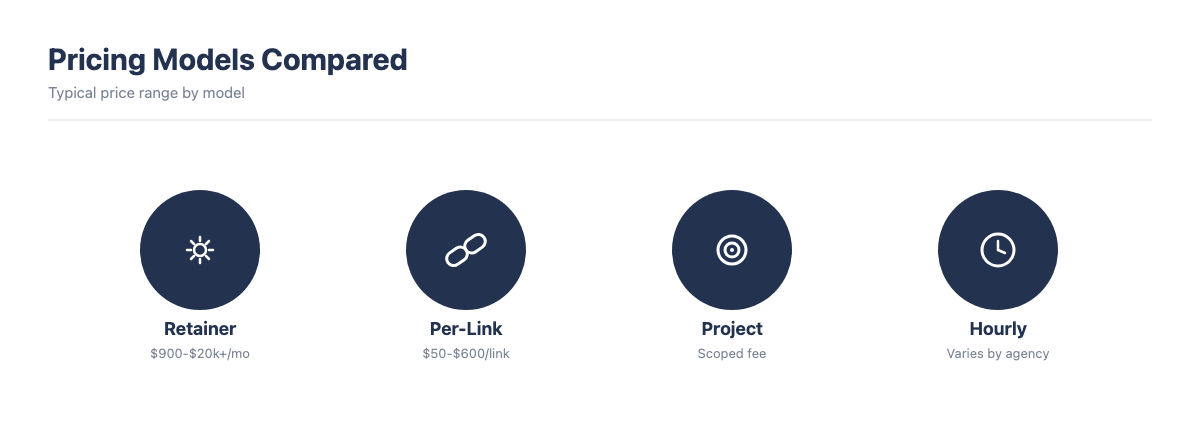
A monthly retainer bundles a set number of placements, research and reporting into a recurring fee, typically ranging from $900 for a handful of lower-authority links up to $20,000 or more for high-volume, high-authority programs. This model fits buyers who want predictable monthly output and don’t want to manage individual orders.
Per-link or per-post pricing charges a flat fee for each placement, commonly $50 to $600 depending on the site’s authority and content type. Niche edits into existing articles usually sit at the lower end. A fully written guest post on a stronger site sits higher. This model fits buyers who want to test a provider, or who only need a handful of links a quarter.
Project-based pricing covers a fixed scope, such as a digital PR campaign built around one story or asset, priced as a single deliverable instead of a per-link fee. It’s a fit for campaigns where the goal is broad coverage and brand mentions, not a specific link count.
Hourly or consulting pricing isn’t common for execution. It shows up when a provider builds your outreach process or trains an in-house team instead of running placements directly. Rates vary widely by agency seniority and aren’t standardized enough to quote a reliable range.
The table below lines up all four models side by side so you can see what you’re actually being quoted.
| Pricing model | Typical range | Best fit |
|---|---|---|
| Monthly retainer | $900 to $20,000+/month | Ongoing programs needing predictable volume |
| Per-link / per-post | $50 to $600 per placement | Testing a provider or low, irregular volume |
| Project-based | Scoped per campaign | Digital PR pushes built around one asset or story |
| Hourly / consulting | Agency-dependent, not standardized | Process or team training instead of execution |
What’s Included in a Typical Link Building Package
A solid link building package includes target-site research and vetting, outreach or content placement, a live link confirmation and a monthly report showing what went live and where. If a proposal doesn’t mention at least three of those four, that’s worth a direct question before you sign.
Before you sign anything, a provider worth using should be willing to show you sample target domains or a niche list, not just metrics on a slide. Reporting should name the actual URLs placed instead of just a link count, so you can verify the work yourself. Most reputable providers also apply a minimum quality bar on the sites they use. That’s commonly a floor on organic traffic or domain rating, not a policy of accepting any site that will take a link.
A replacement or guarantee policy is common and worth asking about directly. If a placement gets removed or de-indexed within a set window, a fair provider replaces it at no extra cost instead of treating the loss as your problem. Ask how that policy is worded before you pay. Some contracts only cover removal within 30 days, while others extend the window to 90 or more.
How to Vet a Link Building Provider: A Step-by-Step Checklist
Vet a link building provider by checking who owns the company, asking to see sample target domains before you order, reviewing the traffic trend on those sites and confirming how disputes or removed links get handled. It’s a short list, and it’s worth running every single time, even with a provider a colleague recommended.
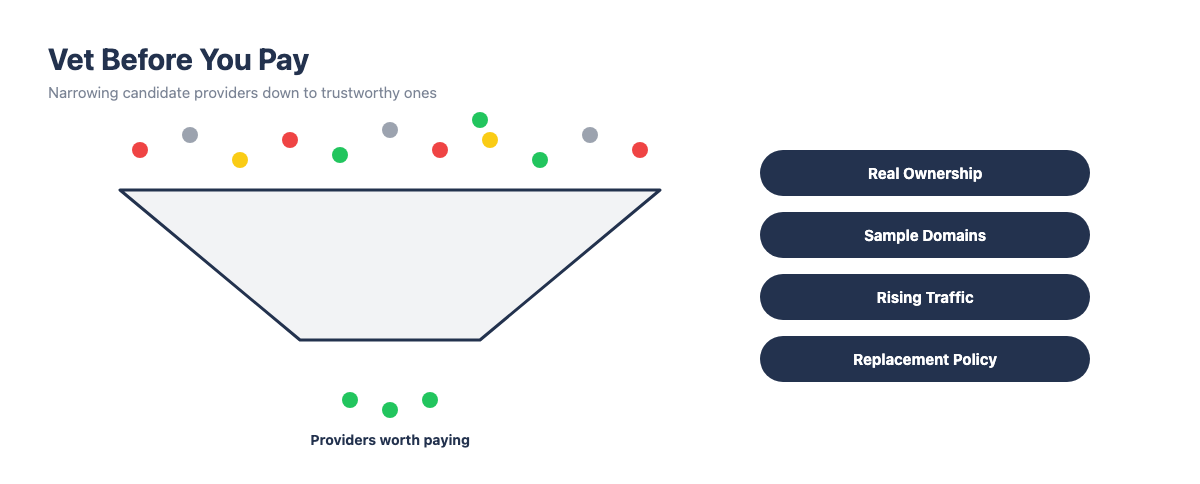
- Find out who owns and runs the company. A provider with a named team, a real office or business address and a track record you can verify is safer than an anonymous storefront.
- Ask for sample target domains or a niche list before you commit, not after. A legitimate provider can show you the kind of sites they place on without revealing every client’s exact placements.
- Check the traffic trajectory of any sample sites, not just their domain rating. A site with a rising or flat traffic graph is a healthier signal than one with a steep decline. Steep declines often point to a penalty or an expired, repurposed domain.
- Ask how metrics get reported. A trustworthy provider explains domain rating, referring domains and traffic side by side instead of leaning on one number alone.
- Request references or case studies tied to a niche similar to yours. Actually contact one if the engagement size justifies it.
- Clarify where your money goes contractually, including whether you’re paying for a guaranteed live placement or just an attempt at outreach.
- Confirm the replacement and dispute policy in writing before the first invoice. Don’t wait until a link disappears to find out.
Skipping this checklist is the single most common reason buyers end up disappointed six months into a contract.
Red Flags That Signal a Risky or Low-Quality Provider
A provider that won’t show you target domains before you order, promises a specific ranking result or quotes prices far below the market range is a red flag worth walking away from.
Watch for these signals specifically. A provider that can’t or won’t share sample domains or a niche list before the first order is hiding something about site quality. Guaranteed rankings are a hard no. No outside party controls Google’s algorithm, and any provider claiming otherwise is flat-out being dishonest with you. Prices dramatically below the ranges in this guide, such as bulk packages of dozens of links for under $100 total, almost always trace back to private blog networks or link farms instead of genuine outreach. Metrics that look manipulated, like a domain rating that jumped overnight with no corresponding traffic or content growth, point to the same problem. Opaque ownership, meaning you can’t find who actually runs the business or where it’s registered, removes any real accountability if something goes wrong.
None of these red flags are subtle once you know to look for them. That’s the whole point of the checklist above: catch them before the invoice, not after.
Is Link Building Still Worth It in 2026?
Yes, link building is still worth it in 2026, though its role inside a broader SEO and search strategy has narrowed. It’s not the whole strategy anymore, and it hasn’t been for a while. Industry surveys show adoption softening. One widely cited study found only 53.3% of marketers still rank link building as a top-tier tactic, down from 73.3% the year before, as budgets shift toward content and digital PR that earn links as a byproduct instead of as the primary goal.

That shift tracks a real change in how search works. AI Overviews and other generative search features increasingly reward brands with consistent editorial presence, meaning being mentioned and cited across relevant publications, over raw backlink counts alone. Links still function as a trust and relevance signal for traditional rankings, and they still drive direct referral traffic when placed on sites your actual audience reads. The practical takeaway: link building earns its strongest return when it’s tied to genuinely useful content or a real story, not treated as a numbers game disconnected from what you’re linking to.
In-House, Outsourced, or Hybrid: Choosing the Right Approach
Choose in-house link building if you have a team member with existing publisher relationships and enough bandwidth to run outreach consistently every month. Choose an outsourced service if you need volume or speed and don’t have those relationships yet. A hybrid model, where strategy stays in-house and execution goes to a provider, fits teams that know exactly what they want but lack the hours to send hundreds of outreach emails.
In-house works best when you already have relationships with relevant publishers, or a brand strong enough that sites want to feature you without much persuasion. It gives you full control over quality and messaging. The trade-off: it’s slow to build from zero, and it doesn’t scale past a handful of placements a month without adding headcount.
An outsourced or agency-run service works best when you need consistent monthly output and don’t want to manage the outreach process yourself. This is where most of the market sits, and it’s why providers structure pricing around retainers in the first place. Linkforce runs outreach and link placement for clients who want this handled end to end, alongside the strategy and content work most link building programs also need. That makes it one option worth evaluating alongside any other provider, using the checklist above.
A hybrid setup makes sense once your program matures. Many teams keep high-value relationship-building and digital PR pitches in-house, where founder or executive involvement genuinely helps, while outsourcing the repetitive volume work, like niche edits and lower-tier guest posts, to a provider. That split gets the best of both without asking one small team to do everything.
Frequently Asked Questions About Link Building Services
How long does link building take to show results?
Most link building campaigns take three to six months to show a measurable ranking or traffic effect. New links need time to get crawled, indexed and factored into Google’s assessment of your site. That’s just how the process works, even with a great provider. Faster movement is possible on lower-competition keywords, but treat anything promising results in weeks as a warning sign, not a selling point.
What is a good domain rating for a placement?
A domain rating in the 30 to 50 range is a reasonable baseline for most budgets, while sites above 50 command a premium and are worth it for competitive niches. Domain rating alone doesn’t guarantee quality, so pair it with a check on the site’s organic traffic trend before you accept a placement.
Can I combine link building with content marketing?
Yes, combining link building with content marketing is one of the most effective ways to earn links. Publishers link to content that genuinely deserves the mention, not to a placement bought for its own sake. A useful data study, tool or original piece of research consistently earns more placements per dollar than outreach for a generic article ever will.
Do link building services guarantee rankings?
No, a legitimate link building service does not guarantee specific rankings. No outside provider controls Google’s algorithm or the hundreds of other factors that affect where a page lands. A reputable provider will guarantee a live placement and a replacement if it’s removed. Treating a specific ranking promise as non-negotiable proof of a scam, not a selling point, will save you real money.