


PR outreach is how brands earn editorial coverage without paying for it. You identify journalists who cover your space, pitch them a story they can actually use, and if the angle is strong enough, they run it. That coverage turns into brand mentions, referral traffic, and backlinks from publications with genuine authority.
Most guides treat it as a soft skill. It’s not. The targeting, the email structure, the follow-up timing — each has a right way and a wrong way, and the difference shows up in reply rates. A startup pitching original research on a relevant trend might land three placements in a week with a targeted list of 20 journalists. The same story sent to 200 untargeted contacts earns nothing. The process is what separates those outcomes. This guide walks through the whole process, from building your first media list to measuring what worked.
What Is PR Outreach?
PR outreach is the process of pitching journalists, bloggers, and media contacts with the goal of earning editorial coverage, brand mentions, and backlinks. It goes by several names — media outreach, press outreach, journalist pitching — but the core activity is the same: you reach out to someone with editorial authority and make a case that your story’s worth their readers’ time.
PR Outreach vs Media Outreach
The terms are used interchangeably. “Media outreach” tends to appear in traditional PR contexts; “PR outreach” is common in digital marketing and SEO circles. For practical purposes, they describe the same activity.
Why PR Outreach Matters for SEO and Link Building
Editorial coverage from a real publication carries a different kind of weight than most link building tactics. When a journalist at a news outlet or trade publication cites your research or quotes your team, the resulting backlink is editorially placed, not exchanged. Search engines treat those links differently, and so do readers. That’s what makes earned media different from paid placements.
This is the central reason PR outreach sits inside digital PR as a strategy. It’s one of the few ways to consistently earn links from high-authority domains without paying for them. If you’d like to understand the broader context, the guide to digital PR covers how editorial coverage connects to domain rating movement and AI search visibility.
How to Build a Targeted Media List
A targeted media list is the difference between a campaign that earns coverage and one that earns nothing. Getting the list right matters more than the pitch itself, because no amount of writing skill recovers a pitch sent to the wrong journalist. Around 80% of publishers say receiving a pitch irrelevant to their beat is the most common reason for declining.
Find Journalists by Beat
Start with publications, not journalists. Identify which outlets your target audience reads, then look at who writes for them. Beat reporters cover specific topics consistently — technology, personal finance, supply chain, whichever vertical you’re in. You want the journalist who’s already writing about your category — not the one who just happens to work at the same outlet.
Search Google News for your topic keywords and filter to the past month. The bylines that appear repeatedly are your primary targets. LinkedIn shows current employers and past coverage. Muck Rack and Cision let you search by beat with more precision, though both require a subscription.
Build a list of 15 to 25 journalists per campaign. Go beyond that and personalization breaks down. Go fewer and you can’t hit a meaningful coverage target.
What to Research Before You Reach Out
Before you write a single word of a pitch, read at least three recent articles from each journalist you plan to contact. Here’s what to look for:

- Topics they return to repeatedly, which reveals their real beat rather than just their job title
- Story structures they prefer, such as data stories, expert interviews, or product reviews
- What they don’t cover, which saves everyone time
- Any recent pieces where your angle would have been a natural fit
Check their social media activity. Journalists often signal what they’re working on, what frustrates them about pitches, and what kinds of stories they need sources for. That context is worth more than any template — often outright worth more than the pitch itself.
How to Write a PR Outreach Email

An effective PR outreach email leads with a specific story angle, stays under 200 words, and makes a single clear ask. That description sounds simple. Most pitches fail because they do the opposite — they lead with company news, run long, and ask for multiple things at once. It’s a reliable pattern that’s easy to avoid once you’ve seen it.
The numbers are stark. Top-tier publications receive between 50 and 500 pitches per week. Around two-thirds of journalists say the subject line determines whether they’ll open an email at all. If the subject line doesn’t earn the open, nothing else matters.
Subject Line Rules That Improve Open Rates
A good subject line names the story, not the company. “New study: 62% of remote workers report productivity decline after 3pm” gets opened. “Exciting news from [Company Name]” doesn’t.
Rules that hold across industries:
- Keep it under 50 characters; most email clients cut off longer subjects
- Name the angle, not the sender (“Study reveals…” rather than “We found…”)
- Avoid “exclusive,” “important,” and “breaking” since they read as spam signals
- Match the journalist’s beat vocabulary exactly; if they write “supply chain” not “logistics,” use their phrasing
The Four-Paragraph Pitch Structure
Keep the body under 200 words using this structure:
Paragraph 1: Lead with the story angle and tie it to something the journalist has already written. One or two sentences.
Paragraph 2: State the ask clearly. Are you offering an interview, a data asset, an expert quote, or a first look at something? Name it directly.
Paragraph 3: Explain why it matters to their readers, not to your company. Include one supporting fact or data point if you have it.
Paragraph 4: Close with your contact details and a next step. “Happy to send the full dataset” or “I’m available for a quick call this week” works well.
Pitching Beyond Email
Email is the default channel for PR outreach, but it’s not the only one that works. Twitter and LinkedIn DMs reach journalists who are active on those platforms but receive fewer messages there than in their inbox. Some journalists list their preferred contact method in their bio or on their outlet’s contributor page — if they say Twitter, use Twitter.
For high-value targets, a short LinkedIn connection request before the email pitch is a legitimate warm-up move. Journalists use LinkedIn to track sources and they’ll see your profile when they look up your company. A familiar name lands differently than a cold sender.
Phone follow-ups are less common in digital PR than in traditional PR, but they’ll still work for breaking news where timing matters. Keep them short: state who you are, what you’re pitching, and ask if they’ve got a moment.
The channel matters less than the angle. A mediocre pitch via the “right” channel still fails.
What to Leave Out
Don’t include press releases as attachments in a first pitch. Don’t explain your company’s history. Don’t use superlatives like “groundbreaking” or “first-ever” unless you can prove it. Don’t copy multiple journalists in the same email. Each pitch should look and feel like it was written specifically for one person, because the ones that earn coverage usually were.
Timing and Newsjacking
Timely pitches outperform evergreen ones. A journalist covering a policy change, a market shift, or a trending topic needs expert sources fast. If your company has relevant data or a credible spokesperson, a same-day pitch tied to the news cycle can land coverage that a months-long campaign wouldn’t.
Newsjacking is the practice of connecting your angle to a breaking story. It works when the connection’s genuine. If a supply chain disruption story is running and your company processes supply chain data, that’s a real connection. If the story’s about something adjacent and you’re stretching to make the pitch relevant, journalists notice immediately.
Set up Google Alerts and track industry news feeds so you’ll catch relevant stories early. The first few pitches after a story breaks have the best chance of landing. By the third or fourth day of a news cycle, journalists have already sourced their comments.
PR Outreach Email Templates
These templates are starting points. Every journalist you pitch deserves a subject line and opening line that reflects your research into their actual coverage. A template used without customization reads like one — they’ve seen thousands of them.
Template 1: Data Study Pitch
Subject: [Specific finding] — data from [X] [industry] companies
Hi [First name],
Your piece on [specific article topic] caught my attention — we just wrapped up a study of [X] companies looking at [related topic].
The headline finding: [one concrete data point]. Happy to share the full dataset and methodology, or offer [expert name] for a quote.
Would that be useful for anything you’re working on?
[Your name] [Title, Company] [Phone or calendar link]
Template 2: Expert Commentary Offer
Subject: Source for your piece on [topic they cover]
Hi [First name],
I noticed you write regularly about [their beat]. We have [expert name] on our team — [one-line credential] — who has strong opinions on [specific angle].
If you’re ever working on a piece that needs a practitioner perspective, I’d be happy to make the intro. No ask attached.
[Your name] [Title, Company]
Template 3: Infographic or Visual Asset Pitch
Subject: Visual on [topic] — free to use with credit
Hi [First name],
You covered [related topic] last month. We built an infographic breaking down [specific angle] — [one-sentence description of what it shows].
It is free to use with a link back. Happy to send the original file or adjust anything that would make it more useful for your readers.
[Your name] [Title, Company]
How to Follow Up Without Annoying Journalists
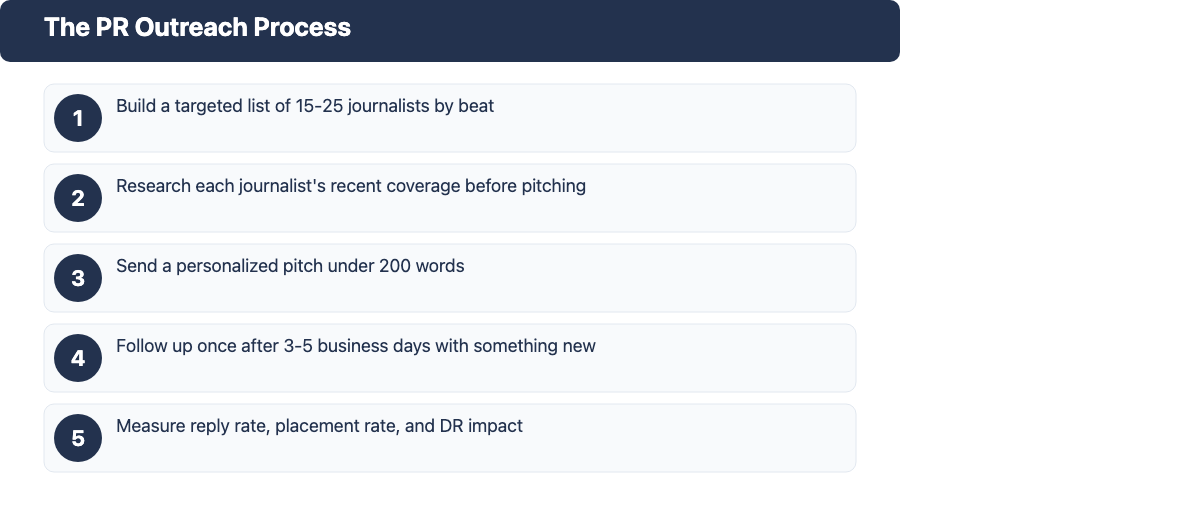
Most coverage isn’t won on the first email. Follow-ups are part of the journalist outreach process, not an imposition — journalists handle too much volume to catch every pitch on arrival, and they’d rather get a brief nudge than miss a good story. Research across outreach platforms consistently shows that a single well-timed follow-up nearly doubles reply rates compared to sending once and waiting.
The goal of a follow-up isn’t to resell the pitch. It’s to surface the original message from a buried inbox and, if possible, add a new reason to respond. A follow-up that arrives three days later and includes one new data point or a fresh tie-in to recent news outperforms one that just says “checking in.” That’s a sentence that’s done no work.
The rules that hold:
- Wait 3 to 5 business days before following up, not 24 hours
- Keep the follow-up shorter than the original pitch
- Add something new — a second data point, a fresh hook, or a relevant event — rather than just restating what you already said
- Send a maximum of two follow-ups total; after that, move on
- When a journalist declines, thank them and stop
The follow-up subject line can be as simple as “Re: [original subject]” — threading keeps the context visible. If you’re pitching multiple contacts at the same outlet, follow up with each individually rather than sending a group reminder.
Relationship-building sits outside the follow-up sequence entirely. If a journalist covered something adjacent to your space, engage with their work on social media or share the piece. That kind of low-pressure contact over time changes how a future pitch lands — it’ll arrive from a familiar name rather than an unknown sender.
PR Outreach Tools
The right tools depend on how systematically you run outreach. For occasional campaigns, free tools’ll get the job done. For teams running outreach at volume, a dedicated platform is worth the cost.
| PR Outreach Tool | Primary use | Best for |
|---|---|---|
| Muck Rack | Journalist search by beat, outlet, and recent coverage | Media list building at scale |
| Cision | Enterprise media database with contact verification | Large teams needing breadth |
| Prowly | Media database plus CRM and pitch tracking in one | Mid-size PR teams |
| Prezly | Newsroom publishing and media contact management | Teams distributing press releases at scale |
| Respona | Outreach automation with built-in contact finding | Campaigns with high volume |
| BuzzStream | Email outreach and relationship management | Link teams with defined lists |
| Journalist research and warm-up engagement | Any team, no cost | |
| Google News | Find journalists actively covering your beat now | Any team, no cost |
| Google Alerts | Monitor topics and flag coverage opportunities | Any team, no cost |
Muck Rack and Cision are the leading media databases for finding and verifying journalist contact data. Both let you search by beat, outlet, and recent publication history. The cost’s substantial, but they save hours of manual research per campaign.
Prowly sits between media database and CRM. It combines journalist discovery with a newsroom tool and pitch analytics, so you can track who opened what and when. Prezly takes a different angle — it focuses on newsroom publishing and media contact management, which works well for teams distributing press releases at scale alongside targeted journalist outreach.
Respona and BuzzStream work well for teams running outreach at volume. Respona automates contact finding and personalizes outreach sequences at scale. BuzzStream focuses on relationship tracking and follow-up management, which fits link building and digital PR campaigns running in parallel.
For teams starting out, LinkedIn and Google News do the discovery work without a subscription. LinkedIn shows journalists’ current outlets and recent professional activity. Google News surfaces who’s covering your topic right now. Google Alerts is free and useful — set up alerts for your main topics and you’ll catch journalists writing adjacent stories before anyone else pitches them.
The outreach emails guide goes deeper on email setup, templates, and tools for managing sequences across campaigns.
How to Measure PR Outreach Success
Coverage is the goal, but coverage alone doesn’t tell you whether a media outreach strategy’s working. These are the metrics worth tracking:
- Coverage placements: total earned (unpaid) editorial mentions across all publications — features, quotes, and product reviews combined
- Link placement rate: percentage of coverage pieces that include a backlink to your site. For SEO purposes, this matters more than raw placement volume. Ten mentions with two backlinks is a 20% link placement rate; that number tells you whether coverage is translating into domain authority gains.
- Referring domains earned: new unique domains linking to your site from coverage over the campaign window
- Domain rating impact: change in your DR over a 30 to 90 day window after the campaign; PR-driven backlinks typically take weeks to register
- Referral traffic: sessions arriving at your site from covered publications, tracked in Google Analytics under Acquisition > Traffic Acquisition > Referral
- Reply rate: percentage of pitches that received any response. The benchmark for well-targeted journalist outreach is 8 to 15%.
- Placement rate: percentage of replies that converted to coverage — typically 1 to 3% of all pitches sent
Reply rate is the fastest feedback signal. Below 5% usually means a targeting problem — you’re pitching journalists whose beat doesn’t match your story — or a weak angle. Fix it before spending more time on the same campaign. If reply rates are solid but placements are low, the follow-up stage or the pitch-to-conversation conversion is where coverage’s leaking.
For teams that want to go deeper, share of voice (SOV) compares your total media coverage against competitors in the same space. It requires monitoring competitor coverage as well as your own, which adds overhead — most teams’ll track it only for major campaigns.
Track the core metrics in a spreadsheet if you’re not using a dedicated outreach platform. The data builds quickly into a clear picture of which publications convert and which angles your best-fit journalists actually care about. It’s faster to diagnose problems when the numbers are in one place.
Frequently Asked Questions
What is the difference between PR outreach and link building outreach?
PR outreach focuses on earning editorial coverage from journalists and publications, where backlinks are a byproduct of genuine coverage. Link building outreach targets website owners to request links through guest posts, resource page placements, or link insertions. The mechanics overlap — both use cold email and personalization — but the audience, angle and success metrics differ. PR outreach earns links from news sites and trade publications; link building outreach typically earns links from blogs and niche sites. They’re complementary, not interchangeable.
How many journalists should you pitch at once?
For a single campaign, pitching between 15 and 30 journalists is the right range. Fewer than that gives you too small a pool to hit meaningful coverage targets. More than that makes genuine personalization impossible, and journalists’ll notice when a pitch wasn’t written for them specifically.
What is a good reply rate for PR outreach?
A reply rate of 8 to 15% is a solid benchmark for well-targeted PR outreach. Anything above 20% is strong. Below 5% almost certainly signals a targeting problem — you’re pitching journalists whose beat doesn’t match your story — or an angle that isn’t newsworthy enough to pull attention from an overloaded inbox. That’s the time to rebuild the list, not rewrite the email.
How long should a PR outreach email be?
Keep pitch emails between 100 and 200 words. Most journalists prefer pitches in this range, and brevity signals respect for their time. The subject line and first sentence do most of the work. If you can’t make the case in 200 words, the angle needs tightening, not more explanation.
When is the best time to send PR outreach emails?
Tuesday through Thursday, between 9am and 11am in the journalist’s time zone, consistently outperforms other days and times. Mondays mean a cluttered inbox from the weekend. Fridays mean pitches’ll get buried before the weekend. Morning sends beat afternoon sends in most industries. That said, if you’ve got timely news or a newsjacking angle, send immediately regardless of the day — relevance beats timing.