
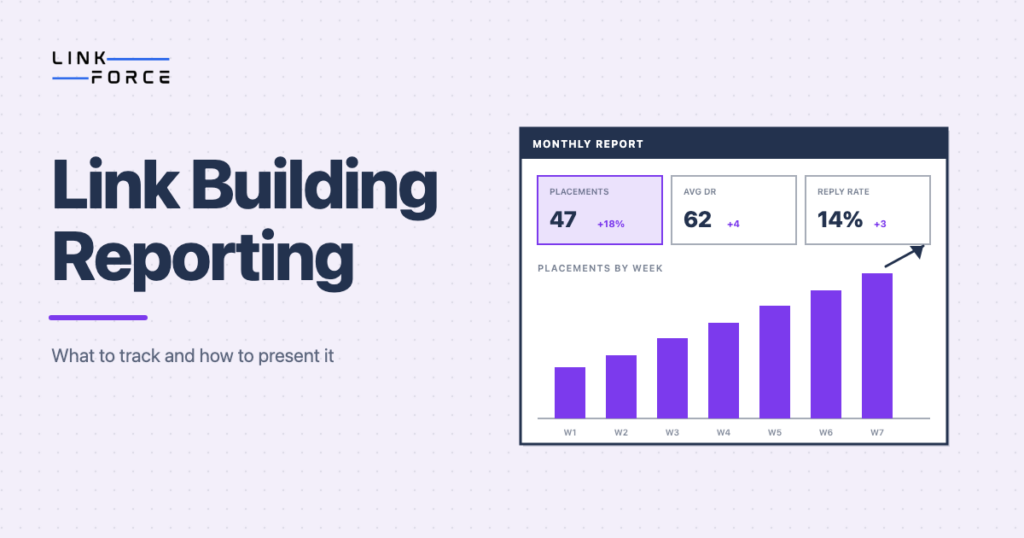
Link building reporting should show progress, quality, and the next action in one clear view. Without a consistent tracking structure, it’s hard to tell whether a campaign is building real authority or just accumulating volume.
If you are still choosing software, start with the guide to link building software. This page focuses on the reporting layer: what to track, how to present it, and how to keep weekly and monthly updates useful.
What should link building reporting show?
Link building reporting should show progress, quality, and next steps in one place. That means combining two data layers: backlink outcomes such as new referring domains or lost links, and campaign context such as outreach movement, blockers, and follow-up actions.
Two audiences typically read these reports:
- the operator who needs to know what happened this week
- the stakeholder who needs a simple summary of progress, quality, and risk
Those audiences do not need the same level of detail. Operators need movement and exceptions. Stakeholders need the headline: what was earned, what improved, what slipped, and what happens next.
Strong link building reporting combines campaign workflow data with backlink data. One side tells you about activity. The other tells you about outcomes.
Which metrics matter most?
The strongest reporting stack starts with seven metrics: new backlinks, new referring domains, domain authority or domain rating, lost links, anchor text patterns, dofollow vs. nofollow ratio, and referral traffic. Everything else should support those seven, not bury them.
| Metric | Why it matters | Best use in the report |
|---|---|---|
| New backlinks | shows output from the campaign | weekly and monthly summary |
| New referring domains | shows breadth and authority growth more clearly than raw link count | weekly and monthly summary |
| Domain Authority / Domain Rating | tracks whether the backlink profile is building authority over time | monthly trend view |
| Lost links | shows decay, reversals, or quality problems | weekly exception review |
| Anchor text patterns | helps spot over-optimization or weak relevance | monthly quality review |
| Dofollow vs. nofollow ratio | shows whether the link profile looks natural | monthly profile health check |
| Referral traffic from backlinks | shows whether links send real visitors, not just SEO value | monthly business impact view |
New backlinks and referring domains
These are usually the first numbers people ask for, but they do different jobs.
New backlinks show visible output. They answer: what landed this period?
New referring domains are often more useful because they show how many unique sites joined the profile. Getting five links from one domain may matter less than earning a first link from a new relevant site. Consistent growth in referring domains — a target of five to ten new domains per month is a common benchmark — is a cleaner signal of campaign momentum than raw link count alone.
Report both together. That keeps the weekly view simple without hiding the quality story.
Domain Authority and Domain Rating
Domain Authority (Moz) and Domain Rating (Ahrefs) measure the strength of a site’s backlink profile on a 0–100 scale. Both use logarithmic scoring, so moving from 20 to 30 is easier than moving from 70 to 80. They are different tools with different methodologies, but both are reasonable proxies for link profile authority.
In reporting, DA or DR belongs as a trend metric, not a weekly data point. The useful question is: is this number moving in the right direction over the past three to six months? According to Databox’s survey of 65 link building practitioners, 72% monitor domain rating or domain authority as part of their regular tracking.
- show the score at the start of the campaign and the current value
- note which tool produced the score so comparisons stay consistent
- avoid comparing Moz DA and Ahrefs DR directly — they measure differently
Lost links and link decay
Most reports spend too much time on wins and not enough on reversals. Lost links matter because they tell you whether gains are holding and whether a campaign is creating durable value.
A weekly report does not need a long note on every lost link. It needs a quick exception check:
- what disappeared
- whether the link mattered
- whether it needs a recovery action
That small habit makes the report operational instead of cosmetic.
Anchor text and page relevance
Anchor text belongs in reporting when it helps you understand quality and fit. A short note is usually enough:
- are new anchors mostly branded, generic, or topical
- do the links point to the pages the campaign was supposed to support
- is any pattern starting to look unnatural or low-value
Commentary matters more here than raw counts. A heavy concentration of exact-match keyword anchors is a signal worth flagging even if total link numbers look healthy.
Dofollow vs. nofollow ratio
Dofollow links pass link equity directly. Nofollow links carry a signal to Google but do not pass PageRank in the traditional sense. A healthy backlink profile includes both.
In reporting, the ratio matters as a profile health check rather than a weekly metric. A profile that is nearly 100% dofollow can look unnatural. A profile with very few dofollow links may not be building the authority the campaign intends.
- flag if the nofollow share grows sharply in a short period
- note whether high-value placements are dofollow or nofollow
- do not treat every nofollow link as worthless — brand mentions from strong sites still carry signal
Referral traffic from backlinks
Referral traffic shows whether backlinks are sending real visitors to the site, not just passing SEO value. A placement on a high-traffic relevant page may drive more meaningful business results than a placement on a high-DA page that nobody reads.
Check referral traffic in Google Analytics (under Acquisition > Traffic Acquisition, filtering by Referral source) or in Google Search Console under links. Monthly is the right cadence for this metric — weekly data is usually too thin to be useful.
- note which placements are actually sending visitors
- track whether referral sessions show engaged behavior, not just a single pageview bounce
- use this to make the case for high-traffic placements in future outreach
Link quality and context
You do not need a single universal authority threshold in every report. Different teams use different quality signals and different tools label them differently. The practical rule is simpler:
- show whether the placement is relevant to the target topic or niche
- show whether the linked page makes sense as a destination
- call out anything that looks weak, off-topic, or risky
Toxic backlinks — links from spammy domains, hacked pages, or known link networks — belong in quality review too. If the profile is growing quickly or using freelance vendors, run a periodic check with Ahrefs or Semrush to surface any links that may need disavowing before they compound into a risk.
How should weekly and monthly reporting differ?
Weekly reporting helps operators move work forward. Monthly reporting helps stakeholders understand whether the campaign is compounding. Both views can draw from the same source data, but they should not read like the same document.
Weekly report for operators
The weekly update should be light, fast, and useful. It is not the place for a long narrative. It answers:
- what links were earned this week
- what was lost or needs attention
- which campaigns moved forward
- which prospects or workflows are stalled
- what the team will do next
If you cannot produce this view quickly, the stack is probably missing a source of truth for either outreach workflow or backlink monitoring.
Monthly report for leadership
The monthly report compresses the detail into a story:
- progress over the month: links earned, referring domains added
- authority trend: DA or DR movement since campaign start
- quality of links earned and any profile health notes
- important wins or losses worth calling out
- next-step priorities
Leadership usually does not need every outreach status change. They need a clean answer to: is the campaign building the kind of links we actually want, and is the work compounding?
Which tools help you build the report?
Most reports pull from more than one source. One tool usually owns backlink outcomes, another owns outreach activity, and the reporting layer turns both into something readable.
- a backlink intelligence tool such as Semrush or Ahrefs for link and referring-domain visibility, DA/DR tracking, and toxic link detection
- an outreach workflow tool such as BuzzStream, Pitchbox, or Respona for campaign status and follow-up context
- Google Analytics and Google Search Console for referral traffic from backlinks and link indexing status
- a contact support tool such as Hunter when discovery and verification need their own workflow
The mistake is expecting one dashboard to tell the whole story automatically. The reporting layer works when you decide which source owns which question. Backlink data explains outcomes. Outreach workflow data explains effort and next steps. Commentary connects the numbers to decisions.
What is a simple report structure you can reuse?
A useful link building report works with four sections: summary, core metrics, commentary, and next actions. That structure is easy to scan and still leaves room for context.
Section 1: Summary
Start with a short paragraph covering:
- overall movement for the period
- the most important win or placement
- the biggest risk or blocker
- the next action
Section 2: Core metrics
Include a small table or bullet list for:
- new backlinks and referring domains added
- DA or DR change since last period or campaign start
- lost links worth noting
- notable anchor text or target-page patterns
Section 3: Commentary
Add interpretation, not just numbers:
- what changed that matters
- which placements were strongest
- where quality looked weaker
- what needs follow-up
Section 4: Next actions
Close with a short list of two to three follow-up actions. Reporting is most useful when the reader knows what happens next — not just what happened last period.
Common reporting mistakes
Treating volume as the whole story
More links does not automatically mean better links. A report that celebrates raw totals without context — anchor quality, placement relevance, dofollow vs. nofollow mix — is easy to misread.
Mixing every stakeholder into one view
The operator and the executive should not get the same level of detail. One report can serve both, but only if it separates the fast summary from the working detail.
Hiding losses
Lost links, weak fits, and campaign stalls belong in the report. They are not embarrassing side notes. They are part of the operating picture, and surfacing them early is what makes the report useful rather than cosmetic.
Overloading the dashboard
When every available metric appears in the report, nothing stands out. Keep the report narrow enough that somebody can read it quickly and still know what happened.
FAQ
What metrics matter most in link building reporting?
The most reliable starting set is new backlinks, new referring domains, domain authority or domain rating, lost links, anchor text patterns, dofollow vs. nofollow ratio, and referral traffic from backlinks. Start with those seven and trim or expand based on what the campaign actually needs.
Should reporting be weekly or monthly?
Both serve different purposes. Weekly reporting keeps operators aligned on what moved and what needs attention. Monthly reporting gives stakeholders a clean summary of progress, quality, and the campaign’s direction.
Do I need special software just for reporting?
Not always. Many teams report well by combining backlink intelligence with outreach workflow data. The bigger question is whether the stack makes it easy to produce a fast, reliable view without rebuilding the report from scratch each cycle.
Should I track Domain Authority or Domain Rating?
Track whichever one your primary tool produces — Domain Authority if you use Moz, Domain Rating if you use Ahrefs. Do not mix them in the same trend line, since they are calculated differently and their scores are not comparable. Pick one and stick with it for consistent reporting across the campaign.
Final takeaway
Good link building reporting shows seven core metrics in a four-part structure: summary, core metrics, commentary, and next actions. It separates the weekly operational view from the monthly stakeholder summary, tracks whether authority is building over time, and surfaces losses and quality risks before they compound.
If the stack is still unclear, decide which tool owns backlink outcomes, which owns campaign activity, and which owns referral traffic visibility — then build the report from those three sources.