

A PR link is a high-quality backlink earned through public relations activity rather than through link exchanges, payments, or manipulation. When a journalist cites your research, a news outlet covers your product launch, or a publication quotes your company as an expert source, the link that website includes in its content is a PR link. These backlinks are editorially granted by media outlets and authoritative sources. That editorial barrier is why they carry a stronger quality signal in search than most acquired links.
PR links and digital PR overlap. A digital PR program uses media outreach, data campaigns, and expert positioning to generate coverage. High-quality backlinks that come out of that coverage are PR links. Understanding what they are, why they matter for SEO, and how to earn them is foundational to any serious link-building strategy.
What Is a PR Link?
A PR link is a hyperlink from a third-party publication or media site earned through public relations effort, where the linking site chose to include your link because your brand, content, or data was relevant to their readers rather than because of any arrangement between the two parties.
PR links most commonly come from:
- News outlets and online magazines covering your industry
- Bloggers and niche publications that cite your original research or data
- Journalists who include your expert commentary in a story
- Websites that link to your content when picking up your press release or announcement
You cannot negotiate or pay for this placement. You influence the likelihood of earning a link by creating something newsworthy or being a useful source. The editorial decision belongs to the publisher. That is what makes these links valuable.
PR Links vs Standard SEO Backlinks
PR links and standard SEO backlinks both point to your website. That is where the similarity ends. Their origin, quality signal, and editorial nature differ in ways that matter for SEO.
| Factor | PR Links | Standard SEO Backlinks |
|---|---|---|
| Origin | Earned through news coverage, research, or expert positioning | Acquired through outreach, guest posts, exchanges, or purchase |
| Editorial control | Publisher decides independently | Negotiated or arranged |
| Quality signal | High: editorial grant from media and authoritative sources | Variable: depends on the site and method |
| Scalability | Hard to scale quickly | Easier to produce at volume |
| Longevity | News archives tend to persist for years | Can be removed if an arrangement lapses |
| Link attribute | Often nofollow on major news sites; followed on industry blogs | Varies |
This matters for link quality. Search engines have become significantly better at recognizing unnatural link patterns, and editorially placed links carry more trust per link than acquired ones because they reflect a genuine endorsement decision made independently by the publisher rather than through any arrangement with the site being linked to. That scarcity is part of the signal.
Why PR Links Matter for SEO
PR links matter for four reasons, and the reasons are connected.
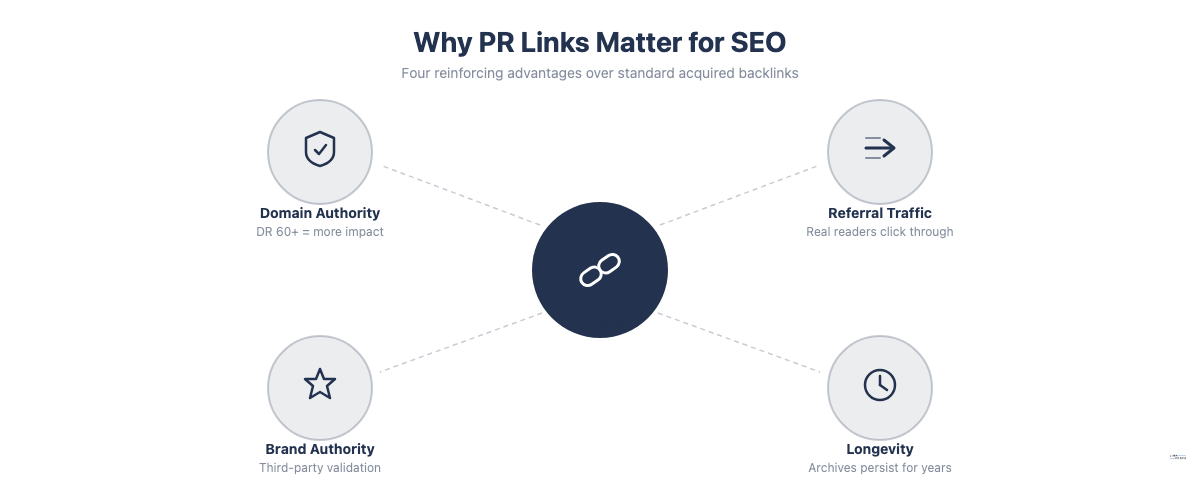
Domain authority and trust. One link from a DR 60+ industry publication provides more domain rating improvement than dozens of links from DR 0-10 sites. Ahrefs scales DR logarithmically. Moving from DR 40 to DR 50 requires exponentially more high-quality backlinks than moving from DR 10 to DR 20. A single well-placed PR link can move your domain metrics in ways that volume-based link building cannot.
Referral traffic. Most backlinks pass equity silently. PR links often generate real visitors. When your company appears in an article read by your target audience, some readers click through, and that traffic signal reinforces topical relevance.
Brand authority. Being cited by respected publications shapes how potential customers perceive your brand. Coverage in industry outlets functions as third-party validation, and this credibility effect compounds as more media references accumulate over time, particularly in niches where buyers research extensively before committing. The brand signal from PR links is hard to replicate through paid placements.
Longevity. Articles on major publications stay indexed for years. A link in a news archive from three years ago still passes link equity today. PR links built into solid editorial content outlast most guest posts and directory links, which get pruned more often.
How to Earn PR Links
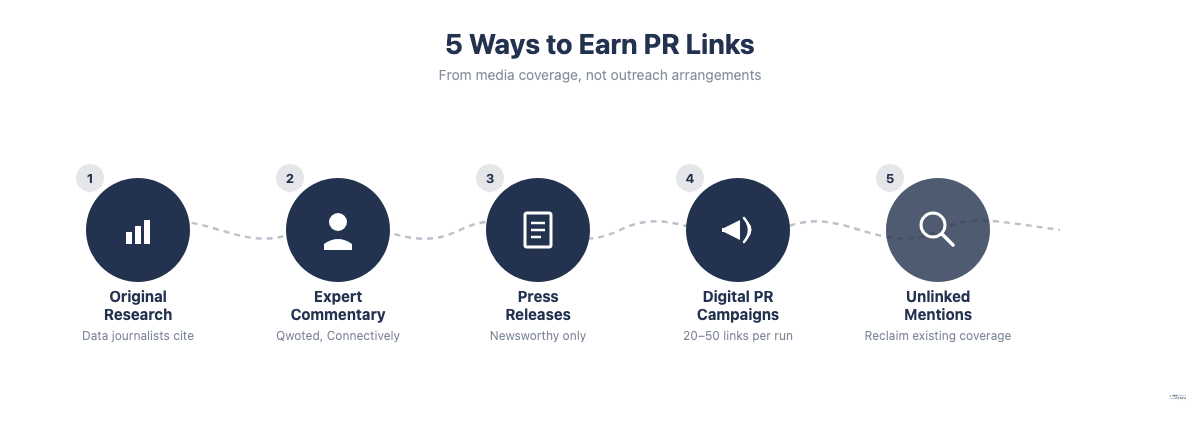
Earning PR links requires giving publishers something worth linking to. Five tactics produce the most consistent results.
Original Research and Data Studies
Journalists search for original data to cite. Produce a study, survey, or dataset that provides new insight into your industry and publishers will reference it. The research does not need to be academic. A salary survey of 500 professionals in your niche, a pricing analysis across your market, or a benchmark report on industry adoption rates can generate significant link equity. Credibility and relevance to what journalists are already covering are what matter.
Publish the full methodology and raw data. Restricting findings behind a registration gate reduces citations. Journalists will not cite what they cannot read.
Expert Commentary and Source Pitching
Journalists writing time-sensitive articles need expert quotes fast. Sign up for media networking platforms where journalists request quotes from industry professionals:
- Connectively (formerly HARO): journalists post specific queries asking for expert sources; you browse daily queries and submit pitches
- Qwoted: free for newsrooms to source expert commentary; known for strict editorial verification, making it a preferred choice for top-tier journalists
- Source of Sources: connects experts with journalists to secure high-authority backlinks

Make your pitch specific and free of marketing language. For more on how to structure and send these pitches, see our guide to backlink outreach. A narrow, data-backed opinion from a named professional is more citable than a broad statement from a brand.
Newsworthy Press Releases and Announcements
Press releases work when the announcement is genuinely newsworthy. A significant product launch, a notable partnership, a funding round, a milestone your industry cares about. Send it to relevant journalists rather than mass wire services. When they cover the story, they include a link to your announcement or your site. Wire distribution alone rarely generates high-quality backlinks.
Digital PR Campaigns
Data-led campaigns purpose-built to attract media coverage are among the highest-yield tactics for earning PR links at scale. Think interactive cost calculators, original indexes tracking industry metrics, visual datasets, or counterintuitive findings from proprietary data. These campaigns work because they give journalists a complete story, with the data, the angle, and often the visual assets ready to publish. A well-executed campaign can earn 20 to 50 links from a single effort.
Unlinked Brand Mention Reclamation
Many publications mention your brand without a link. A journalist writes about your tool, a blog references your research, a news article names you as a market participant, but the reference has no hyperlink. These unlinked mentions are recoverable. Use Ahrefs Content Explorer or a media monitoring tool to find brand references without a link, then send a short note to the author or editor asking them to add one. Because coverage already exists, the ask is small. Conversion rates run higher than cold link requests.
It is the fastest way to convert existing coverage into measurable link equity.
What Makes a PR Link Valuable
Not all PR links carry equal weight. Assess these signals when evaluating a link you have earned:
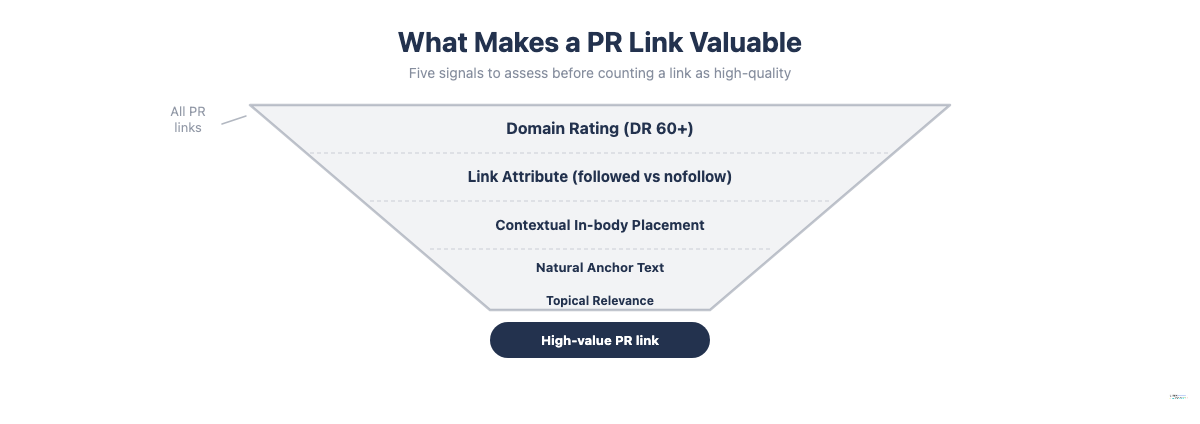
- Domain rating of the linking site. One link from a DR 70+ industry publication passes more link equity than a link from a DR 20 local blog, even if both are editorially placed.
- Link attribute. Followed links pass PageRank. Nofollow links do not pass equity in the traditional sense, but they generate referral traffic and brand signal. Many major news outlets default to nofollow on outbound links. That does not make the coverage worthless.
- Contextual placement. In-body links carry more weight than links in sidebars, author bios, or site footers. Contextual placement is what editorial intent implies.
- Anchor text. Branded anchor text is most common in PR links and is natural. Exact-match keyword anchors in press links are rare and can look unnatural.
- Topical relevance. A link from a publication covering your industry is more relevant than a link from a general-interest site at the same domain rating.
One followed, in-body link from a topically relevant DR 60 publication is worth more than five nofollow sidebar links from high-DA news sites. Quality beats count.
How to Track PR Links
Tracking PR links requires monitoring two things: new backlinks to your domain and unlinked media mentions.
Ahrefs and Majestic both show new referring domains in near real time. Set up alerts and filter by DR to focus on links from authoritative sources. Google Search Console also shows new linking domains under the Links report, but with some delay. For unlinked mentions, Google Alerts is a free starting point. Media monitoring platforms go further, covering social and broadcast sources that Alerts misses.
Metrics worth tracking:
- New referring domains from editorial sources, segmented by DR
- Followed vs nofollow ratio per quarter
- Referral traffic from PR coverage
- DR trajectory tied to link acquisition periods
One link from a DR 60+ site provides more DR improvement than dozens of links from DR 0-10 sites. Track by quality segment, not total count.
PR Links and Your Digital PR Strategy
PR links are one measurable output of a broader digital PR program. A well-run program combines media outreach, expert positioning, data campaigns, and relationship-building to generate consistent coverage.
If you are building this capability for the first time, start with our guide to digital PR, which covers the full strategic framework. The digital PR tools you use for outreach and monitoring and the digital PR agencies that can accelerate the process are all part of the same system.
PR links are not a shortcut to domain authority. They are the result of being useful to journalists and creating content worth linking to. Done consistently, they are among the most defensible link-building strategies available.
Are PR links the same as earned media?
PR links are a subset of earned media. Earned media includes all unpaid coverage: social shares, podcast mentions, and press articles. PR links refer to the high-quality backlinks generated when that coverage includes a hyperlink to your website.
Are PR links followed or nofollow?
It varies by publication. Major news sites use nofollow or sponsored attributes on outbound links. Industry trade publications and niche blogs more commonly include followed links. Both types have value: followed links pass PageRank, and nofollow links generate referral traffic and brand signal.
How long does it take to earn PR links?
Organic journalist outreach takes weeks to months to produce results for a single effort. Well-executed data campaigns can earn links within days if the story lands. Building consistent PR link flow requires an ongoing program.
Do PR links count for SEO?
Yes. Google’s approach to link quality favors editorially placed links from credible sources. PR links from authoritative media sources are high-value because they are hard to manufacture at scale and represent genuine third-party endorsement.