

Most web pages never earn a single backlink. An Ahrefs study of more than a billion pages found that roughly two-thirds have no external links pointing to them at all, and outreach is the fastest way out of that group. It’s not passive: instead of waiting for links to appear on their own, you contact a site’s owner, editor or journalist directly and ask for one.
Every link earned through outreach still has to trigger the same underlying signals. How link building helps SEO walks through those four mechanisms in detail.
Done well, it produces the kind of backlinks that move rankings in Google. Done poorly, it wastes time on ignored emails and doesn’t produce anything.
What Is Backlink Outreach?
Backlink outreach is when you reach out to another website and ask them to link to your content. The link you earn is a backlink, and getting it through direct contact is what makes it outreach: it’s active, not passive.
The reason it works is that most websites won’t link to you unless you ask. Good content alone rarely attracts links outside a few high-authority publications. Outreach closes that gap. You identify pages that could link to yours, find the site’s decision-maker and give them a reason to add the link. When the pitch is right, they do.
A backlink’s value comes from how search engines treat it: as a trust signal, not just a citation. A link from a relevant, trusted site tells Google’s ranking systems that your content is worth surfacing. More good backlinks, from more authoritative domains, tends to mean higher positions and more organic traffic over time.
Types of Backlink Outreach
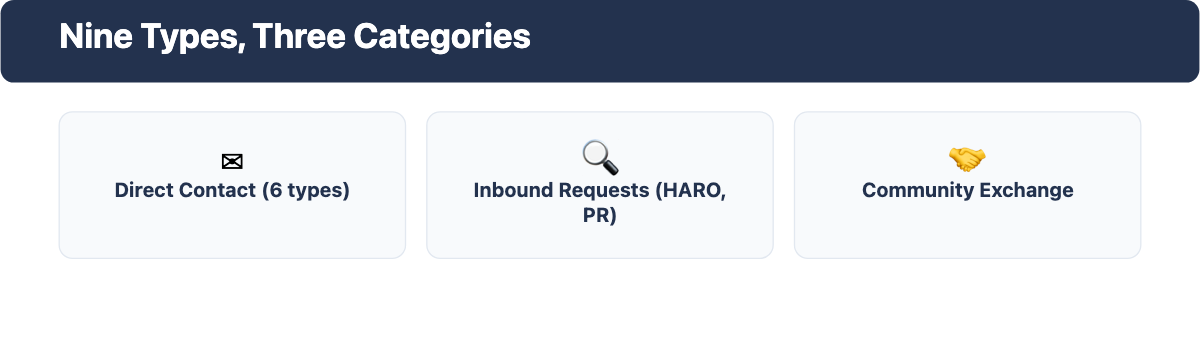
Nine main types of backlink outreach exist today. Most rely on direct contact with a site’s owner or editor. HARO/Connectively and digital PR attract inbound requests instead of pitching first, and relationship-based link building works through ongoing community relationships rather than one-off cold contact. The table below shows when each one fits.
| Type | How It Works | Best For |
|---|---|---|
| Broken link building | Find a dead link on a relevant site, create a replacement resource, pitch the backlink swap | Sites with content-heavy blogs and aged link profiles |
| Guest posting | Contribute an article in exchange for an author or contextual link | Building domain authority early; niche relevance |
| Unlinked mentions | Find where your brand is mentioned without a link, ask for it to be added | Brands with existing press coverage |
| Digital PR | Publish data or research that earns coverage and links from journalists | High-volume link campaigns; authority building |
| Resource page outreach | Pitch your content to pages that list helpful links in your niche | Educational or tool-based content |
| Skyscraper outreach | Create a clearly better version of a high-performing page, pitch sites that linked to the original | Competitive niches with linkable cornerstone content |
| HARO / Connectively | Respond to journalist queries with expert commentary in exchange for a citation link | Earning press links at scale without direct prospecting |
| A-B-C link exchanges | Arrange a three-way link swap so no direct reciprocal exchange appears | Situations where pure editorial links are hard to earn |
| Relationship-based link building | Join a vetted SEO or SaaS community and trade guest posts or placements directly with other members | Ongoing link flow without repeating a cold-outreach campaign each time |
Broken Link Building
Broken link building means finding dead links on relevant websites and offering your content as a replacement. You use a tool like Ahrefs or Semrush to locate 404 errors on your niche’s pages, then reach out to the site’s owner to flag the broken link and suggest your content fills the gap. The value exchange is clear: you’re helping them fix a problem while earning a backlink. It works best on sites with large editorial archives where broken links accumulate over time.
Guest Posting
Guest posting is contributing an article to another website in exchange for an author’s link or a contextual link within the content. You pitch an original article idea to a relevant site in your industry, write the piece to the site’s editorial standards and include a link back to your site as part of the author bio or naturally within the body. It’s one of the highest-volume outreach types available and an effective way to build brand authority in your niche. It takes more time per placement than most other approaches, but the links tend to be embedded in topically relevant content that carries clear authority.
Unlinked Mentions
An unlinked mention is when another site references your brand, product or content by name without linking to it. These are among the easiest backlinks to earn because the relationship already exists. Search Google for your brand name with -site:yourdomain.com to find pages that mention you but don’t link to you, then reach out and ask for the link to be added. Sites that have already mentioned you are far more likely to say yes than cold-pitch targets.
Digital PR
Digital PR outreach means creating original data, research or commentary that a journalist’s or editor’s story wants to cite. You publish a study, a survey or a dataset, then pitch it to journalists and media outlets that cover your industry. When they write about the findings, the outlet’s story links back to your source. The linkable asset is the core tool here. A single well-constructed data piece can earn dozens of links from high-authority media domains, often with minimal follow-up once the story’s first pickup starts other outlets citing it too.
Resource Page Outreach
Resource page outreach targets pages that exist specifically to curate helpful links for their audience. These pages are common in educational, B2B and niche industries. You identify relevant resource lists, check whether your content belongs on them and pitch the page’s maintainer with a short note explaining what you offer. Because the maintainer has already decided to link out, your pitch is a natural fit rather than a cold interruption.
Skyscraper Outreach
Skyscraper outreach is creating a clearly better version of a well-linked piece of content, then reaching out to sites that currently link to the original and showing them why they should link to yours instead. The SEO skyscraper technique works best in competitive niches where popular cornerstone articles exist but have become outdated or have obvious coverage gaps. The outreach is direct: you show the linking sites what’s improved and why the switch makes sense for their readers.
HARO and Connectively
HARO (Help a Reporter Out), now operating as Connectively, connects journalists with expert sources. Reporters post queries when they need commentary for articles, and you respond with a relevant quote or insight. When your response is selected, you typically earn a citation link in the published piece. It requires no prospecting: the journalist’s query comes to you instead of the other way around. The challenge is speed and quality: the best responses go out within the first few hours of a query being posted. Paid alternatives such as Qwoted, Featured (formerly Terkel) and SourceBottle work the same way and are worth checking if Connectively’s query volume in your niche runs thin.
A-B-C Link Exchanges
An A-B-C link exchange involves three sites instead of two: Site A links to Site B, Site B links to Site C and Site C links to Site A. This avoids a direct reciprocal exchange between two sites, which Google views skeptically. It is most common in niches where editorial links are hard to earn purely on merit, or in early-stage campaigns where the site needs a starting base of links. Use it in moderation. It’s riskier than a strategy built mainly on genuine editorial placements.
Relationship-Based Link Building
Relationship-based link building happens inside SEO or SaaS communities where members trade guest posts, mentions and placements directly with each other instead of cold-pitching strangers. Some, like Traffic Think Tank, charge a monthly membership fee for access to senior SEOs and the community’s vetted exchange channels; others are free and focus on lighter co-marketing swaps between similar-sized sites. It takes longer to pay off than a single outreach campaign, since you need to become an active, trusted member first, but it produces a steadier flow of links once you’re in rather than a pipeline that dries up when the campaign ends.
How to Do Backlink Outreach Step by Step
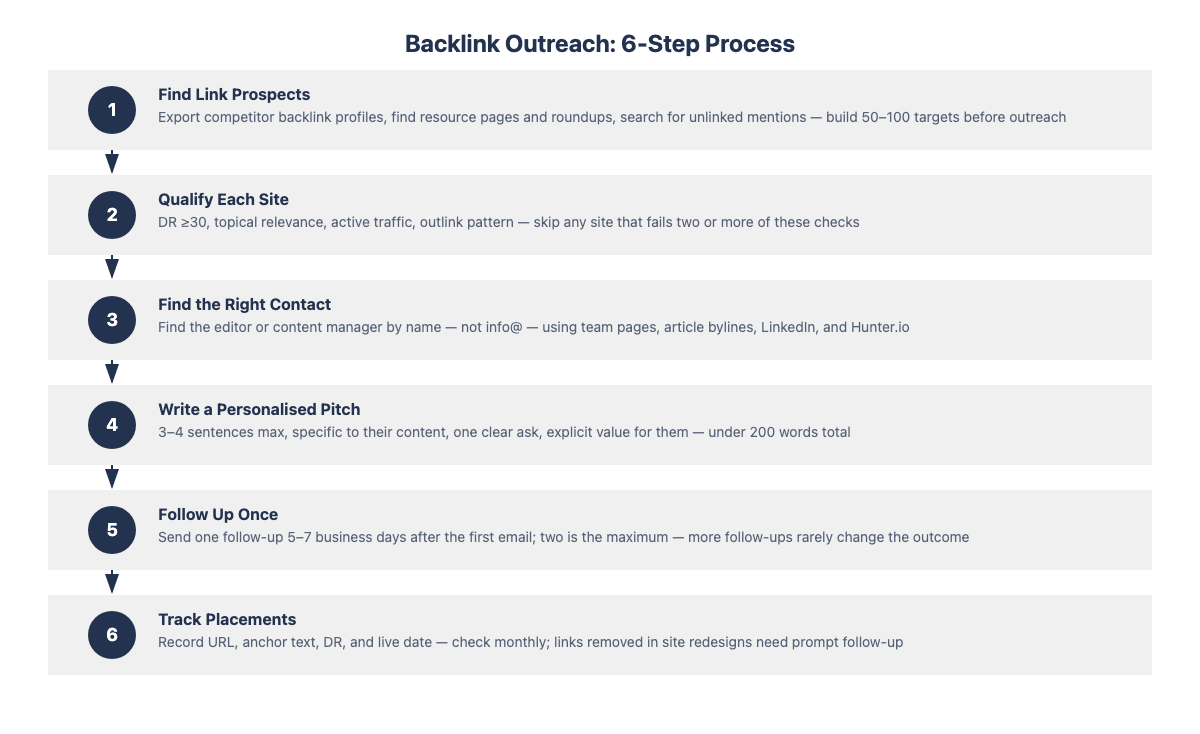
Backlink outreach follows six steps: find prospects, qualify each site, locate the right contact, write a personalised pitch, follow up once or twice, then track what was placed. Skipping qualification leads to wasted emails. Skipping follow-up cuts your response rate roughly in half.
Step 1: Find Link Prospects
Start with sites that already rank for topics adjacent to yours or that have linked to similar content. Three methods work reliably for finding them.
- Competitor backlink analysis: Export a competing article’s backlink profile using Ahrefs, Semrush or Majestic. Sites that linked to them are likely candidates for your content too.
- Content-type search: Search for resource pages, roundup posts or comparison articles in your niche. These pages link out by design and are easier to pitch.
- Unlinked mention search: Use Google with
"[your brand]" -site:[yourdomain.com]to find mentions that don’t yet carry a link.
Aim to build a prospect list of 50 to 100 sites before you start contacting anyone. Volume matters because the average response rate across most backlink outreach campaigns runs 5 to 10 percent, meaning 100 emails typically yield five to ten conversations.
Step 2: Qualify Each Site
Not every site worth targeting is worth the time. Check the prospect’s fit against these five signals before you write a single email.
- Topical relevance: Does the site cover subjects related to your content? Off-topic links carry less authority and a mismatched site’s pitch is harder to land.
- Domain Rating: DR is the most common proxy for a site’s authority. A DR above 30 is a reasonable floor; below that, the link equity is too thin to move rankings meaningfully in most cases.
- Traffic: A live Ahrefs or Semrush traffic estimate above zero confirms the site is indexed and active, not a link farm.
- Existing link: Check whether the site’s owner already links to you. If they do, focus elsewhere unless you have a reason to deepen the relationship.
- Outlink patterns: Scan a few of the site’s pages. Sites that link out freely respond better to pitches than sites that never link to external content.
A prospect’s site that fails two or more of these checks isn’t worth contacting.
Step 3: Find the Right Contact
Generic contact forms and info@ addresses rarely reach someone who can add your link. Find a person.
Look for the editor, content manager or SEO lead depending on the site’s type. The team page and the bylines on published articles give you names. From there, LinkedIn and tools like Hunter.io let you find working email addresses. An anonymous pitch to a shared inbox won’t outperform a direct name paired with the correct address. That’s worth the extra five minutes of digging.
Step 4: Write a Personalized Pitch
Each email should reference something specific about the site or the page you’re targeting. A pitch that could have been sent to any website gets treated like one.
Keep the email short. Three to four sentences is enough. Introduce yourself briefly, explain why you’re reaching out in relation to their specific content, make your ask clear and leave an easy next step. Don’t over-explain the SEO benefit. The recipient already knows why links matter.
Send a maximum of 20 to 50 emails per day to maintain quality. Beyond that volume, personalisation doesn’t hold up and deliverability suffers.
Step 5: Follow Up
One follow-up is standard. Two is the maximum. Wait three to five business days after the first email before following up. Keep the follow-up shorter than the original: one or two sentences that acknowledge the recipient’s inbox is busy and repeat the ask is enough.
Don’t apologise for following up. Don’t add new information or attach files. The goal is to resurface your original message for someone who was interested but busy.
Step 6: Track Placements
Once a link is placed, record it. A basic tracking sheet should include: the linking URL, the target URL on your site, the anchor text used, the linking domain’s DR and the date it went live. Check monthly that the link is still present. Links are occasionally removed during a site’s redesign or content update, and catching that quickly lets you follow up before the relationship goes cold.
How to Write a Backlink Outreach Email That Gets Responses
A good backlink outreach email has five components. Each one does a specific job.

- Subject line: Specific enough to be clear, short enough to fit in a preview. Reference the page or topic you’re contacting them about. Avoid anything that reads like a newsletter subject line.
- Personalised opening: One sentence that shows you actually read their content. Mention something specific: a data point they cited, a position they took, a format they used. Generic openers (“I love your blog”) fail because they apply to everyone.
- Clear reason for reaching out: One sentence that explains what you want and why their site is the right fit. Be direct. Vagueness signals a mass email.
- Value proposition: What’s in it for them? A broken link fixed, a content gap filled, a resource their readers would find useful. Make the benefit explicit.
- Single call to action: Ask one thing. Asking whether they accept guest posts and whether they want a sample and whether they have editorial guidelines in the same email creates friction. Ask one thing and stop.
Keep the whole email under 200 words. Anything longer doesn’t get read properly; it gets skimmed or ignored. An example of how this looks in practice:
Subject: Quick note on your [topic] guide
Hi [Name], I noticed your article on [specific topic] references [X]. We recently published a study on [related topic] that extends that point with fresh data.
It could make sense to link to it from that section. I’m happy to share a draft paragraph if that helps.
[Your name]
The email above is four sentences. The subject is specific to their content. The opening references a real detail. The ask is one clear action.
Volume and personalisation sit on a tradeoff. A small, highly targeted batch of pitches usually earns a noticeably higher reply rate than a much larger batch of lighter-touch emails, even though the larger batch can still produce more replies in absolute terms once the extra volume is factored in. Pick a lane for each campaign: go narrow and personal when the list is short and each site’s relationship matters individually, or go broader when the opportunity is more commoditised and consistency across many small wins matters more than any single placement.

For follow-up, repeat only the core ask in one to two sentences. Don’t introduce new arguments in the follow-up email.
Common Backlink Outreach Mistakes
Over-templatised, unpersonalised pitches cause more failed outreach campaigns than any other single mistake, but a handful of other problems account for most of the rest.
- Over-templatising: A template with five personalisation fields that were all left blank is obvious. So is a template where only the recipient’s first name and URL were swapped. Recipients spot these immediately.
- Pitching irrelevant sites: High-DR sites that cover unrelated topics are harder to pitch, less likely to accept and produce links with less topical authority. Relevance matters more than raw domain strength.
- Skipping follow-up: The majority of positive responses come from a campaign’s follow-up emails, not its first contact. Campaigns that send one email and move on leave a significant portion of potential placements behind.
- Treating outreach as transactional: Outreach that only exists to extract a link doesn’t build the kind of relationship that produces multiple links over time. Sites that place one link will often place another if the first experience was good.
- Ignoring deliverability: Sending from a fresh domain, using a free email provider’s address or exceeding sending limits can land your emails in spam before anyone reads them. Use a warmed domain and a dedicated sending address.
Should You Outsource Backlink Outreach?
Outsourcing backlink outreach makes sense once you need more placements than your team’s available hours can produce and you have the budget to pay for them. Doing it in-house makes more sense when volume is modest and the team’s own time and writing skill are enough to run a personalised campaign.
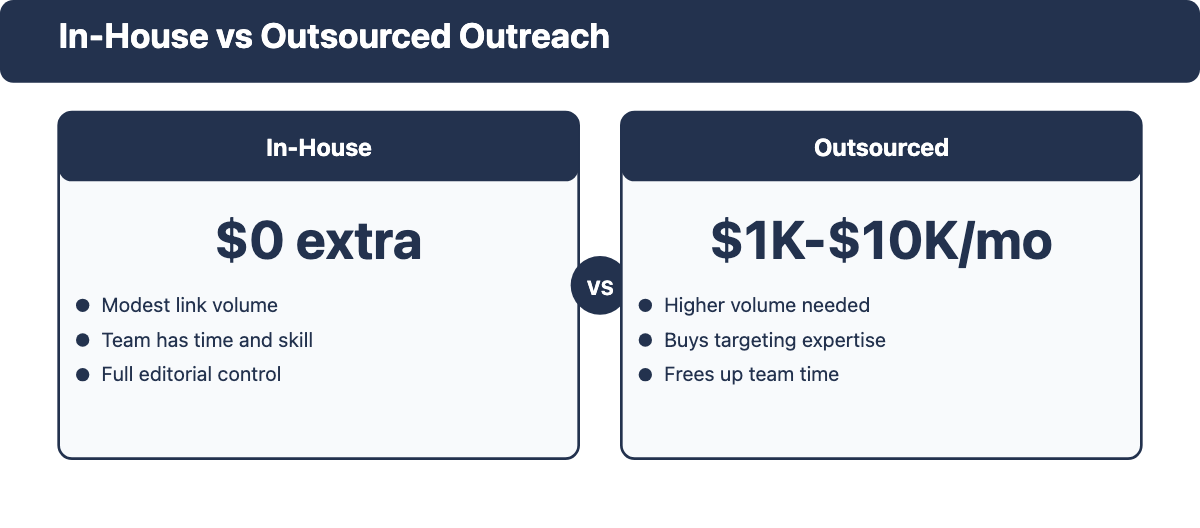
Agencies and freelancers who run backlink outreach typically charge $1,000 to $10,000 a month in retainers (depending on volume and niche competitiveness) or a few hundred dollars up to around $1,500 for a single placement on a higher-authority site. That range moves with quality. Cheap, high-volume packages don’t buy the same relevance as the higher end, which usually pays for more selective targeting and real editorial relationships.
Before paying for outreach, check for three things:
- A sample of past placements you can verify are live, relevant and still linking
- A clear answer on how prospects are qualified, not just how many emails get sent
- Reporting that shows the actual linking pages, not just a placement count
If a provider isn’t willing to show any of those three things, treat the offer as a red flag regardless of price.
What to Expect from Backlink Outreach
A typical backlink outreach campaign achieves a response rate of 5 to 10 percent, and meaningful ranking improvement takes 3 to 4 months. That’s the baseline to plan around before you start.

Translated into a working model: if you send 40 targeted, personalised emails per day, you can expect roughly two placements per day at a 5 percent response rate, the conservative end of the 5-to-10-percent range. That’s around 40 to 50 new backlinks a month from a consistent daily effort.
The 3 to 4 month delay is between link placement and visible ranking movement, not between effort and link placement. Links can go live within days. The delay comes from the time Google needs to crawl and index the new links, weight them against your existing profile and re-evaluate your pages relative to competitors. Campaigns that stop after six weeks because they “didn’t work” usually stopped just before the results would have appeared.
Volume and consistency matter more than any single placement. A burst campaign that runs for one month and stops won’t match what a white hat SEO link building approach built on regular, targeted outreach delivers over time.
FAQ
What is backlink outreach?
Backlink outreach is the practice of contacting a site’s owner, editor or journalist directly and asking them to link to your content, rather than waiting for links to happen on their own. You pick the sites, find the right person and make the case for the link yourself.
Is backlink outreach worth it?
Backlink outreach is worth it when the target sites are relevant, the content being pitched is genuinely good and the outreach is personalised. A generic mass campaign doesn’t produce strong results. A targeted campaign with solid content and careful site selection consistently produces high-authority placements that improve rankings over time.
What is a good response rate for backlink outreach?
A response rate of 5 to 10 percent is typical for well-targeted, personalised backlink outreach campaigns. Outreach that is highly personalised with a strong value proposition can reach 15 percent. Response rates below 2 percent usually mean the targeting isn’t right, the templating’s too obvious or both.
How long does backlink outreach take to show results?
Expect 3 to 4 months before outreach-driven backlinks produce measurable ranking improvements. The links can go live within days of a successful campaign. The delay comes from the time it takes Google’s index to crawl, weigh and re-rank the new links against your existing backlink profile.
How many follow-up emails should you send?
Send one follow-up email, three to five business days after the first contact. A second follow-up is acceptable if the site is a high-priority target. More than two follow-ups damages the relationship and doesn’t usually change the outcome.
What makes a backlink outreach email effective?
The most effective backlink outreach emails are short, specific and personal. They reference something real about the recipient’s content, make a clear and single request and explain the value in one or two sentences. Emails that are long, vague or obviously templated get deleted before they’re finished.
Should you outsource backlink outreach or do it in-house?
Outsourcing pays off once your target volume outgrows what one person can pitch personally, usually in the $1,000 to $10,000 a month range depending on scope and quality. Below that volume, keeping it in-house is usually cheaper and just as effective, provided someone already writes well and has the time to spare.