

A digital PR agency earns media coverage, editorial links, and brand citations for your business through content campaigns, journalist outreach, and data-driven storytelling. Unlike a traditional PR firm focused on broadcast coverage or a link building agency focused on placement volume, a digital PR agency ties every piece of coverage directly to search visibility, organic website traffic, and long-term brand authority.
For SaaS companies, e-commerce brands, and B2B businesses, effective digital PR is one of the highest-ROI ways to build domain authority at scale, combining the journalist relationships of traditional PR with the measurable outcomes of SEO.
If you are still learning the mechanics of digital PR itself, start with the overview at Digital PR: What It Is, How It Works, and How to Use It for SEO. This page is about the external provider side: what these agencies actually deliver, how to evaluate them, and which ones are worth your attention.
What Does a Digital PR Agency Do?
A digital PR agency secures editorial coverage from publishers, journalists, and content creators on your behalf, with the goal of earning backlinks, brand mentions, and citations that strengthen your domain authority and organic rankings.
The core service mix varies by agency, but a full-capability digital PR agency should offer all five of the following:
- Editorial outreach and earned media placements: pitching original stories, data, or expert commentary to pitch stories to journalists in relevant media outlets and securing coverage that generates referral traffic
- Data-driven content campaigns: producing original research, surveys, or visual assets designed to earn high authority links and press coverage at scale
- Link acquisition with editorial quality: earning backlinks from editorial context rather than directories or paid placements
- Influencer and blogger outreach: building relationships with bloggers, influencers, and niche content creators to amplify brand stories beyond traditional media
- AI visibility and brand citation building: getting your brand cited as a source in AI-generated answers on ChatGPT, Perplexity, Gemini, and similar tools
- Online reputation and presence management: monitoring brand mentions, managing crisis narratives, and expanding your authority footprint across relevant media
Digital PR Agency vs. Traditional PR Agency
Digital PR and traditional PR share the overarching goal of building brand awareness and reputation. The core difference is in what they optimize for: traditional PR agencies prioritize media impressions, broadcast coverage, and share of voice; digital PR agencies prioritize search engine authority, editorial backlinks, and organic website traffic.
Traditional PR agencies focus on press releases, broadcast media, brand image, and crisis communications. They measure success in media impressions, share of voice, and publication tier; SEO and backlinks are rarely primary KPIs. A brand-building campaign in print or broadcast may earn significant awareness without generating a single link that affects organic rankings.
Digital PR agencies evaluate every placement against metrics like referring domain authority, link placement in editorial body text, and the resulting organic traffic. For online-first businesses (SaaS, e-commerce, digital services), the ability to track ROI from every placement makes effective digital PR the more measurable and directly growth-connected choice. The two disciplines overlap on journalist relationships and storytelling, but digital PR agencies are specifically optimized to move organic search metrics.
| Dimension | Digital PR Agency | Traditional PR Agency | Link Building Agency |
|---|---|---|---|
| Primary focus | Earned links + SEO visibility | Brand awareness + press coverage | Link volume and anchor optimization |
| Primary output | Editorial backlinks + coverage | Media impressions + placement | Backlinks |
| SEO integration | Core to strategy | Secondary or absent | Core to strategy |
| Content investment | High (original research, assets) | Medium (press releases, pitches) | Low to medium |
| Journalist relationships | Central | Central | Peripheral |
| AI visibility | Emerging capability | Not typically included | Not typically included |
Digital PR Agency vs. Link Building Agency
Digital PR and link building are both off-page SEO strategies used to build website authority, but they approach this goal from opposite angles. Link building agencies acquire backlinks through outreach, guest posts, and content syndication; the focus is placement volume. Digital PR agencies create newsworthy content campaigns designed to earn high authority coverage organically, which produces fewer but more impactful placements.
The practical difference: a link building agency delivers 20 placements at DR 40–60. A digital PR agency might deliver 8 placements at DR 70–85 in publications that journalists and AI systems actually reference. If you want to build a brand reputation that people trust and earn referral traffic from major publications, digital PR is the better-fit strategy. Both approaches have their place depending on your growth stage and budget.
Types of Digital PR Agencies
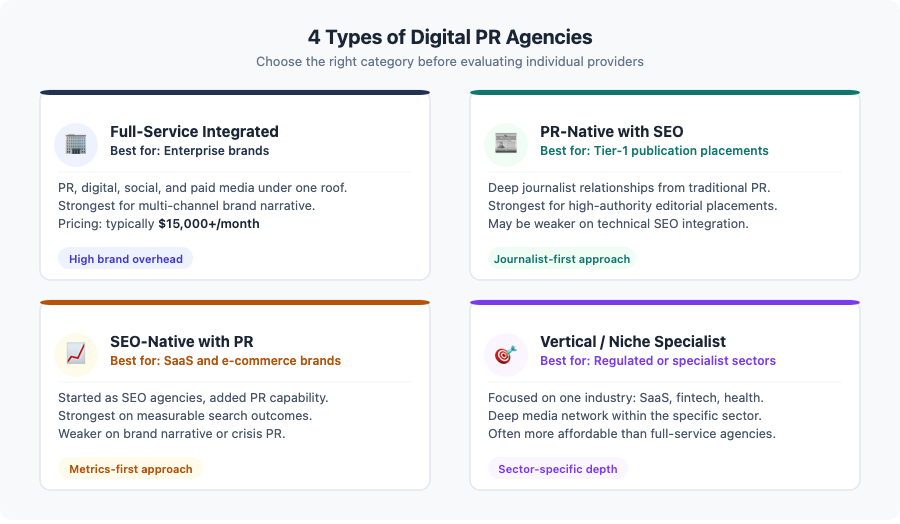
Not every digital PR agency is built the same. Before you evaluate individual providers, understand which category fits your situation: the agency type determines what you get, at what price, and how well-suited they are to your goals.
Full-service integrated agencies combine PR, digital, social, and sometimes paid media under one roof. They are best suited for enterprise brands that want a single partner managing brand narrative across all channels. Pricing reflects the overhead; expect $15K+/month.
PR-native agencies with SEO specialization started as traditional PR firms and evolved to add link-building and search strategy. They tend to have the deepest journalist relationships and are strongest for high-authority placements in tier-1 publications. They can be weaker on technical SEO integration.
SEO-native agencies with PR capability started as SEO agencies and added digital PR as an earned link acquisition channel. They tend to be stronger on measurable search outcomes and weaker on brand narrative or crisis communications. Good fit for SaaS and e-commerce companies optimizing for organic acquisition.
Vertical and niche specialists focus exclusively on a single industry: B2B SaaS, fintech, health, legal, e-commerce, or similar. Their value is deep media network within a specific sector and content that resonates with specialist journalists. Pricing varies widely; boutique niche specialists often charge less than full-service generalists.
Which type fits your situation?
If you need brand visibility + links across multiple channels → full-service integrated
If your top priority is placement in major publications → PR-native with SEO
If you need to move organic search metrics measurably → SEO-native with PR
If you operate in a regulated or specialized sector → vertical specialist
What to Look for When Choosing a Digital PR Agency
Track Record and Case Studies
The most important signal is verifiable proof that the agency has moved search metrics for clients in a comparable situation. Ask for case studies that show:
- Which specific publications did coverage appear in (not just “top-tier media”)?
- How many editorial backlinks did the campaign earn?
- What happened to organic traffic or rankings after the campaign?
Specific questions to ask:
– “Can you share 2–3 case studies in my industry or with a similar budget?”
– “What was the average DR of placements in your last five campaigns?”
Media Network and Journalist Relationships
Digital PR effectiveness depends on real relationships with journalists, editors, and content managers. An agency without these relationships relies on cold outreach with low acceptance rates and long lead times.
Specific questions to ask:
– “Which publications do you have established contacts at?”
– “How do you personalize pitches: do you have someone who has worked with the journalists at [specific publication]?”
Research and Content Production Capability
Strong digital PR campaigns are built on original data: surveys, proprietary research, or novel analysis that journalists want to cite. Agencies without in-house research or content production capability outsource this work or skip it, which limits the authority of their placements.
Specific questions to ask:
– “Do you produce original research internally or partner with research firms?”
– “Can I see examples of data-driven campaigns you have run?”
Reporting Standards
Good agency reporting tells you what actually happened, not just what looks impressive. A solid monthly report should include: placement list with URLs and DR, organic impressions lift if trackable, anchor text distribution, and a clear read on whether the link acquisition is moving domain authority.
Specific questions to ask:
– “What does your standard monthly report include?”
– “Do you track how placements affect our organic traffic or rankings over time?”
Pricing Structure and Transparency
Agencies with vague pricing (“we will quote after a discovery call”) often set prices based on how much budget they perceive you have, not on what the work costs. Ask for a pricing framework upfront so you can assess value before investing time in a discovery process.
Specific questions to ask:
– “What is your minimum monthly retainer?”
– “What is typically included versus charged as an add-on?”
Industry or Vertical Fit
An agency that covers your sector will pitch journalists who write about your topic, use the right vocabulary, and build relationships with the outlets that matter to your audience. A generalist agency working in an unfamiliar vertical has to learn it on your dime.
Specific questions to ask:
– “What percentage of your current clients are in my industry?”
– “Which sector-specific publications do you have the strongest relationships with?”
Questions to ask before you sign:
1. Can you share 3 verifiable case studies with DR of placements listed?
2. What is your standard monthly reporting package?
3. What publications do you have established journalist relationships with?
4. How do you measure campaign success beyond placement count?
5. What is your minimum retainer, and what does it include?
6. How do you handle months where a campaign underperforms?
7. Do you have experience in my industry?
8. What is your process for producing the content that earns coverage?
Red Flags to Watch For
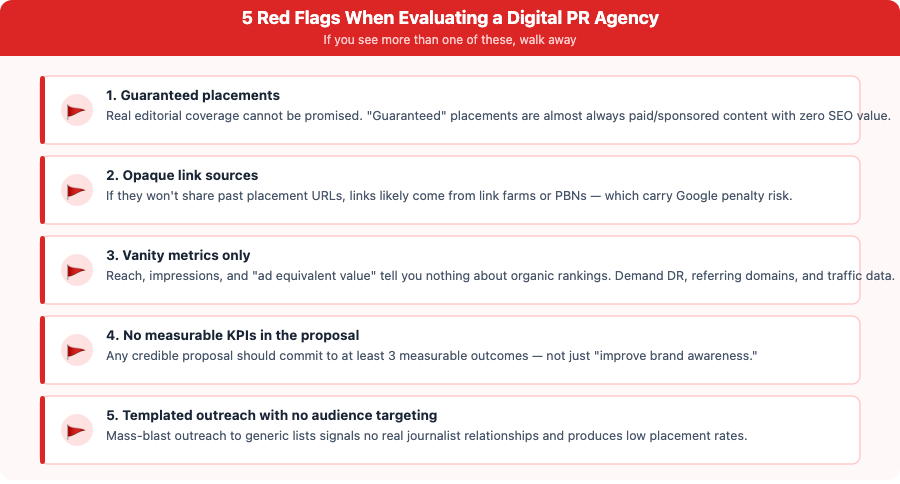
1. Guaranteed placements. Real editorial coverage cannot be guaranteed. If an agency promises guaranteed placements in named publications, they are almost certainly selling sponsored content labeled as editorial, which has no SEO value and often violates Google’s link spam guidelines.
2. Opaque link sources. If an agency is reluctant to share URLs of past placements or delivers links from sites with no clear editorial standards, the links may be from link farms or private blog networks (PBNs) that carry a penalty risk.
3. Vanity metrics without SEO impact. Reach, impressions, and “equivalent advertising value” are traditional PR metrics. They tell you nothing about whether a campaign is improving your organic search position. An agency that reports only these metrics is not measuring what digital PR is actually for.
4. No measurable KPIs in the proposal. Before signing, a credible agency should propose at least 3 measurable outcomes tied to your business goals: link quantity, placement DR, organic traffic change, or AI citation appearances. Vague language like “increase brand awareness” with no metric attached is a warning sign.
5. Templated outreach with no audience targeting. Mass outreach to generic journalist lists produces low placement rates and often damages your domain reputation through spam associations. Ask how the agency customizes pitches. If the answer is generic, the strategy probably is too.
If an agency displays more than one of these signals, trust your instincts and walk away.
How Much Do Digital PR Agencies Cost?
Digital PR agency pricing typically runs on monthly retainers, though some offer project-based pricing for one-off campaigns. Project pricing generally runs $5,000–$30,000 per campaign depending on scope.
| Tier | Monthly Range | Typical Deliverables | Best For |
|---|---|---|---|
| Boutique | $3,000–$7,000 | 4–8 editorial links/month, 1 campaign asset, monthly reporting | Startups, SMBs, niche verticals |
| Mid-market | $7,000–$20,000 | 8–20 links/month, 2–3 campaign assets, custom reporting | Scale-ups, funded SaaS, mid-size e-commerce |
| Enterprise | $20,000+ | 20+ links/month, research studies, full content production, PR + SEO integration | Enterprises, competitive verticals |
Cost-per-link context: At boutique pricing, a campaign delivering 6 editorial links at average DR 65 costs roughly $500–$1,000 per link. At mid-market pricing for 15 links at DR 70+, cost-per-link typically falls to $450–$700. Enterprise retainers often include research production and content assets whose value compounds across multiple campaigns.
What is typically included:
– Campaign concept and content production
– Journalist research and outreach
– Placement tracking and reporting
– Strategy calls (monthly or quarterly)
What is typically extra:
– Paid survey or research panel costs
– Video or interactive asset production
– Crisis communications or reactive PR
– Local or international market outreach
Top Digital PR Agencies to Consider
These agencies have established track records in digital PR with SEO-measurable outcomes. Pricing tiers and specialties reflect publicly available information and industry positioning as of 2026.
Fractl — Specialty: Data-driven content campaigns / Tier: Mid-market to enterprise
Best for: Companies that want original research at the center of every campaign. Fractl has produced campaigns earning coverage in The New York Times, CNN, and Forbes, with an emphasis on data visualization and survey-based content. They work primarily with brands that have budget to invest in research assets. Pricing typically starts at $15,000/month.
Siege Media — Specialty: Content-led link acquisition / Tier: Mid-market to enterprise
Best for: B2B and SaaS companies that want SEO-integrated PR. Siege Media ties every content asset directly to organic search outcomes and has a strong track record of link acquisition through long-form assets and expert-driven content. Pricing is custom but typically starts around $10,000/month.
Go Fish Digital — Specialty: Full-service digital marketing + PR / Tier: Mid-market to enterprise
Best for: Brands that want digital PR integrated with broader SEO and PPC strategy. Go Fish Digital has served major clients including Amazon, GEICO, and Marriott. They bring strong media relationships alongside a technical SEO foundation. Pricing is custom.
Reporter Outreach — Specialty: Boutique editorial placement / Tier: Boutique to mid-market
Best for: Companies with smaller budgets looking for measurable editorial placements. Reporter Outreach focuses on transparency in its process and pricing, publishing clear case studies and placement DR data. Monthly retainers start around $3,000.
Omniscient Digital — Specialty: SEO-integrated content and PR for SaaS / Tier: Mid-market
Best for: B2B SaaS companies that want digital PR embedded in a broader content strategy. Omniscient Digital builds link acquisition programs around editorial content designed to rank and earn links simultaneously. Pricing starts at approximately $10,000/month.
Green Flag Digital — Specialty: Digital PR for venture-backed tech companies / Tier: Mid-market
Best for: Funded startups and tech companies building authority in competitive spaces. Green Flag Digital was founded with SEO analytics at its core and focuses on data-backed campaigns for growth-stage companies. Pricing is custom.
North Star Inbound — Specialty: High-authority link acquisition / Tier: Mid-market to enterprise
Best for: Companies that prioritize placement authority over volume. North Star Inbound focuses on DR 70+ placements in top publications and works best with companies that have a 6–12 month investment horizon. Pricing starts at $15,000/month.
Linkifi — Specialty: Done-for-you link building / Tier: Boutique
Best for: Agencies or brands that want a managed link acquisition service without building internal capability. Linkifi offers clear monthly deliverables at transparent pricing, typically $3,000–$7,000/month.
Digital Third Coast — Specialty: Digital PR and social / Tier: Mid-market
Best for: Brands in competitive verticals that want PR integrated with social amplification. Digital Third Coast blends media outreach with organic social strategy. Pricing is custom but typically starts around $5,000/month.
Rise at Seven — Specialty: Reactive PR and newsjacking / Tier: Mid-market to enterprise
Best for: Brands that want to capitalize on trending news cycles. Rise at Seven is known for fast-turnaround PR campaigns that tie brand commentary to breaking news, earning high-authority placements in short timeframes. Based in the UK with global reach.
Linkforce — Specialty: Managed link building and digital PR / Tier: Boutique to mid-market
Best for: Businesses that want a structured, transparent link acquisition program with clear reporting. Linkforce offers managed outreach programs with a focus on editorial quality and measurable SEO outcomes. A good fit for companies building their first external link acquisition program.
How to Evaluate Your Agency’s Performance
Once you are working with an agency, set performance expectations upfront and review them monthly. Vague progress updates are a common complaint; the solution is to define specific metrics before the retainer starts.
| Metric | What It Measures | How to Track | Target Benchmark |
|---|---|---|---|
| Earned media placements | Coverage volume and publication quality | Manual URL list + DR check via Ahrefs | DR 50+ for boutique; DR 65+ for mid-market |
| Editorial backlink acquisition | Link volume with editorial context | Ahrefs new backlinks report, filtered by dofollow | 5–20/month depending on tier |
| Organic visibility lift | Whether links are moving rankings | GSC position tracking for target keywords | Positive trend over 90 days |
| AI citation appearances | Whether your brand appears in AI-generated answers | Perplexity, ChatGPT, and Gemini brand mention tracking | Increasing month-over-month |
| Brand mention volume | Unlinked mentions that signal authority | Google Alerts, Ahrefs Mentions | Growing trend tied to campaign activity |
For more on tracking link building outcomes, see Link Building Reporting: What to Track and How to Present It.
What a Good Monthly Agency Report Includes
A credible digital PR agency should deliver, at minimum:
- Full list of placements earned in the period, with URL and DR for each
- Anchor text distribution across all new links
- Domain authority trend (your root domain DR over time)
- Campaign status and next-month plan
- Organic impressions and click data from Google Search Console if baseline was set
- AI citation tracking summary (which queries now surface your brand)
- Commentary on what worked and what was adjusted
If your agency’s reports contain only placement counts and PR reach metrics without linking them to SEO outcomes, ask for a revised reporting framework; or look at how to develop your own using the guidance in our link building reporting guide.
Digital PR Agency vs. In-House: When to Go External
Signs you are ready to hire an agency:
- You are spending significant internal resource on outreach with inconsistent results
- Your domain authority has plateaued despite content investment
- You do not have an in-house journalist network or PR relationships
- You need to scale link acquisition without scaling headcount
Signs in-house makes more sense:
- Your topic is highly specialized and requires deep subject-matter expertise that an agency cannot match
- You have budget for a full-time PR or content hire who can focus exclusively on your domain
- Speed of turnaround matters more than authority (reactive PR in your own industry is hard to outsource)
The hybrid model: Many mid-market companies use an agency for research-driven campaigns (2–3 per year) while managing reactive PR and expert commentary in-house. The agency provides scale and relationships; the internal team provides speed and subject-matter depth. This is often the most cost-efficient structure once you have at least one person internally who understands what good digital PR looks like.
FAQs
What does a digital PR agency cost?
Most agencies price on monthly retainers ranging from $3,000–$7,000 for boutique services, $7,000–$20,000 for mid-market, and $20,000+ for enterprise. Project-based work for a single campaign typically runs $5,000–$30,000 depending on the asset type and outreach scope.
How long until I see results from a digital PR agency?
Most campaigns take 6–12 weeks from kickoff to first placement. Organic search impact from a consistent link acquisition program typically becomes visible in 3–6 months. Expecting meaningful ranking movement within the first 30 days is not realistic.
What is the difference between digital PR and link building?
Link building acquires backlinks through outreach, guest posts, and content syndication; the focus is placement volume. Digital PR earns coverage through newsworthy content campaigns; the focus is placement authority and editorial context. Digital PR tends to produce fewer but higher-DR links that are also brand-building assets. See Backlink Outreach: How to Get Links That Actually Get Placed for more on the outreach mechanics that both disciplines share.
Can a small business use a digital PR agency?
Yes, if the retainer fits the budget. Boutique agencies at $3,000–$5,000/month can deliver meaningful link acquisition for small businesses, particularly in niche verticals where a handful of authoritative placements can move rankings measurably. The key is choosing an agency with experience in your sector so the learning curve does not eat your first 60 days.
What KPIs should I track with my digital PR agency?
The five most important: editorial placement DR (quality), placement volume per month (scale), referring domain growth (cumulative), organic position changes for target keywords (search outcome), and AI citation appearances (emerging). Avoid measuring only impressions or equivalent advertising value; those metrics do not tell you whether the investment is improving your search position.