
HARO link building means earning a backlink through a simple, repeatable loop: a journalist posts a request for sources, you reply with a quote or data point, and if they use it, the published article links back to your site. The tactic predates most of today's outreach software, and it still works, but the platform behind it has changed ownership twice since 2024, and most guides to it online describe a version of HARO that no longer exists.
This guide covers what HARO actually is right now, who runs it, how the request-and-reply flow works today, how to write a pitch that gets picked over a hundred competing replies, and where it fits next to other outreach and digital PR work in a broader SEO strategy.
What Is HARO Link Building?
HARO stands for Help A Reporter Out. Journalists and bloggers post requests describing a story they're working on and the kind of source they need; people with relevant expertise reply with a quote, a data point, or an answer; if the journalist uses the reply, the published piece usually credits the source with a link back to their site. That link is the "backlink" in HARO link building; it's an earned editorial link rather than one you'd build or buy directly.
The mechanics sound simple, and they are, but the platform itself isn't the same one that made this tactic popular a few years ago. Before getting into pitching tactics, it's worth being clear on what HARO is today, because the answer definitely changed, twice, in the last two years.
Do
- Reply within the first hour of a digest when possible
- Lead with a specific number or named example
- State your qualification in the first sentence
- Check your own backlink profile instead of waiting for a notification
- Run HARO alongside at least one other platform like Qwoted or SourceBottle
Don't
- Send a generic pitch that could come from any company
- Pitch your product instead of your insight
- Leave out your name, title or contact details
- Treat HARO as your only outreach channel
- Ignore a stated requirement in the original request
What Happened to HARO? The Connectively and Featured Timeline
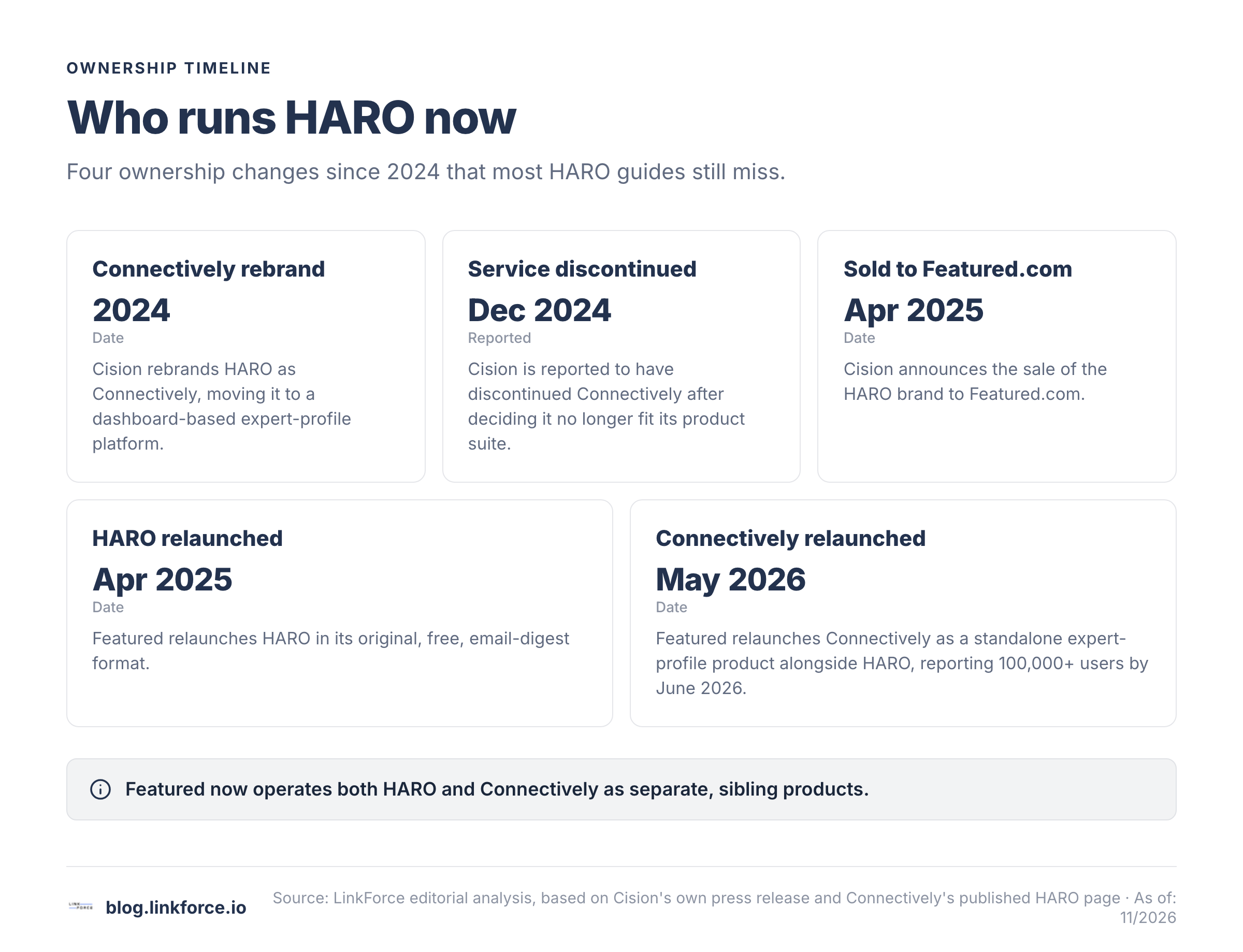
Featured.com now owns and operates HARO, after a chain of ownership changes that started in 2024. Before that, HARO had been a stable Cision product for a decade: it started as an independent service, was acquired by Vocus, and ended up owned by Cision after Cision bought Vocus in 2014. That stability didn't last.
- In early 2024, Cision rebranded HARO as Connectively, moving it from a simple email digest to a dashboard-based expert-profile platform.
- Connectively was reported to have been discontinued by Cision in December 2024, after Cision's leadership said the HARO and Connectively services no longer fit its product suite.
- On 15-16 April 2025, Cision announced it had sold the HARO brand to Featured.com, a platform built around connecting subject-matter experts with publishers.
- Featured relaunched HARO in its original, simpler email-digest format around 22 April 2025, free to use, with no account required to reply to a request by email.
- In May 2026, Featured relaunched Connectively as a separate, standalone expert-profile product alongside HARO, rather than folding everything into one platform. By its June 2026 update, Featured reported Connectively had passed 100,000 users.
Frankly, four out of five HARO guides you'll find today still describe the pre-2024 Cision version, with no mention of Connectively or Featured at all. That gap matters for two practical reasons: the sign-up flow and digest format described below are the current one, not the one most other articles show, and Featured's ownership also means there's current anti-spam and AI-pitch vetting, covered further down, that didn't exist in the older version of HARO.
How HARO (Now Powered by Connectively) Works for Sources
As of this writing, Featured operates HARO through its Connectively platform. The current flow for a source, meaning anyone replying to requests rather than posting them, works like this.
- Create a free Expert Profile with your name, title, area of expertise, and a short bio. Connectively uses this profile to surface queries relevant to you and to build a public expert page that search engines can index on its own.
- Queries from journalists go out as email digests three times a day, organized into topic categories so you can filter to the ones relevant to your expertise.
- You respond either inside the platform or by replying to the digest email directly, depending on the request.
- You can track your submissions, and the platform reports back figures such as average time to placement for successful pitches.
Signing up is free and it doesn't require a credit card. Featured also sells paid tiers of its separate Featured Experts product for people who want higher usage limits, but the baseline HARO/Connectively expert profile and the email digests cost nothing, period.
How to Write a HARO Pitch Journalists Actually Use
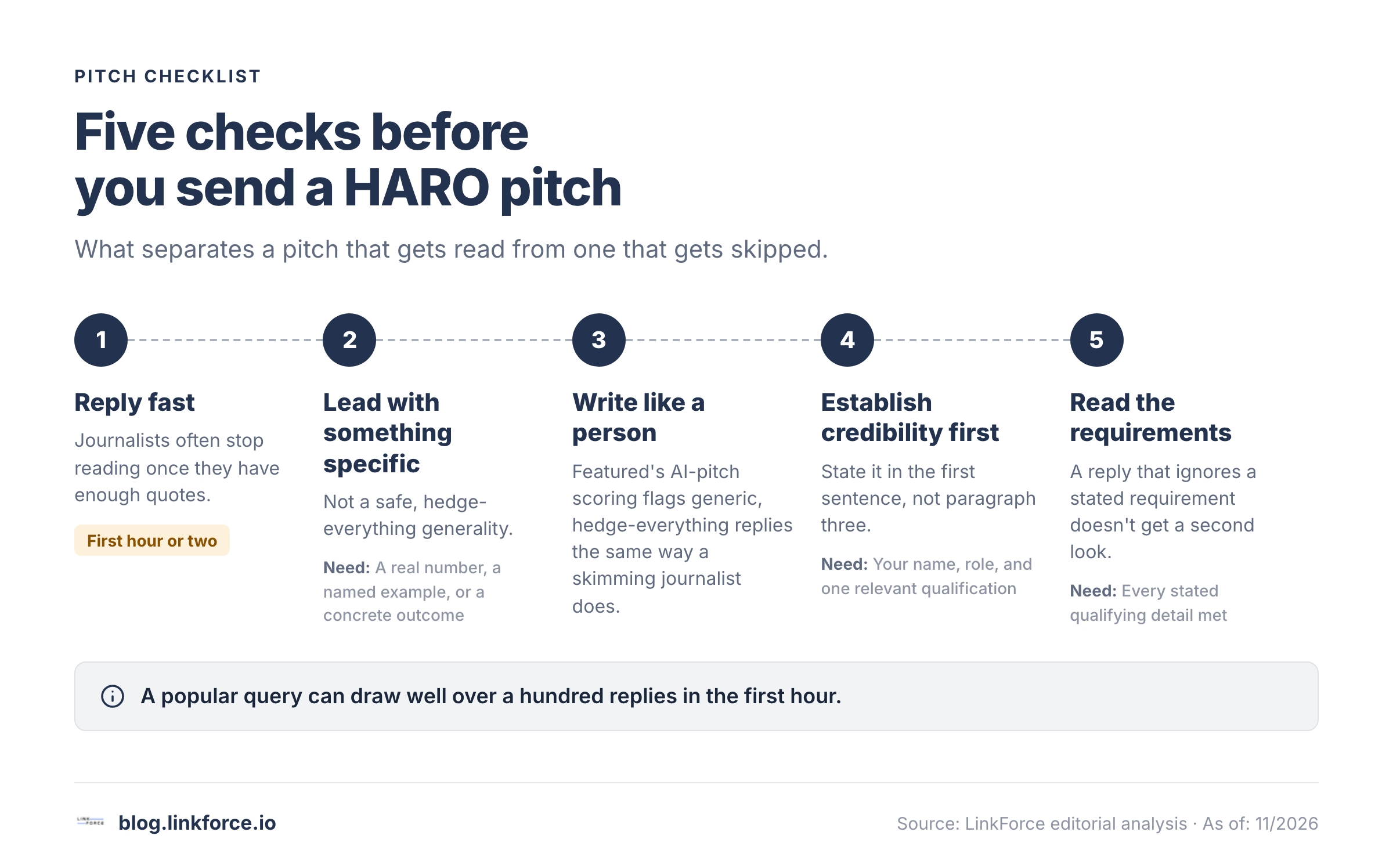
A single popular query can draw well over a hundred replies within the first hour of a digest going out. Journalists skim fast and don't use very much of what lands in their inbox, so the bar for a reply that actually gets read, let alone used, is higher than "answer the question."
Reply fast
Journalists on tight deadlines often stop reading submissions once they've got enough good quotes, sometimes within the first hour or two after a request goes out. A well-written reply sent the next morning frequently arrives too late to be considered at all, regardless of quality.
Lead with something specific, not a safe generality
A reply that opens with a real number, a named example, or a concrete outcome reads as credible in a sentence; a reply that opens with a broad, hedge-everything statement reads as generic in the same amount of time. Specificity isn't just a style preference here; it's what separates a usable quote from one a journalist skips past, and it's not hard to spot which is which once you've read a few of each.
Write like a person, not like an AI assistant
Featured's current anti-spam system actively screens for AI-generated-sounding pitches as part of vetting who gets through, on top of checks like LinkedIn verification and headshot review for repeat-offender bans. Featured partners with AI-detection vendor Pangram Labs to score every pitch; according to Featured's own reported figures covering June 2025 through July 2026, roughly 21% of the 1,394,740 pitches scored, about 293,000, were flagged as fully AI-generated, and accounts that eventually got banned were about 3.6 times more likely to have at least one AI-flagged pitch than accounts that stayed active. A single AI-flagged pitch doesn't get you banned on its own, but pitches that read as generic, hedge-everything AI output, exactly the kind the scoring is built to catch, are exactly what any journalist skimming a hundred replies also skips first.
Establish credibility in the first line
State your name, your role, and the one qualification that makes you relevant to this specific question, in the first sentence. A journalist deciding whether to keep reading makes that call almost immediately; burying your credentials in paragraph three means most readers won't ever get there.
Read the actual requirements before replying
Many requests specify qualifying details, such as a minimum years of experience, a specific job title, or a requirement to be quotable by full name rather than anonymously. A reply that ignores a stated requirement doesn't get a second look, no matter how good the answer is.
Before you send, check:
- Does the first sentence establish who you are and why you're qualified to answer this?
- Is there at least one specific detail, number, or named example, rather than only general advice?
- Would this read as something only you could have written, or could it have come from anyone?
- Does it meet every stated requirement in the original request?
- Are your name, title, and a working link or contact detail included?
The free Email Permutator generates every common address format for a name and domain.

LinkForce connects you with 800+ SaaS marketers who swap partner and content links.
Example HARO Pitch
A request from a business publication might read: "Looking for SaaS founders or finance leaders who've cut a specific software cost without losing functionality. Need your name, title, company, and a concrete before-and-after figure. Must respond by 3pm ET today."
A reply built around the tactics above wouldn't be complicated; it'd read something like this.
Hi [Name],

I'm [Full Name], [Title] at [Company]. We cut our outreach-software
spend by renegotiating usage tiers instead of switching vendors.

Specifically: we moved from a $890/month plan to a $540/month plan
(a 39% reduction) by auditing which seats and features we actually
used over 90 days before the renewal call, then negotiating from
that data instead of a list price.

The tactic that worked: ask for a usage report before the renewal
conversation, not during it. Vendors negotiate differently when you
already have the numbers.

Happy to go deeper on the specific negotiation points if useful.

[Full Name], [Title], [Company]
[Email] | [Phone] | [Website]
The template above is illustrative, not a verified placement. What makes it work structurally: the credibility line comes first, the number's specific rather than rounded or vague, the tactic is named rather than just the outcome, and contact details are complete, so a journalist on deadline doesn't have to chase anything down.
Common HARO Link Building Mistakes
- Generic pitches that could come from anyone. If a reply contains no detail specific to your business or experience, swap in a different company name and it would still read the same. That's the clearest sign it needs more specificity, not more polish.
- Pitching your product instead of your insight. A reply built around "our tool does X" rather than "here's what I learned doing X" reads as an ad, and most journalists filter ads out immediately.
- Missing or incomplete contact information. A journalist on deadline won't chase down your website to confirm your title or find a working email address; incomplete replies get skipped in favor of complete ones.
- Treating a published link as the end of the process. Links occasionally go missing, point to the wrong page, or get added without a notification. Periodically checking your own backlink profile catches mentions that never generated the expected link, since journalists don't always notify sources after a story's published.
- Treating HARO as the only channel. HARO/Connectively is one source of journalist requests among several; relying on it exclusively means missing queries that only appear on other platforms.
Is HARO Link Building Still Worth It?
Practitioner opinion on this is mixed and mostly anecdotal: plenty of people report that it takes a lot of outreach before a reply turns into an actual placement, and that most replies never get used at all. That's consistent with how the platform's built, a high volume of pitches competing for a small number of slots per story.
For scale context, Connectively reports, as of its own site at the time of writing, more than 50,000 expert members, over 1 million pitches facilitated, an 18-day average time to placement for successful pitches, and more than 500 publisher outlets posting queries on the platform. These are the vendor's own reported figures, not independently audited numbers, and they describe the whole platform rather than any individual source's odds. Treat them as a sense of scale, not a guarantee of your own results.
What that means practically: HARO link building is worth doing as one source among several, not as a guaranteed-return channel on its own. The links it produces are genuine editorial citations from outlets you likely couldn't get coverage from otherwise, which is real value, but the time-per-placement cost is real too.
It's also worth being clear on what kind of backlink you're actually earning. A HARO placement is an earned, editorial link: nobody paid for it and nobody built it directly, a journalist chose to cite you. That's different from a built link, one you create yourself through a guest post or a directory listing, and different again from a bought link, one placed in exchange for payment, which carries real risk if it looks manipulative to search engines. Earned links like HARO's tend to carry more trust precisely because they're the hardest of the three to fake.
HARO Alternatives and Complementary Platforms
Several platforms run the same basic model, journalist posts a request, sources reply, including Qwoted, SourceBottle, Featured Experts, JustReachOut, and ProfNet, and they're worth running alongside HARO rather than instead of it. Prices below are each platform's own published rate, checked directly at the time of writing rather than copied from another article. For a longer list and more detail on choosing between them, see our full guide to HARO alternatives.
| Platform | Free tier | Paid pricing (USD) | Best for |
|---|---|---|---|
| HARO (Connectively / Featured) | Yes, free Expert Profile, no credit card | n/a (core HARO use is free) | Default starting point, highest-volume request flow |
| Featured Experts | Yes | $39-$299/month billed monthly ($29-$239/month billed annually) | Higher usage limits and more daily query matches on the same network |
| Qwoted | Yes, 2 pitches/month with a 2-hour delivery delay | Pro: $149.99/month (or $1,188/year) | Faster, higher-volume pitching once the free tier feels limiting |
| SourceBottle | Yes, free account | Pay-per-pitch at $25/pitch, or unlimited at $65/month ($650/year); agency plan at $130/month | Flexible pay-per-use pricing instead of a flat monthly fee |
| JustReachOut | 7-day trial only, no permanent free tier | $98-$417/month billed annually ($147-$1,997/month billed monthly) | Managed, hands-on outreach rather than self-service pitching |
| ProfNet | Not applicable | Custom quote on a sliding scale by organization size and category count; no public rate | Enterprise or agency-scale use through the PR Newswire network |
For most sites, starting with the free HARO/Connectively profile and adding a second free-tier platform like Qwoted or SourceBottle before you pay for anything is the lower-risk sequence. Journalist-request work also pairs naturally with other white hat link building tactics and with testimonial-based outreach, since both rely on the same underlying asset: a credible person willing to go on record.
HARO Link Building FAQ
Is HARO still free?
Yes, HARO is still free. Creating an Expert Profile and responding to HARO requests through Connectively is free and doesn't require a credit card. Featured sells separate paid tiers of its Featured Experts product for higher usage limits, but the core HARO/Connectively profile costs nothing.
Is HARO the same as Connectively?
HARO and Connectively are related but not identical. Connectively's the expert-profile platform Cision built when it rebranded HARO in 2024; after Cision discontinued it and sold the HARO brand to Featured.com in 2025, Featured relaunched HARO as a simpler, free, email-first service, and then relaunched Connectively separately in May 2026 as a standalone product alongside it. Today HARO and Connectively are sibling products under Featured, not two names for the same thing.
How often are HARO requests sent?
Connectively sends query digests three times a day, organized by topic category so sources can filter to the requests relevant to their expertise.
How long does it take to get a backlink from HARO?
Connectively reports an 18-day average time to placement for pitches that do result in coverage, as of its own published figures at the time of writing. That's an average across the whole platform, not a guarantee for any individual pitch, and plenty of pitches don't result in a placement at all.
What's the actual way to respond to a HARO request?
Reply through the platform or directly to the digest email, depending on how the specific request is formatted, and lead with your name, title, and qualification, followed by a specific, concrete answer rather than general advice. Speed matters: popular queries can draw well over a hundred replies within the first hour.