
HARO shut down in 2024, and the company that bought its name has since folded it back into a bigger product. If you're looking for the best HARO alternatives to send expert quotes to now, here's the honest short answer: Featured.com runs both HARO and Connectively today, and five other alternatives (free and paid) fill the gaps it leaves. Below is what each one actually costs, how it delivers requests, and which one fits your situation.
What Happened to HARO?
HARO (Help a Reporter Out) ran as a free email service connecting journalists with expert sources from 2008 until Cision, its owner, rebranded it as Connectively in 2024. Connectively didn't last long under that name either; it was discontinued on December 9, 2024, as Cision shifted its focus to CisionOne, Brandwatch, and PR Newswire.
In April 2025, Cision sold the HARO brand to Featured.com, which relaunched it as an email-based journalist request service later that year. Then, in June 2026, Featured relaunched the Connectively brand too, this time as its own standalone platform for connecting experts with publishers. So as of late 2026, Featured.com owns and runs both names: HARO as an email digest, Connectively as a platform. Most other roundups of HARO alternatives still describe one or both as simply gone, and that's genuinely out of date.
What Are "HARO Backlinks"?
A HARO backlink is a link a journalist adds to your site when they quote you after you answered one of their requests on HARO (or on an alternative like the ones below). A journalist posts a question, you send a short, relevant answer, and if they use it in their article, you typically get named with a link back to your site as the source. The link is the journalist's choice, not something you can demand, and plenty of quotes run with a brand mention but no link at all.
The Best HARO Alternatives Right Now
Six platforms currently cover most of what HARO used to do, and no two of them work quite the same way. The table groups them by cost, how requests reach you, who each one suits best, and whether it checks your identity before you can pitch. None of the six requires you to use it exclusively, so pairing two is common. Read the row for your situation first, then jump to that tool's section below for the full detail.

Featured (HARO and Connectively)
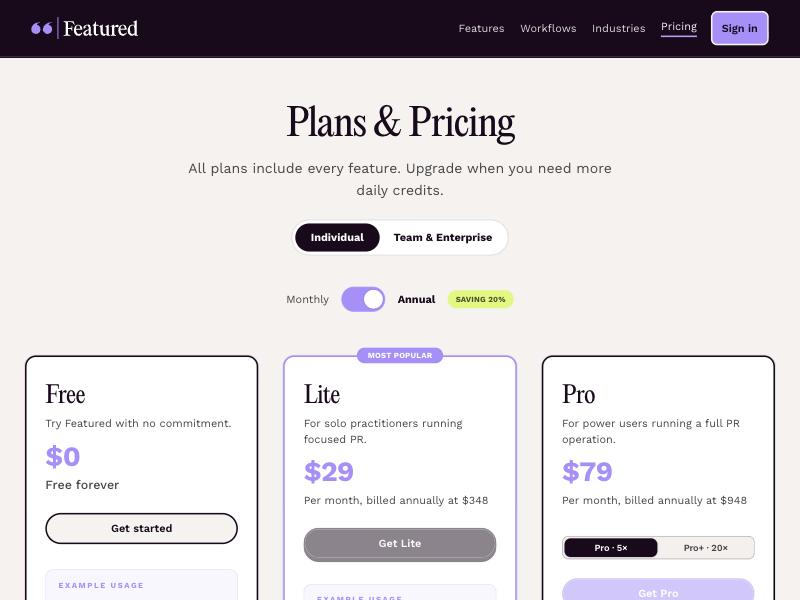
Closest to the original HAROFeatured owns both the HARO and Connectively brands, so it's the closest thing to a direct continuation. The free plan gives you a small weekly allowance to chat with its AI assistant and see 2-3 media opportunities a week. The Lite plan, at $29/month billed annually ($348/year), is built around monitoring HARO and similar feeds and drafting pitches at a steady weekly pace. The Pro plan, at $79/month billed annually ($948/year), adds a higher daily usage allowance for people running outreach at volume. Every plan includes journalist request matching, podcast and speaking-opportunity discovery, and media monitoring.
Is HARO still free?
Yes, HARO is still free to use, with a caveat: the free tier caps how often you can use Featured's AI pitching assistant each week, so heavy users eventually bump into that limit. If you'd rather keep the old habit of scanning daily requests and replying yourself by email, with no weekly usage cap at all, Source of Sources (below) is a much closer match to the original free experience.
- Owns both the HARO and Connectively brands
- Free tier covers journalist request matching and media monitoring
- Free tier caps weekly AI pitching assistant usage
- Paid tiers needed for heavier daily volume
Verdict: The closest thing to a direct HARO continuation, with a real free tier.

Qwoted
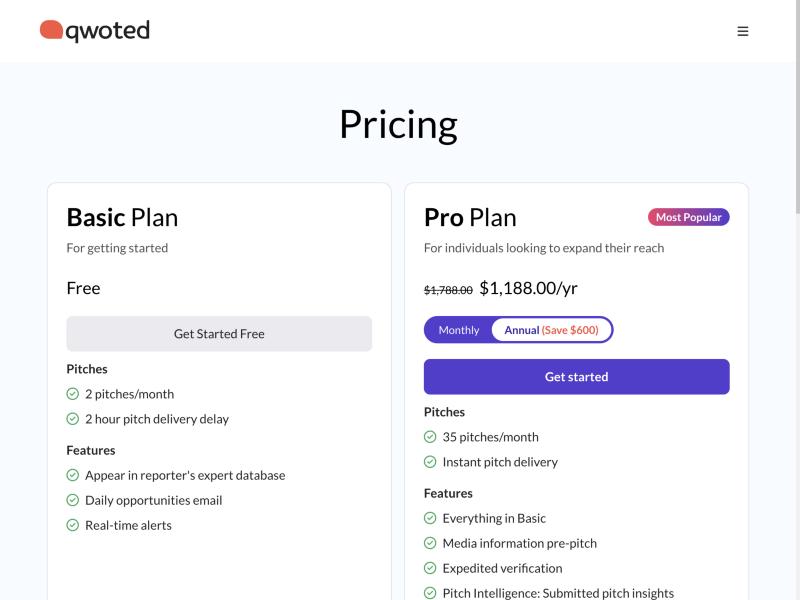
Best for high-volume pitchingQwoted's built for PR professionals who want more pitching volume than the free HARO-style lists allow. The free Basic plan gives you 2 pitches per month with a 2-hour delay before you can even respond, which is a real handicap on time-sensitive requests. The Pro plan removes that delay and raises your limit to 35 pitches per month, priced at roughly $99-149/month depending on whether you pay annually or monthly. A Team plan for agencies is priced on request. Qwoted also pre-shares media information before you pitch and offers expedited verification for Pro members, which genuinely speeds up getting your first quote accepted.
- Pro removes the pitch delay and raises the monthly limit
- Pre-shares media information before you pitch
- Free tier's 2-hour delay hurts time-sensitive requests
- Pricier than most alternatives once upgraded
Verdict: Built for PR pros who need real pitching volume without a reply delay.

MentionMatch
MentionMatch is clearly the rebrand of Help a B2B Writer; you can confirm that yourself, since the old domain now redirects straight to it. It's free for both sides: B2B and SaaS writers submit requests for quotes, data, and anecdotes, and more than 9,000 registered sources get notified by email when a request matches their listed expertise. Teams at Shopify, HubSpot, Ahrefs, G2, and Semrush are listed as users on the writer side, which gives you a sense of the B2B/SaaS skew. If your expertise is marketing, SaaS, sales, SEO, or something similarly B2B-flavored, this is one of the few alternatives built specifically for that audience rather than general consumer press.
- Rebrand of Help a B2B Writer, 9,000+ registered sources
- Every request is already filtered to B2B/SaaS/marketing
- Not useful outside B2B, SaaS, and marketing niches
- Lower overall request volume than general platforms
Verdict: The most relevant free option if your expertise is B2B or SaaS.
Source of Sources (SOS)
Best completely free optionSource of Sources is run by Peter Shankman, the same person who originally created HARO, and it shows. It works almost exactly like the original: up to three emails a day with journalist requests, and you reply directly to the journalist if you've got something genuinely useful to add. It's entirely free, there's no paid tier, and Shankman asks that instead of paying him, you donate to an animal charity or share the service if you found it useful. The site reports more than 20,000 journalists, broadcasters, and brands use it. The tradeoff for that free, no-frills format is that there's no platform, no pitch tracking, and no verification layer: it runs on an honor system, and off-topic pitches will get you removed.
- Run by Peter Shankman, HARO's original founder
- Up to 3 emails a day, no weekly usage cap
- No platform, pitch tracking, or verification layer
- Runs on an honor system, off-topic pitches get you removed
Verdict: The closest thing to the original HARO email habit, completely free.

SourceBottle
SourceBottle's the dominant option if your outreach targets Australia, New Zealand, or Singapore, though it also carries some requests from other regions. Creating an expert profile and browsing call-outs is free, and your profile sits in a public directory journalists can search directly. SourceBottle also offers a paid, human-run pitching service for people who'd rather have help getting matched and submitted than do it themselves, though the current price for that upgrade isn't published on its own site, so you'd need to ask directly. If your audience and media targets are APAC-based, this is a better fit than the more US/UK-leaning tools on this list.
- Dominant option for APAC-focused outreach
- Public expert directory journalists can search directly
- Thinner coverage outside Australia/NZ/Singapore
- Paid upgrade price not published, needs a direct ask
Verdict: The best-fit directory for APAC-focused outreach.

ResponseSource
ResponseSource is the UK's longest-running journalist request service, running since 1997, and it's built for PR teams and agencies rather than individual experts. You choose from 25 categories (Business & Finance, Medical & Pharmaceutical, Home & Garden, and more), and pricing is category-based: you only pay for the sectors relevant to your business, with pricing available on request and a free trial offered. If most of your media targets are UK trade or national press, this is worth the setup effort in a way the broader US-leaning tools aren't.
- UK's longest-running journalist request service, since 1997
- Pay only for the categories relevant to your business
- Built for teams/agencies, not individual experts
- Custom pricing means no published price to compare upfront
Verdict: Worth the setup effort for anyone whose media targets are UK press.

LinkForce turns your research into partner sites that actually link back. Free plan, no credit card.
Build Google search operator queries for link prospecting with the free Search Operator Generator.
How to Choose the Right HARO Alternative
Three questions settle most of the decision: your niche, your goal, and your budget. Answer those first, then pick from the matches below instead of chasing whichever list ranks a tool first.
What's your niche or area of expertise?
If you're a generalist (finance, lifestyle, small business, consumer tech), Featured and Qwoted carry the broadest mix of requests. If you specifically work in marketing, SaaS, or B2B sales, MentionMatch will send you noticeably more relevant requests than the general platforms, since every query on it is already filtered to that audience.
Are you after SEO backlinks, or just brand mentions and PR?
If a dofollow backlink is the actual goal, prioritize Featured and Qwoted; both platforms give journalists a strong incentive to credit and link back to a quoted source. If you mainly want your name and company mentioned in front of the right audience, even without a link, Source of Sources and SourceBottle work just as well for that, since the journalist still gets a credible quote either way.
What's your monthly budget for outreach tools?
At $0, combine Source of Sources with Featured's free tier (or MentionMatch if you're B2B). At roughly $30-80/month, Featured's paid tiers or ResponseSource's category pricing add real volume. At $100+/month, Qwoted's Pro plan is the one built for serious pitching at scale.
Which HARO alternative is completely free?
Source of Sources, MentionMatch, and SourceBottle's basic expert profile are all completely free, with no paid tier required to participate. Featured's free tier and Qwoted's Basic plan are also free to join, but both cap how much you can do before nudging you toward a paid plan.
How fast do I need to reply to a journalist request?
Journalists on these platforms are usually working against a same-day or next-day deadline, so the realistic reply window is hours, not days: aim to answer inside the first hour you see a relevant request, since most journalists stop reading responses once they've got enough quotes.
A few habits raise your odds once you're actually writing that fast reply. Answer the specific question in two or three sentences before you add any background on who you are, and skip paid plans that build in an artificial delay (like Qwoted's free-tier 2-hour hold) if speed matters more to you than the cost does. Most of all, don't send an obviously AI-generated reply: several journalists have said publicly they now filter these out on sight, and getting flagged for it is the fastest way to lose access to a platform's request list entirely.
Running your own digital PR and outreach program makes these differences easy to feel, not just read about: the tools that still deliver real journalist requests quickly are worth the setup time, and the ones that have quietly folded into something else aren't worth the wasted pitch.