
Getting backlinks means earning links from other websites that point back to yours. A search engine, and increasingly an AI answer engine, treats each link as a small vote that your page is worth citing. For a brand-new site, the fastest path to a first batch of links isn't the biggest campaign you can run. It's picking the one or two tactics that match your current time and budget, then sequencing the rest over the next few months.
This guide breaks link building tactics down by cost, time to first result and skill level, so you don't have to guess where to start. It walks through seven white-hat ways to execute them, then gives you a 90-day sequence to follow if you're starting from zero.
Key Takeaways
- A backlink is a link from another site to yours. Search engines and AI answer engines both use these links, alongside the content itself, to judge how trustworthy and citation-worthy a page is.
- Quality beats quantity, and that's not changing anytime soon. A handful of relevant, editorially-placed links outperforms a large batch of low-relevance ones. That gap has widened as spam-link detection has improved, so it's riskier than it used to be to chase volume.
- Free and low-cost tactics (broken-link building, directory and resource-page listings, link insertions) tend to land a first link in one to six weeks. Content-led tactics (guest posts, linkable assets) take longer but compound.
- Expect early ranking movement in two to three months. The fuller effect of a sustained link-building effort usually shows over six to twelve months, not overnight.
- Editorial roundups and "best of" lists pay off twice now: once as a conventional SEO signal, and again because AI answer engines pull brand mentions from the same kind of indexed, structured content.
What Is a Backlink and Why Does It Still Matter?
A backlink (also called an inbound or external link) is any hyperlink on someone else's website that points to a page on yours; see our full definition of a backlink if you want the longer version with examples. Backlinks remain one of Google's longest-standing ranking signals, and that isn't likely to change soon. The logic hasn't changed: a link is one site effectively saying "this page is a source worth sending readers to."
Ahrefs' own backlink-growth study found that most #1-ranking pages gain new followed backlinks at roughly 5% to 14.5% per month, a benchmark that has held up since the study first ran. Pages that keep earning links after they rank tend to keep ranking.
The backlink signal now does double duty, beyond classic search rankings. AI answer engines such as Google's AI Overviews, Perplexity and ChatGPT's browsing mode generate answers from indexed web content. The pages and brands that get cited most often are usually the ones that already show up in editorial content elsewhere on the web, link included or not. A link from a relevant, real publication still carries the most weight for both purposes. A link from a spam directory or a comment section carries close to none, no matter how many you collect.
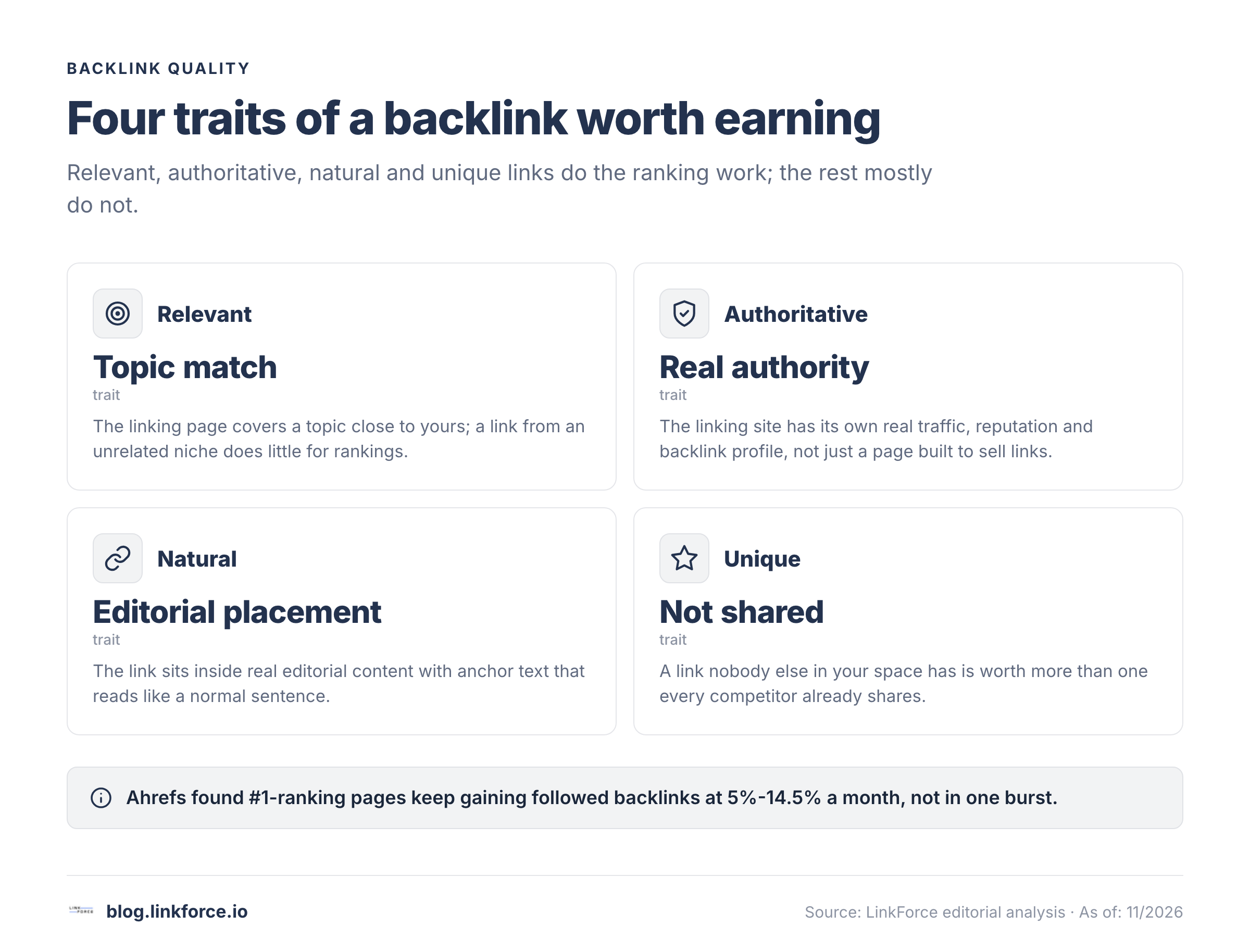
Four traits separate a backlink worth earning from one that isn't:
- Relevant. The linking page covers a topic close to yours. A link from a gardening blog does little for a SaaS tool, and the reverse is just as true.
- Authoritative. The linking site has its own real traffic, reputation and backlink profile, rather than existing only to sell links.
- Natural. The link sits inside real editorial content. Its anchor text reads like a normal sentence, not a stuffed keyword phrase.
- Unique. A link nobody else in your space has is worth more than one every competitor already shares.
The most powerful backlinks combine all four traits at once: a relevant, authoritative site linking naturally to a page no competitor has. In practice this follows a simple 80/20 pattern. A small share of your links, the ones from genuinely authoritative, relevant sites, will do most of the ranking work, while a larger number of smaller links mainly add volume and referral traffic. That's also consistent with the 5%-14.5% monthly link growth Ahrefs measured on #1-ranking pages: it's a small number of strong links added steadily, not a flood of weak ones.
A full walkthrough of checking and monitoring the links you already have (Google Search Console's Links report, third-party checkers and what the numbers mean) is honestly its own topic. See our guide on how to check backlinks using Google Search for that part.
Build Google search operator queries for link prospecting with the free Search Operator Generator.
Choose Your Tactics: Cost, Time and Skill Compared
Every white-hat way to get backlinks trades off differently across four things: what it costs, how long it takes to land a first link, how much skill it needs, and how well it scales once you have a process down. Pick your first tactic from this table based on your actual constraints; don't pick one just because it sounds impressive. If you're also wondering how many links are actually enough, see how many backlinks you need to rank.
| Tactic | Typical cost (benchmark, USD) | Time to first link (weeks) | Skill level | Scalability |
|---|---|---|---|---|
| Broken-link building | Free (time only) | 2-6 weeks | Beginner | Medium |
| Directory and resource-page listings | Free to low-cost | 1-2 weeks | Beginner | Low-medium |
| Link insertions | $50-$150 at small sites, $150-$450 at established niche sites | 1-3 weeks | Beginner-intermediate | Medium |
| Competitor backlink-gap analysis | Free with tool access | 4-8 weeks | Intermediate | Medium |
| HARO-style journalist requests | Free to low-cost | 2-4 weeks | Intermediate | Medium |
| Guest posting | Free (time-heavy) to $150-$450 paid placement (DR 30-50 sites), $350-$800+ at higher-authority sites | 4-8 weeks | Intermediate | Medium-high |
| Skyscraper and linkable-asset content | Time and design cost | 8-16 weeks | Advanced | High |
Free tactics cost your time instead of money, which is great when you don't have a budget. Where sites do charge for placement, benchmark pricing clusters into three rough tiers: $50-$150 at small or local sites, $150-$450 at established niche sites (roughly DR 30-50), and $350-$800+ at higher-authority publications. BuzzStream data reported by Ranktracker puts the average guest post bought directly from a site at about $295, and the average bought through a vendor at about $461, which sits squarely inside that middle tier. Treat these as directional benchmarks rather than a fixed price list, since individual sites set their own rates. Start with whichever free or low-cost tactic matches the skill level you already have. Layer in the slower, higher-effort ones once the first links are live.
Guest posting and broken-link building sit at opposite ends of that tradeoff. Guest posting takes longer and demands real writing effort, but it compounds: the same relationship can produce a second or third link later, and the byline builds brand awareness on top of the link itself. Broken-link building needs no content creation and can land a link in a couple of weeks, but each win is a one-off with no ongoing relationship behind it.
7 White-Hat Ways to Get Backlinks
1. Broken-Link Building
Best for anyone with no budget and a few hours a week. Time to first link: 2-6 weeks.
Find a dead (404) link on a relevant site, then suggest your own page as the replacement. It's one of the few tactics that genuinely helps the site owner too, since you're pointing out something broken on their own page. Use LinkForce's Search Operator Generator to pull up resource-page and "useful links" footprints for your niche. Open each page and check for links that no longer resolve; you'll usually find at least one within the first few pages. When you find one, send a short, specific pitch.
Template: Subject line "Quick fix for a dead link on [Page Title]." Body: "Hi [Name], I was reading [Page Title] and noticed the link to [old resource] in the [section name] section no longer works. I have a page on [your topic] that covers the same ground; it could be a useful replacement so your readers don't hit a dead end. Here's the link if it's helpful: [your URL]. Either way, thought you'd want to know about the broken one. [Your name]"
800+ SaaS marketers swap partner, integration and content links. Free plan, no credit card.
2. Directory and Resource-Page Listings
Best for new sites that need their first few links fast. Time to first link: 1-2 weeks.
Not every directory is worth a submission, admittedly. Niche and local directories relevant to your category still pass real referral value and, in many cases, a dofollow link. Use the Search Operator Generator's resource-page and "inurl:links" footprints to find curated lists in your space. Skip anything that looks like a link farm: no editorial review, no topical focus, link-only content.
3. Link Insertions
Best for sites with an existing piece of relevant content worth citing. Time to first link: 1-3 weeks.
Rather than pitching a brand-new guest post, ask a site owner to add one link to an already-published, already-indexed article where your page genuinely adds value. It's faster than guest posting because there's no new content to write or approve, so you don't lose weeks waiting on an editor. The link starts counting the moment it goes live. The pitch works best when you can point to the exact paragraph where the link would fit naturally.
Template: Subject line "A resource worth adding to [Page Title]." Body: "Hi [Name], in your post [Page Title], the paragraph on [specific topic] could use one more resource for readers who want to go deeper. I put together [short description of your page] that covers exactly that gap; happy to send more detail if it's a fit. [Your URL]. [Your name]"
4. Competitor Backlink-Gap Analysis
Best for anyone willing to spend an afternoon in a backlink-research tool. Time to first link: 4-8 weeks.
Pull the backlink profile of two or three direct competitors. Look for sites that link to more than one of them but not to you. Those sites have already shown they'll link to your category, which makes them warmer prospects than a cold list you've never contacted. Authority on a prospect site is usually estimated with a third-party metric such as Ahrefs' Domain Rating, Moz's Domain Authority or Semrush's Authority Score; these track each other reasonably well, so pick one and stay consistent. Run each candidate through LinkForce's Domain Rating Checker first and set a DR floor, so you're not spending outreach time on sites too thin to matter.
5. HARO-Style Journalist and Expert-Source Requests
Best for anyone with genuine subject-matter expertise and 15-30 minutes a day. Time to first link: 2-4 weeks.
Services that connect journalists with expert sources (HARO, which Featured relaunched in 2025, Qwoted and similar platforms) send out daily requests for quotes, data and commentary. Sign up as a source, filter to queries in your actual area of expertise, and respond fast, within the first hour where possible, with a specific, usable quote; a generic pitch won't get picked up. A link earned this way tends to carry real authority, because the site didn't accept it as a favor and it isn't a transaction. It accepted it because the quote was useful.
6. Guest Posting
Best for sites with time to write full articles and build relationships. Time to first link: 4-8 weeks.
Writing a full article for someone else's site, in exchange for a byline link and often a link in the body, remains one of the most durable tactics on this list. It also builds brand awareness and a relationship with the publication, not just a single link. Target sites that already cover your topic and accept outside contributors; if they don't publish guest content at all, you're wasting a pitch. Propose two or three specific angles rather than a vague "can I write for you," and match their existing content's depth and formatting.
7. Skyscraper and Linkable-Asset Content
Best for teams with design or data resources and a longer time horizon. Time to first link: 8-16 weeks.
Build something genuinely more useful than what currently exists on a topic: a deeper guide, an original dataset, a free tool, a well-designed infographic. Then promote it directly to the people already linking to the weaker version. This is, frankly, the slowest tactic on the list to pay off. It's also the one that keeps earning links passively once it's live, without repeated outreach for every new link. If your linkable asset is visual, our guide on infographic outreach covers the promotion side of this tactic in more depth.
These seven cover the core playbook; see our broader link building strategies roundup once you've worked through these if you want more options.
First 90 Days: A Sequencing Roadmap for a New Site
Link building compounds, but it doesn't start fast. New backlinks commonly take a few weeks just to get crawled and indexed, so you won't see any effect before then. Most sources that track this put early ranking movement at two to three months out, with the fuller effect of a sustained effort showing over six to twelve months.
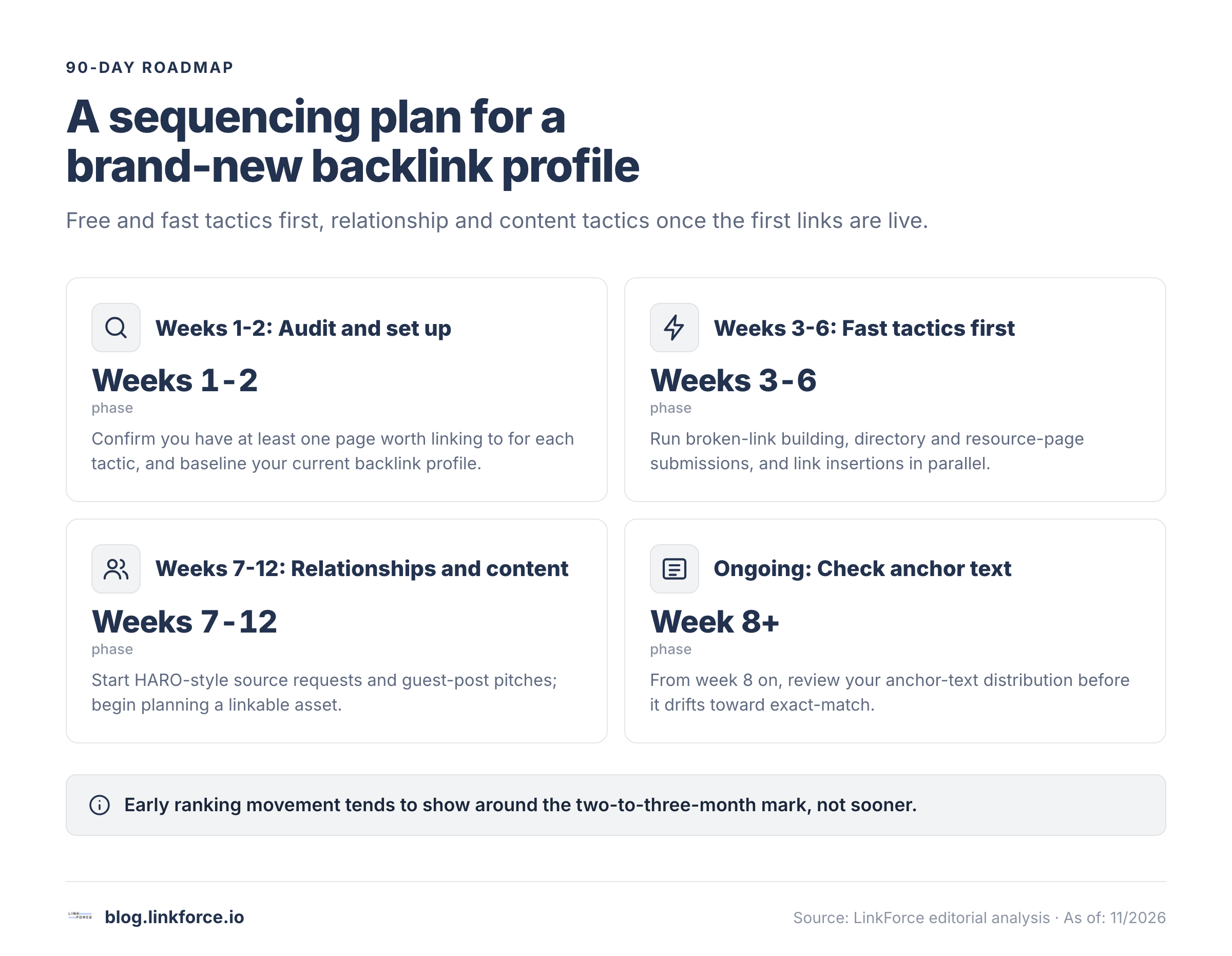
- Weeks 1-2: Audit and set up. Confirm you have at least one page worth linking to for each of the seven tactics in this guide. Run your current backlink profile through a checker so you have a baseline to compare against later.
- Weeks 3-6: Run the free and fast tactics first. Start broken-link building, directory and resource-page submissions, and link insertions in parallel. These need the least skill and typically produce a first link inside six weeks.
- Weeks 7-12: Layer in the relationship-based and content-led tactics. Start HARO-style source requests and your first guest-post pitches once the faster tactics are running on their own cadence. If you have the resources, begin planning a linkable asset to launch after week 12.
- Ongoing, from week 8 onward: Check your anchor-text mix. Once you have more than a handful of backlinks, review the anchor-text distribution before it drifts, as covered in the anchor-text caution below.
A Quick Caution on Anchor Text
Google has never published an exact target ratio for anchor text, and it clearly isn't going to start now. Treat any specific percentage you read as a rule of thumb, not a hard rule. The direction is consistent across available guidance, even where the exact numbers aren't: branded anchors (your company or site name) and naked URLs should make up the bulk of a healthy link profile, with exact-match keyword anchors kept to a small minority.
A profile where most anchors use the same commercial keyword phrase is one of the clearest signs of manufactured links, even though every individual link can look fine on its own. Run your current anchors through LinkForce's Anchor Text Analyzer every month or two once you're actively building links; it's a five-minute check, not a project. If you ever need to clean up low-quality links from an earlier campaign or a previous agency, the Disavow File Generator builds a correctly formatted disavow.txt file from a plain list of domains and URLs.
Frequently Asked Questions (FAQ)
How much does a backlink cost?
A backlink's cost depends entirely on the tactic and the site. Benchmark pricing for a paid placement runs roughly $50-$150 at small or local sites, $150-$450 at established niche sites, and $350-$800+ at higher-authority publications; independently reported BuzzStream data puts the average guest post around $295-$461 depending on whether it's bought directly or through a vendor. Broken-link building, directory listings and journalist-source requests are typically free beyond your own time. A fully managed campaign that bundles research, content and outreach can run into the thousands of dollars per month.
Can I do SEO and link building myself?
Yes, especially the free and low-cost tactics in this guide: broken-link building, directory listings, link insertions, journalist-source requests. They need time and persistence more than specialist skill. Content-led tactics like skyscraper assets and larger guest-posting campaigns take longer to learn and scale, and that's fine; you don't have to start there. That's when some sites choose to bring in outside help; see how to pick a link building agency without getting burned if you go that route. A realistic DIY starting sequence: (1) pick one free tactic from the comparison table above, (2) run it for two to three weeks and track whether it lands a link, (3) add a second free tactic once the first has a repeatable process, (4) only then consider a paid or content-led tactic.
Are backlinks still relevant with AI search?
Yes, backlinks are still relevant with AI search. AI answer engines generate their responses from indexed web content. The pages and brands that already appear in well-linked, editorially-placed content are the ones that tend to get cited. Backlinks remain a signal of both conventional ranking authority and AI-visibility.
How long does link building take to show results?
Expect a new link to take a few weeks to get crawled and indexed. Early ranking movement tends to show around the two-to-three-month mark. The fuller effect of a sustained link-building effort usually shows over six to twelve months. Competitive keywords and newer sites generally sit at the slower end of that range.