
White label SEO is a business arrangement where a specialist provider does the actual SEO work (link building, content, technical fixes, reporting) and your agency delivers that work to clients under your own name. The client never sees the provider. It’s a simple trade: money for time. You set the price, own the relationship and keep the difference between what you pay the provider and what you charge the client.
A marketing or web design agency gets asked “can you also handle our SEO” sooner or later. White labeling is usually the fastest honest answer. You don’t need an in-house SEO team, a link building operation or a stack of expensive tools to say yes. You need a provider you trust and a markup that makes sense.
This guide covers what white label SEO actually is, how it differs from white label link building, what it costs, whether it’s legal to keep the arrangement invisible to clients, how to vet a provider and how to start reselling it.
What Is White Label SEO?
White label SEO is when a specialist provider delivers SEO services on your agency’s behalf while you present that work to clients under your own brand. The provider handles keyword research, content, link building or technical audits. Your agency handles the client relationship, the invoice and the reporting.
Nobody outside your agency needs to know the provider exists. Reports, emails and even client calls can carry your branding. The provider’s a back-office vendor, not a subcontractor your client interacts with directly.
How the White Label Relationship Actually Works
There are two common shapes this takes. In a referral model, you introduce a client to a partner and collect a recurring commission, often a flat percentage of what the client pays, and the partner handles the client relationship openly. This type of relationships can be handled with referral tools, like ReferralCandy. In a full white label model, the partner stays invisible. They do the work. You own every touchpoint, and your markup is baked into what you bill.
Most agencies that talk about “white label SEO” mean the second model. It’s the version where the client genuinely doesn’t know another company touched their campaign, and it’s the version this guide focuses on.
A typical setup looks like this: you send the provider a signed brief (target keywords, site access, brand voice notes), the provider executes monthly, and you receive white-labeled reports, your logo, your color scheme, sometimes your domain on the login page, that you’ll forward or present yourself.
Classic In-House SEO vs. White Label SEO
The honest comparison isn’t “white label is always better.” It depends on volume and cash flow. There’s no universal winner here.
| Factor | In-house SEO | White label SEO |
|---|---|---|
| Time to first client delivery | Weeks to months (hiring, training) | Days to a few weeks |
| Upfront cost | Salaries, tools, training | Per-client wholesale fee only |
| Margin per client | Higher once staff is fully utilized | Lower per client, but scales instantly |
| Quality control | Direct, in your control | Indirect, depends on provider vetting |
| Best fit | Agencies with 15+ steady SEO clients | Agencies with 1-15 clients or unpredictable SEO demand |
If you already have enough steady SEO revenue to keep two or three specialists fully billable, in-house clearly wins on margin. Below that volume, white label is close to always the better math, because you aren’t paying salary during the gaps between clients.
Why Agencies Use White Label SEO
Agencies turn to white label SEO to say yes to a client need without carrying the staffing risk that comes with it. The most common reasons show up in nearly the same order every time an agency explains the decision.
- You can add SEO or link building to your service menu without hiring a specialist. A slow month for SEO demand doesn’t mean paying idle salaries.
- You get access to a team that already has the tools, rank trackers, link databases, content pipelines, that would otherwise cost several hundred dollars a month per seat.
- Your account managers can focus on the client relationship and strategy instead of execution. That’s usually the higher-margin part of the job anyway.
- Reporting is typically already built for reselling, so you aren’t building dashboards from scratch.
- Pricing is close to fixed and known in advance. That makes your own client pricing math predictable instead of a guess.
The tradeoff is real. You give up some margin and some direct control over execution quality. There’s no way around that. That’s why the vetting step later in this guide matters more than the pricing step.
White Label SEO vs. White Label Link Building: What’s the Difference?
White label link building is a specialized subset of white label SEO focused only on backlink acquisition. White label SEO can also include content, technical fixes, on-page optimization and full-service campaign management.
If your agency already handles content and technical SEO in-house but has no outreach team or link inventory, buying white label link building alone fills exactly that gap without paying for services you don’t need. If you have no SEO capability internally at all, full white label SEO covers the whole campaign for you.
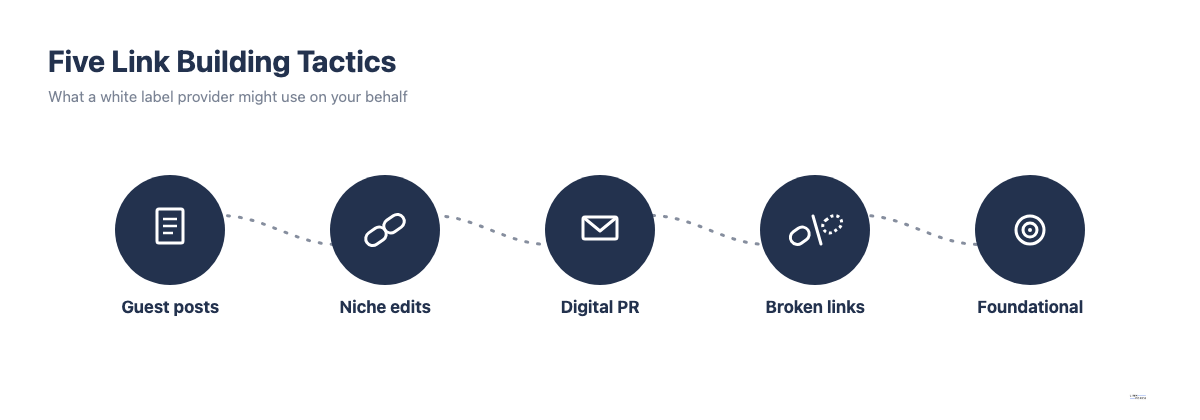
“Link building” isn’t one action. A provider selling white label link building runs some mix of these tactics, and knowing the names helps you ask sharper questions during vetting:
- Guest posts: a full article written for someone else’s site, with the client’s link placed naturally inside the body text.
- Niche edits: a link inserted into an existing, already-indexed page rather than new content. Some providers call this a link insertion.
- Digital PR and press releases: links earned by pitching journalists and outlets a real story angle, not just an announcement nobody would cover otherwise.
- Broken-link building: finding a dead link on a relevant page and offering the client’s page as a working replacement.
- Foundational and profile links: lower-effort, lower-risk placements, directories, citations, profile pages, used early in a campaign to round out a link profile before heavier tactics start.
A provider naming only guest posts is offering a narrower service than “link building” implies. Ask which tactics are in scope before you assume a package covers all five.
| Scope | White label link building | Full white label SEO |
|---|---|---|
| Typical deliverable | Placed backlinks, outreach reports, anchor text tracking | Keyword research, content, on-page, technical audits and links |
| Best fit buyer | Agencies with content/technical skills, no outreach team | Agencies with no in-house SEO capability at all |
| Pricing shape | Per-link or monthly link package | Monthly retainer per client, tiered by scope |
| Where it plugs in | One line item inside a broader campaign you run | The entire SEO line item on your invoice |
For most agencies reading about link building specifically, the specialized route is the more common entry point. It’s a smaller commitment. It’s easier to quality-check, since you can see exactly which sites linked to your client, and it slots into a campaign you’re already running instead of replacing it.
How Much Does White Label SEO Cost, and What Margin Can Agencies Expect?
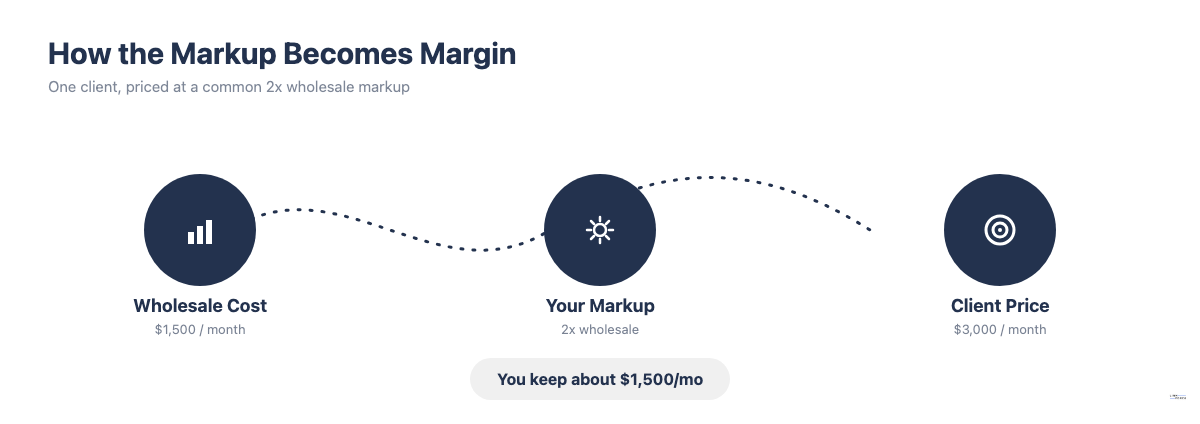
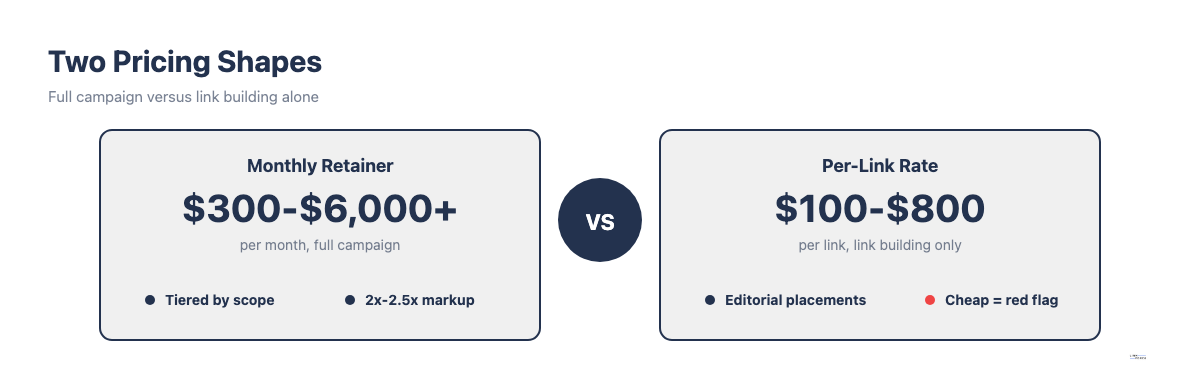
Wholesale white label SEO typically runs $300 to $900 a month for local-business scopes, $900 to $2,500 a month for mid-market campaigns, and $2,500 to $6,000 or more a month for ecommerce or enterprise scopes. Agencies commonly mark that up 2x to 2.5x. That lands most resellers in a 45% to 65% gross margin band once account management time is factored in.
| Scope | Typical wholesale range (per month) | Common markup | Typical retail range |
|---|---|---|---|
| Local business | $300-$900 | 2x-2.5x | $700-$2,000 |
| Mid-market | $900-$2,500 | 2x-2.5x | $2,000-$5,500 |
| Ecommerce / enterprise | $2,500-$6,000+ | 2x-2.5x | $5,500-$13,000+ |
Here’s what that looks like for one client. An agency buying a $1,500-a-month wholesale package and pricing it at $3,000 to $4,000 for the client keeps roughly $1,500 to $2,500 a month in gross margin on that single account. Multiply that across a client base, and the math is why white label SEO gets described as a high-margin add-on rather than a break-even service.
Margin below roughly 25% over wholesale is thin enough that most agencies end up losing money once account management time, churn and the occasional client escalation get priced in. That’s the thin end of the range, and it doesn’t leave much room for error. The margin exists to cover the parts of the job the provider doesn’t do: fielding client questions, adjusting strategy and standing behind the results with your own name on them.
Treat every number in this section as a market estimate, not an official fixed rate from any single vendor. Wholesale pricing moves with provider quality, campaign scope and the specific niche, so confirm current pricing with any provider directly before quoting a client.
If your agency is buying link building specifically rather than a full monthly retainer, pricing shows up as a per-link rate instead of a package fee. Professional per-link pricing for editorial placements runs roughly $100 to $800, depending on quality tier, niche competitiveness and publisher authority. Premium placements on genuinely high-authority publications cost more than that range. A rate of just a few dollars per link points to a low-quality directory or link farm, not a real editorial placement. Treat a cheap per-link offer as a quality warning, not a bargain. As with the monthly retainer figures above, treat this as a current market range rather than a fixed price list; confirm actual per-link rates with any provider before quoting a client.
Is White Label SEO Legal, and Do You Have to Tell Clients?
Yes, white label SEO is legal, and in most cases you aren’t required to disclose to a client that the work is being done by a third party under a service agreement. Reselling a vendor’s work under your own brand’s a standard business practice across marketing, web development and IT services. Nothing about SEO specifically creates extra legal exposure here.
That said, disclosure norms are a business decision, not just a legal one. Some agencies write it into their contract in general terms, something like “services may be fulfilled directly or through vetted partners,” without naming the provider. That protects them from a “why didn’t you tell me” conversation later without giving away the vendor relationship. This isn’t legal advice for your specific contracts or jurisdiction. Check your own client agreements, and if you operate somewhere with specific service-disclosure rules, confirm with a lawyer instead of relying on general industry practice.
How to Vet a White Label SEO or Link Building Provider
The single highest-signal thing to check before signing with a white label provider is whether their reporting is specific and verifiable, not whether their marketing sounds confident. Agencies that have actually used these arrangements say the same thing consistently: the providers worth keeping are the ones whose tools and processes are specialized, measurable and easy to manage, not the ones with the flashiest sales page.
There’s no shortcut here. Use this as a working checklist before you commit budget to a provider:
- Ask for a sample report from an existing client (redacted is fine) and check whether it shows real placements and specific metrics, not vague summary language.
- Ask directly how they build links. Treat vague answers, like “we have relationships across many sites,” as a red flag. A provider that won’t name its general tactics (guest posts, digital PR, resource pages) is harder to quality-control later.
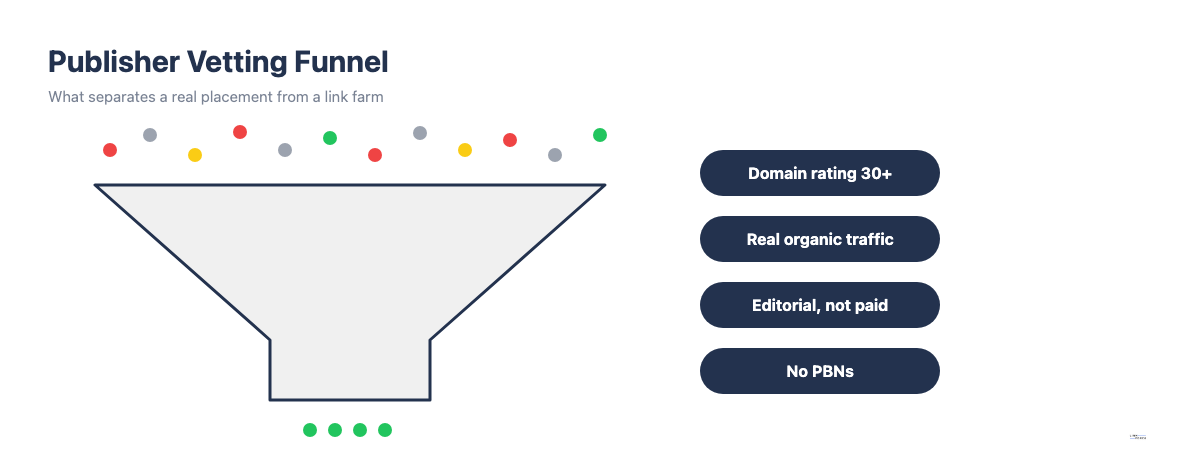
- Ask for their typical domain rating and organic traffic floor for placements. A reasonable working range is domain rating 30 or higher for standard placements and 50 or higher for premium ones, alongside real organic traffic, roughly 1,000 to 5,000 or more monthly visitors depending on tier. A high domain rating on a site with almost no organic traffic is a common sign of an inflated metric, not real editorial authority.
- Ask whether placements are editorial or paid, and get the answer in writing. An editorial placement exists because an editor judged the content worth publishing; a purely paid slot on a site with no other editorial standards carries more risk if search engines start scrutinizing that publisher’s link patterns.
- Check whether they operate or use private blog networks. A provider using PBNs is taking on risk that eventually lands on your client’s site, under your name, outright.
- Ask what happens if a placement gets removed or a link gets flagged, and whether the provider actively monitors placements after delivery rather than only during the initial campaign window. A provider with no replacement, disavow or refund policy is handing that risk entirely to you.
- Confirm reporting cadence in writing before you sign. Weekly or monthly, and exactly what’s included: rankings, links placed, anchor text used, referring domain metrics.
- Ask for two or three case studies where the client agreed to be named, not just anonymized graphs. Anonymized-only “results” are the easiest thing in this space to fake.
None of this finds a provider with zero risk. That provider certainly doesn’t exist, and it’d be naive to expect one. It finds one whose risk you can actually see and manage instead of one you’re simply trusting on faith.
Should Your Agency Build In-House, White Label, or Do Both?
The right choice depends mainly on how many SEO or link building clients you can keep steadily billable, not on which model is inherently better. Below roughly ten to fifteen active SEO clients, white label is usually the stronger financial choice, because you aren’t carrying salary during slow stretches. Above that volume, however, in-house execution often wins on margin once your specialists stay consistently busy.
A hybrid model is common, and it’s often the most practical choice. Keep strategy, client communication and reporting in-house. White label only the execution piece you don’t have capacity for, such as link building or content production. This gives you control over the parts clients notice most (communication, strategic direction) while you still buy capacity for the labor-intensive parts.
- Fewer than 10 SEO clients: white label the whole campaign. Hiring dedicated staff at that volume rarely pencils out.
- 10-15 clients with steady growth: consider a hybrid. Keep strategy in-house and white-label execution-heavy pieces like link building.
- 15+ clients with predictable demand: build in-house. Fully utilized staff typically beats wholesale markup on margin at that scale.
How to Start Reselling White Label SEO and Link Building Services
- Pick one pilot client. Don’t migrate your whole client base to a new provider at once. Choose a client where a slow month is recoverable, and use that account to test reporting quality and communication first.
- Get the reporting cadence and format in writing. Confirm what a report looks like before the first billing cycle, not after. Ask for a sample report from an existing engagement, not a template.
- Draft a simple internal partner agreement. Cover scope, turnaround times, what happens if a deliverable is late and how disputes get resolved, even if it’s a one-page document.
- Set your client-facing pricing before you sign the provider. Decide your markup ahead of time (2x to 2.5x wholesale is the common range) so you aren’t improvising a number on a sales call.
- Run the pilot for a full billing cycle before expanding. One month rarely tells you enough about link quality or ranking movement. Give it a full cycle, review the actual report against what you were promised, then decide whether to expand.
- Build your own quality-control habit. Even with a trusted provider, spot-check placements and rankings yourself instead of only relaying the provider’s report. That’s what protects your brand if something goes wrong.
If your agency’s gap is specifically link building rather than full-service SEO, start with a monthly link building service or a guest post marketplace instead of a full white label SEO retainer. Both let you buy exactly the piece you’re missing without paying for campaign work you already do in-house. For a broader look at how link building services get priced and delivered across providers, see our link building services guide. If you’re sourcing links at volume across multiple clients, a link building marketplace is a faster way to compare vendors than vetting each one individually.
Frequently Asked Questions About White Label SEO
What does a white label SEO provider actually do day to day?
A white label SEO provider runs the campaign work you’d otherwise do in-house: keyword research, on-page changes, content production, technical fixes and link building. They package the results into a report you send to your client under your own brand.
Can I resell white label SEO if I have no in-house SEO knowledge?
Yes, you can resell white label SEO with no in-house SEO knowledge. Plenty of agencies don’t have any either. You should still learn enough to ask informed questions during vetting and to sanity-check the reports you get before forwarding them to a client.
How long before a white label SEO client sees results?
Most white label SEO campaigns need three to six months before meaningful ranking movement shows up, stretching to nine or twelve months in competitive niches or on brand-new domains. That’s the same timeline as in-house SEO, because the delay is inherent to how search engines process new content and links, not something a provider can shortcut.
What happens if a white label SEO provider underperforms?
A written agreement with a defined reporting cadence and a clear escalation or refund policy protects you if a provider underperforms, and that’s why confirming those terms before signing matters more than the initial price quote. Treat any provider promising guaranteed top rankings in an unusually short window, say 30 days, as a red flag, since no provider controls search engine algorithms and that kind of guarantee usually hides black-hat tactics or near-zero-volume keywords.
Is white label link building different from guest posting?
Guest posting is one tactic inside white label link building, not a separate category. A white label link building provider might use guest posts, digital PR or resource page outreach, and a provider that relies on guest posts exclusively is offering a narrower service than the full category implies.
Will my client find out I’m outsourcing link building to another company?
No, a reputable white label link building provider keeps every client-facing touchpoint under your brand, so your client has no direct way to discover the arrangement. Reports, placement URLs and any correspondence carry your name, not the provider’s, and the provider has no reason to contact your client directly.
What happens if a link building provider places a link and it later gets removed?
A provider worth keeping will replace or credit a link that gets pulled down within an agreed window, and some monitor live placements on an ongoing basis specifically to catch removals early. Get this policy in writing before you sign, since a provider with no stated replacement terms is quietly shifting that risk onto your agency.
How do I know if a white label link building provider is using white-hat tactics?
Ask which sites they place links on and check a handful yourself: look for real content, real traffic and an editorial reason the page exists beyond hosting paid links. A provider that hesitates to show you actual placement examples, or whose sample sites look thin and templated, is a stronger warning sign than anything in their sales pitch.