

Guest posting is still one of the most reliable ways to build high-quality backlinks and grow topical authority. The real question isn’t whether to use a guest post marketplace. It’s whether your team has time to do this manually at scale.
A guest post marketplace solves the operational side. Instead of spending weeks on prospecting and cold outreach, you search a curated database of publishers, select placements that fit your niche and authority targets, and order directly. The link building happens. You stay focused on strategy.
But marketplaces vary enormously in quality. Some have large inventories padded with low-traffic sites, guest post farms and private blog networks. Others have tighter vetting, stronger editorial standards and replacement guarantees worth relying on. The platform matters just as much as the placements you pick from it, and that’s easy to forget once you’re staring at a database of 100,000 sites.
This guide covers what a guest post marketplace is, how it differs from a guest post service, which platforms are worth using in 2026, how pricing breaks down across quality tiers and what to watch for before spending your link budget.
What Is a Guest Post Marketplace?
A guest post marketplace is a platform that connects link buyers (SEO teams, agencies and brands) with website publishers who accept paid guest post placements. Buyers search a pre-verified inventory of sites filtered by domain rating, organic traffic, niche and price. They place an order, submit content and the post goes live on the publisher’s site with a backlink to their target URL.
The core mechanism is a self-serve database. Most platforms verify publisher metrics against third-party tools, Ahrefs, Moz, Semrush or Google Analytics, and maintain a searchable directory. Buyers filter by what their campaign requires, preview individual sites, place orders and track delivery, all within the platform, and that’s the whole loop with no outreach required.
Guest post marketplaces are a subset of the broader link building marketplace category. Link building marketplaces also cover niche edits (link insertions into existing articles), digital PR placements and sponsored content. Guest posts are the dominant product because they give buyers control over both the backlink context and the surrounding article. That control matters more for SEO now that content quality signals carry real weight, and that emphasis won’t fade.
Guest Post Marketplace vs. Guest Post Service
The terms are often used interchangeably, but they describe meaningfully different products, and mixing them up doesn’t help anyone budget correctly.
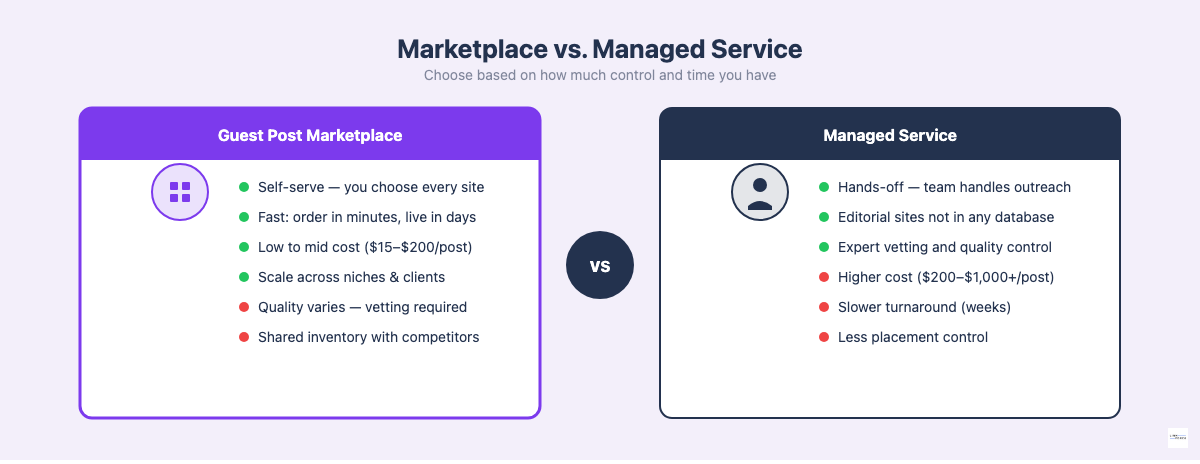
A guest post marketplace is a self-serve platform. You browse the inventory, evaluate sites, select placements and manage orders yourself. Control and speed are the defining features. Most marketplaces carry large inventories, anywhere from 10,000 to 150,000+ sites, at competitive per-placement pricing.
A guest post service is usually a managed offering where a team handles site selection, outreach, content creation and placement on your behalf. You define targets and goals. The service executes, and that’s the tradeoff: less control, less hands-on work. Examples include LinksThatRank and Vettted, both of which rely on manual editorial vetting rather than an open marketplace model.
When to use a marketplace: you want control, speed and the ability to browse and pick placements yourself. Maybe you already have a process for evaluating site quality. Maybe you’re scaling a campaign and need volume without adding headcount.
When to use a managed service: You need placements on specific editorial sites that aren’t listed in any inventory. You don’t have the capacity to vet sites at scale. You’re willing to pay the premium for expert judgment and hands-off delivery.
Plenty of SEO teams run both: marketplaces for consistent monthly volume, managed services for high-value placements that need relationship-based outreach.
Why Guest Posting Still Works in 2026
Google’s approach to links has gotten more sophisticated, but guest posting on real, editorially active sites remains one of the most consistent authority-building tactics available. What actually separates a good placement from a bad one is simple: genuine editorial placements on sites with real audiences work, and link-scheme placements on content farms don’t.
Quality guest post links on topically relevant sites with real traffic still move rankings, because they signal topical authority and not just generic authority. A DR 35 blog that publishes exclusively in your industry carries more SEO weight than a DR 60 general lifestyle blog with zero topical connection to your niche.
Low-quality marketplace placements don’t deliver, plain and simple: thin content on sites with no organic audience produces weak signals. The article wrapper matters just as much as the link itself. A well-written guest post that earns traffic and reader engagement passes a stronger link signal than a 500-word placeholder that exists only to host a backlink.
There’s a newer reason guest posting still earns its budget: AI search. Tools like ChatGPT, Perplexity and Google’s AI Overviews pull answers from full articles, not bare links sitting on thin pages. A guest post surrounded by real, topically relevant content gives these systems far more context to connect your brand with a subject than a stripped-down link ever could. That’s a second reason, and a fairly new one, to insist on real editorial placements instead of the cheapest listing on any marketplace.
How a Guest Post Marketplace Works
The ordering process is simpler than most teams expect. Here’s what happens from search to live placement:
Browse and filter the publisher inventory. Search by niche, domain rating, organic traffic, price and country. Most platforms let you filter by 20 to 40+ attributes. Shortlist sites that meet your minimum thresholds for both authority and topical relevance.
Evaluate sites before ordering. Metrics are a starting point. They aren’t a verdict. For each shortlisted site, visit the actual domain and check whether the content is topically relevant to your niche, whether the site is actively publishing, whether existing posts look editorial or purely monetized and whether the audience appears real. Ten minutes of this evaluation before a $100 to $200 order prevents most budget waste.
Submit your order and content brief. Place the order through the platform, and specify your target URL, preferred anchor text and any content requirements. Most platforms offer two paths: you supply the article yourself, or you commission one through the platform’s writing service, typically $30 to $100 per post at 700 to 1,200 words. Supplying your own article gives you full control over content quality and the context around your backlink, something a platform’s staff writer can’t fully replicate.
Track placement and verify the live post. After the publisher accepts your submission, usually within 3 to 14 days, you’ll get a notification with the live URL. Check that the post is indexed, that the link is dofollow and that the anchor text matches your spec. Most reputable platforms include a link monitoring period of 3 to 6 months, with replacement guarantees if the link goes down, so you’re not stuck if a site disappears.
What to Look For in a Guest Post Marketplace
Not all platforms deliver what they promise. Here are the signals that separate reliable marketplaces from the ones that’ll waste your budget.
Publisher Quality Signals
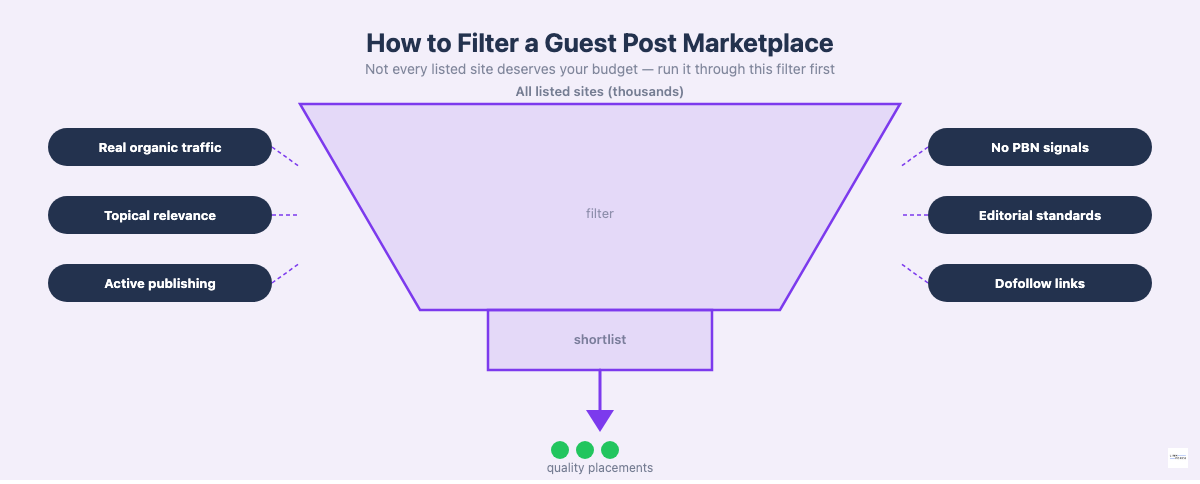
The quality of the site inventory is the most important variable. Evaluate platforms on:
- Traffic verification. Platforms that require Google Analytics verification, or that cross-check traffic estimates against Ahrefs and Semrush, are harder to game than those relying on DA or DR alone. Organic traffic is the most important signal: it indicates a real audience.
- Topical relevance filtering. The best platforms categorize sites by niche and make topical filtering easy. A DR 35 site covering your exact industry is more valuable than a DR 60 general site with no topical connection to your brand, even though the bigger number isn’t the better signal.
- Editorial standards. Sites with minimum content requirements (700+ words, original writing, editorial review before acceptance) produce placements with more lasting value than sites that accept any content, and that staying power is what you’re paying for.
- PBN exclusion. Private blog networks are clusters of sites built purely for link selling. Their authority metrics are manufactured, their links carry near-zero SEO value and buying from them carries a penalty risk. Reputable marketplaces actively audit their inventory and remove PBN-linked sites, so they don’t stay listed for long.
- Nofollow vs. dofollow transparency. Every placement should be a dofollow link unless you have a specific reason otherwise. Make sure it’s stated clearly per listing before you order.
Platform-Level Transparency
Before using any marketplace:
- Can you see the full domain before ordering? Some platforms hide site URLs until after payment. That’s a red flag: you can’t evaluate quality without seeing the domain.
- Are metrics from named third-party sources? Ahrefs, Semrush, Moz and GA are standard. Proprietary scores are harder to trust.
- What is the replacement policy? Understand what happens if a link goes down: does the platform find a replacement, offer credit or leave you with nothing?
- Is the vetting process documented? Reputable platforms describe how they screen sites. Vague claims about “quality checks” without specifics usually aren’t worth trusting.
Pricing and Value
- Per-post pricing is the standard. You pay once per placement. No subscription required.
- Subscription tiers (Accessily’s model) make sense if you’re running ongoing campaigns and want access to filtering tools and link tracking dashboards.
- Content writing add-ons are typically $30–$100 per post, and they aren’t optional on every platform. At volume, this adds up, so calculate whether in-house writing is more cost-effective.
- Replacement guarantees are worth paying for. A marketplace with a 12-month link protection policy at $120 is better value than one without protection at $80.
Best Guest Post Marketplaces in 2026
The following platforms have the strongest combination of inventory quality, transparency and delivery reliability, based on SEO community feedback and hands-on platform research. Each one also carries a real trust signal worth checking before you commit budget: an independent Trustpilot rating, which the table below includes alongside price and inventory so you can compare reputation the same way you compare cost, and you don’t have to just take our word for it.
| Marketplace | Best For | Starting Price | Inventory | Traffic Verified | Trust Rating |
|---|---|---|---|---|---|
| Adsy | Volume campaigns, beginners | $15 | 150,000+ sites | Yes | ~4 stars (230+ reviews) |
| Collaborator.pro | EU/US agencies | $40 | 44,000+ sites | Google Analytics | ~4 stars (200+ reviews) |
| WhitePress | European / multilingual | Variable | 25,000+ | Yes | ~4.7 stars (86 reviews) |
| Accessily | AI-matched placements | $15 | 25,000+ | Yes | ~4 stars (65+ reviews) |
| FatJoe | Managed editorial | $72 | 10,000+ | Yes | ~5 stars (440+ reviews) |
| Loganix | Premium placements | $200 | Curated | Yes | ~4 stars (100+ reviews) |
| Linkhouse | Visual-first interface | $49 | 74,000+ | Yes | ~5 stars (130+ reviews) |
| The HOTH | Agency campaigns | $150 | Large | Yes | ~4 stars (265+ reviews) |
Adsy
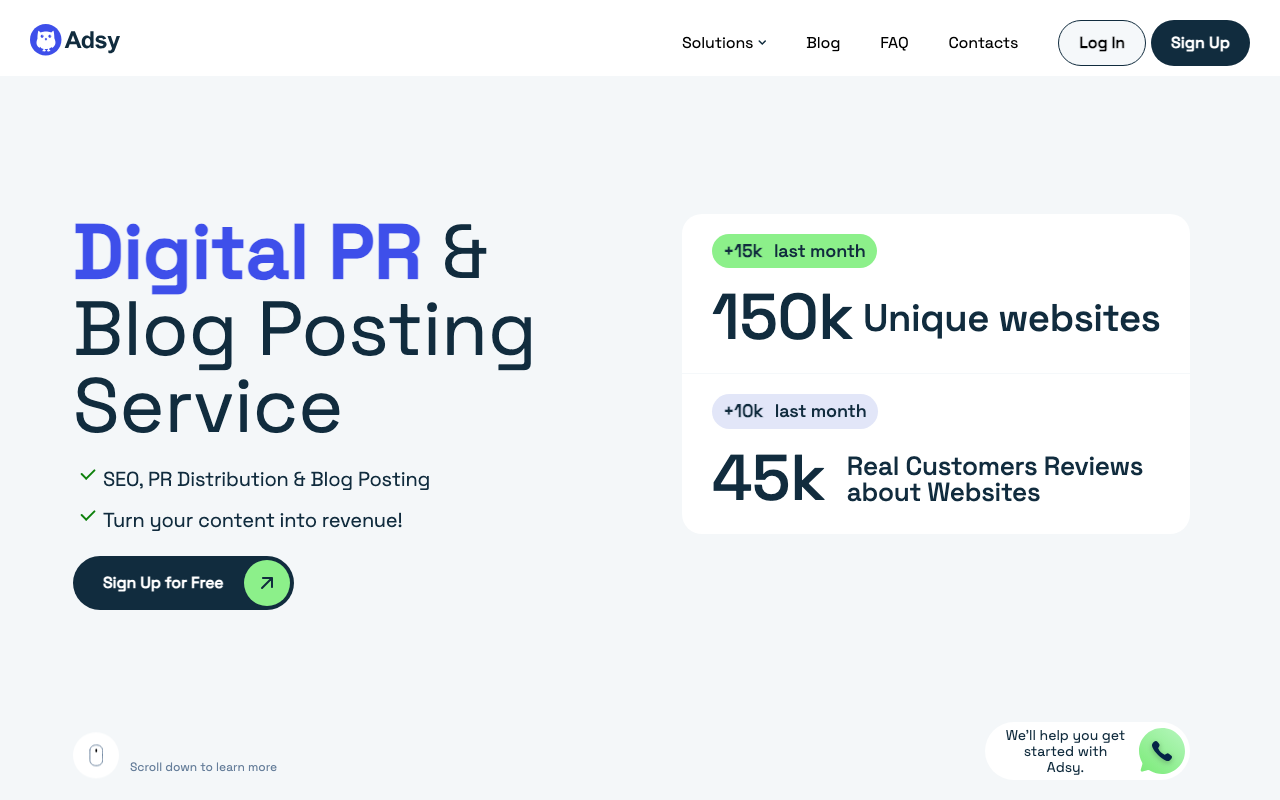
Adsy is one of the largest and most accessible guest post marketplaces available, with 150,000+ sites across multiple countries and niches. Pricing starts at $15 per placement and scales to $1,000+ for high-authority sites. It also carries a solid reputation off-platform: around 4 stars on Trustpilot from 230+ reviewers, which is solid for a marketplace this size.
Key features:
- 40+ filters including DR, traffic, niche, country and language
- Escrow payment system (funds held until placement is confirmed)
- Link monitoring for a minimum 3-month duration
- Publisher rating system based on order history
- Content writing service available as an add-on
Pricing: $15–$1,000+ per placement.
Best for: Beginners learning the marketplace workflow, agencies running volume campaigns across multiple niches, campaigns that require broad geographic or language targeting.
The breadth of inventory means quality swings hard, and that’s the tradeoff for a database this size. Use the traffic filter aggressively and preview each site before ordering. Sites with strong organic traffic estimates in the 1,000–10,000 monthly visitor range are generally more reliable than the cheapest options.
Collaborator.pro
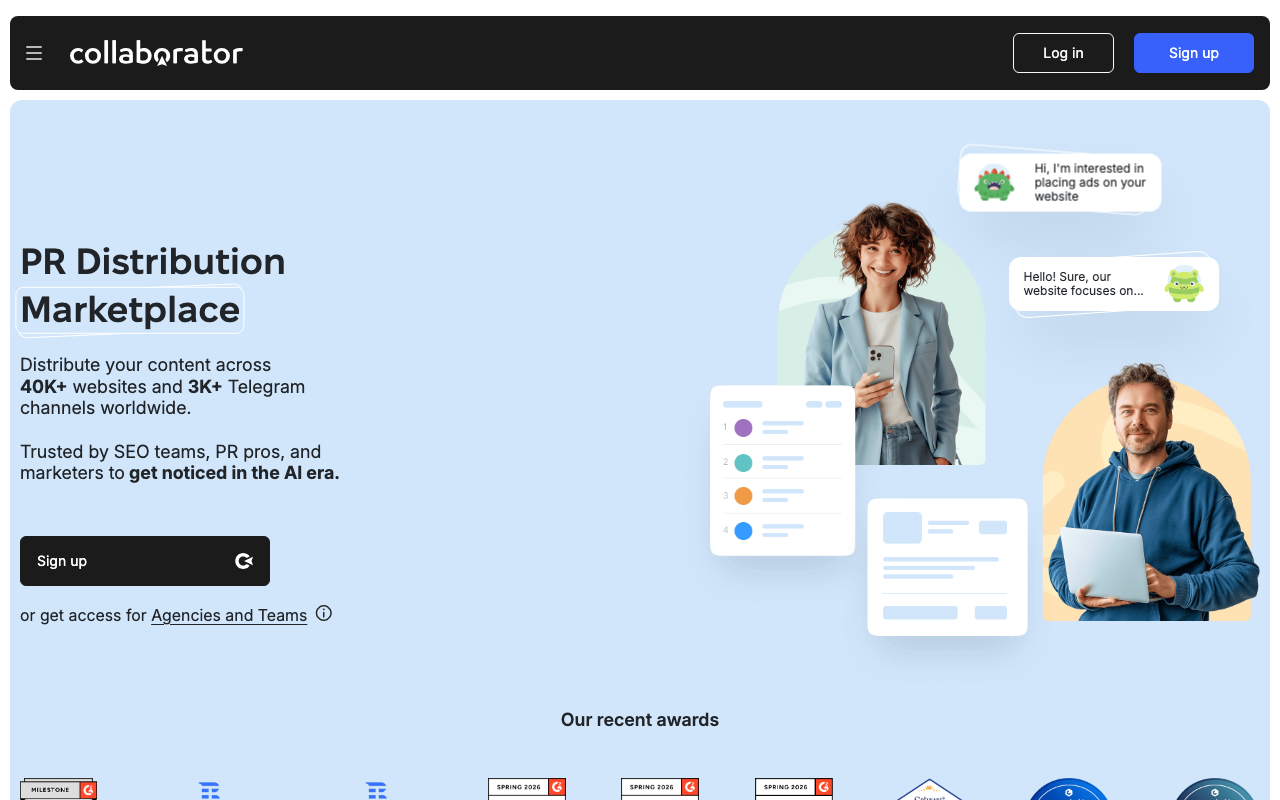
Collaborator.pro has become the go-to platform for EU and US agencies that need verified traffic data, fast turnaround and strong publisher support. Its database now covers 44,000+ websites, with 75% of orders fulfilled within 48 hours. On Trustpilot it holds around 4 stars from 200+ reviewers, respectable though a few reviews mention high commission rates.
Key features:
- Google Analytics-verified traffic for participating publishers
- 40+ filtering options
- 3-month link protection with guaranteed replacement
- 24/5 live support (extended weekend hours)
- Telegram channel placements available
Pricing: Starting at $40; most placements between $40 and $90.
Best for: Agencies running multi-client campaigns, teams that need fast turnaround and independently verified traffic data.
Strong for European market campaigns. If you’re targeting US-specific audiences, use the country filter and cross-check that shortlisted sites have meaningful US organic traffic rather than bulk EU traffic.
WhitePress
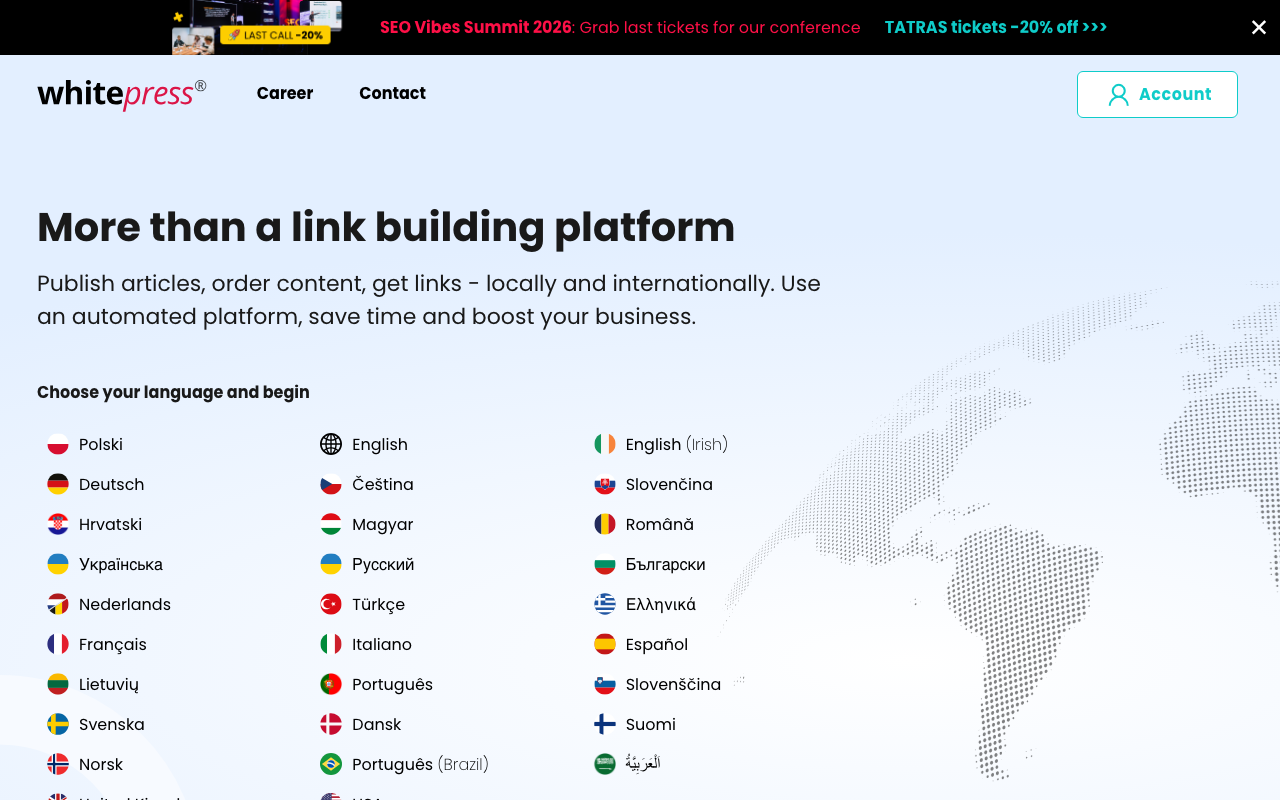
WhitePress specializes in European markets and multilingual campaigns. It covers 25,000+ publishers across Germany, Poland, Italy, France, Spain and other European markets, alongside English-language options. Trustpilot rates it “Excellent” at 4.7 stars, the highest of any platform in this list, from 86 reviews, a small sample but a clean one.
Key features:
- Regional language targeting with native-speaker editorial support, so you don’t need an in-house translator
- Publisher credibility scoring beyond raw DR
- Coverage in markets where other platforms have sparse inventory
- Content writing with regional native speakers
Pricing: Variable by publisher and region.
Best for: Brands targeting European audiences, agencies running campaigns in non-English markets, campaigns requiring language-native content.
Accessily
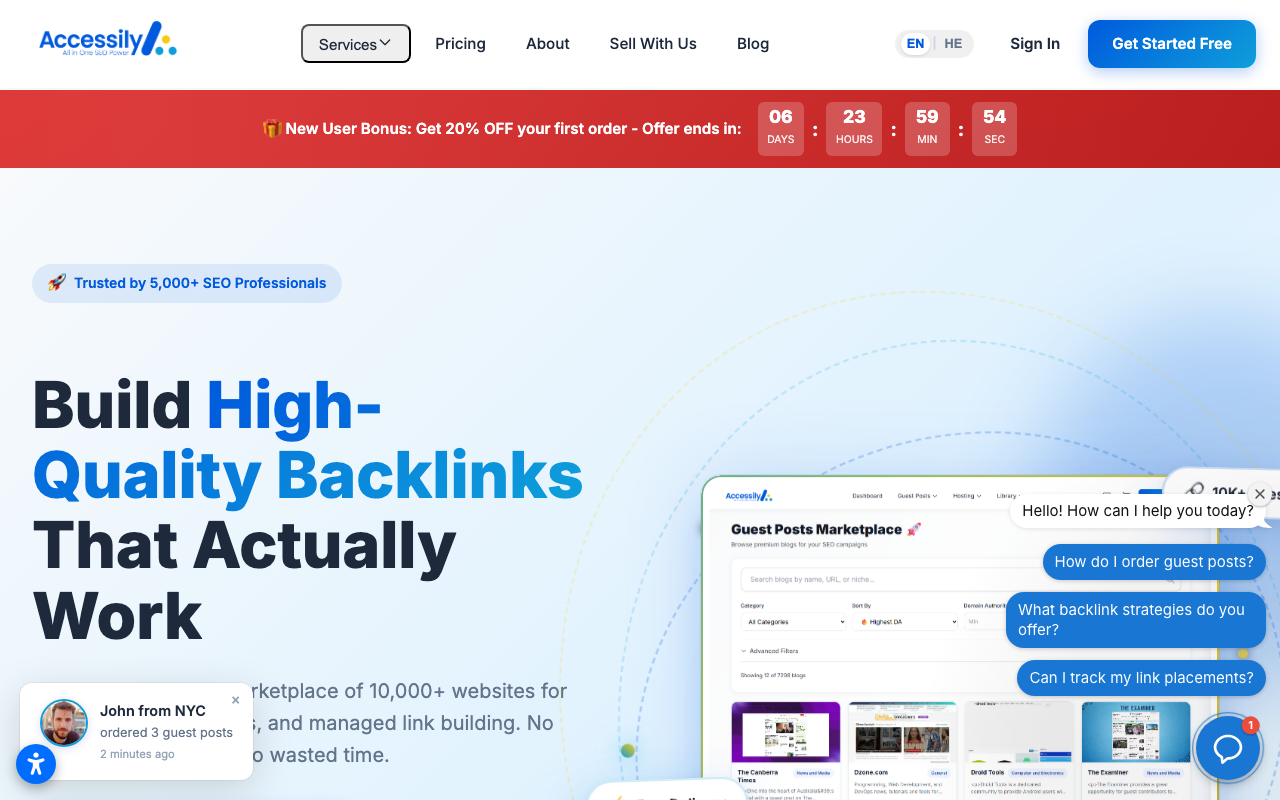
Accessily uses an AI-matching system that maps your target URL and niche to publishers most likely to accept your content and deliver link equity in your topic area. The freemium model makes it accessible, while paid tiers add filtering depth and link tracking, so you don’t have to commit budget before you’ve tested the matching quality. It sits around 4 stars on Trustpilot from 65+ reviewers.
Key features:
- AI-assisted site matching based on niche and target URL
- 25,000+ sites, influencers and authors
- 180-day money-back guarantee
- Free plan available; Plus ($27/month) and Advanced ($50/month) for additional features
- Link monitoring and reporting dashboard
Pricing: $15–$50+ per placement; platform subscription optional.
Best for: Small teams that want algorithmic placement recommendations to reduce manual evaluation time, campaigns spanning multiple niches where relevance matching is difficult to do manually.
FatJoe
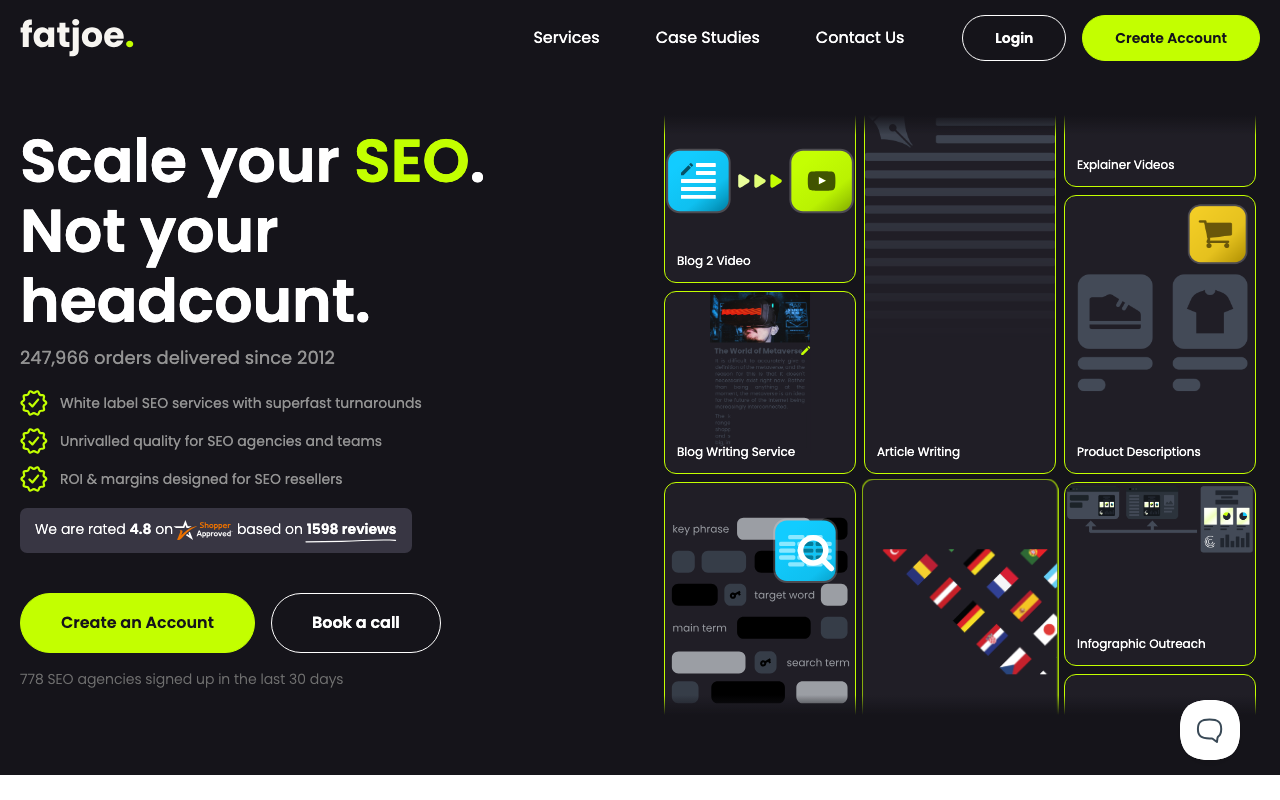
FatJoe operates as a managed editorial placement service inside a marketplace structure. You access 10,000+ pre-vetted publishers, but FatJoe’s team handles the editorial submission and quality check. The price includes content writing. It’s not an add-on. FatJoe also has the strongest reputation of any platform here: close to 5 stars on Trustpilot from 440+ reviewers, the largest review base in this list, not a fluke at that volume.
Key features:
- 10,000+ pre-vetted publishers with active editorial review
- Content writing included in placement cost (not an add-on)
- 100% money-back guarantee if the post doesn’t go live
- Duplicate prevention: the service won’t place on sites used for previous orders
- White-label reporting available for agencies, so you don’t have to build your own reports
Pricing: Starting at $72 per post (volume discounts available).
Best for: Agencies and in-house teams that want managed editorial quality without paying full-service agency prices, campaigns where content quality needs to meet a higher bar than standard marketplace writing.
The $72+ starting price puts FatJoe above entry-tier marketplaces but below premium managed services, which makes it a strong value position for teams where content quality matters.
Loganix
Loganix occupies the premium end of the self-serve marketplace spectrum. Its publisher network is curated (not open-inventory) with stricter site auditing than volume-first platforms. Placements start at $200 for sites with 100+ monthly organic visits. Reviewers are consistent on Trustpilot too, right around 4 stars from 100+ ratings, several mentioning relationships that have lasted years, hard to fake at that volume.
Key features:
- Curated publisher network with active DR and traffic auditing
- 3-week average turnaround
- Guaranteed replacement if a link drops
- Traffic-tiered pricing (100+ monthly visits, 500+ visits, 1,000+ visits tiers)
- White-label reports
Pricing: Starting at $200.
Best for: Campaigns where placement quality matters more than volume, brands building authority in competitive niches, teams that don’t mind trading scale for consistency.
If your strategy favors 10 high-quality placements over 50 average ones per month, Loganix is the right tool. The curated model also reduces the vetting burden on your team: you’re paying partly for their curation work, so there’s less busywork on your plate.
Linkhouse

Linkhouse stands out for its visual interface and easy site browsing experience. Publisher cards display key metrics at a glance (DR, traffic trends, niche and price), which makes it faster to review and shortlist sites without opening each domain in a separate tab. Its inventory’s grown well past its original size: the platform now lists more than 74,000 placements across sponsored articles, link insertions and other formats, not just standalone guest posts. On Trustpilot it’s one of the strongest performers in this list, around 5 stars from 130+ reviewers, a strong signal for a platform this size.
Key features:
- Visual publisher card layout with metrics overlay
- Traffic trend indicators (not just current estimates)
- Strong niche filtering
- Content writing add-on available
Pricing: Starting at $49.
Best for: Teams that want fast visual evaluation of placements, mid-tier campaigns in the $50–$150 per post range, SEO teams that find the standard table-view databases harder to scan efficiently.
The HOTH
The HOTH is a large agency-oriented platform offering both self-serve marketplace access and a more managed ordering model for agencies that need consistent delivery guarantees and client-ready reporting. It holds a solid reputation too: around 4 stars on Trustpilot from 265+ reviewers, most of whom highlight the account management team by name, a good sign when support is what agencies actually rely on.
Key features:
- Large publisher network filterable by traffic, DA, DR and niche
- 30-day guaranteed placement: if it isn’t live within 30 days, the team escalates
- White-label reporting available
- Agency dashboard for managing multiple clients, so you aren’t juggling spreadsheets
Pricing: Starting at $150 per post.
Best for: Agencies running multi-client campaigns that need consistent delivery SLAs and white-label reporting, in-house teams that want the self-serve model with a fulfillment backup.
Guest Post Marketplace Pricing: What to Expect
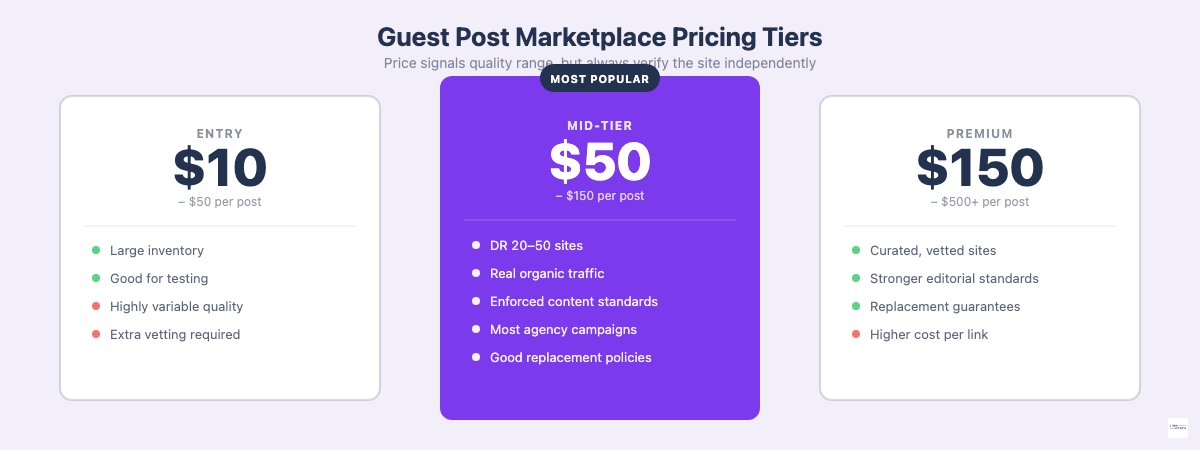
Prices vary a lot, and cost alone is a poor proxy for value. Here’s what each tier actually delivers, and what an independent market study says about where the real numbers land:
Entry tier ($10–$50 per post): Large inventory, highly variable quality. Sites at this price point often have lower organic traffic and weaker editorial standards. Useful for testing a new marketplace, lower-competition niches or campaigns where volume matters more than individual placement quality. You’ll want careful site vetting before ordering.
Mid-tier ($50–$150 per post): The most useful range for most campaigns. DR 20–50, genuine organic traffic in the hundreds to thousands of monthly visitors and platforms that enforce minimum content standards. That’s where most agency campaigns run.
Premium tier ($150–$500+ per post): Curated inventory, stronger editorial standards, more meaningful traffic and better link protection policies. It’s worth the premium when domain authority and topical relevance matter more than post volume.
An outside data point backs this up. An analysis of more than 250,000 live guest post listings, published in mid-2026, found that sites selling placements directly average $295 per post, while listings sourced through a vendor or marketplace average $461. Price still tracks authority closely: expect around $200 on a DR 0-9 site and roughly $3,000 or more once you reach DR 80+. The same study found that only 1.37% of guest post sites qualify as High Quality or Top-Tier, which is exactly why the vetting work in the previous sections matters more than the price tag ever will.
Budget allocation advice: A single placement on a topically aligned DR 35 site with 3,000 monthly organic visitors produces more SEO impact than five placements on DR 15 sites with 200 visitors each, period. When in doubt, put your budget on fewer, higher-quality placements instead of maximizing post count.
Content writing costs: If you’re not supplying the article yourself, add $30 to $100 per post for marketplace writing services. At 20+ posts per month, this adds up fast, so factor it into your cost-per-link calculation and think about whether a dedicated content writer is more efficient. It’s a real cost, not a rounding error.
Red Flags and Quality Risks to Avoid
Most guest post marketplace failures come from buying placements on sites that shouldn’t be in any inventory to begin with. Learn to spot these patterns before you order, not after.
Private blog networks (PBNs). Clusters of sites created purely to sell links, with manufactured authority metrics. Signs: near-identical site templates across multiple domains, no real social presence, all posts are paid placements, suspiciously high DR relative to organic traffic and authors with no online presence elsewhere. Google’s ability to detect PBN patterns has gotten better. Links from PBNs are outright liabilities: they carry next to no value and put you at risk of algorithmic or manual penalties.
Inflated authority metrics. Sites can pump their own DR by buying links to themselves. If a site has DR 45 but only 150 monthly organic visitors according to Ahrefs, the authority signal is manufactured, and that’s the giveaway. Always cross-check DR against actual traffic estimates from a third-party tool.
Guest post farms. Sites where 80–90% of content is paid placements with no consistent editorial voice, no real audience and no original content the site’s team produced. Even if metrics look acceptable, the link signal is weak and getting weaker as Google’s quality scoring evolves, and it won’t get easier to hide.
Anonymous domain listings. Any platform that won’t show you the site domain before payment is blocking your ability to evaluate quality. That’s non-negotiable: always see the domain before ordering.
No editorial review. Platforms that accept any article regardless of quality set up conditions Google can detect: a site publishing scaled sponsored content with no editorial bar. The bar for what gets published should be real. It shouldn’t be decorative.
No link permanence policy. If there’s no stated replacement policy, you’re taking on the full permanence risk yourself. Domains expire, blogs shut down and CMS migrations break redirects. Buying from platforms without replacement guarantees is riskier than it looks at the time of order.
How to Use a Guest Post Marketplace Effectively
The mechanics of ordering are simple. The campaign strategy around it is where results diverge, and it’s usually where budgets get wasted.
Build a target list before you order. Identify 10–15 specific sites that meet your quality and relevance criteria before placing a single order. Evaluating upfront reduces the chance of budget waste and helps you build a feel for what a quality placement looks like in your niche. It’s worth the extra time up front.
Prioritize topical relevance over domain rating. For SEO impact on a specific topic cluster, a DR 35 site that covers exactly your industry beats a DR 60 general blog with no topical connection, every time. Topical authority signals matter more now that Google’s understanding of content relevance has gotten sharper.
Vary your anchor text profile. Exact-match anchors on every placement signal an unnatural link-building pattern. A healthy profile includes branded anchors (your company or product name), partial-match phrases, URL-style anchors and natural context phrases. Keep exact-match below 20–25% of your total anchor distribution.
Supply quality content. The best marketplace placements read like genuine editorial contributions, not link wrappers. Articles that provide real value to the host site’s audience are more likely to stay live, attract secondary links and generate referral traffic. Thin articles that exist purely to host a backlink are lower-value and higher-risk.
Track every placement. Link decay is real. Site migrations, domain expirations and CMS updates all cause previously live links to break. Use Ahrefs, Semrush or a dedicated link tracker to monitor your placements and activate replacement guarantees before they expire. It’s a five-minute check that can save a wasted placement.
Pace your acquisition. A sudden spike in guest post links (such as 100 in a month for a site that had none previously) is a velocity anomaly. Consistent acquisition over time is safer and more sustainable than bursts, and that’s the whole strategy: steady, not spiky.
Frequently Asked Questions
Is buying guest posts safe for SEO in 2026?
Buying high quality guest posts through reputable marketplaces is standard practice among SEO agencies and in-house teams today. Google’s guidelines target manipulative link schemes, not editorial content, and they don’t treat every paid placement the same way: links from real, editorially active sites with genuine audiences are qualitatively different from link farming. Risk comes from low-quality sites, PBNs and unnatural anchor patterns. It doesn’t come from using marketplaces itself. Stick to platforms with documented site vetting, verify individual sites before you order and the practice holds up fine.
What is the difference between a guest post and a niche edit?
A guest post is a new article published on a third-party site that includes your backlink. A niche edit (also called a link insertion) places your backlink into an already-published article on a third-party site. Both are available on most link building marketplaces, and that’s the core difference between the two products in practice. Guest posts give you control over the surrounding content, something a niche edit can’t offer. Niche edits benefit from the existing page authority and traffic of an established article. Both approaches produce dofollow backlinks; verify this per listing before you order.
How long do guest post links stay live?
This varies by publisher and platform, and there’s no fixed number that applies everywhere. Reputable marketplaces offer minimum 12-month guarantees with a replacement policy if the link goes down. “Permanent” is a practical claim, not a guarantee: domains expire, blogs migrate and platforms change ownership. Always buy from platforms with an active replacement or refund policy to reduce long-term decay risk.
How many guest posts per month is reasonable?
There’s no universal number here. It depends on your domain’s current authority, your competitive niche and your overall link velocity baseline. A new site building its first links might target 5 to 10 placements a month. An established domain in a competitive niche might run 20 to 40, and there’s nothing wrong with either pace. Dramatic velocity spikes, jumping from 0 to 100 placements in a single month for example, are the pattern to avoid, not a specific post count.
Can guest post marketplaces be used for local SEO?
Guest post marketplaces work fine for local SEO at the national or regional level, though they run out of depth once you need true city-level targeting. Most major platforms support country-level filtering, and some, WhitePress in particular, carry strong regional inventory for European markets. For hyper-local targeting at the city level, marketplace options get thin fast: local news sites, city-specific directories and regional blogs usually need direct outreach instead of marketplace ordering.