

A brainstorm session, a few keyword ideas, a gut feeling about what might rank: that is how most content calendars still get built. Gut feelings do not reflect what your audience is actually typing into Google, and brainstorming rarely surfaces the topics where proven search demand already exists.
Ahrefs content gap analysis replaces the guesswork with data. Instead of starting from scratch, you start with the keywords your competitors already rank for that your site does not cover. These are gaps backed by real search volume, proven ranking difficulty benchmarks and confirmed audience intent, which makes them one of the most reliable inputs for a content strategy that compounds traffic over time.
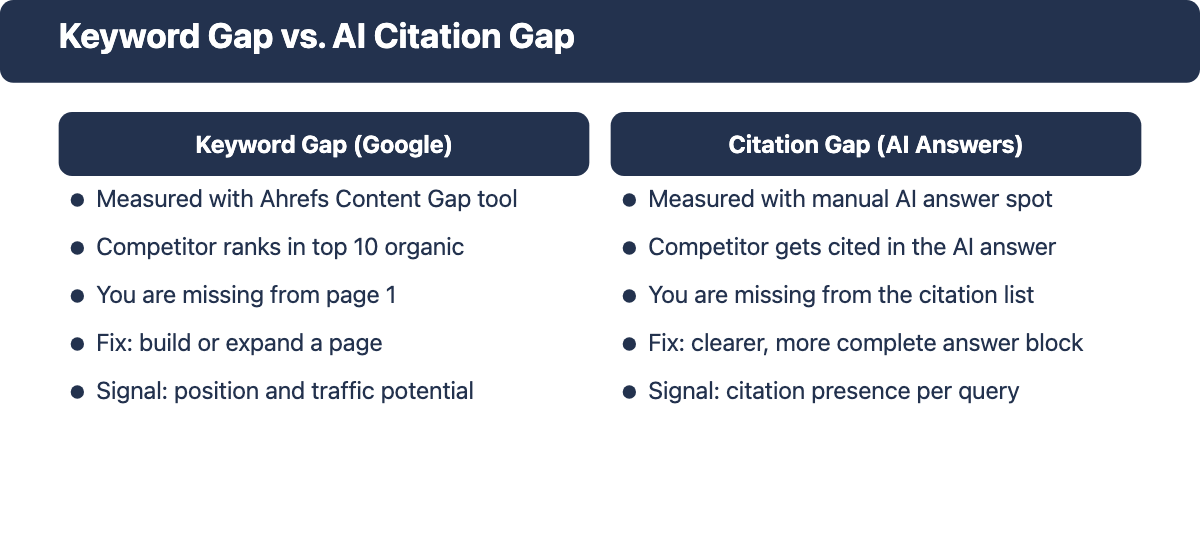
Google rankings are not the only place gaps show up anymore. AI answer engines pull from a different citation pool than the top-20 organic results, so a full review increasingly needs to check both: where competitors outrank you, and where they get cited that you do not.
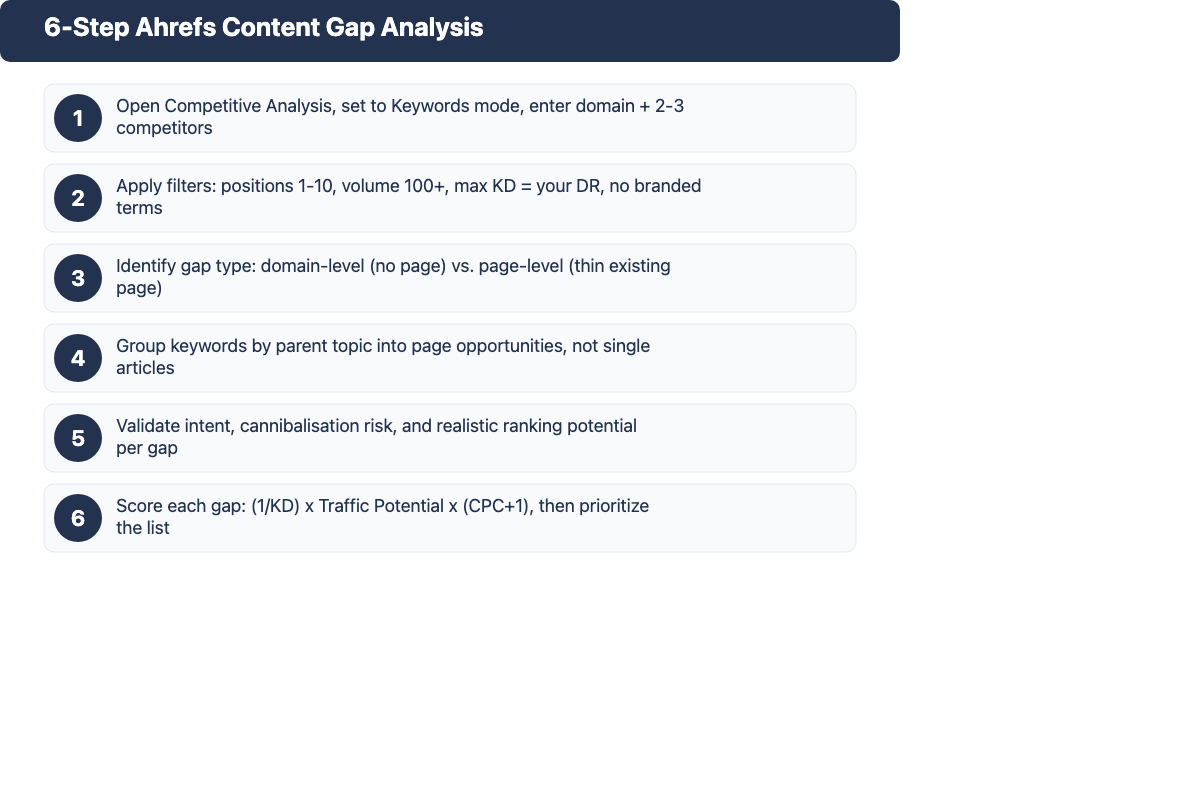
This guide walks you through the complete process: what a content gap analysis is, when to run one, how to choose the right competitors, the six-step Ahrefs workflow, how to act on your findings and the most common mistakes that waste your effort. It sits within our broader guide to SEO competitor research, the full strategic framework for using competitor data to drive organic growth.
What Is a Content Gap Analysis?
A content gap analysis is the process of identifying keywords and topics that your competitors rank for in search results, but your site does not. The goal is to surface content opportunities where search demand is already proven, so you can prioritize what to create or update next.
There are two distinct types of content gaps worth understanding:
Domain-level gaps occur when a competitor has created content on a topic that you have not covered at all. You have no page targeting this keyword cluster. The action required is creating new content.
Page-level gaps occur when you and a competitor both have content on the same general topic, but their page ranks for significantly more keyword variations than yours. You have a page, but it is thinner or less comprehensive. The action required is expanding or updating your existing page.
Knowing which type you are dealing with changes what you do next, so keeping this distinction in mind throughout the analysis saves time.
Content Gap vs. Keyword Gap Analysis
These terms are often used interchangeably, but there is a meaningful distinction. A keyword gap analysis focuses narrowly on individual keywords your competitors rank for that you do not. A content gap analysis is broader: it uses keyword gaps as evidence to identify entire topic areas or content formats your site is missing. Content gap analysis produces page-level opportunities; keyword gap analysis produces a raw keyword list.
Content Gap vs. Backlink Gap Analysis
These are two different reports in Ahrefs that serve different strategies. Content gap analysis (keywords mode) finds topics you should create or improve to capture organic traffic. Backlink gap analysis (referring domains mode) finds websites that link to your competitors but not to you, which is useful for link building outreach. Run content gap analysis when you want to grow editorial coverage. Run backlink gap analysis when you want to grow link authority.
Content Gap Analysis and AI Visibility
Classic content gap analysis targets Google keyword rankings, and that is still the foundation. AI answer engines add a second layer worth checking, because they do not simply cite whatever sits in the top 20 organic results. A page can rank respectably on Google and still be invisible in an AI Overview or a chatbot answer, while a competitor with a weaker ranking gets quoted directly.
Treat this as an extension of the same workflow rather than a separate tool. After you run your standard content gap report, spot-check a handful of your highest-value target queries directly in Google and in an AI chatbot. Note which competitor pages get cited in the AI-generated answer and which do not appear at all. If a competitor shows up consistently in AI answers on a topic where your keyword gap report also flags them, that topic earns a higher priority score, since you are behind on two channels at once, not one.
The content fix is the same either way: cover the topic more thoroughly, answer the question directly near the top of the section and structure headings so a passage can stand on its own. Content that already wins a keyword gap tends to close the AI-visibility gap alongside it, because both reward the same thing: a clear, complete, well-organized answer. The comparison below lines up both gap types side by side.
Do
- Run a full content gap analysis every quarter
- Run it for a new site or niche, or when traffic plateaus
- Run it after a competitor ramps up publishing or before a product launch
- Run a lighter pass after a drop in organic traffic
- Spot-check high-value queries in AI answers and raise priority where competitors win on both
Don't
- Choose competitors by brand recognition instead of keyword overlap
- Treat every keyword as its own article
- Ignore search intent before writing
- Run the analysis only once
- Chase high-volume keywords instead of Traffic Potential
When Should You Run a Content Gap Analysis?
Run a full content gap analysis every quarter, and treat it as a standing task rather than a one-time exercise. A handful of other trigger moments make an off-cycle pass especially valuable too:
New site or new niche. When you are starting out, you do not have enough historical data to know which topics matter. A content gap analysis against established competitors in your space gives you an instant content map built on proven demand instead of assumptions.
Existing site hitting a plateau. You have written about the obvious topics. Traffic is flat. A content gap analysis reveals what topics your competitors are capturing that your site is missing, often a significant number of mid-funnel and long-tail opportunities that are less obvious but highly convertible.
After a competitor ramps up publishing. If a competitor significantly increases their content output, run a content gap analysis to see which topics they are targeting. This lets you respond strategically instead of reactively.
Before a product or service launch. If you are expanding into a new audience segment or launching a new product, a content gap analysis helps you map the content needed to support that launch, comparison pages, use-case articles, and informational content that captures people earlier in the funnel.
After a drop in organic traffic. Run a lighter version of the analysis to check whether competitors have captured territory you previously held, and confirm the drop is competitive rather than technical before you start writing.
Test titles and meta descriptions in the free SERP Snippet Generator before you publish.
How to Choose the Right Competitors for Your Report
Competitor selection is the most underestimated step in content gap analysis. Get it wrong and your report fills with irrelevant keywords that waste your content team's time.
The key insight: your SEO competitors are not necessarily your business competitors. Your SEO competitors are the sites that rank for the same keywords your target audience uses. A software product company might find that an independent blog dominates more of their keyword space than any direct product competitor.
How to find your true SEO competitors in Ahrefs:
Open Ahrefs Site Explorer, enter your domain, and navigate to Organic Competitors. Ahrefs shows you the sites that rank for the most overlapping keywords with your domain. Sort by organic traffic to see which competitors are winning in your space. These are the sites to use in your content gap report.
How many competitors to include: Use 2-3 closely matched domains. More than three starts to introduce noise, you will surface keywords from loosely related sites that do not reflect your actual content opportunities. Fewer than two limits the cross-domain signal.
When to override Ahrefs suggestions: If Ahrefs suggests a competitor that is significantly larger than your site (10x the DR, much broader audience), consider excluding them unless you have realistic ranking potential in their keyword space. Their content map may be too advanced for your current domain authority.
How to Run a Content Gap Analysis in Ahrefs (Step-by-Step)
Step 1: Open the Competitive Analysis Tool
In Ahrefs, navigate to the Competitive Analysis tool from the main navigation. This is the dedicated tool for gap analysis, do not use Site Explorer's Content Gap tab if you are looking at keywords across multiple competitors simultaneously, as the Competitive Analysis tool handles this more efficiently.
Set the mode to "Keywords" at the top of the interface. The alternative mode is "Referring domains," which runs a backlink gap analysis, a different workflow entirely.
Enter your domain in the first field (the "The target doesn't rank for" field). Then add your chosen competitor domains in the fields below. You can add up to 10 competitors, but 2-3 is optimal for a clean signal.
Click "Show keyword opportunities" to generate the initial report. See the screenshot below for what the live tool looks like before you run your own report.
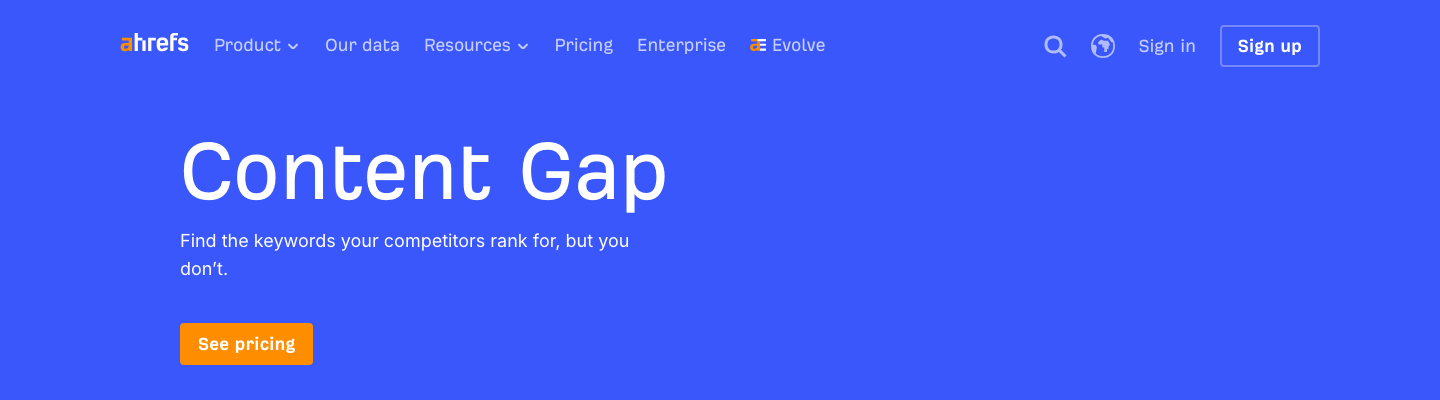
The Ahrefs Content Gap tool, confirmed live as of August 2026. (Source: Ahrefs) Step 2: Apply Filters to Remove the Noise
The raw report will often contain tens of thousands of keywords, most of which are not realistic opportunities. Filters are how you turn a noisy dataset into an actionable list.
Position filter. Set competitors to rank in positions 1-10. If a competitor ranks on page two or lower for a keyword, that keyword may not represent a strong enough signal. Focus on keywords where they are genuinely winning.
Volume floor. Set a minimum monthly search volume of 100 for the primary sweep. For a long-tail pass, you can lower this to 20-50. Anything below 20 is unlikely to generate meaningful traffic even if you rank first.
Keyword Difficulty filter. A practical rule of thumb: set your maximum KD at approximately your site's Domain Rating. If your DR is 35, cap KD at 35. This is a starting point, not a hard rule, always validate with a manual SERP check.
Exclude branded terms. Use the keyword filter to exclude competitor brand names. You cannot realistically rank for branded competitor terms as an outside site. Filter these out using partial match to catch variations.
Exclude irrelevant topic clusters. Review the initial results and identify any broad topic areas that are clearly not aligned with your content focus. Use the keyword exclude filter to remove entire clusters in a single step.
Export the refined results to CSV after applying filters. This becomes your working dataset.
Step 3: Identify the Gap Type (Domain vs. Page Level)
With your refined keyword list, the next step is to categorize each opportunity as a domain-level gap or a page-level gap. This determines your content action.
For each keyword cluster in your list, run a quick site search:
site:yourdomain.com [topic keyword]. If nothing returns, you have a domain-level gap, you need to create a new page. If a result returns, you have a page-level gap, the keyword cluster should be added to an existing page through new sections, improved headings, or richer content.In Ahrefs, you can also use the Parent Topic column to see which broader topic each keyword belongs to. This helps you spot whether a cluster of keywords should map to one page or multiple pages.
Step 4: Group Keywords Into Content Opportunities
Treating every keyword in your gap report as a separate article is one of the most common content strategy mistakes. It produces a fragmented site full of thin, overlapping pages that compete with each other for the same rankings.
Instead, group related keywords by shared search intent. The test: do the top-ranking pages for these keywords look similar in format and content? If yes, they likely belong on the same page.
Ahrefs' Parent Topic feature helps here. Keywords that share a parent topic typically belong on the same page. Group your export by parent topic, then review each group to confirm the SERP alignment.
Output from this step: a list of content opportunities, where each opportunity is a page idea with a primary keyword, a cluster of supporting keywords, and a content type (how-to, comparison, listicle, definition, etc.).
Step 5: Validate Each Opportunity Against the SERP
Before you put a gap opportunity into your content calendar, validate it against three quick checks:
Search intent check. Look at the current top 5 results. Are they blog posts, product pages, tool landing pages, or comparison tables? If the SERP is dominated by product pages and you plan to write a blog post, you are mismatched with user intent and will struggle to rank regardless of content quality.
Cannibalisation check. Does your site already have a page that partially targets this keyword? If yes, adding a new page will likely split authority and hurt both pages. Update the existing page instead.
Realistic ranking check. Look at the DR of the sites ranking in positions 1-5. If all of them are DR 80+ and your site is DR 30, you need a strong link-building plan alongside the content. Flag these opportunities for a future phase when your authority has grown.
Step 6: Score and Prioritize Your Content Plan
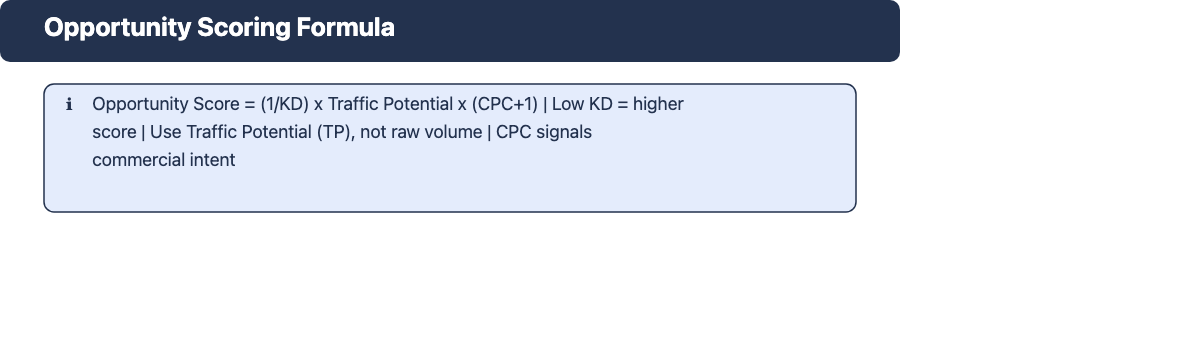
Opportunity scoring formula for prioritizing content gap findings With your validated opportunity list, prioritize using an opportunity score so you write the highest-value content first.
A practical scoring formula:
Opportunity Score = (1 / Keyword Difficulty) x Traffic Potential x (CPC + 1)
What each component signals:
(1 / KD): Inverts difficulty so lower-difficulty keywords score higher. A KD of 5 scores 0.20; a KD of 50 scores 0.02. This prevents high-volume but impossible keywords from dominating your list.
Traffic Potential: Use the "TP" column in Ahrefs (the monthly traffic the top-ranking page actually receives), not raw keyword volume. TP is a more realistic estimate of the actual traffic ceiling for a well-optimized page.
(CPC + 1): Cost-per-click signals commercial intent. Adding 1 prevents zero-CPC keywords from scoring zero. A CPC of $5 weights the keyword higher than a CPC of $0.50, reflecting the downstream value of ranking traffic.
Sort your opportunity list by score descending. The top items are your starting point for the content calendar. Add them to your project management tool with the keyword cluster, content type, and target URL (new or existing page).
How to Act on Your Content Gap Findings
Analysis without action produces no results. Once you have your prioritized opportunity list, act on it systematically.
For domain-level gaps: Create a new, comprehensive page targeting the keyword cluster. Use the grouped keywords from Step 4 to structure the page, the primary keyword goes in the title and H1, supporting keywords go into H2s and body copy naturally. Aim to cover the topic more thoroughly than the top-ranking competitor page, not just match it.
For page-level gaps: Audit your existing page against the missing keywords. Ask: what sections does the top-ranking competitor have that you do not? What questions do they answer that you skip? Add new H2 or H3 sections to address these gaps. Update the title and meta description if the primary keyword framing has shifted.
Content brief basics. For every opportunity you move into production, create a brief that includes: target keyword, supporting keyword cluster, recommended heading structure, URLs of the top 3 competitors to beat, word-count target, and any required data or statistics to verify. Briefs prevent writers from producing generic content and ensure every gap opportunity is addressed with specificity.
Timeline expectation. A well-executed content gap analysis takes 2-4 hours for the analysis phase. Content creation, quality review, and publishing add additional time per piece. Content gap analysis is the beginning of a 3-6 month content production cycle, not a one-session task that produces immediate ranking results.
Common Mistakes in Content Gap Analysis
Using the Wrong Competitors
Selecting competitors based on brand recognition rather than keyword overlap is the most common error. Run the Organic Competitors report in Ahrefs to find who you are actually competing with in the search results. A site you do not think of as a competitor may be capturing a large portion of your keyword space.
Treating Every Keyword as Its Own Article
A 500-keyword gap report does not mean you need 500 new articles. Most of those keywords belong in clusters of 10-30 related terms that map to a single page. Building a page for each keyword fragments your site, dilutes internal authority, and often leads to keyword cannibalisation. Group first, then create.
Ignoring Search Intent
A keyword gap is only a real opportunity if you can match the content format that users expect. If the SERP shows product comparison tables and you write an informational blog post, you are unlikely to rank no matter how good the content is. Always check search intent before writing a single word.
Running the Analysis Once
Competitors publish new content continuously. A gap analysis from six months ago is outdated. Build quarterly gap analysis reviews into your content calendar as a standing task. New gaps open as competitors expand their coverage. Old gaps may close once you have published on those topics.
Chasing High-Volume Keywords Only
Volume is visible. Traffic potential is what matters. A keyword with 1,000 monthly searches where the top-ranking page receives 400 monthly visits is a stronger opportunity than a keyword with 5,000 searches where the top page captures only 200 visits due to SERP fragmentation. Use the Traffic Potential column in Ahrefs, not raw volume, as your primary sizing metric.
Content Gap Analysis vs. Backlink Gap Analysis
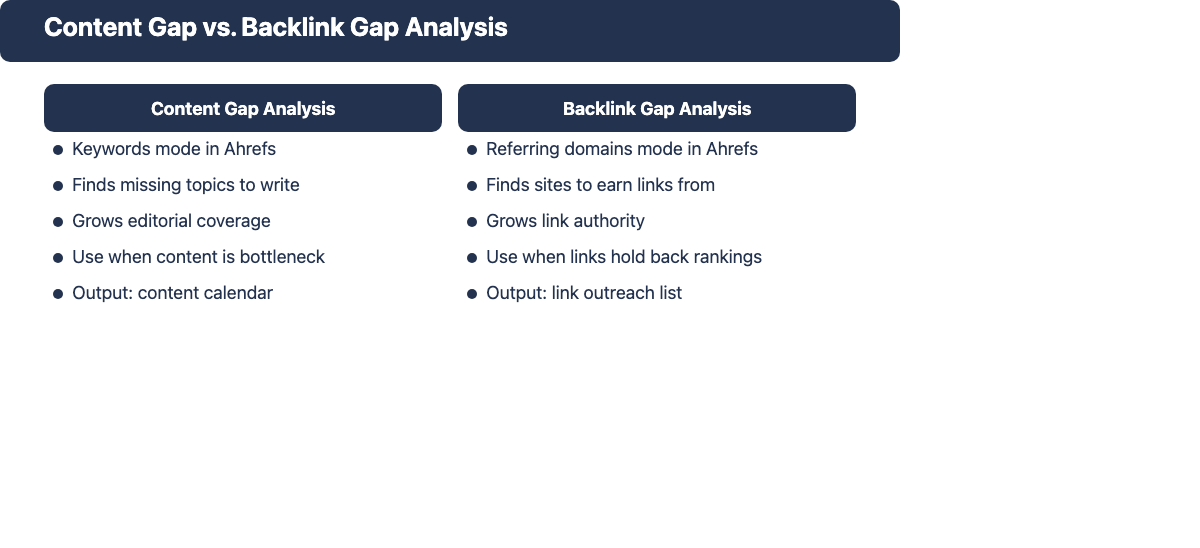
These two analyses serve different parts of the same SEO strategy and are often confused because both live in the Ahrefs Competitive Analysis tool.
Content gap analysis (keywords mode) identifies topics and keywords to add to your editorial calendar. It answers: what should we write? Backlink gap analysis (referring domains mode) identifies websites that link to your competitors but not to you. It answers: who should we try to earn links from?
Run content gap analysis when your primary bottleneck is editorial coverage, when you lack the pages needed to compete on the keywords your audience searches for. Run backlink gap analysis when you have strong pages that deserve more authority, when the content exists but links are holding back rankings.
In practice, both analyses feed into a complete SEO competitor strategy. Content gap findings show you what to build. Backlink gap findings show you how to amplify what you have already built. Both fit within the broader SEO competitor research framework.

800+ SaaS marketers swap partner, integration and content links on LinkForce.
Frequently Asked Questions
How often should I run a content gap analysis?
Quarterly is the recommended cadence for most sites. Run an additional pass after any significant organic traffic drop, after a major competitor publishes a content push, or when entering a new topic cluster. The competitive landscape shifts continuously, and gaps that did not exist six months ago may now represent your best ranking opportunities.
How many competitors should I include in the report?
Include 2-3 competitors for the cleanest signal. More than three introduces noise from loosely related domains. If your niche is very competitive, consider running two separate reports: one with your closest brand-level competitors, one with the top organic competitors Ahrefs identifies in the Site Explorer Organic Competitors report.
What is the difference between a content gap and a keyword gap?
A keyword gap is a single keyword your competitor ranks for that you do not. A content gap is a topic area or content type that is missing from your site entirely, typically identified by clustering multiple keyword gaps together. Keyword gap analysis gives you a list; content gap analysis gives you a strategy.
Can I do a content gap analysis without Ahrefs?
Yes. You can use Semrush's Keyword Gap tool, Similarweb, or Google Search Console combined with a competitor's manually reviewed sitemap to approximate the same analysis. However, Ahrefs provides the cleanest interface, the most accurate traffic potential data, and the most efficient filtering workflow for this specific process.
What should I do if my content gap report has 50,000+ keywords?
Apply stricter filters: raise the volume floor to 500+, lower the maximum KD, and require competitors to rank in positions 1-5 rather than 1-10. If the list is still overwhelming, narrow your competitor set to 2 very closely matched domains. The goal is a working list of 100-300 opportunities you can realistically evaluate and prioritize.
Does content gap analysis work for small or new sites?
Yes, with adjusted expectations. New sites with low DR should apply a tighter KD filter (maximum KD 20-30) and focus on long-tail keyword clusters with lower competition. The underlying process is identical: find what competitors rank for that you do not, validate intent, and create better content. The priority order changes based on your realistic ranking window, but the analysis itself is equally valid for any site size.
Does content gap analysis help with AI search visibility, not just Google rankings?
It can, once you add an AI-answer spot check to the workflow. Run your standard Ahrefs report first, then check whether the same competitors who beat you on keywords also get cited in AI Overviews or chatbot answers for your priority topics. Overlap on both signals is a strong sign that the topic deserves a higher place on your content calendar.
Should I update an old page or create a new one when I find a gap?
Check first whether a page on your site already targets the general topic. If it does, expand that page instead of publishing a near-duplicate, since a new page competing with your own content for the same keywords tends to hurt both. Create a new page only when the site search check from Step 3 comes back empty.
Conclusion
Ahrefs content gap analysis remains one of the most reliable methods for building a content strategy grounded in real search demand. Instead of guessing what your audience wants, you start with what your competitors have already proven works, on Google and increasingly in AI-generated answers too.
The six-step process: open the Competitive Analysis tool in keywords mode, set your filters to surface genuine opportunities, identify whether each gap requires a new page or an update to an existing one, group keywords into page-level opportunities rather than individual articles, validate each opportunity against the current SERP, and score your list to prioritize the highest-value content first.
The analysis is only as good as the action you take on it. Build quarterly gap reviews into your content calendar, maintain a prioritized opportunity list, and use briefs to ensure every piece of content addresses the specific gaps you identified.
For the full strategic context, how content gap analysis fits into a broader competitor research workflow, see our SEO competitor research guide.