
Local link building is the process of earning backlinks from websites tied to a specific town, city or region, rather than from national or industry-wide sites. It matters because Google treats a link from a genuinely local source as stronger proof that a business actually operates and serves customers in that area than a generic link ever provides. This guide covers what counts as a local link, whether it’s still worth pursuing, how many you realistically need, nine tactics that earn them, what the work costs, when to do it yourself versus hire it out, the mistakes that can backfire and how to check whether any of it is working.
What Is Local Link Building?
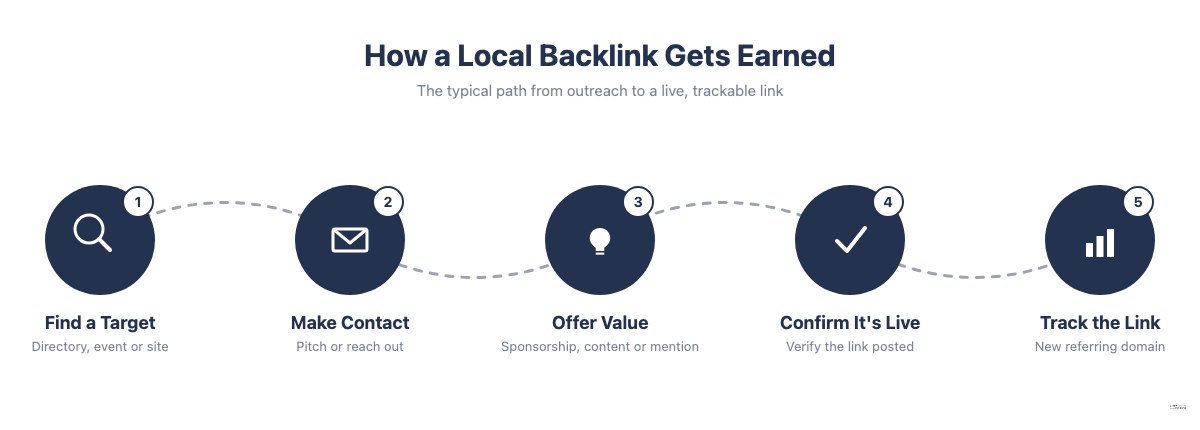
Local link building means getting other geographically relevant websites, ones based in or focused on your specific city, region or service area, to link back to your site. It’s a subset of general link building, narrowed by location instead of topic alone.
It’s easy to confuse a local backlink with a citation, but they’re not the same thing. A citation is any online mention of your business name, address and phone number, on a directory, a local news writeup or a community listing, whether or not it’s got a clickable link. A backlink requires an actual hyperlink pointing to your site. Citations are usually easier to earn in bulk; backlinks take more work but carry more direct ranking and referral value, since they pass a real, followable connection instead of just a text mention.
A local news outlet linking to your site after covering a community event, a chamber of commerce directory listing with a live link, or a neighborhood blog referencing your business all count as local backlinks. A directory listing with your name, address and phone number but no hyperlink is a citation, not a backlink, even though the two often get lumped together in casual conversation.
Do Local Backlinks Still Move Local Pack Rankings?
Yes, local backlinks definitely still influence local pack and map pack rankings. Google uses them as a trust and relevance signal that a business is a genuine, established part of the area it claims to serve, and that signal carries weight alongside reviews, proximity and on-page optimization.
Three mechanisms explain why. Local authority comes from links on regional websites, community blogs, local newspapers or a chamber of commerce, since these sources implicitly vouch that a business is relevant to a specific area in a way a national directory can’t replicate. Map pack visibility benefits from a stronger link profile too, though it’s one factor among several; reviews and physical proximity to the searcher still carry heavy weight in that particular result type. Organic local search benefits in a more traditional way: a site with authoritative inbound links tends to outperform a comparable site without them, the same mechanism that drives non-local rankings.
None of this means links are the only lever worth pulling. It means a business ignoring local backlinks entirely is leaving a real ranking signal on the table.
How Many Local Backlinks Do You Actually Need?
There’s no fixed number of local backlinks that guarantees a ranking result, and any guide that gives you one is guessing. The useful benchmark isn’t an absolute count, it’s a relative one: how your referring domain count compares to the businesses already ranking above you in the local pack for your target terms.
Start by checking how many referring domains the top three local competitors for your main keyword actually have. If they’re sitting around 15 to 25 relevant referring domains and you’ve only got three, that gap is your real target, not some generic number pulled from a blog post. Close it steadily rather than trying to match it in a single push, since a sudden spike in new links looks unnatural and doesn’t reflect how real local relationships get built.
Multi-location businesses face a different version of this question. A link earned by one location, a local sponsorship for the downtown store, for example, doesn’t automatically transfer authority to a location across town or in another city. If you operate multiple locations, you’ll want to plan link building per location page, not just for the brand as a whole, or your secondary locations’ pages will keep lagging behind.
9 Local Link Building Strategies That Earn Real Backlinks
Some of these tactics take an afternoon; others take months of relationship-building before the first link shows up. The table below gives a fast read on effort versus payoff before you commit to any one approach.
| Tactic | Typical effort | Typical link quality |
|---|---|---|
| Local directories | Low | Moderate |
| Sponsorships and events | Medium | High |
| Local partnerships | Medium | High |
| Localized content | Medium-high | High |
| Guest posts | High | High |
| Unlinked mention reclamation | Low | Moderate-high |
| Competitor backlink-gap analysis | Medium | Variable |
| Roundups and digital PR | High | High |
| Vendor and supplier links | Low | Moderate |
1. Claim and Optimize Local Business Directories
You’ll want to claim your listing on Google Business Profile first, then move to industry-specific and city-specific directories rather than generic national ones. A plumbing business gets more value from a listing on a regional trade association’s member directory than from a low-authority national directory that accepts any business without review.
2. Sponsor Local Events and Organizations
Sponsoring a youth sports team, a community festival or a local nonprofit event typically earns a link from the organizer’s website, since most organizations list their sponsors online with a link back as a standard courtesy. It’s one of the lowest-effort tactics on this list once the sponsorship itself is in place. Pick sponsorships that overlap with your actual customer base rather than the cheapest option available, so the traffic and the link both carry relevance.
3. Build Real Partnerships With Nearby Businesses
Cross-promotion with non-competing local businesses, a co-hosted event, a joint discount, a shared resource page, tends to earn a mutual link because both sides have a reason to reference the other. A bakery and a coffee roaster in the same neighborhood recommending each other on their sites is a natural fit that doesn’t read as manufactured.
4. Publish Genuinely Local Content
A neighborhood guide, a roundup of local resources or a page built around a specific regional event gives other local sites and residents an actual reason to link to you, unlike a generic service page. This works best when the content answers a real local question rather than existing purely to attract links.
5. Contribute Guest Posts to Local and Regional Sites
Pitching an article to a regional business blog, a local news site or a community publication earns a link, usually in an author bio, in exchange for genuinely useful content. This tactic takes more upfront work than most on this list, since it requires writing to someone else’s editorial standard, but the resulting link tends to carry real authority.
6. Reclaim Unlinked Brand Mentions
Search for instances where your business name already appears on a local site without a hyperlink, a news writeup, a blog post, a forum thread, then ask the site to add one. This is often the fastest tactic on this list, since you’re not pitching a new placement, you’re asking for a small edit to something that already exists.
7. Analyze Competitor Backlinks for Local Prospects
Run a backlink analysis on the two or three competitors ranking above you locally, then filter for the sites linking to them but not to you. Those sites have already shown they’ll link to a business like yours, which makes them a warmer outreach target than a cold list built from scratch.
8. Get Featured in Local Roundups and Digital PR
Pitch journalists and local publications with a genuinely newsworthy angle, a data point about your industry in the area, a milestone, a community contribution, rather than a generic press release about your business existing. It’s the tactic with the highest ceiling on this list, and also the one that’s hardest to plan on a fixed schedule. A single well-placed feature in a local roundup can outperform a dozen low-effort directory links in both authority and referral traffic.
9. Ask Vendors and Suppliers for a Reciprocal Link
If you buy from or supply local vendors, ask whether they maintain a partner or client page and request inclusion. Offer the same in return if you run one. This tactic gets overlooked because it doesn’t feel like classic outreach, but the relationship and the relevance are already in place, which makes it one of the easier links on this list to close.
How Much Does Local Link Building Cost?
Local link building typically costs between $150 and $1,500 or more per link. That’s a wide range, and it depends on the tactic and how much content creation or manual negotiation it requires.
Three cost tiers cover most of the market. Niche edits and link insertions into existing local content run around $150 to $400, since you’re paying to add a link rather than create new content. Guest blogging runs roughly $300 to $900, which covers writing a full article, pitching it and often an editorial fee from the publisher. Digital PR campaigns, building a data study or local angle and pitching it to journalists, typically start around $1,250 and can run higher, since the upfront campaign cost buys natural, harder-to-replicate media coverage rather than a single placement.
Budget for the range, not a single number.
If you’d rather hand the whole process to someone else, a managed retainer bundling research, outreach and reporting generally lands between $3,000 and $15,000 a month, scaled to how many placements you need and how competitive your local market is.
Can You Do Local Link Building Yourself, or Should You Outsource It?
You can do local link building yourself if you’ve got the time to research local sites, feel comfortable reaching out cold and can commit reasonably consistent hours to it every month. Outsource it if any of those three things are missing, since inconsistent, sporadic outreach tends to underperform a smaller but steady effort.
The honest self-check comes down to bandwidth and relationship-building comfort. If you already know local reporters, event organizers or business owners, you have a head start that no outsourced provider can fully replicate, and doing it yourself makes sense. If outreach feels like the part of the job you keep pushing to next week, that’s a signal the work needs a dedicated owner, whether that’s a hire or a service. Linkforce runs this kind of outreach and placement work for businesses that want the tactics in this guide executed consistently without adding it to someone’s already full plate.
Local Link Building Risks and Mistakes to Avoid
Volume over relevance is the most common way local link building goes wrong.
Chasing it can attract a genuine Google penalty rather than just a wasted budget. A handful of patterns cause most of the damage.
Paid directory submissions with no editorial standard, sites that will list any business for a fee regardless of relevance, add little ranking value and can look manipulative in bulk. Google’s own spam policies explicitly call out exchanging money or goods for links, and note that any paid or exchanged link needs a nofollow or sponsored attribute to stay compliant, so a directory or sponsorship that expects a plain followed link in return for payment is a real risk, not just a gray area. Scholarship-for-link schemes, offering a scholarship purely to get a link from a school’s resource page, sit close enough to that same guidance that they’re worth avoiding even when the scholarship itself is genuine. Review-gated backlinks, where a link is conditional on a business receiving a positive review or writeup, tie two things together that should stay separate and undermine the credibility of both. Reciprocal-link farms, large-scale “link to me and I’ll link to you” arrangements with unrelated local sites, are named directly in Google’s guidance as excessive link exchanges and read as manufactured the moment a reviewer or an algorithm looks at the pattern across many pages at once. One more pattern worth watching: stuffing every guest post or press release with the exact same keyword-rich anchor text is also named in Google’s guidance as a spam signal, so vary the phrasing you ask for across placements instead of requesting identical anchor text everywhere.
None of this means a nofollow link is worthless, and it’s worth not treating it that way out of an abundance of caution. Google has said publicly that it treats nofollow as a hint it can still choose to follow and count for ranking and crawling purposes, not a directive it always obeys, so a nofollow mention from a legitimate local directory or news site still sends real traffic, builds citation consistency and keeps that source discoverable to Google’s crawlers either way.
The safer test before pursuing any tactic: would this link exist if search rankings weren’t part of the reason you asked for it? If you’re honestly not sure, that’s worth reconsidering.
How to Track Whether Your Local Link Building Is Working
Track referring domain growth, local pack position and Google Business Profile engagement together, since no single metric tells the full story on its own; that’s why all three belong on the same dashboard.
Referring domain growth is the most direct signal. Google Search Console’s own Links report breaks this down for free under top linked pages, top linking sites and top linking text, so check it monthly alongside whatever paid backlink tool you already use, and confirm new local links are actually landing, not just that outreach emails went out. Local pack position for your target terms is the outcome metric that matters most; track it weekly for your primary keywords rather than relying on a single snapshot. Google Business Profile insights, specifically calls, direction requests and website clicks, often move before rankings do, making them a useful early signal that something is working. Branded search volume is a slower-moving but meaningful signal too; a rise in people searching your business name directly often follows increased local visibility and citations from the links you’ve earned.
Give any single link building push at least eight to twelve weeks before judging results, and don’t expect an overnight jump. Local ranking changes rarely happen within days of a new link going live.
Frequently Asked Questions
Is local link building still relevant? Yes. Search engines and increasingly AI-driven search tools both use local links as a signal of genuine geographic relevance, and that hasn’t changed even as other local ranking factors have grown more sophisticated.
What’s the difference between a local backlink and a citation? A citation is a mention of your business name, address and phone number, with or without a link. A backlink requires an actual clickable link to your site, which makes it harder to earn but more valuable for both rankings and referral traffic.
Can local link building hurt my rankings? It can, if the links come from low-quality directories, reciprocal-link schemes or anything resembling a paid link scheme without proper disclosure. The tactics in this guide focus on links that would exist independent of SEO value, which is the safest standard to hold any tactic to.
Do I need local backlinks if I already rank well? Even businesses ranking well benefit from an ongoing trickle of local links, since a link profile you build once and never refresh tends to erode as competitors keep building, and that’s true even for a page sitting at the top today.