

Event link building is the practice of acquiring backlinks by associating your brand with events – hosting, sponsoring or speaking – to earn editorial links from event websites, press outlets, speaker directories and attendee content. It’s different from cold outreach or guest posting. Event-based links come through participation. That makes them harder to manufacture and more valuable to your link profile.
This guide covers what event link building is, which event types generate the most links, the specific tactics that work and how to run a campaign from start to finish.
Why Event Link Building Works
Event-sourced backlinks carry editorial weight because event organizers, press outlets and speaker directories add them as part of covering an event – not as part of a link exchange. A single conference sponsorship typically generates 5–50 backlinks from the event page, speaker profiles, press coverage and recap posts. These links come from conference domains, local news sites, .edu event calendars, chamber of commerce pages and industry publications. Search engines treat these sources as high-trust because they’re not paid placements – they’re the result of genuine participation.
Event link building produces four distinct link types: sponsor and event-page links from the official event site, press and media links from journalists covering the event, referral and directory links from listing platforms and relationship-driven links that appear weeks or months after the event ends.
Here’s what event link building delivers:
| Benefit | What it looks like | Why it matters | Next step |
|---|---|---|---|
| High-authority editorial links | Your brand listed as a sponsor or speaker on the conference website | Conference domains often have strong DR; the link is earned, not paid for in the traditional sense | Before sponsoring, check that the event’s previous editions actually link to sponsors |
| Press and media links | Local news or industry publications covering the event mention your brand | Press links come from diverse domains, improving backlink profile variety | Follow up with journalists who mention your brand without linking |
| Referral traffic from event listings | Eventbrite, Meetup or event calendar pages link to your website | Targeted referral traffic from people already interested in your space | List every event on at least two aggregator platforms, not just one |
| Local SEO benefit | Local event directories and community sites link to you | Locally relevant links help Google associate your brand with a geography | Prioritize local directories over national ones if you serve a specific region |
| Relationship-driven future links | Speakers and attendees blog or post about the event and mention your brand | Long-tail link acquisition continues weeks after the event ends | Set a calendar reminder to check for unlinked mentions 60 days out |

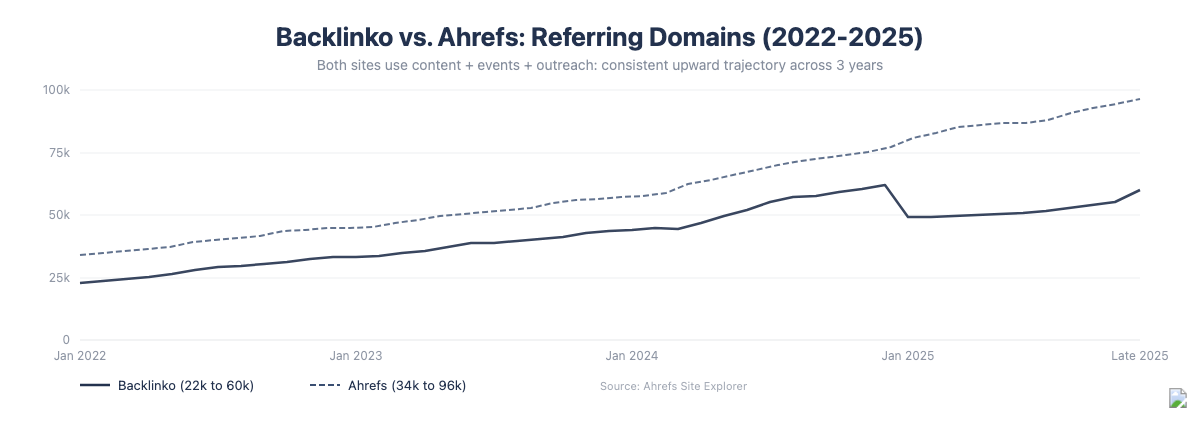
The chart below shows what sustained link building through content and events looks like at scale. Both Backlinko and Ahrefs have used event appearances, sponsorships and conference speaking to supplement their content-driven link profiles over three years.
High-Authority Editorial Links
When you sponsor or speak at an event, your brand gets listed on the event’s official website – usually on a sponsors page or speakers page. These links are editorial: the organizer added them as part of documenting the event, not because you paid for a placement. Conference domains carry strong domain ratings. That’s what makes these placements valuable for your overall authority.
Press Links and Brand Mentions
Press links come from journalists and industry bloggers covering the event who mention sponsors and speakers in their writeup. A well-placed sponsorship or a talk generates brand mentions across multiple publications, and mentions that don’t already carry a link can be converted with a brief follow-up email.
Referral Traffic from Event Listings
Event aggregator platforms – Eventbrite, Meetup – link to your website when you list your event or sponsorship. These aren’t high-DR links. But the referral traffic they send is self-qualifying: people clicking through are already interested in the topic, which overlaps with your target audience.
Local SEO Benefits
Sponsoring or hosting a local event generates links from local event directories, community websites and local news outlets. These links signal geographic relevance to search engines. They’re what Google uses to connect your brand to a specific location. For businesses competing for local search visibility, a steady pattern of local event participation is one of the most natural ways to build locally relevant backlinks.
Relationship-Driven Link Opportunities
Events create in-person relationships. Those lead to links later. Attendees who meet your team may write about the experience. Speakers you share a stage with may reference your talk in future content. Organizers you work with may include your brand in post-event roundups. These links arrive over weeks and months – not just on the day of the event.
Types of Events for Link Building
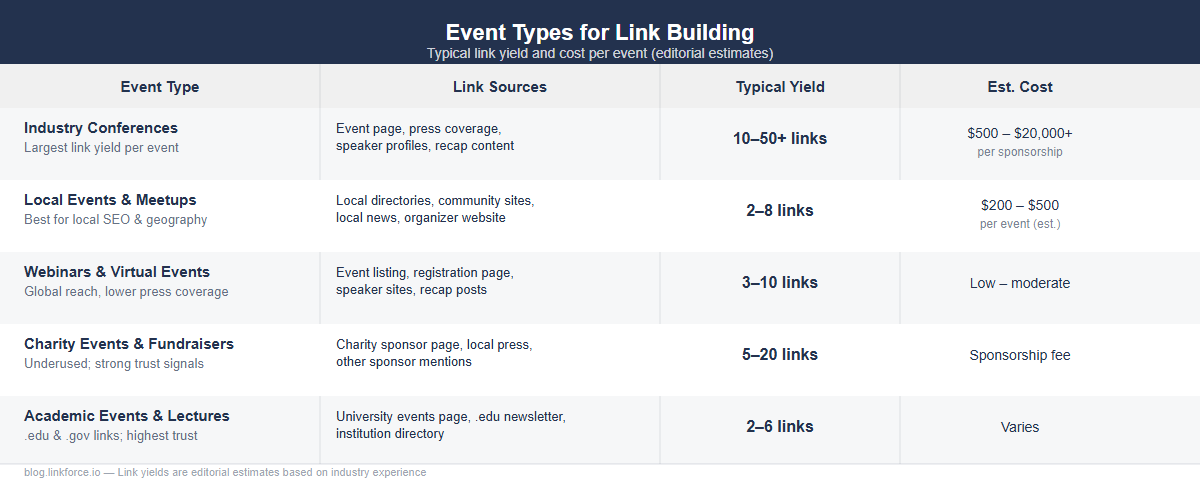
The strongest single-event link yields come from industry conferences, where one sponsorship can generate 10–50+ backlinks from the event page, press and recap content. There are five main event categories – industry conferences, local events, webinars, charity events and academic lectures – each producing links from different source types. That’s why a mix of event types builds a more diverse link profile than any single category alone.
Industry Conferences
Industry conferences are the highest-yield event type for link building. A sponsorship earns you a listing on the official event website (often a high-DR domain), coverage in industry press and mentions in speaker and attendee content afterward. Large conferences with 1,000+ attendees can yield 10–50+ backlinks from a single sponsorship, counting the event page, press coverage and recap content. Smaller niche conferences with 200–500 attendees generate 5–15 links.
The tradeoff is cost. Conference sponsorships range from around $500 for a niche event to $20,000+ for major industry shows. You’ll pay more for a higher-profile conference – but link yield scales with the event’s credibility and reach. They’re benchmark estimates; actual costs vary by industry and event.
For illustration: a mid-sized SaaS company sponsors a 300-attendee industry conference at the $2,000 tier. The event page links to the company from its sponsors page, three speakers mention the sponsorship in recap posts and one industry publication covering the event includes the brand in its roundup. Across the event page, the recap posts and the press mention, that single sponsorship lands inside the 10–50+ link range already covered above – a realistic middle-of-the-range outcome, not the best or worst case.
Local Events and Meetups
Local events are the most accessible entry point for businesses targeting a specific geography. Sponsoring a local meetup on Meetup.com earns a listing on the group’s event page and often a link on the organizer’s website. These links have lower DR than conference links. But they’re geographically relevant, affordable (benchmark estimate: $200–$500 per event) and repeatable. A business that sponsors 12 local events per year builds a steady stream of backlinks from local event directories, community sites and local news outlets. Typical yield: 2–8 links per event.
For businesses with local or regional audiences, local events generate the kind of links Google uses to assign geographic relevance. That’s a signal paid link campaigns can’t replicate as naturally.
To find local events, check community event calendars on Facebook, Nextdoor and local business association websites alongside Meetup and Eventbrite. Many city governments publish official event calendars that accept event submissions – that’s a .gov link for your site. Local chamber of commerce websites list events too; they’re strong for local authority signals. They’re recurring opportunities: businesses that build relationships with local organizers can secure consistent link placements from multiple local events per year without starting from scratch each time.
Webinars and Virtual Events
Virtual events generate links from the event listing page, the registration landing page and post-event recap content. They’re cheaper to run or sponsor than in-person events and can reach a global audience. The link yield is lower than in-person conferences because there’s less press coverage and no local event directory listing. Expect 3–10 links per webinar from event pages, host websites and recap posts. The advantage is reach: a well-run webinar can attract speakers from high-DR domains who may link to the event from their own sites.
Charity Events and Fundraisers
Charity events are underused for link building. Most link builders don’t think of them. A sponsorship earns a listing on the charity’s donor or sponsor page, coverage from local press and sometimes mentions from other sponsors. Charity domain pages tend to have solid trust signals and the links are editorial – they’re not paid placements. Typical yield: 5–20 links per event, with local press links included.
Academic Events and Public Lectures
University conferences, public lectures and academic symposiums generate links from .edu domains – one of the strongest trust signals in link building. Speaking at or sponsoring an academic event can earn you a listing on the institution’s events page or a mention in their newsletter. You’ll spend more time tracking these opportunities down. But the link quality justifies it. Typical yield: 2–6 links, often from .edu or .gov domains.
How to Find Events to Target
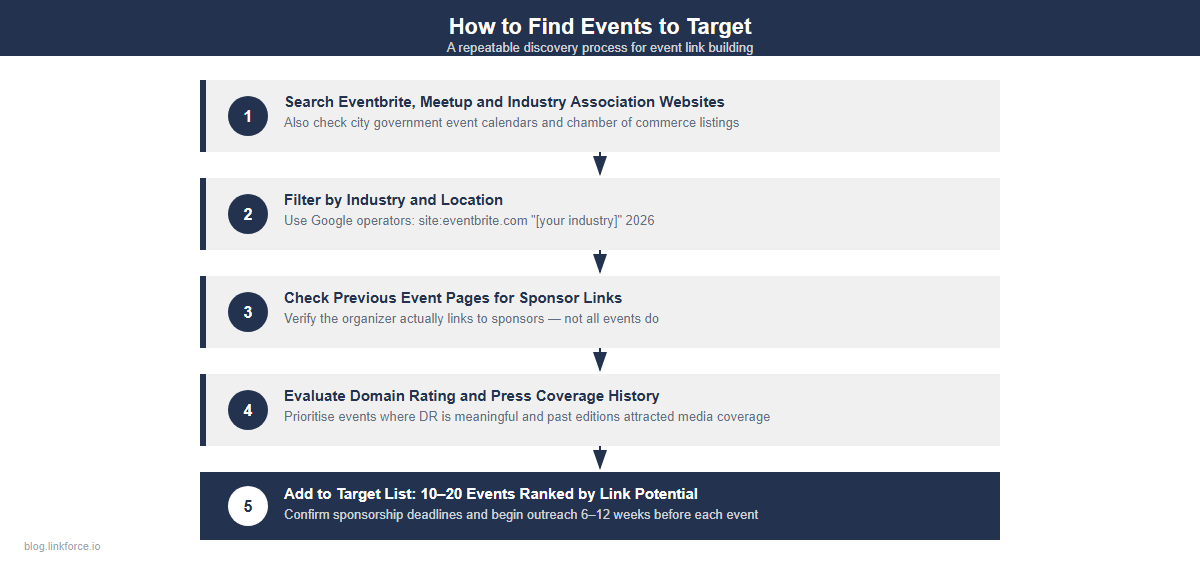
Most relevant events appear on Eventbrite, Meetup.com or industry association websites – covering everything from 50-person niche meetups to 5,000-person trade shows. Start with these platforms. Then narrow down by industry and location using search operators.
Here is what a typical Eventbrite search for marketing conferences in the United States returns – these events are your first prospecting pool for potential sponsorships and speaker opportunities.

The most reliable discovery platforms:
- Eventbrite (eventbrite.com) – broad coverage of conferences, workshops and community events with filterable categories and locations
- Meetup (meetup.com) – best for recurring local meetups and professional groups
- Lanyrd – tech and professional conference aggregator
- Industry association websites – most trade associations publish annual event calendars for their sector
For finding niche-specific events not listed on aggregators, use Google search operators:
site:eventbrite.com "digital marketing conference" 2026"[your industry]" + "conference" + "sponsors" + 2026"[your city]" + "meetup" + "marketing" OR "SaaS" OR "tech"intitle:"event sponsorship" "[your industry]"allinurl:sponsors "[your industry] summit"
When evaluating an event, check: Does the event website link to sponsors? What’s the domain’s DR? Does the event attract media coverage? Is the audience relevant to your business? An event with 500 attendees and solid industry press coverage is worth more than a larger event with no linking organizer.
Event Link Building Strategies
The most effective event link building strategies combine pre-event positioning (sponsorships, speaker slots) with content creation and post-event outreach to convert exposure into editorial links. Here are 13 tactics that work.
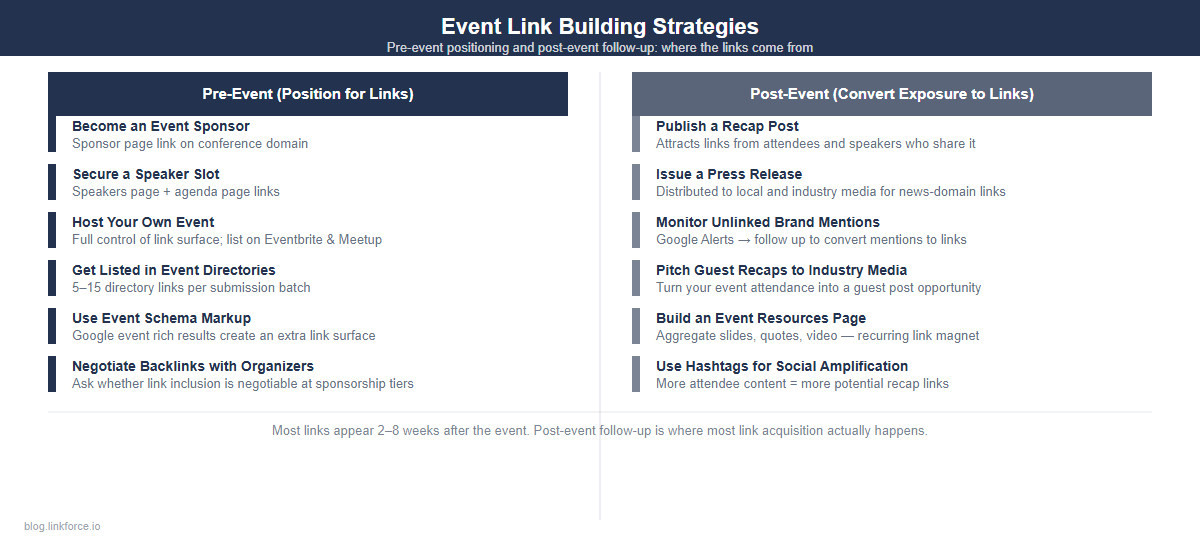
Become an Event Sponsor
Sponsorship is the most direct path to event links. Most conference and meetup organizers publish a sponsors page that links to each sponsor’s website. Before committing, verify the organizer links to sponsors (check their previous event pages) and that the event domain has meaningful DR. Sponsorship tiers vary in link placement – you’ll sometimes earn a link in email newsletters or on the homepage, not just the sponsors page.
Secure a Speaker Slot
Speaker slots earn links from the event’s speakers or agenda page. That page sits on the conference domain – it’s high-authority. Speaking also generates social mentions and often results in recap coverage. You’ll need a concrete topic proposal and a credible speaker profile to pitch a slot. Start with smaller niche conferences where competition is lower. Use those speaking credits to pitch larger events.
Host Your Own Event
Running your own event – a meetup, webinar or workshop – gives you full control over the link surface. Link generation for a self-hosted event runs through three channels: your own event page, third-party directory listings and outreach to speakers or press. The upside is brand ownership; the downside is planning effort.
- Owned page. Create a dedicated event landing page on your domain and update it after the event with a recap, photos and any recorded sessions – other sites are more likely to link to a page that stays useful past the event date.
- Directory listings. List the event on Eventbrite and Meetup, then submit it to local event calendars and industry-specific directories for additional listing links.
- Speaker and press outreach. Pitch your speakers and any media contacts before the event so they have what they need to link to it, then follow up after with a short recap they can reference.
You can repurpose post-event content (video, slides, recap) to generate additional links from each of these three channels for weeks after the event ends.
Get Listed in Event Directories and Calendars
Event directories link to events they list. Submitting your event to relevant local event directories is one of the faster link-building actions you can take. Target local city event calendars, industry-specific event aggregators and niche community sites in your space. Each listing is a link back to your event page or website. A single event can earn 5–15 directory listings with an afternoon of submissions. Volume is the advantage here.
Use Event Schema Markup
Implementing Event schema (schema.org/Event) on your event landing page helps search engines surface the event in Google’s event rich results – the visual event cards that appear for event-related searches. These cards include a link to your page. That creates an additional organic link surface. Event schema requires at minimum: name, startDate, location (or online event URL), description and organizer fields. Adding it takes under an hour and increases the organic visibility of any event you host.
Google’s own case study on Eventbrite is the clearest evidence of what this markup does at scale: after Eventbrite added Event structured data to its listing pages, it saw a 100% increase in typical year-over-year growth of Google Search traffic to those pages, with visible changes in search results appearing within two to three weeks of implementation. Your own event page won’t see Eventbrite’s volume, but the mechanism – more visible listings, more clicks, more chances at a link – works the same way at any scale.
Pitch Guest Posts and Recaps to Event Media
Pitch a guest post summarizing key takeaways from an event you attended or spoke at to the industry blogs and trade publications that cover it. Standard guest blogging outreach applies here, with the event itself as your pitch angle. It’s a legitimate way to earn links from publications you’d otherwise struggle to approach. The pitch angle is simple: “I spoke at [Conference] and wanted to share key insights with your readers.” Publications that cover the event have audience interest already. Your guest post fills a content gap they’d otherwise have to handle themselves.
Build an Event Resources Page
Create a dedicated page on your website that aggregates resources for a major industry event: speaker slides, key quotes, video recordings and reading lists. It’ll attract links from attendees and speakers who want to share resources, and from bloggers covering the event who’d rather link to a compiled resource than multiple individual sources. Update it for each edition of the event to build recurring link value.
Negotiate Backlinks with Organizers
Event organizers sometimes add sponsor links only at higher sponsorship tiers. But they’re often willing to negotiate a link in exchange for a slightly higher fee or additional value – an in-kind sponsorship, a prize for attendees or a speaker slot. Ask the organizer: “Does the sponsorship package include a link on the event website?” If not, ask what it would take to add one. Many organizers will accommodate the request – particularly from sponsors who’ve already proven to be strong partners.
Use Hashtags and Social Amplification
Creating and promoting an event hashtag increases the volume of attendee content generated during and after the event. More social content means more potential for blogger mentions and link-generating recap posts. Promote the hashtag before the event and display it at the venue or in the webinar interface. Aggregate the best hashtag content into a post-event roundup on your blog. Share the roundup on LinkedIn and tag speakers to maximize organic reach.
Issue a Press Release for Significant Events
For events you host or for significant sponsorships, a press release distributed to local and industry media is a legitimate source of links. Many online publications run press releases verbatim. That generates links from news domains. Focus the release on what the event delivers to attendees, not on your sponsorship. A release framed around event value attracts more pickup than one that reads like it’s just a sponsorship announcement.
Monitor for Unlinked Brand Mentions
Set up Google Alerts for your event name, your brand name plus “event” and key speakers’ names. When coverage appears, you’ve got a narrow window to reach out, offer additional information or request a link correction if a brand mention is unlinked. Google Alerts catches coverage that would otherwise go unnoticed. Unlinked mentions are a straightforward conversion opportunity.
Post-Event Content for Ongoing Links
Post-event content is one of the most underused link-building assets. A conference talk can become a blog post, a video or a slide deck on SlideShare. Recap posts on your blog attract links from attendees and speakers who share them. Bloggers covering similar topics embed YouTube recordings from events. The event itself is the content; the link opportunities extend for months afterward.
Host Satellite Events
A satellite event is a smaller, independently organized gathering that runs alongside a major industry conference – in the same city on the same days. These events attract the same audience as the main conference without requiring official sponsorship. They’ve got their own event listings, press mentions and attendee content. The barrier is lower than sponsoring the main conference. Link yield can be comparable for well-organized events.
How to Run an Event Link Building Campaign
Run an event link building campaign in five steps: research and select events, reach out and build relationships with organizers, create content and assets, promote around the event, then follow up after it ends to convert exposure into links.
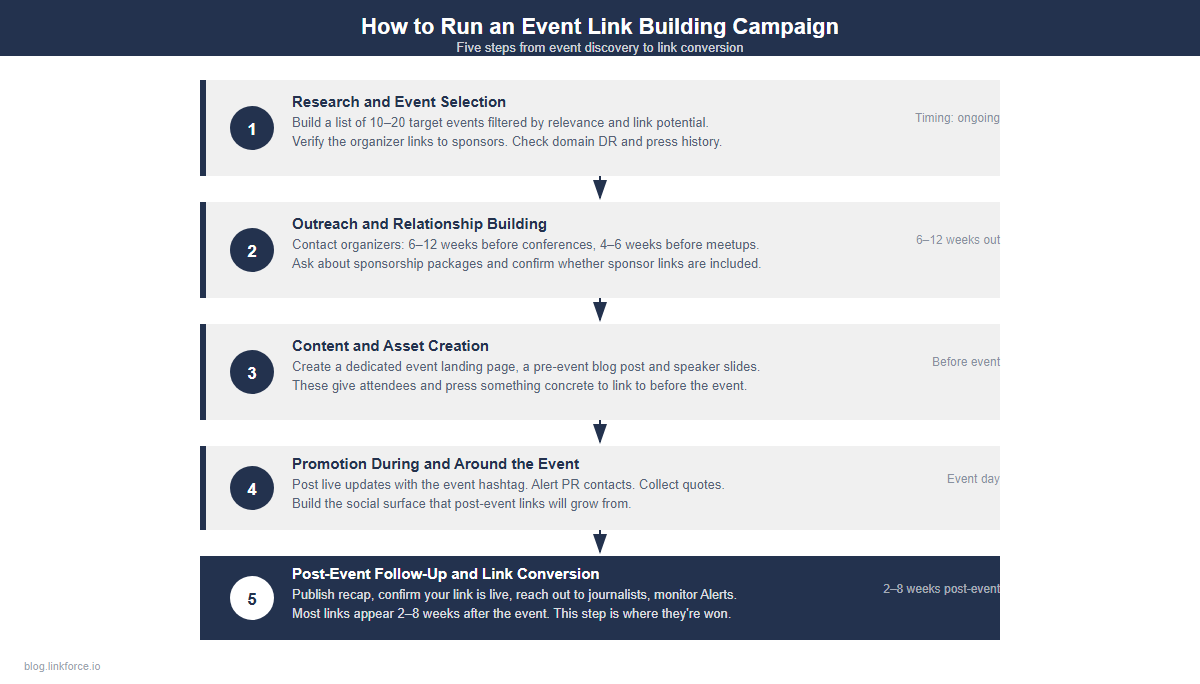
Step 1 – Research and Event Selection
Build a list of 10–20 target events filtered by relevance, link potential and timing. For each event, check whether the organizer links to sponsors and speakers (look at previous event pages), check the domain’s DR, confirm the event dates and sponsorship deadline and estimate the audience size and press coverage history. Prioritize events where the organizer’s confirmed sponsor links and the event has press coverage history.
Step 2 – Outreach and Relationship Building
Contact event organizers 6–12 weeks before the event for conferences, 4–6 weeks for meetups and 2–4 weeks for virtual events. Introduce your company, ask about sponsorship packages, confirm whether sponsor links are included on the event website and ask about speaking opportunities where relevant. Build a relationship, not just a transaction. Organizers who know you’ll mention your brand in event communications and media outreach.
Step 3 – Content and Asset Creation
Before the event, prepare content that’ll attract links during and after: a dedicated event landing page or sponsor profile on your website, a pre-event blog post highlighting what you’re looking forward to, speaker slides if presenting and shareable resources tied to the event’s theme. These assets give attendees and press something concrete to link to.
Step 4 – Promotion During and Around the Event
Post live updates using the event hashtag. Engage with speakers and attendees on social media. Collect quotes for post-event content, alert PR contacts that you’re participating and photograph any on-site presence. The goal’s building the social and media surface that post-event links’ll grow from.
Step 5 – Post-Event Follow-Up and Link Conversion
That’s where most link acquisition happens. Publish a recap post, email organizers to confirm your link is live on the event page, reach out to journalists who covered the event and monitor Google Alerts for brand mentions. Follow up with speakers and attendees who engaged with your content. Most event links appear 2–8 weeks after the event. That’s the follow-up window you’ll want to work. Don’t let it slip.
How to Measure Event Link Building Results
Track four metrics using four tools: new backlinks acquired (Ahrefs or Moz), referring domain changes (Ahrefs), referral traffic from event sources (Google Analytics) and brand mention volume (Google Alerts). Use a consistent link building reporting process to monitor these across campaigns.
| Metric | What to track | Tool | Timing |
|---|---|---|---|
| New backlinks | New links from event pages, press and recap posts | Ahrefs Site Explorer → New Backlinks | Weekly for 8 weeks post-event |
| Referring domains | Net new domains linking to your site | Ahrefs or Moz → Referring Domains | Monthly comparison |
| Referral traffic | Sessions from event pages, Eventbrite listings and recap posts | Google Analytics → Acquisition → Referral | During event period and 30 days after |
| Brand mentions | Online mentions with and without links | Google Alerts, Ahrefs Alerts, Mention.com | Ongoing, weekly review post-event |
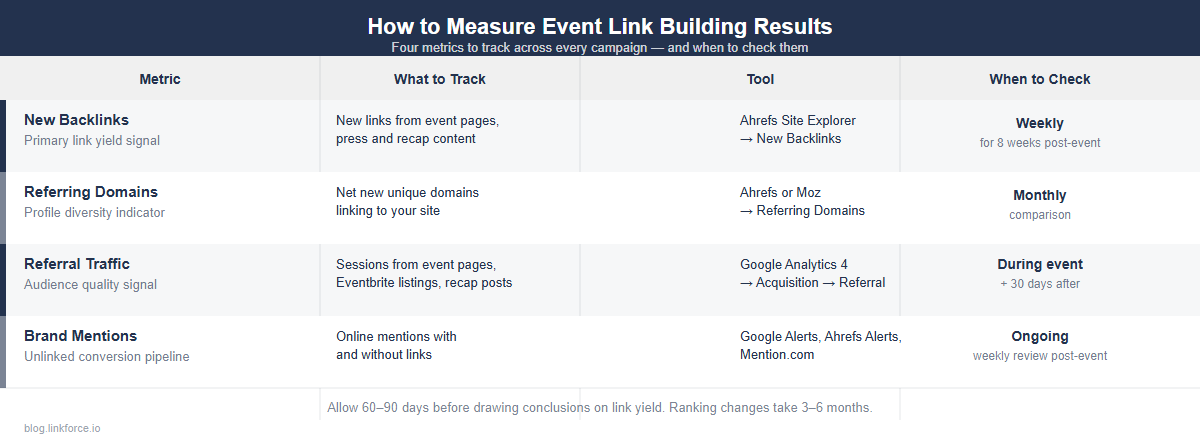
One expectation to set upfront: event links are slow, and the tracking tools are slow too. Ahrefs takes a few days to a few weeks to crawl and register a new backlink. Crawl frequency is weighted toward higher-DR linking domains. A link can be live on the event page well before it shows up in your reports. Press and recap content appears 2–8 weeks after the event ends. Don’t judge a campaign’s success by checking Ahrefs the week of the event. Give it 60–90 days before drawing conclusions on link yield.
For ranking changes, you’re looking at three to six months before event-sourced links produce measurable SERP movement, depending on your current domain strength and the competitiveness of your target keywords.
Common Mistakes to Avoid
The most common event link building mistake is neglecting post-event follow-up. Most links require active outreach to organizers, journalists and attendees after the event ends. They don’t appear on their own.
Targeting events with no link-building potential. Before committing to any event, confirm the organizer links to sponsors and speakers. Some events are well-attended but they’ve got poorly maintained websites with no outbound links. Check previous editions before paying a sponsorship fee.
Skipping pre-event outreach with organizers. Building a relationship before the event gives you a contact who’ll mention your brand proactively. Organizers who know you are more likely to include you in event newsletters, social posts and media pitches.
Neglecting post-event follow-up. Organizers are busy; sponsor links don’t always go live on their own. A follow-up email (“We wanted to confirm our listing is live on the event website”) resolves most omissions. Journalists who’ve covered the event but didn’t mention your sponsorship are easy to reach with a brief factual note. These conversions take 15 minutes and often yield high-DR links.
Ignoring local events. Local events generate locally relevant links – what Google uses to determine geographic relevance for local search. If you serve a local or regional market, local event sponsorships are one of the most efficient tactics available. A link from a local news site or community calendar may have lower DR than a national publication. It’s still valuable for local SEO.
Not using schema markup. If you host events, implementing Event schema on your event pages is a low-effort step that increases organic visibility. Many brands that invest in hosting events skip this entirely. They’re missing the link surface that event rich results create.
Poor event-to-brand relevance fit. A sponsorship link from an event with no connection to your industry is low value and can look manipulative. Prioritize events where the audience and topic overlap with your business. That’s especially important for white-hat link building – link relevance matters as much as domain authority.
Frequently Asked Questions
Is event link building worth it for small businesses?
Yes – when you choose events correctly. Local events and community meetups are well-suited to small budgets. A $200–$500 local event sponsorship that earns 4–8 links from relevant local domains delivers stronger ROI than expensive outreach campaigns. Small businesses with local or regional audiences benefit most from the local SEO effect: links from local event directories, community sites and local press are what Google uses to assign geographic relevance.
How many backlinks can you earn from one event?
The range varies by event size and type. Local meetups generate an estimated 2–8 links per event. Niche conferences with 200–500 attendees yield an estimated 5–15 links across the event page, press coverage and recap content. Large industry conferences with 1,000+ attendees can produce 20–50+ links when counting the main event page, press mentions and attendee recap posts. These are editorial estimates, not guarantees – the actual yield depends on your post-event outreach effort and the organizer’s practice of linking to sponsors.
How long does it take to see SEO results from event links?
Expect 2–8 weeks for links from press coverage and recap posts to appear in Ahrefs or similar tools, and 3–6 months before event-sourced links produce measurable ranking movement on competitive keywords. Event link building compounds over time. You’ll get a clearer picture from a 6-to-12-month pattern across multiple events, not from a single event.
How is event link building different from digital PR?
Event link building earns links through participation: you sponsor, speak at or host an event and links come from the event ecosystem (event pages, directories, press coverage of the event). Digital PR earns links by pitching stories to journalists – there’s no event participation required. The two complement each other. Events generate newsworthy stories – a product launch at a conference, an award at an industry event, record attendance at your hosted webinar – and that’s what digital PR can amplify into additional press links.