

Short answer: your rankings don't move because you added a link to another website. Google has said as much, on the record, in four separate statements dating back to 2015. What actually shifts is softer and slower: a page that cites its sources tends to earn more reader trust, read as more topically complete, and occasionally pick up a link back from the site it cited. This article is built around that gap, naming the exact Google statements and the one real experiment on the subject, instead of repeating the unsourced "do this, avoid that" advice that fills nearly every other page on this query.
What Counts as an Outbound Link (and What Doesn't)
Three link types get confused on this topic, so it helps to separate them before anything else:
- Outbound link: your page → someone else's domain
- Internal link: your page → another page on your own domain
- Inbound link (backlink): someone else's domain → your page
"Outbound" and "external" refer to the same thing: a link that sends a visitor off your domain entirely. Citing a source, pointing to a tool you mention, or linking out to further reading all count. None of that is the same as an internal link (which keeps the visitor on your site) or a backlink (someone else sending a visitor to you). This article answers a narrower question than the definition: whether having outbound links changes how Google ranks the page that contains them.
Do Outbound Links Help SEO? The Direct Answer
No, not on their own. Adding or removing an outbound link does not move your position in Google's results, and that's not an inference, it's what Google's own John Mueller has said repeatedly since 2015. The indirect route is real, though: a well-sourced page reads as more trustworthy and more topically complete to a human visitor, and that in turn can feed signals Google does weigh, like engagement and the backlinks other sites eventually send to content they consider well-cited.
The short version: no direct ranking boost from the links themselves, but real indirect value from what good sourcing does to the page around them.
Paste any domain into the free Domain Rating Checker by LinkForce.
What Has Google Actually Said About Outbound Links?
Most articles on this topic assert a verdict without naming a single source, so here is the actual public record, listed in order.
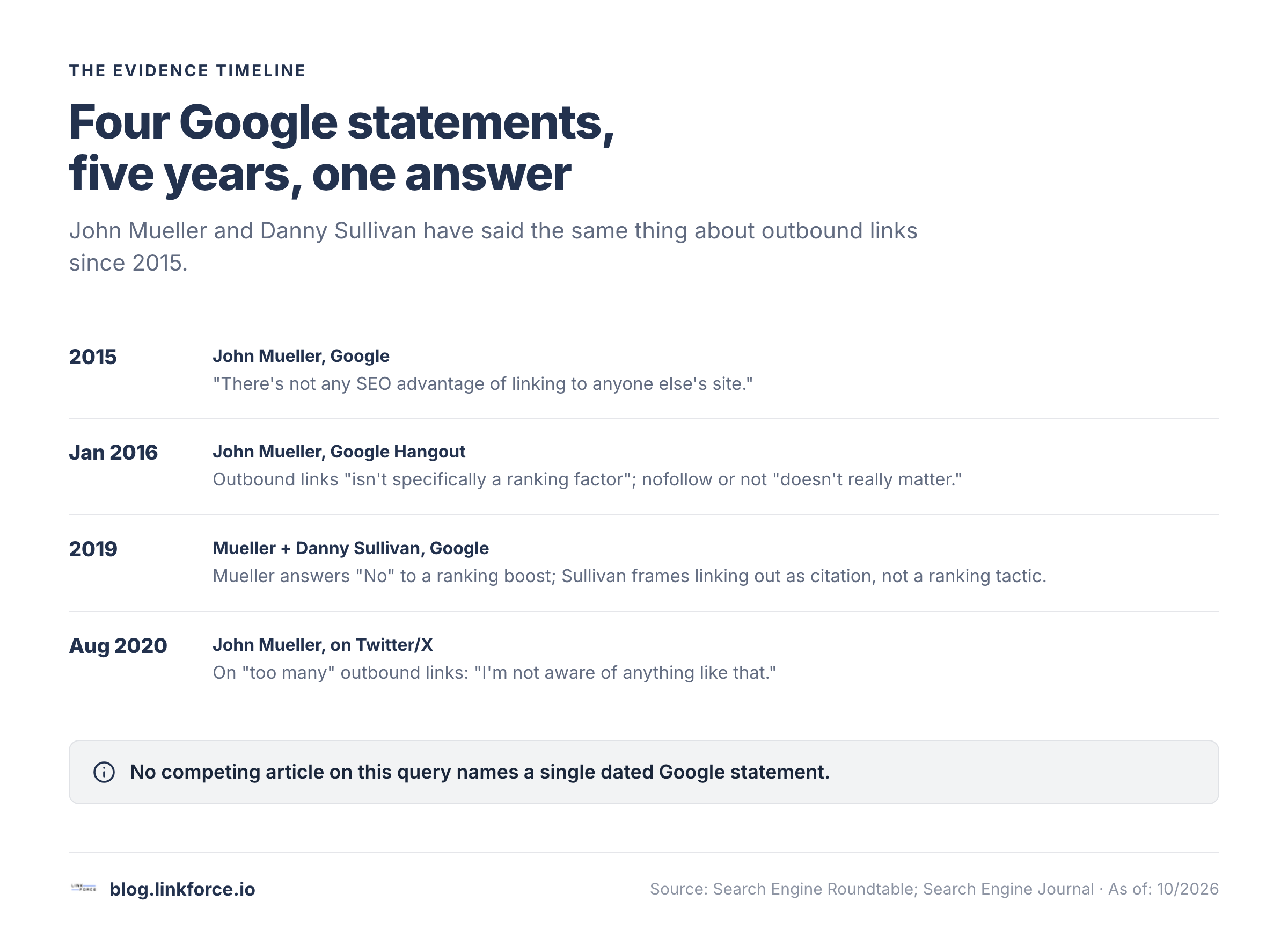
- 2015, John Mueller, Google: Asked directly whether linking out helps a site rank, Mueller said, "We would say there's not any SEO advantage of linking to anyone else's site." (Search Engine Journal)
- January 2016, John Mueller, Google Webmaster Central Hangout: Asked again, Mueller said external links "isn't specifically a ranking factor," adding that they "can bring value to your content, and that in turn can be relevant for us in search." He also said whether an outbound link is nofollowed or not "doesn't really matter." (Search Engine Roundtable)
- 2019, John Mueller, Google: Answered "No" when asked point-blank whether outbound links boost rankings, while separately noting that "linking to other websites is a great way to provide value to your users," a value argument, not a ranking one. Around the same time, Google's Danny Sullivan framed linking out the way a journalist cites a source: good practice for credibility, not a ranking tactic. (Search Engine Journal)
- August 13, 2020, John Mueller, on Twitter/X: Asked whether a page can have too many outbound links, Mueller replied, "I'm not aware of anything like that," adding that when a page with lots of outside links struggles, "usually the problem is more the rest of the site" than the links themselves. (Search Engine Roundtable)
There's also an older piece of advice worth retiring: Matt Cutts' 2009 post on "PageRank sculpting," which suggested Google's systems "encourage links to good sites." That post predates more than a decade of algorithm changes and more recent, more direct statements from Mueller saying the opposite. Citing it today as current guidance is citing outdated advice.
Taken together, four statements across five years, from the same spokesperson, clearly say the same thing: outbound links are not a ranking signal Google weighs directly, and there's no penalty threshold for having "too many" of them either.
Is There Any Study Showing Outbound Links Help Rankings?
One experiment gets cited constantly on this question, and it deserves an honest description rather than the uncritical "proof" framing most competing articles give it.
In 2016, the marketing agency Reboot built ten new websites, all targeting the same keyword, with similar content and tag structures. Five of the sites included links out to very high-authority sources; the other five had no outbound links at all. Reboot tracked rankings for five months. The result: all five sites with outbound links ended up ranking ahead of all five sites without them. Moz's Rand Fishkin reviewed the data before publication and called it "as close to 'proof' as we get in the SEO world." (Search Engine Journal)
That headline result is real, but the experiment has gaps that the people citing it rarely mention:
- Ten sites is a small sample for isolating one variable in a search algorithm with hundreds of signals.
- The test didn't separate the effect of linking to a very high-authority source from linking to a mediocre one.
- It didn't compare followed links against nofollowed links.
- It didn't control for keyword-optimized anchor text, which could be doing some of the work on its own.
So the honest read is: this is the one controlled-ish test that exists, it found a correlation, and it doesn't meet the bar to override four direct statements from the search engine itself about how its own algorithm works. Correlation in a ten-site test isn't the same thing as Google confirming a ranking factor.
Does Linking Out Drain Your PageRank?
Linking out doesn't drain your PageRank. There's no hidden meter where every link out ticks down a stock of "link equity" your page was otherwise hoarding, and PageRank isn't a wallet you empty by spending it on other domains. That tracks with what Mueller said in 2020: he wasn't aware of any mechanism where having many outbound links causes harm by itself. When a heavily-linked-out page underperforms, something else about that page or site is almost always the actual explanation, not the outbound links sitting on it.
When Outbound Links Can Actually Hurt You
"Not a ranking factor" doesn't mean outbound links are risk-free. The risks are genuinely real, they're just not about losing a ranking boost; they're about trust, user experience, and in rare cases, manual review.
- Broken outbound links. A dead link signals neglect to readers and, over time, to you if you're not auditing your own content. Check periodically with a broken-link checker rather than finding out from a frustrated reader.
- Unmarked paid or affiliate links. If a link exists because you were paid to include it, or it's an affiliate link, it needs a
rel="sponsored"orrel="nofollow"attribute. Leaving a paid link as a plain followed link risks a manual action from Google, a real, if narrow, consequence that genuinely exists. - Linking to direct competitors without reason. Sending readers straight to a competing product with no context rarely serves the reader. Citing a competitor's data or comparing features is different and often legitimate.
- Too many links crammed into one page. There's no confirmed cap, per Mueller's 2020 comment, but a page with dozens of outbound links reads as cluttered and makes it harder for readers to follow your own argument. A commonly cited practitioner rule of thumb is to keep it to roughly one to three relevant outbound links per page, useful as a readability guideline, not a ranking rule, since no Google statement ties a specific number to any ranking effect.
How to Use Outbound Links the Right Way (Checklist + FAQ)
A short, practical checklist, grounded in the evidence above rather than generic advice:
- Link to sources that actually back up the specific claim you're making, not just "authoritative-looking" domains in general.
- Use descriptive anchor text ("Google's 2020 statement on outbound links," not "click here").
- Mark paid or affiliate links with
rel="sponsored"orrel="nofollow". - Fix or remove broken outbound links when you find them. LinkForce's own free DR checker works well as part of that audit.
- Open outbound links in a new tab so readers don't lose their place on your page.
- Don't avoid linking out of fear of "losing" ranking value: that fear isn't supported by anything Google has said.
Do outbound links directly improve rankings?
No, and that's a repeated Google statement, not a guess: 2015 through 2020, same answer each time. Whatever benefit exists runs through trust and relevance, not through the link itself.
Should outbound links be dofollow or nofollow?
Per Mueller's 2016 comment, it "doesn't really matter" for ranking purposes either way. Use nofollow for paid or untrusted links as a disclosure practice, not because follow links cost you rankings.
Is there a maximum number of outbound links per page?
Not according to Google. Mueller said in 2020 he wasn't aware of any such limit. Keep the count reasonable for readability, not to dodge a penalty that hasn't been confirmed to exist.
Can linking to a competitor hurt my SEO?
Not in a ranking-factor sense. It can send a reader away from your page, which is a business consideration, not an algorithmic one.
Does this still matter if AI search is changing how people find content?
Yes. If anything, well-sourced, verifiable claims matter even more as AI-generated answers get checked against named sources, even though the underlying mechanism (no direct ranking credit for the links themselves) hasn't changed. For the backlink side of this question, see our guide on how link building helps SEO.

800+ SaaS marketers swap partner, integration and content links on LinkForce.