
A backlink is a hyperlink on someone else's website that points to a page on yours. Search engines treat it as a small vote of trust, and the more relevant and authoritative the linking page, the more that vote tends to count. Definitions only go so far, though. The fastest way to understand what separates a strong backlink from a weak one is to look at real examples side by side.
Below are 10 real, currently traceable backlinks pointing to a single well-known SEO tool site, pulled straight from a live backlink index rather than invented for this article. Each one is annotated with its anchor text, its dofollow or nofollow status, the referring domain's authority score at the time of writing, and the specific reason it counts as a useful example.
Key Takeaways
- A backlink example is only useful if you can see the actual anchor text, the dofollow or nofollow status, and the referring domain together, not just the idea of a link.
- Nofollow links (Wikipedia, Zapier, Shopify in the examples below) can still carry real authority and referral value even though they pass no direct ranking signal.
- Deep links to a specific page, like Zapier linking straight to a feature page instead of a homepage, tend to carry more relevance signal than a generic homepage mention.
- Anchor text varies widely in practice: exact feature names, full sentence descriptions, a bare brand name, and sometimes no visible text at all.
- Backlinks still function as both a ranking signal for search engines and a citation signal for AI answer engines going into 2026.
What Makes a Backlink Example Worth Studying?
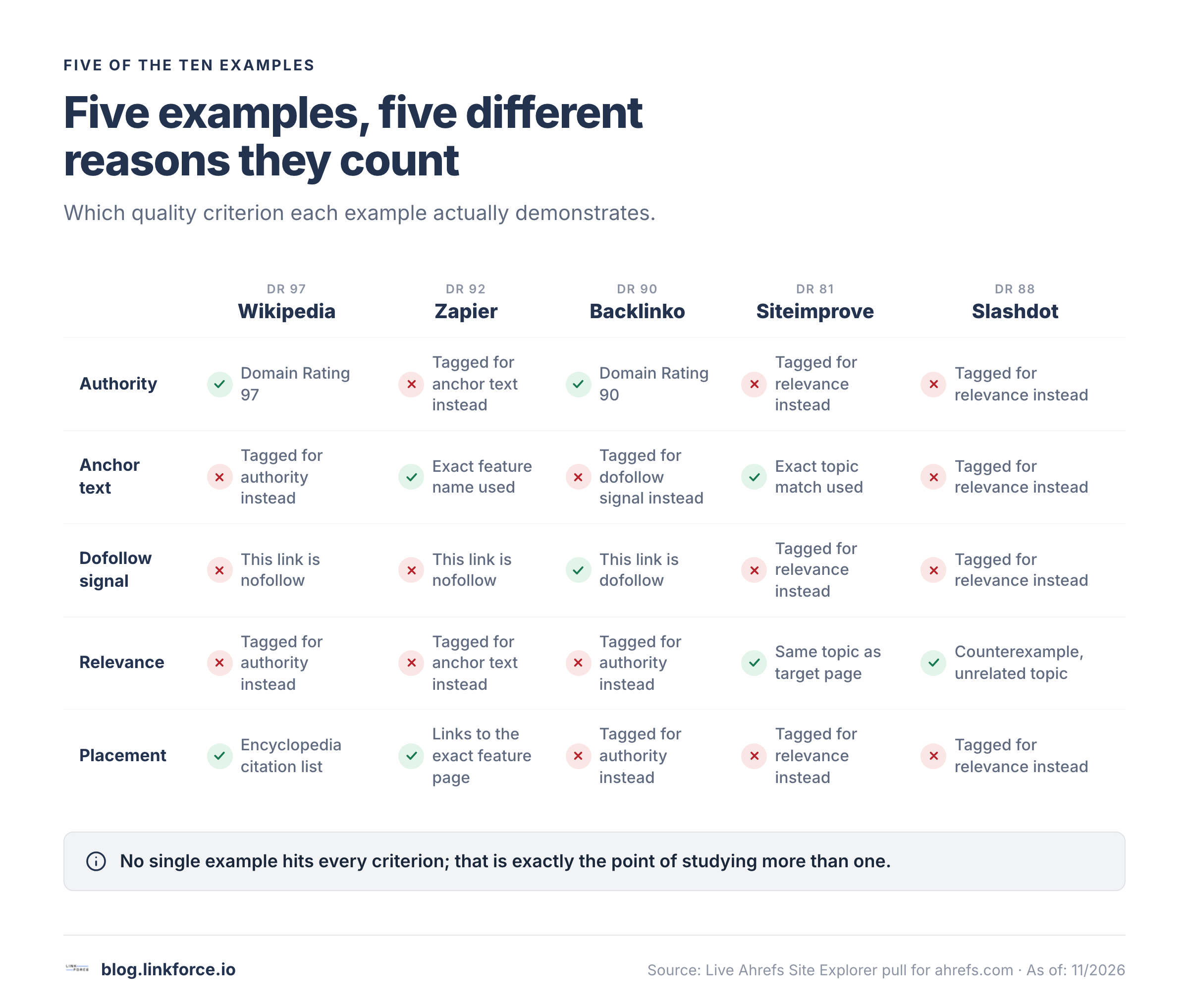
Not every backlink teaches you something. A worthwhile example shows several of these at once, so you can judge the link the way a search engine (or a competitor's SEO team) actually would:
- Relevance. Does the linking page actually talk about something connected to the target page, or is the link just dropped in with no context?
- Authority. How strong is the referring domain's own backlink profile, usually summarized as a Domain Rating or similar score?
- Anchor text. What words are clickable? Exact-match, descriptive, branded, and anchor-free links all behave differently.
- Placement. Is the link buried in a footer or sidebar, or sitting inside the main body content a visitor actually reads?
- Dofollow or nofollow. Does the link pass ranking signal directly, or does it rely on referral traffic and visibility instead?
Every example below is tagged against one or more of these five criteria. None of the 10 examples below are paid placements; every one is a naturally occurring, free mention, which also makes them free backlink examples you can open and study yourself.
Paste any domain into the free Domain Rating Checker by LinkForce.
10 Real Backlink Examples (and What Each One Teaches You)
All 10 links were pulled from a live backlink index for ahrefs.com, a widely linked-to SEO tool site, so every URL, anchor and status below is checkable rather than hypothetical.
| No. | Linking site | Anchor text | Status | Domain Rating |
|---|---|---|---|---|
| 1 | Wikipedia | SXO Explained: How to Adapt to the New Era of Search | nofollow | 97 |
| 2 | Zapier | Free Keyword Generator | nofollow | 92 |
| 3 | Backlinko | Ahrefs | dofollow | 90 |
| 4 | Wix | Ahrefs | dofollow | 95 |
| 5 | Coursera | (empty) | dofollow | 91 |
| 6 | Shopify | Some advertisers | nofollow | 97 |
| 7 | Siteimprove | SEO metrics | dofollow | 81 |
| 8 | Fractl | Ahrefs' free Backlink Checker page | dofollow | 73 |
| 9 | Morningscore | Brand Radar | dofollow | 71 |
| 10 | Slashdot | AhrefsBot | dofollow | 88 |
The ten linking sites listed here, from Wikipedia to Slashdot, answer the common question of which websites are worth studying for backlinks: their Domain Ratings run from 71 to 97 and average 87.5. Most of them cannot be asked for a link. They link only when a page gives them a specific reason to, which is what each walkthrough below shows.
1. Wikipedia's citation-style reference link
Wikipedia's "Search engine optimization" article cites an Ahrefs blog post as a source, using the full article title in quotation marks as the anchor text: "SXO Explained: How to Adapt to the New Era of Search." The link was added in mid-2025, is nofollow (every external link on Wikipedia is by policy), and the referring domain carries a Domain Rating of 97.
Why it counts: authority and placement. A citation inside an encyclopedia reference list is about as high-trust a placement as exists on the web, and it proves a link's value is not limited to its dofollow status.
2. Zapier's exact feature-page link
In a roundup of free keyword research tools, Zapier's blog links the phrase "Free Keyword Generator" directly to Ahrefs' keyword generator tool page, not its homepage. The link is nofollow, and the referring domain's Domain Rating is 92.
Why it counts: anchor text and placement. Pointing the exact feature name at the exact feature page is a precision pattern that tells both readers and crawlers exactly what is being recommended.
3. Backlinko's dofollow listicle mention
Backlinko, itself a well-known SEO publisher, names Ahrefs in its "Best SEO Tools" roundup with a simple branded anchor, "Ahrefs," pointing to the homepage. Unlike the two examples above, this link is dofollow. The referring domain carries a Domain Rating of 90.
Why it counts: authority and dofollow signal. An editorial, unpaid dofollow mention from a top publisher in the same niche is close to the gold standard of a backlink, which is exactly why it is harder to earn than the nofollow examples above.
4. Wix's topically adjacent dofollow link
Wix's "How to Start a Blog" guide mentions "Ahrefs" by brand name with a dofollow link to the homepage. Its Domain Rating sits at 95, and the topic (starting a blog) is adjacent to Ahrefs' core subject (SEO tools) rather than identical to it.
Why it counts: relevance and authority. The link works because the topics are close enough to make sense to a reader, even without being a word-for-word match, and the referring domain's authority carries real weight.
5. Coursera's link with no visible anchor text
Coursera's "What Is SEO Marketing?" article links to Ahrefs' homepage as part of a tool list, but in this instance the anchor text is empty. It still passes ranking signal, since the link is dofollow, on a referring domain with a Domain Rating of 91.
Why it counts: placement, with a lesson about anchor text. A link does not need visible anchor text to exist or to pass signal, but a missing or empty anchor gives search engines and readers far less context than a descriptive one would.
6. Shopify's in-content data citation
In an article about using Quora for marketing, Shopify's blog links the phrase "Some advertisers" to an Ahrefs blog post, using the link to back up a specific claim drawn from Ahrefs' own research. Shopify's own Domain Rating of 97 makes this a high-authority citation, even though the link itself is nofollow.
Why it counts: relevance and authority. This is the "cited as a source" pattern: the link exists because the content made a specific, checkable claim and pointed to where that claim came from, not because of a generic tool mention.
7. Siteimprove's exact-topic contextual link
Siteimprove's content-strategy guide links the phrase "SEO metrics" directly into a sentence about tracking the right numbers, pointing to an Ahrefs blog post on the same subject. Siteimprove carries a Domain Rating of 81, and the link passes ranking signal as a dofollow.
Why it counts: relevance and anchor text. This is as close to a textbook in-content link as it gets: the anchor text matches the subject of both the sentence and the destination page.
8. Fractl's full-sentence descriptive anchor
Fractl's tutorial on using Ahrefs' backlink checker links the full phrase "Ahrefs' free Backlink Checker page" rather than a short keyword or brand name. At a Domain Rating of 73, Fractl's dofollow link still carries real weight.
Why it counts: placement and anchor text. The link sits inside a step-by-step walkthrough that actually uses the linked tool, so the anchor text can afford to be a full description instead of a short keyword.
9. Morningscore's deep link from a competitor review
Morningscore, a competing SEO platform with a Domain Rating of 71, published an in-depth personal review of SEO tools that links several specific Ahrefs feature pages, not just the homepage, including a dofollow link with the anchor text "Brand Radar" pointing straight to that feature's own page.
Why it counts: placement and relevance. Deep links to specific feature pages, from a site that competes directly in the same space, show a level of genuine product familiarity that a generic homepage mention does not.
10. Slashdot's link from outside the SEO topic entirely
Slashdot, a long-running technology news site with a Domain Rating of 88, links the term "AhrefsBot" to Ahrefs' crawler documentation page in a dofollow link, in a discussion about web crawlers that has nothing to do with marketing or SEO content.
Why it counts: relevance, as a counterexample. Not every useful backlink comes from a topically matched marketing article. A technical reference link from a completely different subject area can still be dofollow, high-authority, and genuinely earned.
Dofollow vs. Nofollow: Why Both Examples Above Still Matter
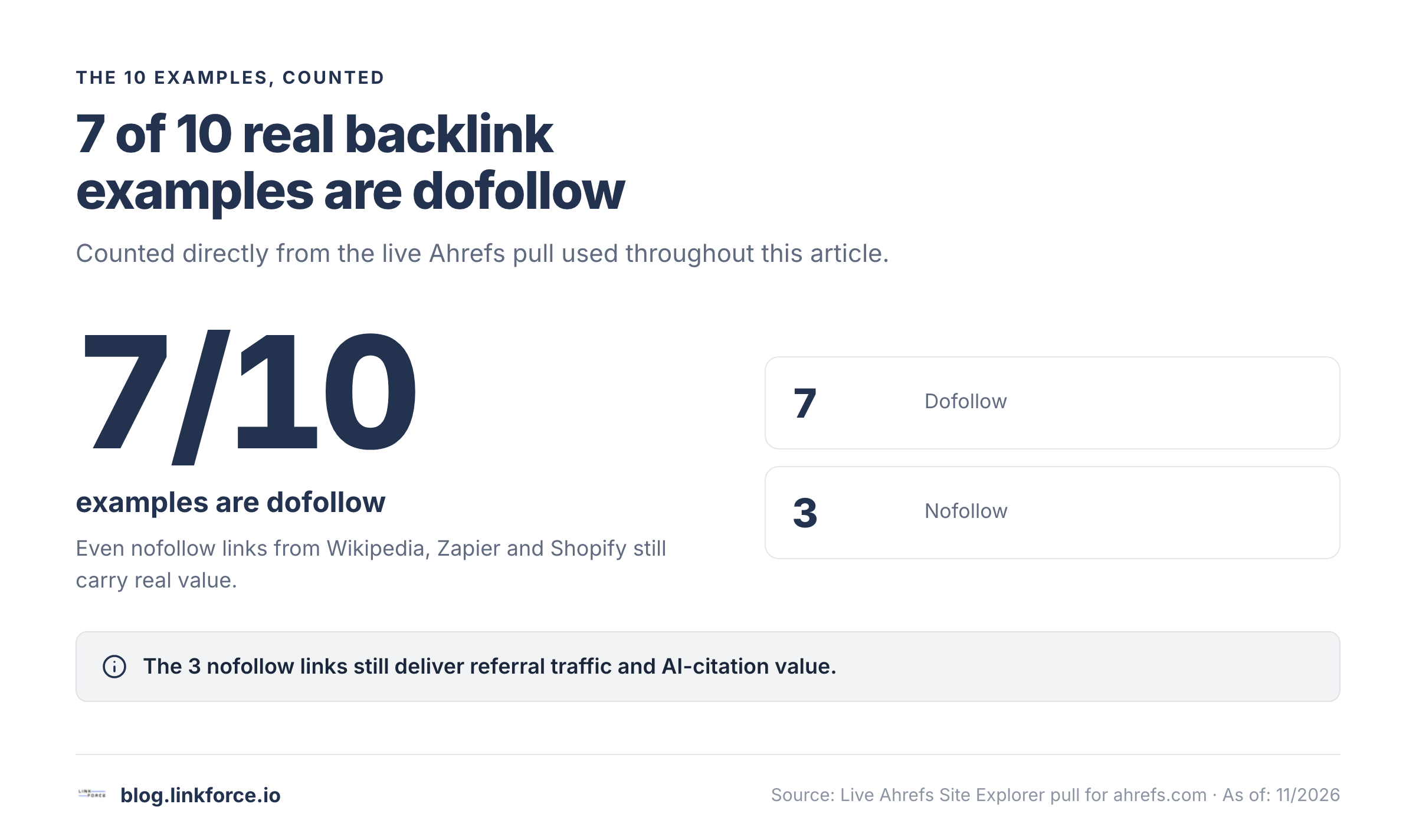
A dofollow link passes ranking signal to the page it points to. A nofollow link does not, by default, though search engines can still choose to factor it in as a hint. Among the 10 examples above, 7 are dofollow (Backlinko, Wix, Coursera, Siteimprove, Fractl, Morningscore, Slashdot) and 3 are nofollow (Wikipedia, Zapier, Shopify).
The nofollow examples are not wasted links. Wikipedia's citation sends authority by association and real referral traffic from one of the most visited sites on the web. Zapier's and Shopify's nofollow mentions still put a brand in front of a large, relevant audience and can be cited by AI answer engines regardless of the nofollow attribute. Ranking signal is only one of the things a backlink can deliver.
Dofollow versus nofollow value in these examples: the three nofollow links come from referring domains with an average Domain Rating of 95.3 (97, 92 and 97), while the seven dofollow links average 84.1 (from 71 to 95). A dofollow link from a weaker domain and a nofollow link from a very strong one therefore deliver different things, direct ranking signal in the first case and authority, traffic and citation visibility in the second. Neither is automatically better, and a healthy link profile contains both.
How Do You Check Whether a Backlink Is Dofollow or Nofollow?
You can check any single link in about a minute with these steps:
- Open the page that contains the link and view its source (Ctrl+U on Windows, Cmd+Option+U on a Mac in Chrome).
- Search the source for the domain of the page being linked to.
- Read the
relattribute on that link. If it containsnofollow,sponsoredorugc, the link is not a standard dofollow link. If there is norelattribute with those values, it is dofollow. - To check many links at once, run the target domain through a backlink checker, which lists the status of each link in a column.
What Are the Three Main Types of Backlinks?
The three main types of backlinks are natural editorial links, manually built links and self-created links. Natural editorial links are given by a site without being asked, because the content deserved a reference. Manually built links come from deliberate outreach, such as guest posts, resource page submissions or partnerships. Self-created links are placed by the site owner, for example in forum signatures, profiles or blog comments, and they carry the least trust. All 10 examples in this article are natural editorial links, which is why each one has a specific, visible reason for existing.
A backlink example and a backlink type answer different questions: the type tells you how a link came about, while the example shows you its anchor, status and referring domain in one real case.
Are Backlinks Still Relevant in 2026?
Yes, as of November 2026, as long as the links are relevant and earned rather than bought in bulk. Search engines continue to use backlinks as both a ranking signal and a way to discover new content through crawling, and AI answer engines draw on the same linked, citable web to decide which sources to reference. The format of the proof has broadened, since a link can now earn visibility through an AI citation as well as a search ranking, but the underlying mechanism, one site vouching for another through a link, has not gone away.
Finding and Earning Examples Like These
Every example above exists because the linking page had a specific reason to reference the destination: a tool it mentioned by name, a claim it wanted to back up, or a feature it was reviewing in detail. The fastest way to earn a comparable link is to be the obvious, checkable source for a specific claim, tool or data point, not to ask for a general mention. In practice, that usually means one of a few concrete routes: getting cited in an editorial article the way Wikipedia and Shopify cite sources, getting listed on a resource or tool page the way Coursera and Zapier do, publishing something a journalist can quote, or writing a guest contribution for a relevant publication. Checking your own backlink profile with a free Domain Rating checker or a backlink tool such as Ahrefs or Semrush, and running a proper backlink audit, are good first steps before reaching out for new links through structured link building services.
How Do You Get a Backlink Like These Examples?
- Pick one page on your site that makes a specific, checkable claim or offers a distinct tool, data set or guide.
- Find pages that already discuss that exact topic and could reference it, for instance roundups, tutorials and resource lists.
- Contact the author with a short note that says what your page adds to theirs, and link to the exact page rather than your homepage.
- Suggest a descriptive anchor that matches the sentence, and accept a branded one if that is what the editor prefers.
- Check the result in a backlink tool after a few weeks to confirm the link is live and note its dofollow or nofollow status.
Frequently Asked Questions
What is an example of a good backlink?
A good backlink example shows a relevant, in-context link from an authoritative page, using clear anchor text, as seen in the Siteimprove and Fractl examples above, where the link sits naturally inside content about the exact same topic.
Do nofollow backlinks still count as examples of good links?
Yes. A nofollow link from a high-authority, relevant page, like the Wikipedia citation above, can still bring real referral traffic, brand visibility and AI-citation value even without passing direct ranking signal.
What is the difference between a backlink example and a backlink type?
A backlink type describes a category, such as editorial, guest post, or directory link. A backlink example is one specific, real instance of a link, with its own actual anchor text, source page and status, like each of the 10 cases described above.
How many backlinks does a page need before it starts ranking?
There is no fixed number. A single highly relevant, authoritative link, like the Siteimprove or Backlinko examples above, can outweigh dozens of weak or unrelated ones. Judge your link profile by relevance and authority per link, not by the total count.
What anchor text should a good backlink use?
A good backlink uses an anchor that describes the destination page in natural words, such as "SEO metrics" or "Free Keyword Generator" in the examples above. Two of the 10 examples use a plain brand name, one has no anchor at all and seven use a descriptive phrase, feature name or term. The limit is that no anchor fixes an irrelevant link: a perfectly worded anchor on an unrelated page still counts for little, and repeating the same exact-match phrase across many links looks manufactured.
Where can I find free backlink examples to study?
The 10 links in this article are free to open and inspect, since each comes with its source page. To find more, enter any well-known domain into a free backlink checker and open the linking pages it lists, then compare their anchor text, dofollow status and the authority of the referring domain.
What is a nofollow backlink example?
Wikipedia's citation of an Ahrefs blog post is a nofollow backlink example: the link sits in a reference list on a page with a Domain Rating of 97, but carries a nofollow attribute by policy. Zapier's link to the Free Keyword Generator and Shopify's citation are two more.
What is a dofollow backlink example?
Backlinko's mention of Ahrefs in its Best SEO Tools roundup is a dofollow backlink example. It uses the plain brand name as anchor text and passes ranking signal from a referring domain with a Domain Rating of 90.
800+ SaaS marketers swap partner, integration and content links on LinkForce.