
A backlink gap analysis compares your referring domains against one or more competitors to find the links they've earned that you haven't. Those domains already link to similar content, which makes them warmer outreach targets than a cold list you'd have to build from scratch. This guide walks through the full method with any backlink tool, free or paid, what to skip, and where the data itself falls short.
What Is a Backlink Gap Analysis?
A backlink gap analysis is the process of finding links that point to your competitors but not to your site. You add your domain and one or more competitors to a backlink tool, and it returns the referring domains that show up for them and not for you.
The value isn't the list itself.
It's what the list tells you: a site that already links to two or three competitors covering the same topic is a site that's open to linking to content like yours, which is a much better starting point than guessing at outreach targets cold.
Do
- Favor competitors in a similar size range, plus one clearly stronger one
- Filter by authority, traffic, and link type before reviewing by hand
- Prioritize domains that link to 2 or more of your competitors
- Treat backlink data as a sample, not a complete record
Don't
- Chase paid placements, partner/parent-company links, or pure directories
- Treat a tool's authority threshold as a universal rule rather than an example
- Assume a missing link in the report means it doesn't exist
How to Do a Backlink Gap Analysis (Step by Step)
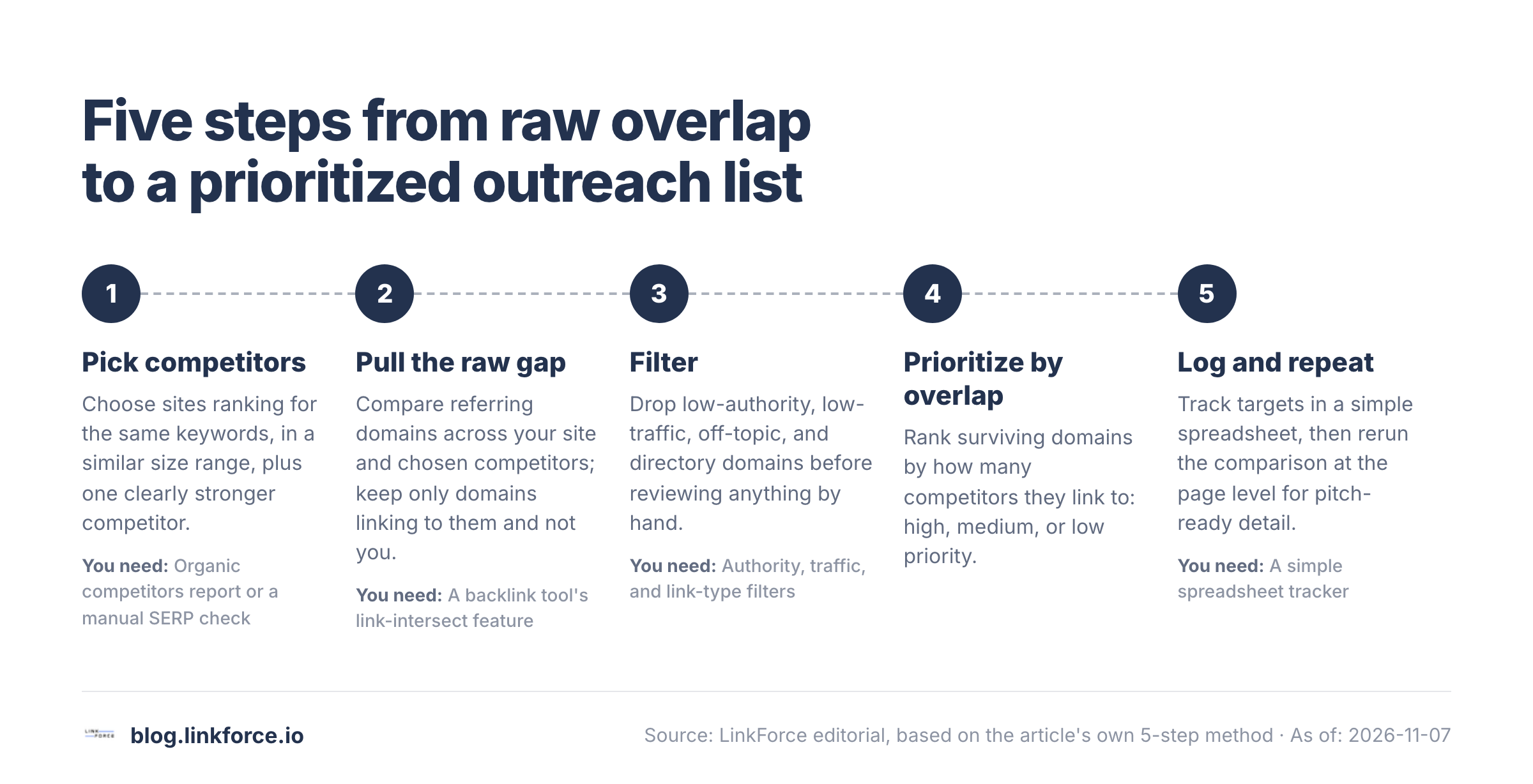
The method is the same regardless of which tool you use: pick competitors, pull the raw overlap, filter out the links you can't realistically win, prioritize what's left, then log it and repeat at the page level.
Step 1: Pick Competitors Worth Comparing Against
Start with sites ranking for the same keywords you're targeting, not just any company you consider a rival. A tool's "organic competitors" report (or a quick manual SERP check) will usually surface these faster than a guess. Favor competitors in a similar size range to your own site, with one exception worth making on purpose: including one clearly stronger competitor. A market leader's backlinks often came with a budget, a press relationship, or years of brand recognition you don't have yet, but the gap report will still surface individual domains from their profile that are realistically reachable even if you can't replicate their whole strategy.
Step 2: Pull the Raw Backlink Gap
Add your site and your chosen competitors to the tool's comparison or "link intersect" feature, pointed at referring domains. The tool pulls backlinks for every site in the comparison, removes duplicates, and keeps only the domains that link to at least one competitor and not to you.
Most tools support comparing against one or two competitors on a free plan, and five or more on paid tiers. Start with two competitors even on a paid plan. A wider comparison just means more noise to filter in the next step, not necessarily better targets.
Step 3: Filter Out Low-Quality and Unrealistic Links
The raw export always needs a pass before it's useful. Three filters do most of the work:
- Authority. Drop domains below a minimum authority score. Ahrefs' own guide to this method uses a Domain Rating of 50+ as a working example threshold, which is a reasonable starting point, though the exact cutoff depends on the tool and your niche rather than being a universal rule.
- Traffic. Drop domains with little to no organic traffic. A high-authority domain that gets no real visitors is rarely worth the outreach effort.
- Link type. Drop dofollow-only if that's what you need, and exclude pure link directories, scraper sites, and anything clearly off-topic for your industry.
Open the domains that survive these filters and check them manually.
A domain can pass every automated filter and still turn out to be a content farm or a site that's gone dormant since it earned its authority score.
Step 4: Prioritize by Competitor Overlap
Not every surviving domain deserves the same priority. The simplest, most reliable rule is counting how many of your competitors a domain links to:
- High priority. The domain links to all, or nearly all, of your competitors.
- Medium priority. The domain links to two or more of your competitors.
- Low priority. The domain links to only one competitor.
A domain that links to every competitor you're tracking is clearly open to linking to content in your space, which makes it worth reaching out to first. Keep this rule consistent as you work through the list. It's easy to drift into judging each domain on vibes once you're twenty rows into a spreadsheet, and that's exactly when the prioritization stops being useful.
Step 5: Log Targets and Repeat at the Page Level
Record each surviving domain in a simple tracker with its authority score, traffic estimate, priority tier, and a status column (something like "to research," "outreach sent," "link live"). You don't need specialized software for this. A spreadsheet with six columns does the job.
Once you've worked through the domain-level gap, switch the same comparison to referring pages instead of referring domains and run it again. A domain-level view tells you who's worth contacting. A page-level view tells you which specific page to pitch and what anchor text or angle already worked for a competitor, which is often the faster path to an actual placement.
Paste any domain into the free Domain Rating Checker by LinkForce.
Which Backlink Gaps Are Not Worth Chasing?
Not every gap in the list is realistically winnable, and treating all of them the same way wastes outreach time on links you were never going to earn. Google's own spam policies describe link spam as "creating links to or from a site primarily for the purpose of manipulating search rankings," and several categories that show up constantly in gap reports fall close to that line or simply aren't available through normal outreach:
- Paid placements and sponsored content. If a competitor's link came from a payment, you'd need to pay too, and Google requires any paid link that passes ranking credit to carry a
rel="nofollow"orrel="sponsored"attribute. Chasing it as a free, organic link usually isn't realistic. - Partner or parent-company links. A link from a sister brand, an investor's site, or a corporate parent reflects a business relationship, not editorial merit. There's no outreach angle that replicates that.
- Pure link directories. Low-effort directory listings add little value even when they're technically earnable, and a large batch of them is one of the patterns Google's spam policies call out directly.
- Required links in a contract or partnership. A link required by a Terms of Service, an affiliate agreement, or a similar arrangement isn't something a cold outreach email can recreate.
Cross these categories off as you review the filtered list, rather than discovering one at a time mid-outreach. It keeps the list honest about how many realistic targets are actually left.
What a Backlink Gap Tool Can (and Can't) Show You
Backlink data is a sample of the web, not a complete record of it. Coverage tends to be strong for established, higher-authority sites that have been crawled repeatedly over time, and noticeably weaker for brand-new pages or very low-authority sites that haven't been indexed as thoroughly. That means a backlink gap report will sometimes miss a real link, and it will sometimes show a link that's already gone, because a crawler simply hasn't revisited that page yet. Treat the list as a strong starting point for prioritization, not as a guaranteed, complete inventory of every link your competitors hold.
Free vs. Paid Backlink Gap Tools: Which Fits Your Situation
The right tool depends mostly on how many competitors you need to compare at once and how often you'll run the analysis.
| Free tools | Paid platforms | |
|---|---|---|
| Competitors per comparison | Usually 1-2 | Usually up to 5 or more |
| Update frequency | Daily limits or capped exports | Larger, more frequently refreshed index |
| Best fit | Occasional checks, one or two close competitors | Ongoing outreach programs, agencies, multiple client sites |
If you're running this analysis once a quarter against a single competitor, a free gap tool plus a free Domain Rating checker to vet the surviving domains covers the job without a subscription. Once you're tracking several competitors across multiple pages on a recurring basis, the larger index and higher comparison limits on a paid platform start paying for themselves in time saved filtering noise. For a closer look at which backlink tools fit which budget, see our backlink checker tool comparison.
800+ SaaS marketers swap partner, integration and content links on LinkForce.
FAQ
What is a backlink gap analysis?
It's the process of comparing your site's backlinks against one or more competitors to find referring domains that link to them but not to you. The result is a prioritized list of realistic outreach targets, not an automatic fix for your link profile.
Is this different from general backlink analysis?
Yes. A general backlink analysis looks at your own link profile in isolation: who links to you, how strong those links are, whether any look toxic. A gap analysis is specifically comparative. It only exists in relation to one or more competitors you've chosen to measure against.
Are backlinks still worth the effort in 2026?
Yes. Backlinks remain one of the clearer, more durable authority signals available. A competitor-based gap analysis is still one of the most efficient ways to find realistic targets, since every domain on the list has already shown it's willing to link to content in your space.
What's an example of a backlink gap?
Say three sites rank above you for your target keyword, and one specific industry blog links to all three of them but not to you. That blog is a textbook high-priority gap: it's already linking to your direct competitors on the same topic, so it's a realistic, well-targeted outreach candidate rather than a cold guess.