

What Is a Link Building Marketplace?
A link building marketplace is an online platform that connects businesses seeking backlinks with publishers offering guest posts, niche edits, and editorial placements. Buyers browse a verified publisher database, filter by domain rating, organic traffic, and niche, review pricing before committing, and place an order. The platform confirms when the backlink goes live. In 2026, the leading marketplaces cover publisher databases ranging from 38,000 to 120,000+ verified sites across dozens of niches and languages.
Think of it as a catalogue for backlinks. Publishers list their sites with pricing, niche categories, and domain metrics. Buyers filter by the criteria that matter to them, select the sites that fit, and submit an order. The platform handles communication with the publisher and confirms when the link goes live.
This differs from a link building agency, which manages the strategy and outreach on your behalf, and from DIY outreach, where you identify and contact publishers directly. A marketplace sits in the middle: it gives you control over which sites you choose while removing the prospecting and negotiation work.
Link building marketplaces are used by in-house SEO teams looking to scale placements efficiently, agencies managing link programs for multiple clients, and operators and affiliates who want targeted placements in specific niches.
How a Link Building Marketplace Works
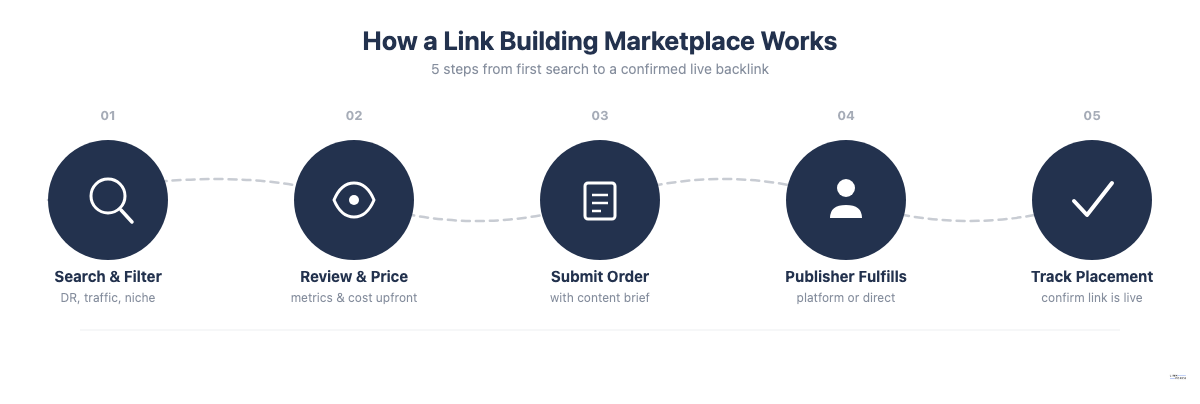
The buyer side follows a consistent pattern across most platforms:
- Search and filter publishers. Enter a keyword, niche category, or domain, then apply filters for domain rating, organic traffic, language, or topic. Most platforms surface results with all metrics visible before you commit.
- Review the site and pricing. Each listing shows the publisher’s URL, SEO metrics, price per placement, and the type of link available. You decide which sites match your quality bar.
- Submit your order with a content brief. Either supply your own article, use the platform’s content writing service, or provide anchor text and placement instructions. Some platforms let publishers write the content themselves.
- The publisher fulfills the order. On self-serve platforms, you communicate directly with the publisher. On managed platforms, the marketplace coordinates the placement on your behalf.
- Track the placement and confirm the link is live. Most platforms send a confirmation once the article is published and provide a link to the live URL for your records.
On the seller side, publishers register their sites, set per-placement prices, and fulfill incoming orders. Some platforms require manual approval of each publisher and periodic rechecks of traffic and spam metrics. Others accept any site that meets a basic threshold.
Types of Links Available on a Marketplace
Most link building marketplaces offer four main link types:
- Guest posts. An original article written for and published on a third-party site with a contextual link back to your site. The most common type and generally the highest quality, since the placement is in fresh, purpose-written content. See our guide to guest blogging for a deeper look at how this tactic works.
- Niche edits (link insertions). A contextual link added to an existing article on a publisher’s site. Because the article already has authority and organic traffic, niche edits can move faster than waiting for a new post to index.
- Digital PR and editorial links. Placements on news sites, industry publications, and editorial outlets. These carry higher authority but typically cost more and are less common in standard marketplace catalogues. See editorial links for more on why these matter.
- Sponsored content. Disclosed paid placements, clearly labeled as sponsored. Accepted by some niches and markets, though these links usually carry a rel=”sponsored” attribute rather than passing full equity.
The right type depends on your goal. Guest posts and niche edits are the workhorses of marketplace link building. Digital PR links are worth pursuing for authority signals but are harder to scale through a marketplace model.
Link Building Marketplace vs. Agency vs. DIY Outreach

Link building marketplaces, agencies, and DIY outreach represent a spectrum of cost, quality, and effort. Marketplaces offer cheap, fast, high-volume links with pre-vetted publishers but lower quality control. Agencies provide high-quality, strategic links at a higher cost. DIY outreach offers maximum control and relevance but requires significant time, skill, and resources.
Here is how the three approaches compare directly:
| Factor | Marketplace | Agency | DIY Outreach |
|---|---|---|---|
| Cost per link | $10 to $600+ depending on DR | $300 to $1,000+ per link (via retainer) | Time cost only; low cash cost |
| Control | High (you choose each site) | Low to medium (agency selects) | Highest (you choose everything) |
| Speed | Fast (days to 1-2 weeks) | Moderate (4-8 weeks per batch) | Slow (weeks to months per link) |
| Scalability | High | High (via retainer) | Low |
| Quality ceiling | Capped by catalogue quality | Potentially higher (editorial relationships) | Highest (bespoke targeting) |
| Strategy input | None (execution only) | Included | Entirely on you |
Marketplace pros: Fast turnaround (typically 1 to 7 days), predictable per-link budget, full visibility into which publisher sites you are buying before paying, and easy scaling for volume campaigns.
Marketplace cons: Higher risk of low-quality sites on open-signup platforms, potential for obvious guest post farm patterns, and no strategic input from the platform itself.
Use a marketplace when you have a clear target site profile, want transparency on pricing before committing, and have an in-house team to manage quality control. Marketplaces work well for tight budgets, rapid scaling, and niches where catalogue coverage is strong.
Use an agency when you need strategy, editorial relationships your team does not have, or complex content work alongside the link. Most link building agencies charge monthly retainers of $695 to $3,000 or more, regardless of how many links are delivered. A monthly link building service packages this into a predictable ongoing program. Agencies tend to perform better in regulated or complex niches where open-catalogue publishers are thin.
Use DIY outreach when you want complete control over which sites you target, you are pursuing editorial placements that are not for sale, or you have the time and relationships to run the campaign yourself. Our guides on backlink outreach and outreach strategy cover this in detail.
How to Evaluate a Link Building Marketplace

Not every marketplace delivers the same quality. These are the factors that matter most:
- Publisher database size and real traffic. A large catalogue is only an asset if the sites in it receive genuine organic visitors. Prioritize platforms that let you filter by real traffic, not just domain rating. A DR 45 site with 200 monthly visitors is far weaker than a DR 35 site with 12,000 monthly visitors.
- Filtering depth. Look for platforms that let you filter by niche, language, traffic floor, DR range, country of audience, and content type. The more precisely you can define your target, the fewer irrelevant listings you have to sift through.
- Verification method. The best platforms manually review every publisher before adding them to the catalogue and run periodic quality checks. Open-signup platforms where anyone can list a site introduce substantially more risk of PBN exposure or low-quality placements.
- Pricing transparency. You should be able to see the exact URL, metrics, and price for every publisher before placing an order. Avoid platforms that require you to pay before revealing where your link will appear.
- Delivery time and replacement guarantee. Check the average fulfillment time and what happens if a link is removed after publication. Reputable platforms offer a free replacement within a defined window, typically 6 to 12 months.
- White-hat compliance. Ask directly whether the platform operates any private blog networks or accepts bulk-registered domains. Platforms that publish their vetting standards publicly are generally safer. For more context on what separates safe from risky tactics, see our guide on white-hat SEO link building.
—
Best Link Building Marketplaces in 2026
The platforms below represent the main options for teams looking to buy quality backlinks through a marketplace. The summary table covers the essential decision variables; individual reviews follow with more detail on each option.
| Platform | Publisher DB | Typical Pricing | Delivery | Best For |
|---|---|---|---|---|
| INSERT.LINK | 45,000+ | $20-30/link | 3-7 days | Scale campaigns |
| PressWhizz | 37,000+ | Varies by site | ~18 hours | Speed |
| WhitePress | 90,000+ | $20+/placement | 30-32 hours | International |
| Collaborator | 38,000+ | $20+/article | 48 hours | Verified traffic |
| Bazoom | 80,000+ | $100+/link | Variable | Full-service |
| MeUp | 120,000+ | $49+/link | 5-10 days | Volume |
| FatJoe | Curated | DR10+ from $75 | Variable | Agencies |
| Linksman | Curated | $50-150/placement | ~1 week | Quality control |
| Editorial.Link | Curated | $375+/link | Variable | Premium authority |
| Linkhouse | Large | Custom | Variable | Platform tools |
INSERT.LINK
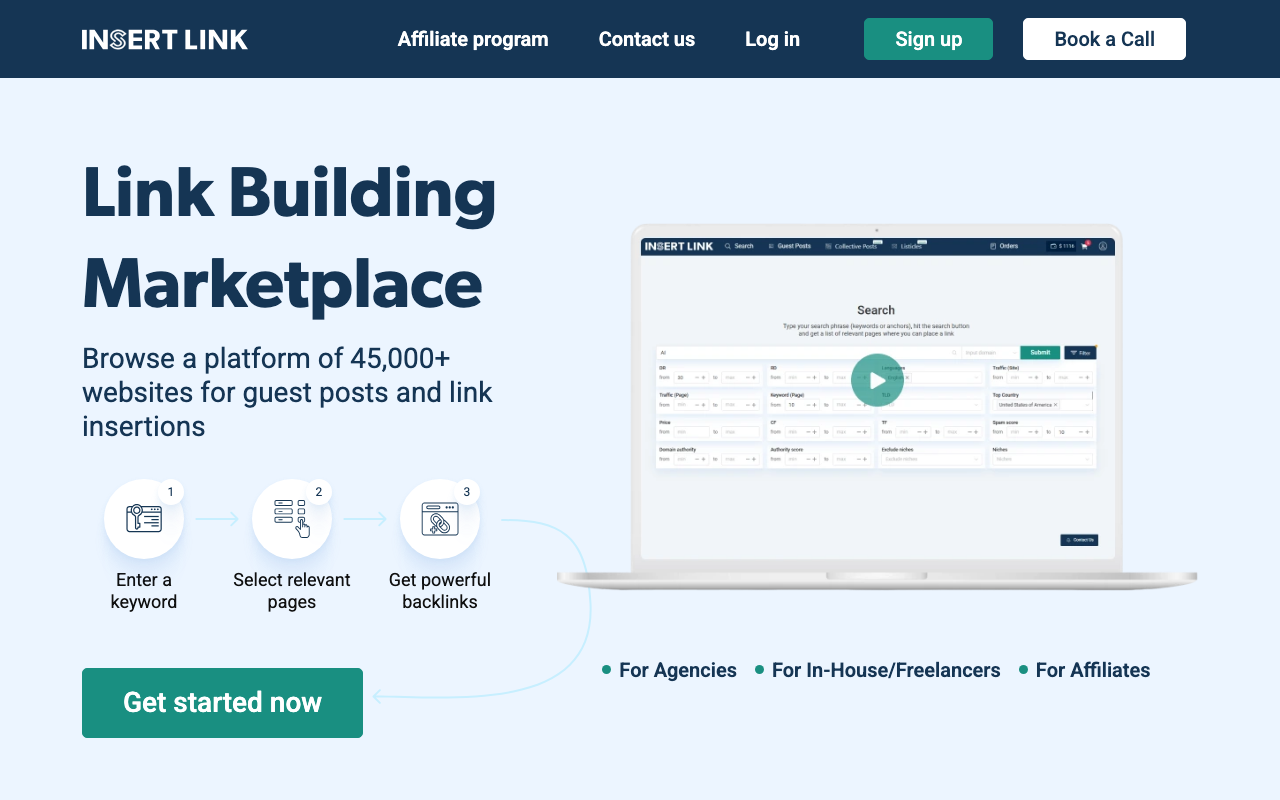
INSERT.LINK operates one of the larger catalogues at 45,000+ sites with a focus on editorial quality. Pricing starts at around $20 to $30 per link, making it accessible for teams running volume campaigns. The platform uses a search-by-keyword model that makes finding niche-relevant sites straightforward. Best for teams that need to build at scale without stretching the per-link budget.
PressWhizz
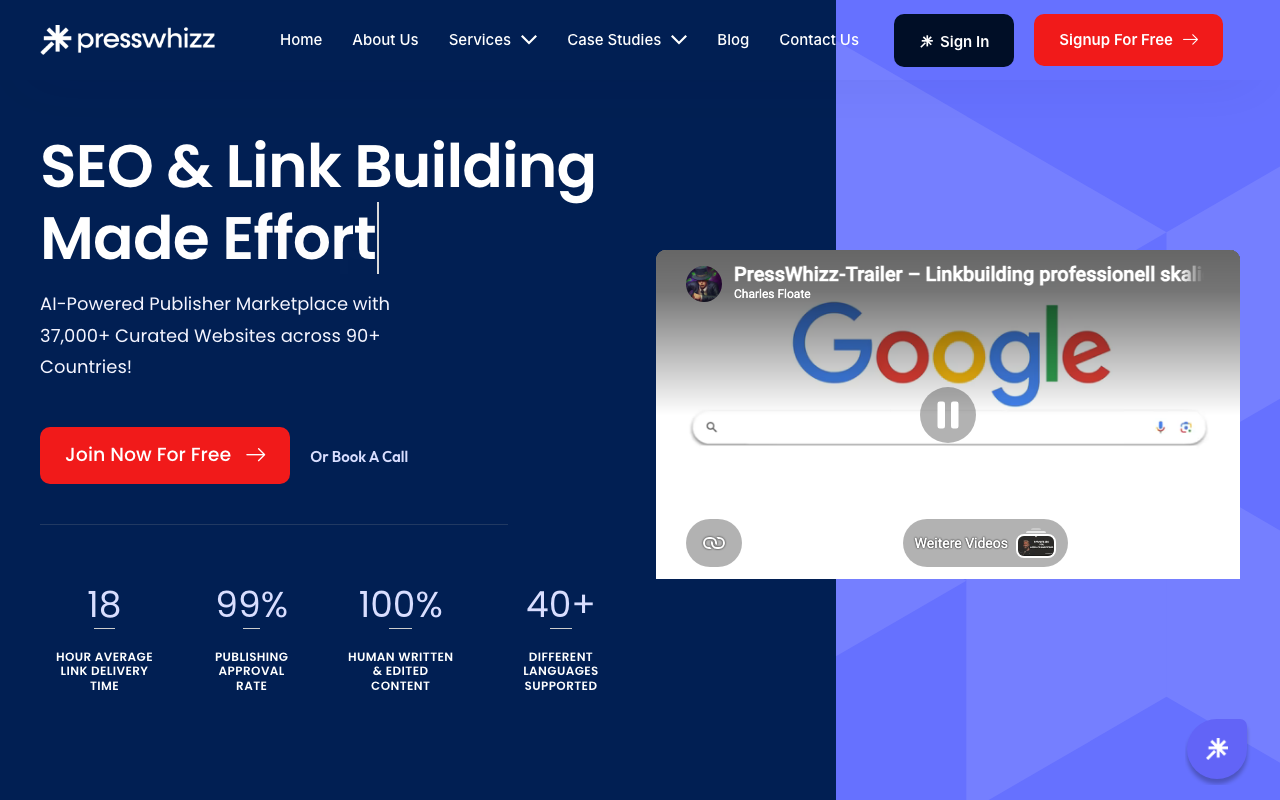
PressWhizz positions itself on speed, with an average fulfillment time of approximately 18 hours. The catalogue covers 37,000+ sites across 90+ countries, and the platform includes competitor link intelligence tools alongside standard filtering. Pricing is one-time per placement with no subscription required. Best for campaigns where turnaround time matters more than breadth of catalogue.
WhitePress
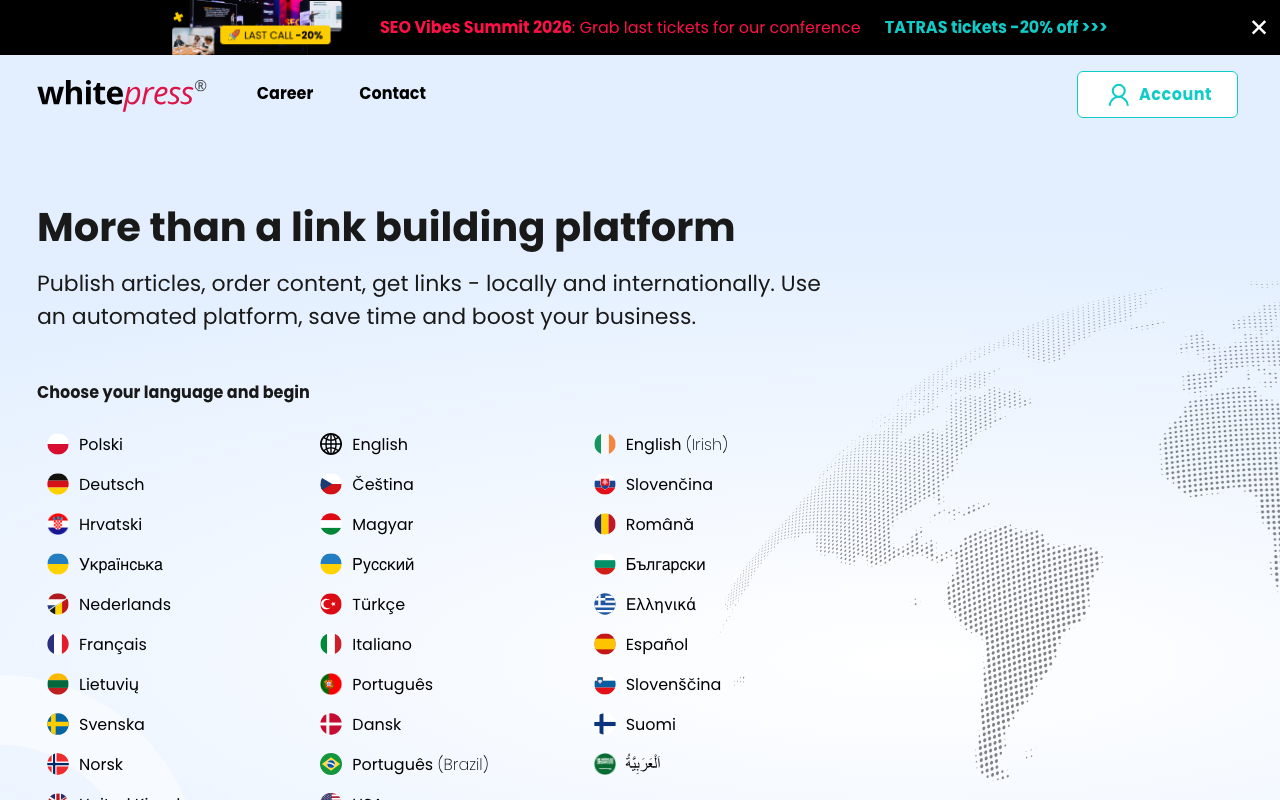
WhitePress runs one of the largest international link building marketplace catalogues at 90,000+ publisher sites across 30+ languages. Advanced filtering includes up to 50 metrics per site, covering traffic, domain rating, audience country, and niche. Placement pricing starts at $20, with delivery averaging 30 to 32 hours. Best for multilingual campaigns or brands that need quality backlinks across European or non-English-speaking markets.
Collaborator
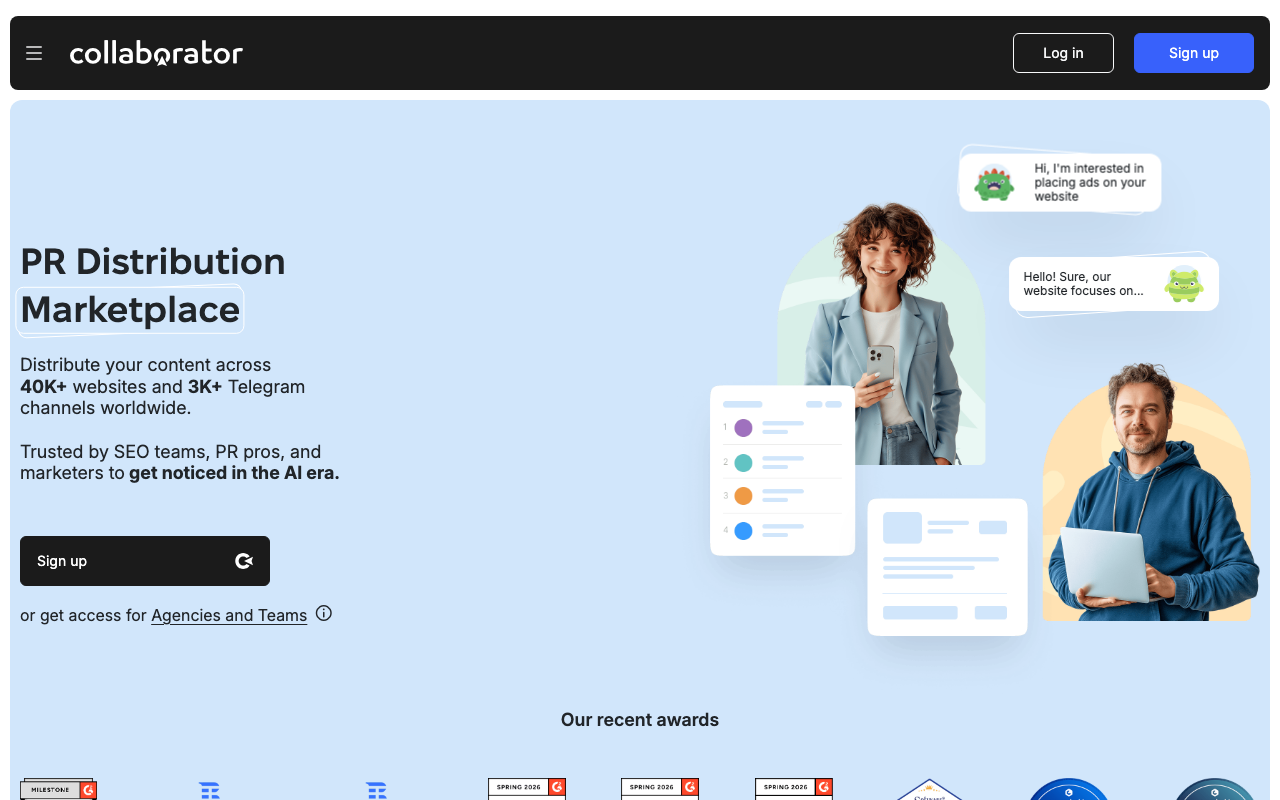
Collaborator is a marketplace that verifies publisher traffic using integrated Google Analytics and Google Search Console data, not estimates from third-party tools. This means the traffic figures buyers see before purchasing are based on first-party source data. The catalogue covers 38,000+ sites with a 48-hour average delivery time. Best for teams that treat verified organic traffic as a non-negotiable quality standard.
Bazoom
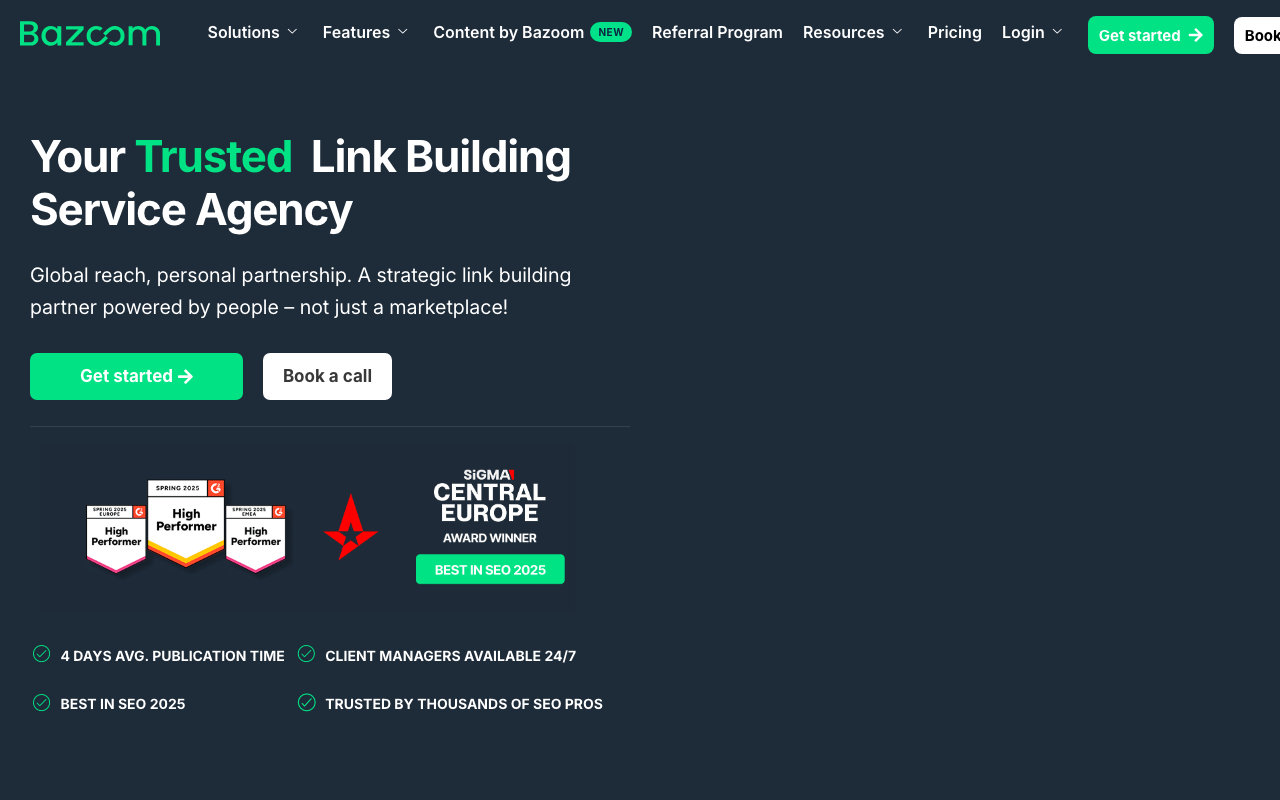
Bazoom covers 80,000+ sites and offers a full-service option alongside the self-serve catalogue. Pricing starts at $100 per link, reflecting a higher average quality floor. Bulk discounts are available for volume orders. The platform has strong coverage in Nordic and DACH markets. Best for buyers who want a hands-on account team alongside marketplace access.
MeUp
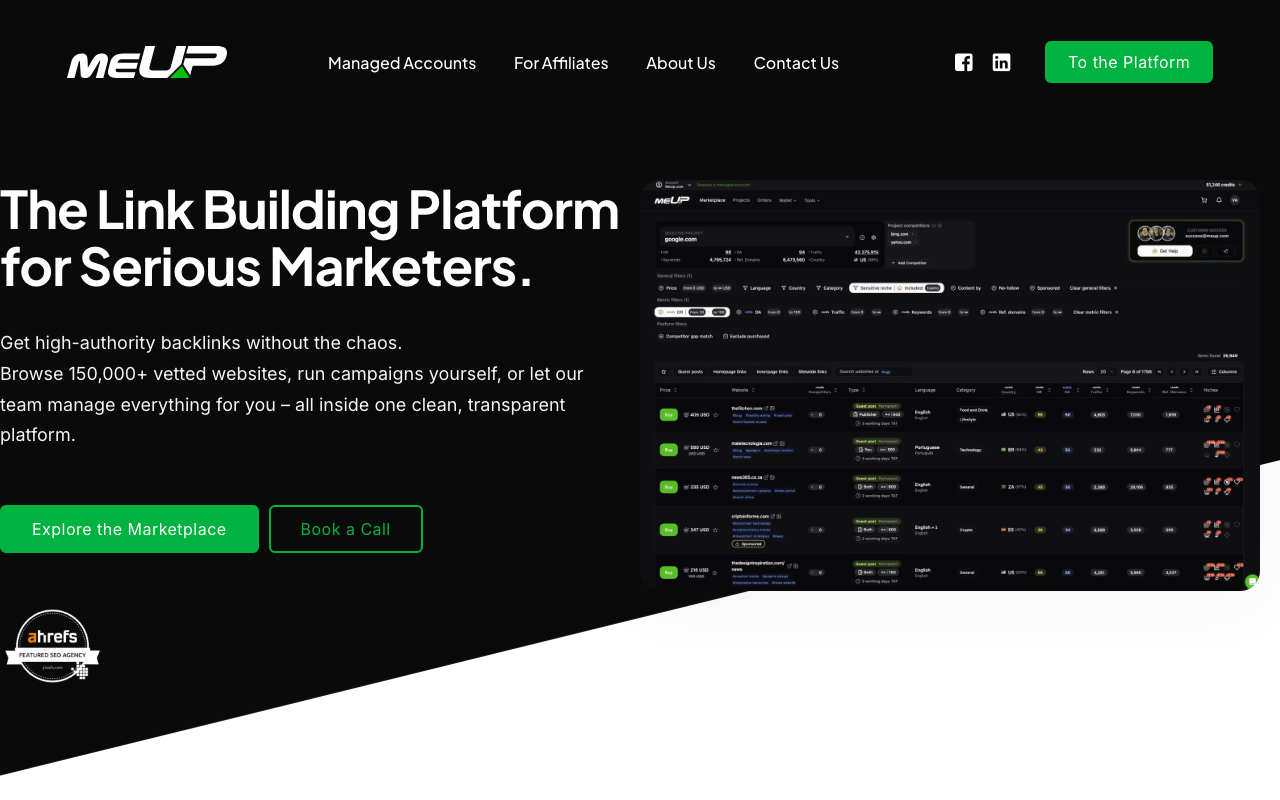
MeUp is one of the largest catalogues by volume with 120,000+ cumulative placements. Pricing starts at $49 per link with delivery taking 5 to 10 days. The platform includes content writing in most orders. Best for agencies managing a high volume of client placements who need breadth over editorial curation.
FatJoe
FatJoe has served over 10,000 marketing agencies and teams since 2012 and is one of the most widely used white-label link building services in the industry. DR10+ guest posts start from around $75, with DR30+ priced from approximately $120. Content writing is included by default, making it a managed service rather than a self-serve catalogue. Best for agencies that want a reliable white-label supplier where writing and placement are handled without client-facing branding.
Linksman
Linksman uses manual domain verification and positions itself on publisher quality over raw size. Placements range from $50 to $150. The platform claims a 99.9% publishing approval rate with a 1-week average delivery. A replacement guarantee covers links removed within an agreed window. Best for buyers who prioritize clean, manually reviewed inventory over maximum catalogue breadth.
Editorial.Link
Editorial.Link is at the premium end, with link pricing starting at $375. The platform focuses on editorial placements on established news and industry sites rather than standard guest post inventory. Best for authority-building campaigns where a single high-quality placement outweighs ten mid-range ones.
Linkhouse
Linkhouse is a link building and content marketing platform offering access to a large publisher network with self-serve and managed placement options. Pricing is customized per order. The platform suits teams that want a broader feature set alongside marketplace access, including analytics, content creation, and campaign tracking in one place. Strong for agencies that want a single platform to manage the full link building workflow.
How Much Does a Link Building Marketplace Cost?
Pricing scales with the quality tier of the publisher site. The figures below are typical market benchmarks based on reported ranges across leading platforms in 2026, not fixed list prices (individual platforms vary):
| DR Range | Niche Edit (est.) | Guest Post (est.) |
|---|---|---|
| DR 10-20 | $10-25 | $15-35 |
| DR 20-35 | $25-60 | $40-90 |
| DR 35-50 | $60-130 | $80-180 |
| DR 50-65 | $130-300 | $180-400 |
| DR 65+ | $300-600+ | $400-1,000+ |
| Digital PR (any DR) | N/A | $1,000-1,500+ |
Mid-tier placements at DR 40-65 average around $365 per link across marketplace and outreach channels, according to pricing research by Minuttia. High-authority, high-traffic placements regularly exceed $600 to $1,000 per link, while premium Digital PR placements on major media outlets can reach $1,250 to $1,500 or more.
A few factors push pricing up or down beyond the DR tier:
- Niche competitiveness. Finance, legal, and health publishers typically price higher than lifestyle or general interest sites at the same DR level.
- Traffic quality. Sites with verified organic traffic command a premium over sites with a similar DR but lower visitor counts.
- Content writing included. If the platform writes the article, expect to add $40 to $80 on top of the placement fee. Supplying your own article usually reduces the total cost.
- Language. Non-English placements in smaller markets are often cheaper for the same DR tier.
Niche edits typically run 20 to 30 percent cheaper than guest posts at the same DR level, since no new content needs to be written or indexed.
Quality Risks and Red Flags in Link Building Marketplaces
The ease of purchasing placements introduces specific risks that manual outreach does not carry to the same degree.
- High DR with no organic traffic. Domain rating measures link equity, not whether a site actually receives visitors. A site with DR 50 and fewer than 500 monthly organic visits is a signal that the domain was built for links rather than readers. Always check traffic alongside DR.
- Open-signup catalogues without manual review. Platforms that allow any site to list without vetting introduce significant PBN exposure. Low-quality sites with thin content and overlapping link patterns are common on open platforms.
- Overlapping publisher networks. Some marketplace catalogues share inventory with other services, meaning the same publisher sites appear across multiple platforms. Buying from several marketplaces does not guarantee link diversity if the underlying network is shared.
- Over-reliance on exact-match anchor text. Marketplaces make it easy to specify any anchor text, which creates a temptation to over-optimize. A natural link profile includes branded anchors, partial match, and generic text. Use exact-match anchors sparingly.
- Google’s stance on paid links. Google’s spam policies classify buying or selling links that pass PageRank as a violation. Practical risk depends on the quality and pattern of placements. Sites with obvious paid-link signals, thin content, many sponsored posts, and low topical relevance carry more risk than well-run editorial publishers with genuine organic audiences. Treat marketplaces as a sourcing tool that still requires your own editorial judgment on every placement.
—
How to Use a Link Building Marketplace Effectively
A marketplace handles sourcing and outreach logistics. It does not replace editorial judgment on whether a placement is actually worth having.
- Start with test orders. Before committing budget to a campaign, place two or three orders across different publishers at different DR tiers. Evaluate the live pages for content quality, topical relevance, and surrounding link context before scaling.
- Set a traffic floor, not just a DR floor. Use the traffic filter on platforms that offer it. A threshold of 1,000+ monthly organic visitors eliminates the bulk of zero-traffic domains in most catalogues.
- Brief content with context. Provide the anchor text, the target URL, and a two to three sentence description of the surrounding topic. The more context a publisher has, the better the placement will read in the finished article.
- Track every placement in a link log. Record the live URL, anchor text, DR, and estimated traffic for each placement the week it goes live. Recheck quarterly for link removals or content changes.
- Diversify anchor text deliberately. Plan anchor text distribution across branded, partial-match, and generic variations. Avoid ordering multiple links with identical exact-match anchors in a short window.
- Use marketplaces alongside earned link tactics. Marketplace placements are faster to acquire, but they work best when combined with strategies that earn editorial attention. For niche link building in competitive verticals, combining purchased placements with earned coverage produces a more natural and resilient link profile.
For tracking and managing your placement log, a dedicated linkbuilding tool or a centralized tracker inside your link building software setup makes auditing easier as volume grows.
Frequently Asked Questions
What is a link building marketplace?
A link building marketplace is a platform that connects website owners who want to acquire backlinks with publishers willing to place links on their sites. Buyers search a verified catalogue, filter by domain metrics and niche, and purchase placements directly without running a manual outreach campaign.
Are link building marketplaces safe for SEO?
They can be, but safety depends on how you use them. Platforms with manual publisher verification, traffic filters, and transparent editorial standards reduce the risk of low-quality placements. The main risks are buying links on sites with no real organic traffic, over-concentrating anchor text, or using platforms that host private blog network inventory. Starting with small test orders and applying traffic floors alongside DR filters is the most practical way to manage quality.
How much does a link from a marketplace typically cost?
Pricing ranges from around $10 to $30 for low-DR niche edits to $350 to $600+ for guest posts on high-authority sites (DR65+). The typical mid-market range for a quality guest post on a DR 35 to 50 site is $80 to $180. Pricing varies by niche, whether content writing is included, and whether you are using a premium or volume-focused platform.
What is the difference between a link building marketplace and an agency?
A marketplace gives you direct access to a publisher catalogue where you choose each placement yourself. An agency manages strategy, outreach, and placement selection on your behalf. Marketplaces offer more transparency and lower per-link costs. Agencies provide strategy, editorial relationships, and managed execution. For teams that know what they want and have the internal capacity to evaluate placements, a marketplace is more cost-efficient. For teams that need a full program run externally, an agency is the better fit.
Can I sell my site’s links on a marketplace?
Yes. Most link building marketplaces have a publisher or seller side where site owners can list their property, set a price per placement, and fulfill incoming orders. Platforms typically require a minimum DR or traffic threshold and review the site before approving it. Publishers earn per order fulfilled. Google’s spam policies address paid links from the seller side as well, so this is a decision worth considering carefully.
What metrics matter most when choosing a publisher on a marketplace?
Organic traffic is the most important single metric because it reflects whether real visitors actually land on the site. Domain rating reflects the site’s accumulated link equity but can be gamed. Topical relevance, the quality of existing content on the site, and the ratio of editorial content to paid placements are equally important signals. A practical test: would you want this placement if it had no SEO value? If the answer is no, the placement is probably not worth buying.