

Niche Link Building: Strategies, Tactics, and How to Do It Right
Most link building advice treats all links the same. Get a high-DR backlink from any site and you’re winning. Or so the thinking goes. The problem is that a link from a technology news site does almost nothing for a healthcare startup’s topical authority, and a link from a cooking blog moves the needle very little for a B2B SaaS company.
Niche link building fixes this. Instead of chasing raw authority metrics, it prioritizes topical relevance, building links from sites that operate in the same or a closely related industry as yours. The result is a backlink profile that signals expertise and authority within a specific domain, not just general web popularity.
In this guide, you’ll learn what niche link building actually means, why relevance consistently outperforms raw DR, how to find opportunities, and five proven strategies to acquire niche-relevant links that move rankings.
What Is Niche Link Building?
Niche link building is the practice of acquiring backlinks specifically from websites that share your industry focus, topic space, or audience. Rather than targeting any site with a high domain rating, the goal is to build links from sources that are contextually aligned with your content and business.
A software company focused on project management, for example, would pursue links from productivity blogs, SaaS review platforms, tech newsletters, and software comparison sites. Not from general news sites or unrelated directories.
The distinction matters because Google evaluates not just the authority of a linking domain but the relevance context of the link itself. A link embedded in a post about project management tools, on a site that covers project management, carries more topical signal than the same anchor text dropped on a cooking blog with a high domain authority. Geography works as the same kind of relevance filter for a local business: a link from a site tied to your actual city or region signals real-world relevance the same way an industry-specific link does. See local link building for the geography-specific version of this same principle.
Niche Link Building vs. Niche Edits: Not the Same Thing
These terms often get used interchangeably, but they describe different things.
Niche edits (also called link insertions) are a specific tactic: you identify an existing, already-indexed page and request that a relevant link to your content be added to it. You’re editing an existing post rather than creating new content.
Niche link building is a broader strategy, the overall approach of acquiring links from topically relevant sites. Niche edits are one tactic within that strategy, alongside guest posting, broken link building, linkable asset creation, and community-driven outreach.
Understanding this distinction matters because optimizing only for niche edits misses most of the opportunity. Niche link building as a full strategy produces a more diverse, more durable backlink profile.
Why Niche Relevance Matters More Than Raw Authority

For years, SEO practitioners measured backlink quality almost exclusively through domain authority scores. The higher the DR or DA, the better the link. That metric still matters, but the landscape has shifted toward topical authority as a primary signal.
Google’s systems increasingly reward pages that demonstrate deep subject-matter expertise across a cluster of related content. A link from a relevant industry publication contributes to that topical signal directly. A link from a high-authority generalist site provides raw link equity but does little to reinforce subject-matter credibility.
The practical implication: a DR 40 link from a site entirely dedicated to your niche often outperforms a DR 80 link from a tangentially related or off-topic domain. Industry surveys consistently show that 88% of SEO practitioners cite topical authority as a major ranking factor, and link relevance is a primary input into that signal.
Topical Authority and Trust Signals
When multiple niche-relevant sites link to the same piece of content, it creates co-citation, a pattern that reinforces to search engines that the content is recognized as authoritative within a specific subject area. Google evaluates not just the link itself but the semantic context surrounding it: the anchor text, the text in the paragraph where the link appears, and the overall topic of the linking page.
This is why niche link building produces compounding benefits over time. As you accumulate links from topically aligned sources, each new link strengthens the topical authority signal of the entire cluster, not just the individual page receiving the link.
Traffic Quality Benefit
Niche relevance also affects the quality of referral traffic, not just search rankings. Visitors who click a link from an industry-specific publication are already interested in your subject area. They understand the context, have relevant intent, and convert at significantly higher rates than untargeted referral traffic from generic sources.
For SaaS companies and B2B businesses especially, this referral quality effect compounds the ranking benefit. A niche link that drives 50 highly qualified visitors a month is often more valuable than a generic high-DA link that drives 500 visitors who immediately bounce.
Brand Credibility in Your Industry
Being cited, referenced, or linked by recognized publications and thought leaders in your niche does more than improve rankings. It builds the kind of brand perception that’s difficult to manufacture through other means. When a respected industry blog links to your content, it functions as a tacit endorsement. Readers in that niche notice.
Over time, a strong pattern of niche-relevant links creates a visible brand presence within your industry’s content ecosystem, reinforcing authority with both search engines and human audiences.
How to Identify Niche Link Building Opportunities
Before executing any strategy, you need a qualified prospect list (sites that are genuinely relevant to your niche and realistic targets for link acquisition).
Use Advanced Search Operators
Google’s advanced search operators let you build targeted prospect lists quickly. Start with these patterns:
[niche keyword] "write for us"[niche keyword] intitle:"guest post"[niche keyword] "submit an article"[niche keyword] inurl:blog "resources"[niche keyword] "recommended reading"
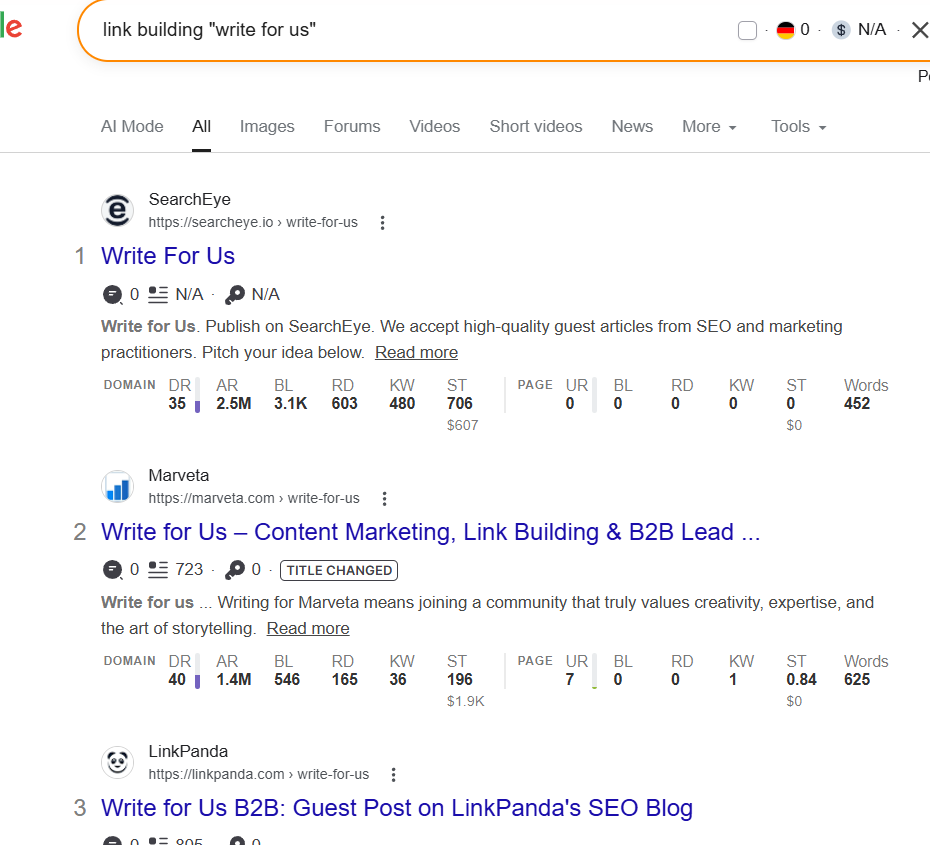
For a SaaS company focused on project management tools, this might look like: project management software "write for us" or team productivity blog "submit a guest post".
Collect 50–100 results per search, then vet them for quality before any outreach begins.
Competitor Backlink Gap Analysis
Your competitors have already identified many of the best niche link opportunities. Use Ahrefs or Semrush to pull their backlink profiles, then filter for:
- Domain rating: 20–70 (the sweet spot for niche sites, which avoids PBNs and ghost sites while staying realistic)
- Organic traffic: 500+ visits/month (confirms the site has real audience reach)
- Topically relevant: same or adjacent niche, not just generic directories
The backlink gap tool in both platforms lets you compare multiple competitors simultaneously and surface domains that link to them but not to you. Those are your highest-priority prospects.
Niche Community Research
Some of the best niche link opportunities don’t appear in backlink tools because the sites are smaller or newer. Niche-specific communities: LinkedIn groups, industry Slack workspaces, subreddits, niche newsletters, and association websites. These surface publishers and creators who are active in your space but may not yet have a large enough footprint to appear in competitive analysis.
Spending time in these communities also generates relationship capital that makes cold outreach far more effective. A message to someone you’ve engaged with publicly in a shared community gets a meaningfully higher response rate than a fully cold email.
5 Proven Niche Link Building Strategies
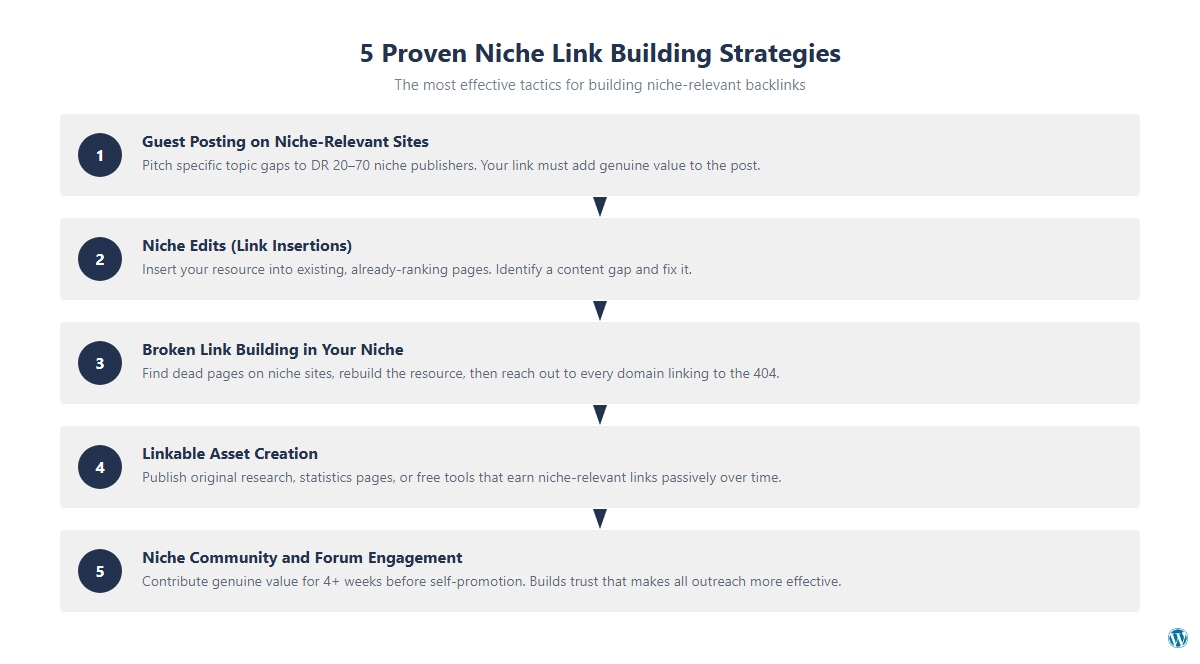
1. Guest Posting on Niche-Relevant Sites
Guest posting remains the most widely used niche link building tactic. Roughly 64% of link builders use it as a core strategy. When done with proper targeting and genuine content quality, it remains one of the most effective.
The key is that most guest posts underperform because they’re pitched generically, written for the link rather than for the audience, and placed on marginally relevant sites. Niche-targeted guest posting works differently.
How to execute it:
- Build a prospect list using search operators targeting your specific niche, not just broad industry keywords.
- Vet each site: check DR (20–70), organic traffic (500+/month), content publication frequency (active in last 90 days), and actual editorial standards (author bios, original content, no obvious link farm signals).
- Review their existing content to identify a topic gap (something their audience would find valuable that they haven’t covered yet or covered only shallowly).
- Pitch that specific gap, not a generic topic. Reference their existing content to show you’ve done the research. Keep the pitch to 3–4 sentences.
- Write content that earns the link contextually. Your link should add value to the post, not be forced in.
- Follow up once, after 5–7 business days, if you haven’t heard back. Data shows that one well-timed follow-up can increase link acquisition rates by up to 40% compared to single-email outreach. Don’t send more than two emails total.
A SaaS company in the project management space, for example, might identify that a popular team productivity blog has covered general collaboration tools but hasn’t published a detailed guide on async workflow setups. They could pitch exactly that, with a contextual link back to their core product page.
2. Niche Edits (Link Insertions)
Niche edits are a high-efficiency tactic because the target page is already indexed, already ranking, and already earning authority. Unlike a brand-new guest post, an edit to an existing page delivers link equity that’s been compounding since the page was first published.
How to execute it:
- Find pages in your niche that are actively ranking for related queries. Use Google search or Ahrefs to identify articles covering topics adjacent to your content.
- Identify a specific content gap within that page: an outdated statistic, a missing resource, an unexplained concept, or a section where your content would add clear value.
- Email the site owner or editor with a concise pitch: explain what the gap is, how your resource fills it, and what specific text would be updated. Don’t just ask for a link. Show exactly where it would go.
- Keep your outreach short. Three to four sentences. Context, specific value, direct ask. Longer emails see lower response rates.
Niche edits work best when you have a strong linkable asset (original research, a comprehensive guide, or a free tool) that genuinely adds to the target page rather than simply appearing relevant. Ecommerce stores get particularly strong mileage from this tactic on category pages, since niche edits pass link equity faster than a brand-new guest post; see ecommerce link building for the tactics that fit product pages versus category pages.
3. Broken Link Building in Your Niche
An estimated 66% of all external links on the web are broken, pointing to pages that no longer exist. For niche link builders, this represents a constant, renewable source of opportunities. Site owners generally want to fix broken links when they’re made aware of them, especially if you arrive with a ready replacement.
How to execute it:
- Use Ahrefs’ Content Explorer or the Broken Outbound Links filter on competitor sites to identify dead pages in your niche.
- Verify the dead page had real value: check its history on the Wayback Machine to confirm it was a legitimate resource, not a spam page or a product that legitimately shut down.
- Create a replacement resource that matches or improves on what the original page offered.
- Reach out not just to the site hosting the broken link, but to all domains that linked to the dead page. Ahrefs can show you every site pointing to a 404 URL.
The advantage here is that you’re solving a real problem for the site owner. The outreach practically writes itself: “I noticed you’re linking to a page that no longer exists. I’ve put together a resource that covers the same topic. Here’s the link if you’d like to update it.”
4. Linkable Asset Creation
The most scalable form of niche link building isn’t outreach-driven. It’s asset-driven. Create something valuable enough that people in your niche want to link to it without being asked.
The most effective linkable assets in B2B and SaaS contexts include:
- Original research or industry surveys (data that other content creators cite)
- Industry statistics pages (aggregated data that journalists and bloggers reference)
- Free tools or calculators (practical resources that get embedded in guides)
- Definitive reference guides (authoritative overviews of complex topics)
How to execute it:
- Research what data, tools, or resources writers and journalists in your niche cite most frequently. Look at the external links used in the top-ranking articles for your target keywords.
- Create an original version: your own survey data, a more current statistics aggregation, a better-explained guide, or a useful free tool.
- Distribute proactively: reach out to journalists who cover your industry, roundup authors in your niche, and podcast hosts who regularly reference data. Let them know the resource exists.
A link building agency that publishes an annual survey on link pricing, for example, creates a resource that every SEO blog covering link building will want to cite. Hootsuite’s downloadable social media reports have followed this exact model. Each edition earns hundreds of backlinks from digital marketing sites in their niche with no active outreach at all. That one asset can earn dozens to hundreds of niche-relevant links per year with minimal ongoing effort.
5. Niche Community and Forum Engagement
The most organic form of niche link building starts long before any outreach email is sent. Genuine participation in niche communities creates the relationships and visibility that make all other tactics more effective.
Industry-specific communities exist across Slack, LinkedIn groups, Reddit, Discord servers, niche forums, and private membership sites. Most industry niches have several active ones.
How to approach it:
- Identify 3–5 active communities specifically in your niche, not general marketing or SEO communities, but spaces where your target publishers and creators spend time.
- Contribute value for at least four weeks before any self-promotion. Answer questions, share useful observations, engage with others’ content. Build a visible, credible presence.
- Share linkable assets when they’re relevant to active discussions, not to farm links, but to add to the conversation. Members who find value in your contributions will link to your content organically.
- Connect directly with webmasters and editors you encounter. Many niche link deals originate in direct messages after establishing a community relationship.
Community-driven link building takes more time to initiate but produces stronger, more durable links. Publishers who’ve seen your contributions firsthand are more receptive to pitches and more likely to link to your content without incentive.
How to Vet Niche Link Prospects Before You Reach Out
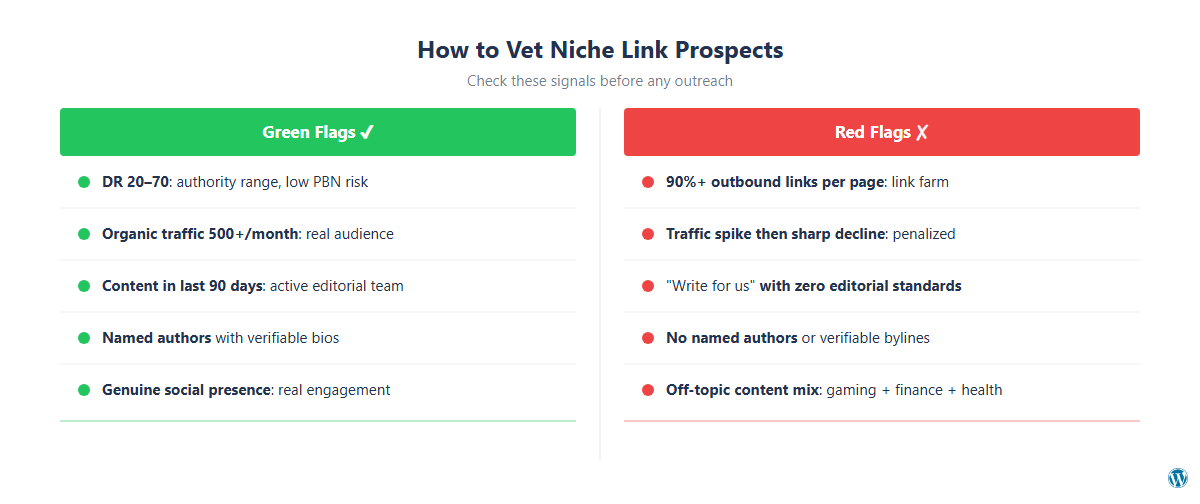
Even when a site appears topically relevant, not every site is worth your time. A basic vetting process before any outreach saves significant effort and protects your outreach sender reputation.
Green Flags
- DR 20–70: High enough to carry authority, low enough to avoid the PBN-heavy zone where fake sites often cluster.
- Organic traffic 500+/month: Confirms the site has a real audience. Check via Ahrefs or Semrush estimates.
- Published content in the last 90 days: Active sites have active editorial teams who respond to pitches.
- Real author attribution: Named authors with bios and verifiable social profiles signal a legitimate editorial operation.
- Genuine social presence: Even modest but real engagement on industry social channels indicates a credible site.
Red Flags
- 90%+ external outbound links on a single page: A clear signal of a link-selling operation rather than editorial content.
- Traffic spike followed by sharp decline: Often indicates a previously penalized site. Linking from it carries risk.
- “Write for us” pages with no editorial standards: Generic pages that accept anything from anyone carry minimal authority.
- No real author attribution: Anonymous or thin “staff writer” bylines with no verifiable identities suggest farmed content.
- Irrelevant content clusters: A “marketing blog” with posts covering gaming, cryptocurrency, and real estate is a link network, not a niche site.
3 Common Niche Link Building Mistakes to Avoid
1. Confusing niche with broad industry. A general “marketing” blog and a “B2B SaaS demand generation” blog are not equivalent niche sources for a marketing automation platform. The more specific the niche alignment, the more meaningful the link. Don’t accept broad industry as a proxy for genuine relevance.
2. Targeting only high-DR sites. Many of the highest-value niche link opportunities come from sites in the DR 20–45 range (newer publications, subject-matter expert blogs, and industry association sites that are highly relevant but haven’t yet accumulated massive domain authority). Dismissing these in favor of chasing DR 70+ misses the strongest topical authority gains.
3. Scaling before qualifying. Sending 500 outreach emails to a poorly vetted prospect list doesn’t scale link building. It destroys email deliverability, wastes content resources, and generates negative associations with your brand among site owners in your niche. Qualify rigorously first, then scale into a smaller, higher-conversion list.
How to Scale Niche Link Building Without Losing Quality
Niche link building done properly is resource-intensive. Scaling it requires systematizing the parts that can be systematized while preserving the human judgment that makes outreach work.
Systematize prospecting: Build saved searches in Ahrefs or Semrush that export new niche prospects weekly. Set filters once (DR range, traffic threshold, niche category) and let the tool surface candidates automatically.
Use dedicated outreach tools: Managing niche outreach manually across email threads and spreadsheets fails at scale. A dedicated link building software platform handles prospect organization, outreach sequencing, follow-ups, and relationship tracking in one place. It’s essential once you’re running 50+ active outreach threads.
Track performance by tactic: Not every niche responds equally well to every strategy. Use link building reporting to track which tactics are producing niche-relevant links and double down on what works in your specific category.
Know when to outsource: If your team is running at capacity or you need to accelerate into a competitive niche, a monthly link building service with genuine niche targeting capabilities can supplement in-house efforts without sacrificing relevance quality.
Integrate with content strategy: The most efficient niche link builders treat content creation and link building as one process. Every major content asset is planned from the start with link acquisition potential in mind. For a practical view of how this plays out in a specific segment, see our guide on link building for SaaS.
Frequently Asked Questions
What’s the difference between niche link building and niche edits?
Niche edits are a specific tactic (inserting a link into an existing piece of content on a relevant site). Niche link building is the broader strategy of acquiring any type of backlink from topically relevant sources. Niche edits are one tool within the niche link building toolkit.
How many niche-relevant links do I need?
It depends on the competitiveness of your target keywords. For informational keywords with modest competition, 10–20 high-quality niche-relevant links can be enough to move rankings. For competitive commercial terms, competing sites often have 50–200+ niche-relevant links pointing to the target page. Benchmark against actual competitors, not arbitrary targets.
Are niche links more effective than high-DR generic links?
For building topical authority and ranking for niche-specific queries, yes. A DR 40 link from a directly relevant industry site typically delivers more topical authority gain than a DR 80 link from an unrelated domain. For general domain authority metric improvement, high-DR generic links may edge ahead. Most strong backlink profiles include both.
How do I find niche link prospects quickly?
Start with Google search operators: [niche keyword] "write for us" and [niche keyword] inurl:blog. Then pull competitor backlinks in Ahrefs or Semrush and filter by niche relevance and organic traffic. For deeper prospecting, explore active industry communities where niche publishers spend time.
Does niche link building work for competitive niches?
Yes, niche link building matters more in competitive niches. When all competitors have similar domain authority, niche relevance becomes the differentiating factor. Building a stronger topical authority signal through niche-relevant links is often the most effective way to create sustainable ranking advantages in contested spaces.
Conclusion
Niche link building works because relevance compounds. Each niche-relevant link you acquire doesn’t just add link equity. It reinforces your topical authority signal, improves referral traffic quality, and builds credibility within your industry’s content ecosystem.
Guest posting, niche edits, broken link building, linkable asset creation, and community engagement work best in combination, deployed consistently against a well-vetted prospect list and tracked rigorously for performance.
Start with the tactics that fit your current resources and content assets, build your prospect pipeline systematically, and measure what drives results in your specific niche. The sites that win long-term aren’t the ones with the most links. They’re the ones with the most relevant links from the most respected sources in their space.
To scale niche link building efficiently, explore link building software that handles prospecting, outreach, and reporting in one workflow.