
Guest post outreach is the process of contacting website owners, blog editors, and content managers to pitch and publish a guest article on their site, typically in exchange for an editorial backlink that supports your SEO and link building goals. It remains one of the most reliable white-hat link building tactics available: well-targeted, personalized campaigns achieve reply rates of 15 to 25 percent, while backlink outreach done at scale requires the right tools and a repeatable process.
This guide covers the full manual guest post outreach process: how to find and qualify target sites, how to reach the right contact, how to write a pitch that gets a reply, three email templates you can copy today, the best tools for scaling outreach, and the most common mistakes that kill acceptance rates.
What Is Guest Post Outreach?
Guest post outreach is the process of identifying websites relevant to your niche, finding the editor or content manager responsible for publishing decisions, pitching one or more guest article ideas, and, if accepted, writing and publishing the piece with a contextual backlink to your site.
The links earned through guest post outreach are editorial: placed inside original content on a real third-party site, reviewed by an editor, and published for a real audience. Google treats editorial links as stronger authority signals than directory submissions or profile links because they require genuine editorial approval.
Guest post outreach differs from outreach marketing in scope. General outreach marketing covers any contact with a publisher or content creator: review requests, brand mention campaigns, and link insertions. Guest post outreach refers specifically to pitching a full article you will write for publication on another site. The terms are sometimes used interchangeably, but the distinction matters when planning campaigns.
Why Guest Post Outreach Still Works in 2026
Guest post outreach still works when it is done correctly. Hyper-personalized pitches achieve reply rates around 19 percent. Generic template emails rarely exceed 3 to 5 percent. That is not a minor difference. That is the difference between a sustainable link building channel and a campaign that produces nothing.
Four reasons manual guest post outreach remains effective in 2026:
- Editorial links from relevant, high-traffic sites remain among the strongest ranking signals
- Many site owners still actively want quality content from outside contributors to supplement their own publishing schedule
- Personalization tools have made it faster to research prospects without sacrificing quality
- A live guest post continues to pass authority and drive referral traffic for years after publication
The channel requires more effort than it did five years ago. That effort is also why the links carry more value.
How to Find Guest Post Targets Worth Your Time
Prospecting too broadly is the most common mistake in guest post outreach. Sites that are not relevant to your niche, or that lack genuine organic traffic, produce placements that carry little SEO value. Build your prospect list using these three methods, then qualify every site before pitching.
Use Google Search Operators
Search operators surface sites that actively accept guest content. Use these patterns:
[your niche] "write for us"[your niche] "guest post guidelines"[your niche] "submit a guest post"[your niche] "contributor guidelines"
For a SaaS or link building context, try: link building "write for us" or SEO blog "guest post guidelines". Review each result manually before adding it to your list.
Mine Competitor Backlinks
If a site accepted a guest post from a competitor, it is already qualified for your niche. Use Ahrefs or Semrush to run a backlink report on two or three competitors. Filter for referring domains where the landing page has an author bio from an outside contributor. Those domains are your highest-priority prospects.
Use a Guest Posting Marketplace
Guest posting marketplaces aggregate publisher sites with verified metrics, so you filter by Domain Rating, organic traffic, and niche before reaching out. Marketplaces are most useful when you are managing outreach at volume or need placements at a specific DR threshold quickly. See our overview of guest posting software for a full comparison of platforms.
Minimum qualification criteria before outreach:
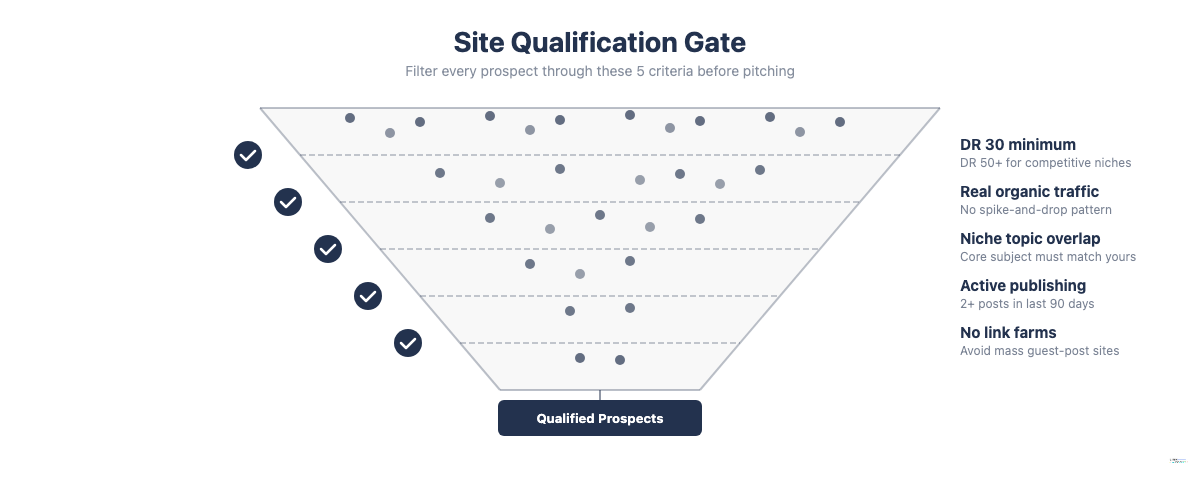
- Domain Rating: 30 or above (DR 50+ for competitive niches)
- Consistent monthly organic traffic from Google: not a spike-and-drop pattern
- Core topic overlap with your niche
- At least two new posts published in the last 90 days
- No signs of mass guest posting: avoid sites where every post is a placement from unrelated industries
A DR 30 site in your exact niche is more valuable than a DR 70 generalist site with no audience overlap.
How to Find the Right Contact at Each Site
The right contact is the editor, content manager, or blog owner who approves and schedules posts. Not a generic inbox. Pitching the wrong person is one of the most common reasons good pitches go unanswered.
Three reliable methods:
– Check the About and Contact pages. Many blogs list a named editor or content manager with a direct email address.
– Use an email finder. Hunter.io is the industry standard for finding verified email addresses by domain. Enter the domain, find the editor’s name from their LinkedIn or About page, and use Hunter to locate their work email.
– Search LinkedIn. Filter by company name and job titles such as “content manager,” “editor,” or “blog manager.” Most professionals in these roles have contact details visible or respond to a brief message.
One practical shortcut: read the site’s recent guest posts and check the editorial note at the bottom of each article. Some blogs name the editor who approved each post. That name is your starting point.
How to Write a Guest Post Pitch That Gets a Reply
A guest post pitch is a short email asking an editor whether they would accept a specific article from you. Most pitches fail because they are too long, too generic, or lead with the sender’s credentials instead of the recipient’s interests. Editors can identify a generic pitch within the first sentence.
Subject Line Formulas That Work
Short, specific subject lines that reference the recipient’s blog or a recent article outperform generic messages like “Guest Post Request” or “Collaboration Opportunity.” Formulas with strong open rates:
Quick pitch: [Topic Idea] for [Blog Name]Guest post idea: [Topic Matching Their Recent Content][First Name]: 3 ideas for your readers
Keep the subject line under 60 characters. Avoid anything that reads like a broadcast message.
The 5-Part Pitch Structure
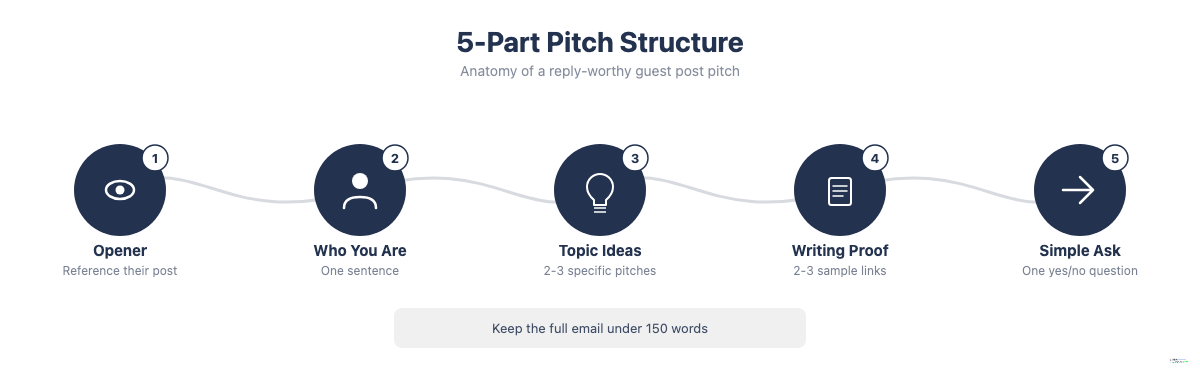
Every effective guest post pitch contains these five elements in order:
- Personalized opener. Reference a specific post on their site with a concrete observation. No generic praise. One to two sentences.
- Who you are. One sentence establishing that you write content in this space.
- Two to three specific topic ideas. Relevant to their audience and not already covered on their site.
- Proof of quality. Links to two or three published articles from comparable sites.
- A low-friction ask. “Would any of these work for [Blog Name]?”. Keep it as simple as that.
Keep the full email under 150 words. A follow-up sent five to seven days later recovers a meaningful share of missed replies without damaging your relationship with the editor. See our outreach emails guide for more templates and subject line data.
3 Guest Post Outreach Email Templates (Copy-Ready)
These three templates cover the most common outreach scenarios. Personalize the bracketed fields before sending. The opener must reference something specific to each recipient’s site.
Template 1: The Topic-First Pitch
Subject: Quick pitch: [Topic Idea] for [Blog Name]
Hi [First Name],
I read your post on [specific article title]: the section on [specific detail] gave me a new angle on [topic].
I write about [your niche] and wanted to pitch a few ideas for [Blog Name]:
- [Title Idea 1]
- [Title Idea 2]
- [Title Idea 3]
A couple of recent pieces: [Link 1], [Link 2].
Would any of these work for your readers?
[Your Name]
Template 2: The Relationship-Led Pitch
Subject: [First Name]: guest post idea (saw your piece on [topic])
Hi [First Name],
I have been reading [Blog Name] for a while. Your post on [specific topic] is one I have referenced more than once.
I contribute to several blogs in [your field] and wanted to see if [Blog Name] is open to guest content.
I had a few ideas in mind:
- [Topic idea 1]
- [Topic idea 2]
My recent work: [Link 1], [Link 2].
Happy to send a full outline if any of these fit.
[Your Name]
Template 3: The Follow-Up Email
Subject: Re: Quick pitch for [Blog Name]
Hi [First Name],
Circling back on my note from [X days ago]. I know inboxes get busy.
Still happy to write any of the pieces I mentioned. If the timing or topics do not work, no problem.
[Your Name]
Send the follow-up once, five to seven days after the original email. One follow-up is appropriate. More than one reduces your chances of a future response from the same editor.
Best Tools for Guest Post Outreach
The right stack depends on your outreach volume. Small campaigns need different tooling than agency-scale operations running 100 or more pitches per week.
| Tool | Best For | Pricing (approx., reported) |
|---|---|---|
| LinkForce | Finding vetted guest post placements with verified DR and traffic | Campaign-based |
| Hunter.io | Finding verified editor email addresses by domain | Free tier + from approx. $49/month |
| BuzzStream | Relationship-based outreach and follow-up management | From approx. $24/month |
| JustReachOut | PR-driven guest post outreach and journalist pitching | Starter approx. $147/month |
| Pitchbox | High-volume agency outreach with CRM and automation | Agency pricing on request |
| Respona | Prospecting and personalized outreach in one platform | From approx. $99/month |
| Apollo.io | High-volume B2B lead prospecting and outreach automation | Free tier + paid plans |
For small-scale outreach (under 50 emails per week): Hunter.io for email discovery combined with BuzzStream for follow-up sequences covers most independent campaigns for under $100 per month. For agency-scale outreach (100 or more emails per week): Pitchbox or Respona combined with Ahrefs handles the volume. A marketplace like LinkForce reduces manual site vetting time significantly.
5 Guest Post Outreach Mistakes That Kill Your Acceptance Rate
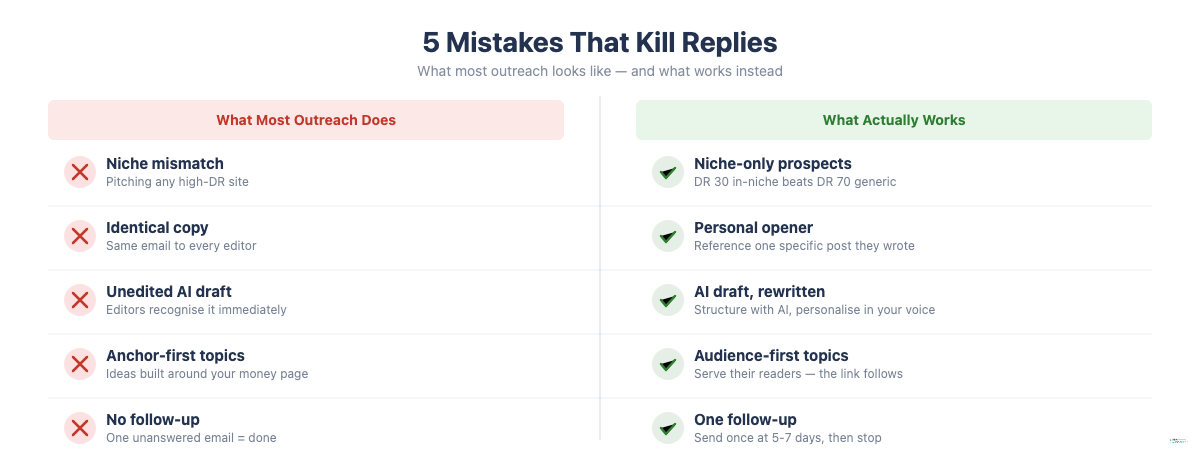
Most manual guest post outreach fails for predictable reasons. These five account for the majority of low acceptance rates.
1. Pitching sites outside your niche. Niche irrelevance is the fastest path to being ignored or marked as spam. Qualify every prospect for topic overlap before outreach begins. Even a high DR site is not worth pitching if there is no audience connection.
2. Using identical copy for every pitch. Editors receive dozens of pitches per week. A generic opener signals immediately that you did not read their site. Write one personalized sentence per pitch referencing a specific post or observation about their recent content.
3. Sending AI-generated pitches without rewriting. AI drafts are recognizable. Many editors now decline any email that reads like it was generated without human review. Use AI to structure a draft, then rewrite the personalized elements in your own voice.
4. Framing topic ideas around your anchor text. If every pitch idea happens to require a link to your target money page, editors notice. Pitch topics that genuinely serve their audience. The right anchor will follow naturally.
5. Not sending a follow-up. A single unanswered email usually means a busy inbox, not rejection. Send one brief follow-up at five to seven days. No apology needed. Keep it short and direct.
How to Track Guest Post Outreach Results
Tracking results is what separates a campaign from a guess. Four metrics cover the full picture:
– Reply rate: percentage of sent pitches that receive any response. A healthy rate on personalized outreach is 15 to 25 percent.
– Acceptance rate: percentage of conversations that result in a confirmed post slot. Typically 40 to 60 percent of engaged replies.
– Published links: total count of live guest posts with an active backlink to your target page.
– Referral traffic and DR movement: whether placements are driving visits and whether your domain rating is trending upward.
A spreadsheet with columns for site, contact name, outreach date, status, and published URL handles most campaigns. For anything above 20 active prospects, a CRM or outreach tool with pipeline tracking prevents follow-ups from falling through the cracks. Our outreach strategy guide covers how to structure a full quarterly campaign.
Frequently Asked Questions
What is a good response rate for guest post outreach?
A reply rate of 15 to 25 percent is healthy for targeted, personalized outreach. Generic templates typically achieve 3 to 5 percent. A rate below 10 percent usually points to lack of personalization or pitching sites with little niche overlap.
How many guest posts should I pitch per week?
For individual contributors, 10 to 20 targeted pitches per week allows enough research time for genuine personalization. For agency teams, 50 to 100 per week is common, but requires dedicated tooling and at least one person managing the pipeline full-time. Volume without personalization consistently underperforms.
Is guest post outreach still effective in 2026?
Yes. Targeted manual guest post outreach to relevant, high-quality sites continues to produce durable editorial links with real SEO value. What no longer works is mass outreach to irrelevant sites and generic pitches that show no evidence of research.
What is the difference between guest post outreach and blogger outreach?
Guest post outreach specifically means pitching a full article you will write for publication on another site. Guest blogging and blogger outreach are broader terms that include reviews, mentions, collaborations, and link insertions. In practice the terms are often used interchangeably, but they describe different scopes of work.
How long should a guest post pitch email be?
Under 150 words. Editors are busy and long pitches rarely get read in full. Lead with your topic ideas, keep the personalized opener brief, and make the ask as simple as possible. If an editor wants more detail, they will ask.