
Most outreach emails get ignored for the same reason. They read like a pitch instead of a message written for one specific person. The fix isn't usually a complete rewrite, though. It's a handful of small, specific changes to the subject line, the first two sentences, the follow-up timing, or the list you're sending to in the first place.
The 20 changes below are grouped into five areas: the first touch, the message body, tone and framing, follow-up timing, and list quality. Every one of them is something you can apply to your next outreach batch today, whether you're running SEO outreach for a guest post, a link request, or a digital PR story. You'll see most of the lift within the first few hundred emails you send.
First Touch and Subject Line
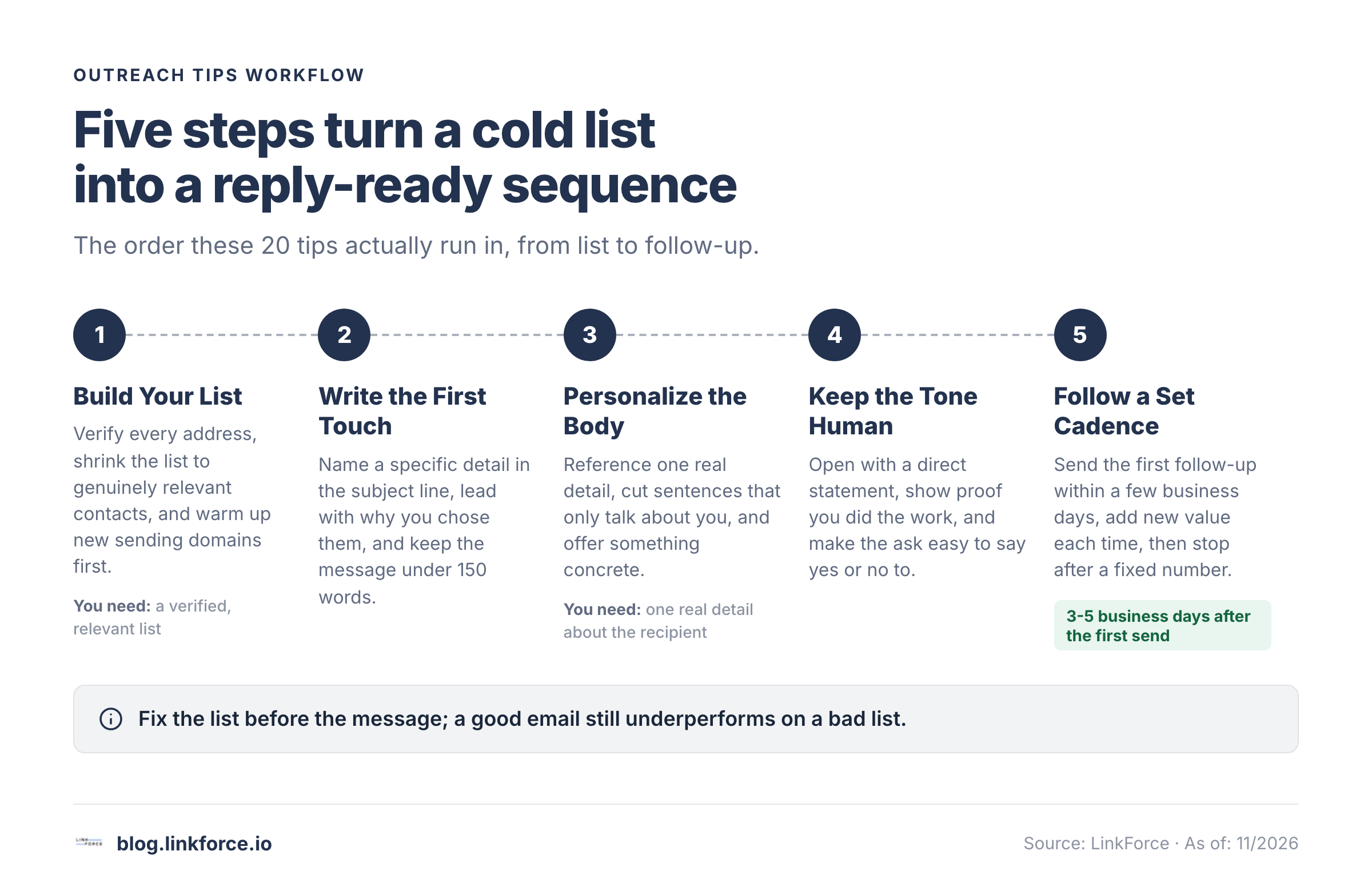
Whether you call it a cold email or just outreach, the subject line and opening line decide whether the rest of your message gets read at all. These four changes make the first touch feel like it was written for the recipient, not pasted from a list.
Name a Specific Detail in the Subject Line Instead of a Category
A subject line like "Guest Post Opportunity" or "Partnership Inquiry" is fast to write, but it tells the recipient nothing except that this is a mass email. Naming something specific instead, such as the title of a page you're referencing or the exact topic you want to cover, signals in three or four words that you actually looked at their site. Specific subject lines don't just read better either; they also survive inbox previews more often, since the recipient sees the detail before they open anything.
Lead With Why You Chose Them Instead of Your Pitch
The first sentence is where most outreach emails lose the reader, because it jumps straight into what the sender wants. Open with the concrete reason you picked this person or this page instead. A specific article, a recent update, or a gap you noticed all work better than a generic compliment. The ask can wait until the second or third sentence. It's worth the extra patience. Readers decide whether to keep reading in the first line, and "I wanted to reach out because..." followed by generic praise reads as a template every time.
Keep the First Message Under 150 Words
A long first message asks for more attention than a stranger is willing to give before they know what you want. Keeping the first touch under roughly 150 words forces every sentence to earn its place, although that's harder than it sounds when you have a lot you want to say. One line on why you're writing, one or two lines of context, and one clear ask is usually enough. If the message needs more explanation than that, save it for the reply, not the first email.
Ask One Specific Question Instead of Making One Big Ask
A vague ask like "Would you be interested in working together?" puts the thinking work back on the recipient. That's exactly what makes people archive a message instead of answering it. Replace it with one specific, easy-to-answer question: a particular page to update, a particular angle to cover, or a particular date to confirm. A specific question is also easier to say yes to in one line, which is most of what you need from a first reply anyway.
Message Body and Personalization
Once the subject line and opening earn a read, the body of the message either reinforces that this is personal or gives away that it's a template. These four changes keep the body focused on the recipient instead of on you.
Reference One Real and Recent Detail From Their Site or Content
One specific, verifiably real detail, such as a line from a recent post or a feature on their page, does more for credibility than several sentences of general compliments. It proves you spent thirty seconds on their site before writing, which most outreach senders skip entirely. Pick a detail that's actually tied to your ask rather than a random compliment, so the reference does work instead of just taking up space. You'll get more credit for one real detail than for five vague ones.
Cut Every Sentence That Talks About You Instead of Them
Outreach emails that spend the first paragraph introducing the sender's company, history, and credentials lose the recipient before the ask even shows up. Every sentence should pass one test: it either helps the recipient decide whether to respond, or it just talks about us. If a sentence only exists to introduce your company, however, cut it, or move it to a signature line instead of the message body.
Offer Something Concrete Before You Ask for Anything
Outreach that leads with a request and only mentions value afterward, if at all, reads as one-sided. Leading with something concrete you're offering changes the exchange. Instead of "give me something," it becomes "here's something, and here's what I'd ask in return." It doesn't need to be large. It needs to be specific enough that the recipient can picture exactly what they're getting.
Match Your Tone to How They Actually Write Instead of a Template Voice
A stiff, formal message to someone who writes casually on their own site, or the reverse, reads as a mismatch instantly. Although it takes only a few extra minutes, skim two or three recent posts or pages before writing and match the general register, without trying to mimic their exact voice. A message that sounds like it was written for this specific person, in roughly their own style, survives the "is this a template" skim test that most outreach fails.
Tone, Framing and Credibility
Outreach often fails for reasons that have nothing to do with the offer itself. It sounds like a pitch instead of a conversation. These four changes fix how the message is framed, not what it contains.
Replace "I Wanted to Reach Out" With a Direct Statement
Opening lines like "I wanted to reach out" or "I hope this email finds you well" delay the actual point, and they're an instant signal of a mass-sent message, since almost no one talks that way to someone they already know. State the reason for writing directly in the first sentence instead. A direct opening reads as more confident, not less polite, and it respects the time it takes to read past the first line. It's a small swap with an outsized effect.
Show Proof You Did the Work Instead of Just Noticing Them
Saying "I love your content" signals that you looked at the site for a few seconds. Showing a specific observation, such as what a particular page is missing, what it does well that competitors don't, or a number that stood out, signals something different: that you actually read it and thought about it. That second kind of message gets treated differently because it demonstrates effort the recipient can verify in one glance.
Make the Ask Easy to Say Yes To
An ask that requires the recipient to make several decisions at once, such as picking a topic, a deadline, and a format in the same reply, adds friction a busy inbox won't tolerate. Narrow the ask down to one decision wherever you can, and offer a default option so a one-word reply, "sounds good" or "that works," is enough to move forward. Obviously, the easier the yes, the more yeses you'll get.
Give Them a Clear Way to Say No Without Feeling Bad
Messages that only account for a yes put pressure on the recipient, even if that's not the intent, and pressure is one of the fastest ways to get ignored rather than answered honestly. A short, genuine line such as "no worries if this isn't a fit" removes that pressure. Counterintuitively, it tends to raise response rates too, because it makes any reply, including a no, feel low-cost to send. People are far more willing to answer an email they don't feel cornered by.
Timing, Follow-Up and Cadence
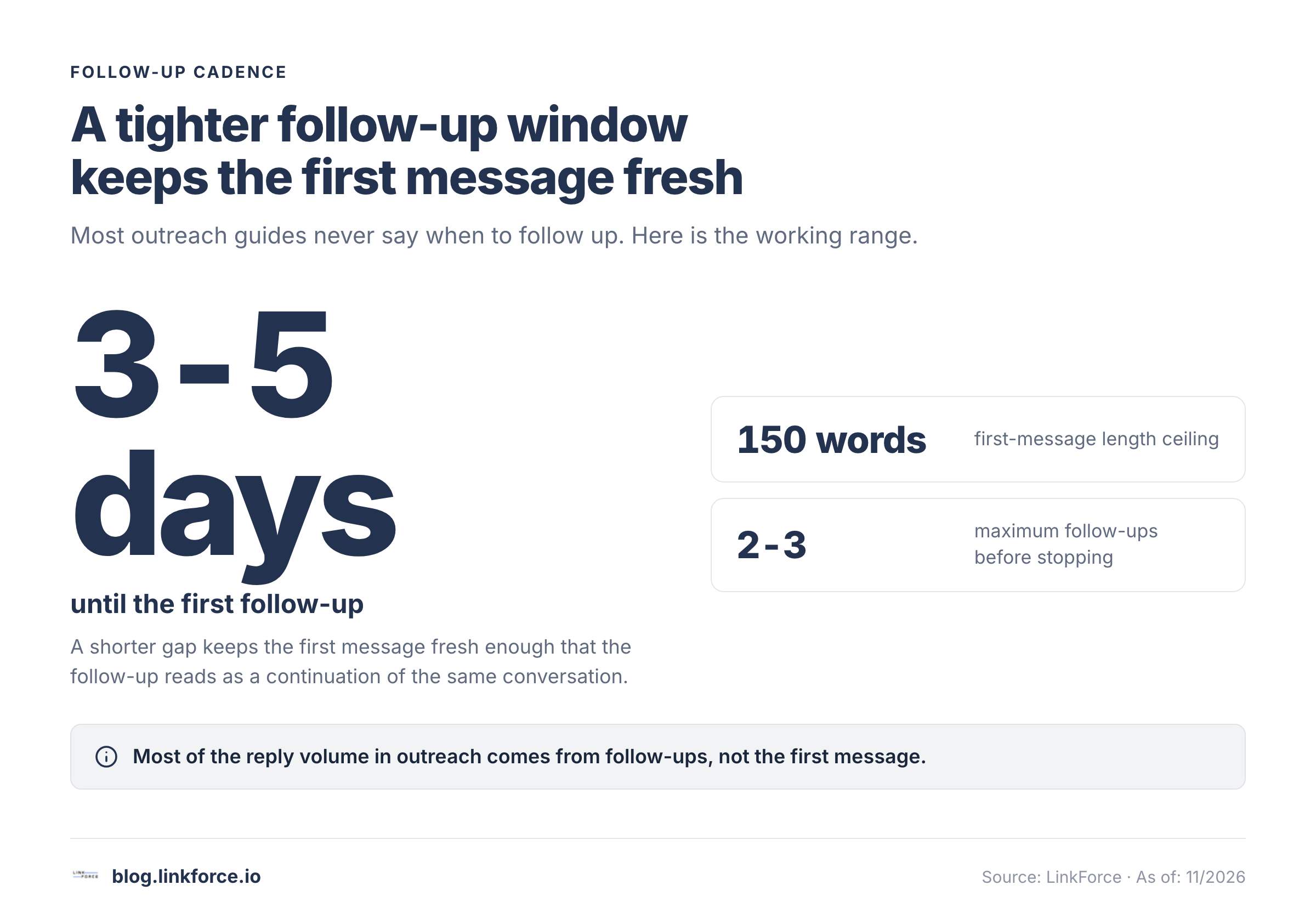
Most of the reply volume in outreach comes from follow-ups, not the first message. Yet most senders either stop after one email or follow up so aggressively that it reads as pressure. These four changes fix the cadence.
Send Your First Follow-Up Within a Few Business Days Instead of Weeks Later
Waiting two or three weeks to follow up means the first message has usually been forgotten entirely, so the recipient has to re-read it from scratch just to understand the follow-up. A shorter gap, in the range of three to five business days, keeps the first message fresh enough that the follow-up reads as a continuation of the same conversation rather than a second cold email. You won't need to re-explain who you are or why you're writing.
Add New Value in Every Follow-Up Instead of Just Checking In
A follow-up that only says "just following up" or "wanted to bump this to the top of your inbox" doesn't give the recipient anything new to respond to. It reads as a nudge rather than a message. Every follow-up should add something: a new piece of information, a narrower version of the ask, or an answer to a question they might reasonably have. A follow-up that gives the recipient a new reason to reply performs differently than one that only repeats the first message. You're essentially sending a new email, not a reminder.
Stop After a Fixed Number of Follow-Ups Without a Reply
Outreach that continues indefinitely without a reply reads as pressure rather than persistence, and it can damage the sender's reputation with that contact for any future outreach too. Deciding in advance on a fixed number of follow-ups, typically two or three after the first message, keeps the sequence predictable. It also lets you move on to the next prospect without second-guessing when to stop.
Test Send Times Instead of Assuming Mornings Work Best
Assuming early mornings on weekdays are universally the best time to send outreach ignores how differently inboxes get used across industries and time zones. Rather than defaulting to one assumed best time, split a batch across two or three different send windows and track which one gets opened and answered for that specific list. The right send time depends on who you're emailing, not on a rule of thumb someone else came up with, even though that rule of thumb is tempting to default to.
Targeting, List Quality and Deliverability
Good message writing can't fix a list that was built carelessly or a sending setup that lands in spam. These four changes address the layer underneath the message itself.
Verify Every Email Address Before You Send
Sending to unverified addresses, including guessed patterns and addresses scraped from outdated pages, produces bounces that damage sender reputation. Worse, it pushes every future message, to everyone on that domain, further toward spam. Running a list through an email verifier before sending is a one-time cost that clearly pays for itself, protecting every campaign after it, not just the current one.
Shrink Your List and Raise Your Relevance Bar
Despite feeling like more reach, a larger list isn't an advantage if most of it is only loosely relevant to what you're offering. Cutting a list down to contacts where the fit is genuinely strong, and writing a more specific message to that smaller group, consistently outperforms a longer list of generic recipients. Relevance is what personalization is actually built on. A smaller, well-targeted list also makes every other tip on this page easier to apply, since there's time to research each contact properly. It's the one change that makes all the others easier.
Warm Up New Sending Domains Before a Real Campaign
Sending a large outreach volume from a brand-new domain or mailbox right away is one of the most common reasons an otherwise well-written campaign lands in spam instead of the inbox. Ramping up volume gradually over one to two weeks feels slower, but it gives mailbox providers a track record to trust before you send at full volume.
Check Your Spam Placement Before Blaming Your Copy
When reply rates are low, it's tempting to rewrite the message again and again. But a message that never reaches the inbox can't get a reply no matter how it's worded. Checking spam placement, through a seed-list test or our email deliverability checklist, before changing the copy again rules out the most common silent cause of low reply rates: the email was never seen in the first place. That's an easy thing to rule out before you touch the copy at all.

800+ SaaS marketers swap partner, integration and content links. Free plan, no credit card.
Outreach Tips: Frequently Asked Questions
How Do You Get Better at Outreach?
Getting better at outreach comes from improving a small number of specific things rather than rewriting the whole approach: a more specific first message, a shorter and more consistent follow-up cadence, and a smaller, better-targeted list. Most of the gain comes from fixing the first touch and the follow-up timing, since those two areas affect every message sent afterward.
What Does Outreach Consist Of?
Outreach consists of four connected parts: building or buying a list of relevant contacts, writing a first message tailored to each one, following up on a set schedule when there's no reply, and tracking what's working so the next batch improves on the last. Skipping any one of the four, most often list quality or follow-up, is what makes an otherwise well-written outreach campaign underperform.
How Do You Conduct Outreach the Right Way?
Conducting outreach well means starting from a short, relevant list rather than a long generic one. From there, write a first message that references something specific about each recipient, keep that message short, and follow up two or three times on a set schedule before moving on. The "right way" isn't really about any single clever tactic. It's about doing those basics consistently for every contact instead of only the first few on the list. You don't need a bigger playbook, just a more consistent one.
The free Email Permutator generates every common address format for a name and domain.