
A good cold email subject line is short, specific to the recipient, and honest about what's inside the email. It tells a stranger enough to decide the message is worth ten seconds, without promising something the email itself can't deliver. Everything else, personalization, length, emojis, urgency, is a tactic in service of that one job.
Most advice on this topic repeats the same unsourced claims. Frankly, it's hard to find a listicle on this topic that cites a real sample size at all. This guide doesn't do that: it sticks to numbers from named studies, Saleshandy's 2026 cold email benchmark and Snov.io's own platform data, both with disclosed sample sizes, plus a full, ready-to-send example bank organized by the situation you're actually emailing about.
What makes a cold email subject line good?
A subject line earns an open when a stranger can tell, in under seven words, who's emailing and why it matters to them specifically. That means naming a real detail (a company, a role, a shared contact, a specific problem) instead of a vague teaser, and it means the email itself has to deliver on whatever the subject line implies.
The subject lines that consistently underperform aren't the short ones or the long ones. They're the ones that could've been sent to anyone: "Quick question," "Checking in," "Partnership opportunity." A recipient's seen those exact words hundreds of times, and the brain learns to skip them before the eyes finish reading.
Strip away the tactics and here is what that leaves as the real checklist:
- Specific to one recipient, not a template that still reads like a template.
- Clear about the topic, so the open doesn't feel like a bait-and-switch.
- Short enough to survive the shortest inbox preview pane it'll land in.
- Free of language that filters and recipients both associate with spam.
What the data says about subject line length and open rates
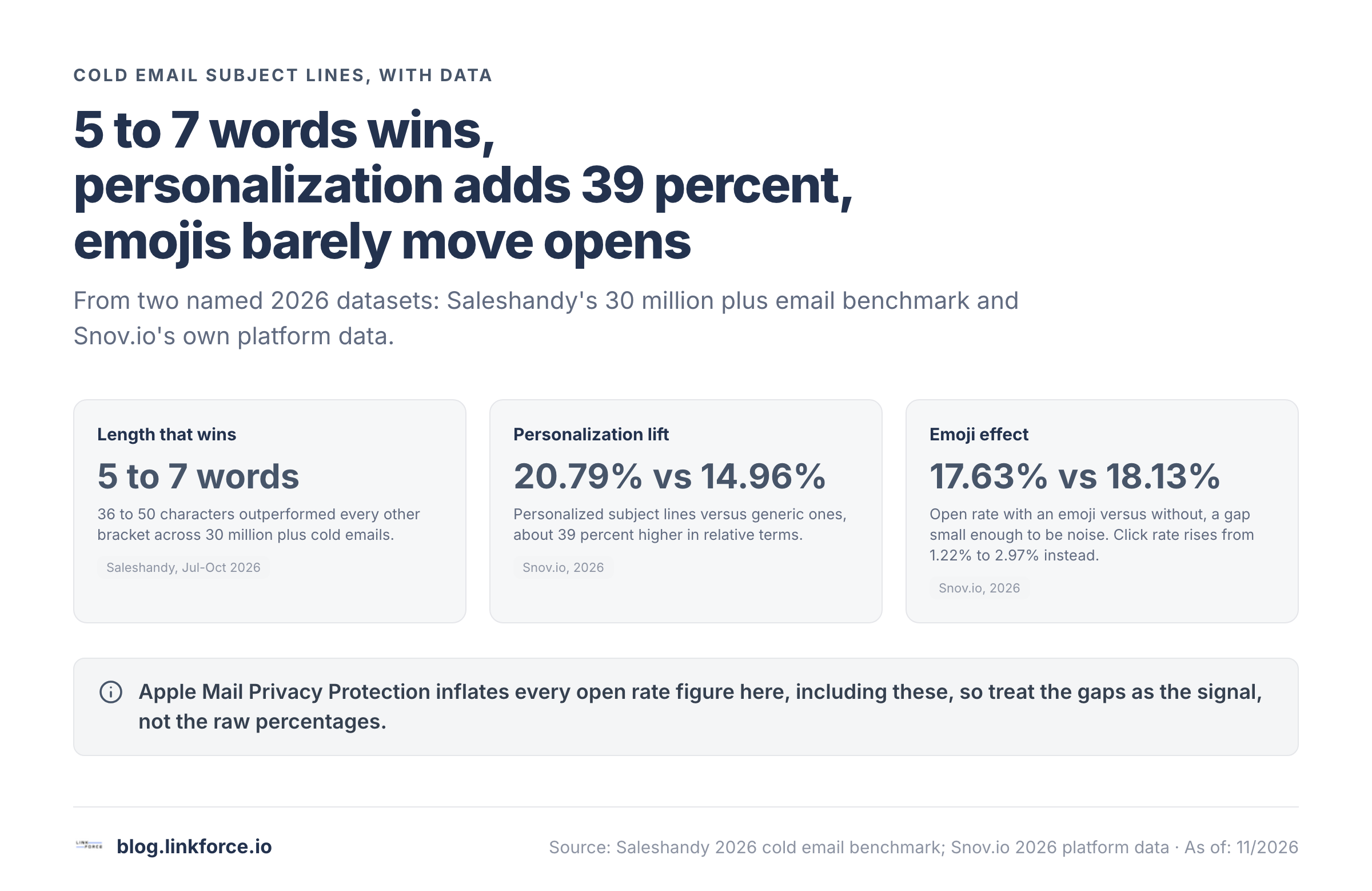
Across more than 30 million cold emails sent between July and October 2026, subject lines of 5 to 7 words (roughly 36 to 50 characters) consistently outperformed every other length bracket, according to Saleshandy's 2026 cold email benchmark report. Lines shorter than 3 words read as incomplete, and lines longer than 7 words didn't survive mobile screens; they started getting cut off before the recipient reached the point.
That length window exists for a mechanical reason as much as a psychological one: every major email client truncates the subject line before it ever reaches a recipient's eyes, and mobile clients are the strictest about it. Based on testing published by several email deliverability vendors, approximate visible-character counts before truncation look like this:
- Gmail, desktop browser: around 70 characters.
- Outlook, desktop app: roughly 50 to 73 characters.
- Apple Mail, desktop: roughly 55 to 78 characters.
- Gmail app, mobile: as few as 33 to 41 characters.
- Apple Mail, iPhone: around 46 to 48 characters.
- Outlook, mobile app: around 38 to 46 characters.
These truncation-character figures vary by device, font size, and screen width, and no email client publishes an official spec, so treat them as directional, not exact. The practical takeaway holds regardless of the exact number: put the specific, recipient-relevant part of the subject line in the first 30 to 40 characters, because that's the part every client shows, every time.
Saleshandy's benchmark data (same 30-million-email dataset) also flags three mechanical mistakes that get subject lines filtered before a human ever sees them: colons and quotation marks, which trigger spam scoring in Microsoft 365 and Outlook; "Re:" or "Fwd:" prefixes on a first-contact email, which every major inbox provider now flags as a deception signal; and ALL CAPS, which was penalized across every email service provider in the dataset. None of these cost opens through poor writing. They cost opens before the subject line's even displayed.
Does personalization actually raise open rates?
Yes, measurably. Snov.io's 2026 analysis of its own sending platform found personalized cold email subject lines reached a 20.79% open rate, against 14.96% for generic subject lines sent to the same kind of list. That is close to a 39% relative improvement from personalization alone, on real send data rather than a one-off test.
Personalization in a subject line is not the recipient's first name in brackets. The subject lines that earn that lift usually reference one of:
- The company name, when it changes the sentence's meaning (not just dropped into a template).
- A specific role or team the recipient actually has.
- A recent, public trigger event (funding round, launch, hire, job change).
- A detail that proves the sender looked at something real before writing.
A first name alone, especially a merge-tag first name sitting awkwardly inside brackets, reads as mail-merge personalization, which recipients recognize instantly and which doesn't carry the same lift as personalization tied to a real, checkable detail.
Do emojis help or hurt cold email subject lines?
Mostly neutral on opens, and genuinely useful further down the funnel, per the same Snov.io platform dataset: subject lines with an emoji got a 17.63% open rate versus 18.13% without one, a difference small enough to be noise. But emails with an emoji in the subject line got a 2.97% click rate against 1.22% without, and a 0.64% reply rate against 0.48% without.
Read together, that means an emoji in a cold email subject line won't reliably win you more opens, and it carries real risk in a first-contact B2B email, where it can read as a promotional blast rather than a message from a person. If you use one at all, save it for a warmer, already-replied thread rather than a stranger's first message, and never use more than one.
The free Email Permutator generates every common address format for a name and domain.
Why open rate alone is a misleading number
Treat every open rate figure in this guide, and honestly every open rate figure anywhere, with one caveat: Apple's Mail Privacy Protection (MPP) feature pre-loads a message's remote content, including the invisible tracking pixel that records an "open," the moment the message arrives, whether or not the recipient ever looks at it. Mailchimp's own help documentation confirms this directly: for contacts who've got MPP enabled, Apple Mail loads tracking pixels in advance even when the contact hasn't opened the email, and the platform can't accurately report opens, device, location, or email client for those contacts. The more of your list reads mail through an Apple Mail app, the more inflated your open rate becomes, independent of anything in your subject line.
Apple's Mail Privacy Protection doesn't make open rate useless. It makes it a relative metric, good for comparing two subject lines sent to the same list in a real A/B test, bad as an absolute number to chase or to compare across different lists and different tools. Reply rate and click rate are less distorted by MPP and are the better metric whenever you can measure them.
30 cold email subject lines that are ready to send
Every line below is finished, not a bracket template you still have to fill in. These cover the outreach scenarios that come up most in cold email: a stranger, a referral, a shared event, a pain point, curiosity, and a re-engagement bump. Swap the bracketed detail for a real one specific to your recipient, and keep the rest as close to the pattern as it reads naturally, since that's where most rewrites go wrong.
Cold outreach to a stranger
- Question about [Company]'s [specific process, e.g. "onboarding flow"].
- [Your company] for [their role] at [Company].
- Saw [Company]'s [specific detail], quick thought.
- [Mutual topic] at [Company]?
- Found a gap in [Company]'s [specific page/process].
These work because every bracket forces a real, checkable detail into the first line, which is exactly what Saleshandy's and Snov.io's data both point to as the difference between a 15% and a 21% open rate.
Referral or mutual connection
- [Name] suggested I reach out.
- [Mutual contact] thought we should talk.
- Following up on [Name]'s introduction.
- [Name] mentioned [Company] might need this.
- A note from [Name], about [Company].
A real referral subject line borrows trust the sender hasn't earned yet, which is why it consistently reads as less "cold" than any of the other categories here, even with zero stylistic tricks.
Event or shared context
- We were both at [Event name].
- Following up from [Event/Conference].
- [Company]'s talk at [Event] got me thinking.
- Saw you on the [Event] speaker list.
- Met your team at [Event].
Problem or pain-point led
- [Company]'s [specific metric] could be higher.
- The [specific process] slowing down [Company].
- Why is [Company] still doing [specific task] manually?
- A fix for [Company]'s [specific problem].
- [Number]-minute fix for [specific pain point].
Curiosity led (use sparingly, keep it honest)
- A question about how [Company] handles [X].
- What [Competitor] is doing differently.
- One thing [Company]'s [page/process] is missing.
- Is [specific tactic] still working for [Company]?
- Noticed something on [Company]'s site.
Curiosity works only when the email itself resolves the curiosity in the first sentence. A curiosity subject line with no payoff is the single fastest way to burn a domain's reply rate.
Re-engagement or bump
- Still worth a look, [Name]?
- Closing the loop on [topic].
- One more thought on [Company]'s [X].
- Did this get buried, [Name]?
- Quick bump: [original subject topic].
Cold email subject line mistakes that kill open rates
- Spam-trigger words. "Free," "guarantee," "act now," and excessive punctuation ("!!!") still move a message toward spam folders on major providers, independent of how well-written the rest of the line is.
- ALL CAPS. Flagged across every email service provider in Saleshandy's dataset. It reads as shouting to a human and as a spam signal to a filter.
- Fake "Re:" or "Fwd:" on a first email. Major inbox providers now detect this specifically and treat it as deceptive, which is worse for deliverability than a plain, honest subject line.
- A promise the email can't keep. If the subject line implies a guarantee, a mutual connection, or a specific detail that isn't in the first two sentences of the email, the recipient notices immediately and the next email from that domain gets a worse look, not a better one.
- Generic templates with no recipient-specific detail. "Quick question," "Partnership opportunity," and "Checking in" aren't inherently bad words. They're bad because millions of other cold emails use the exact same three phrases with nothing else attached.
A quick subject line checklist before you hit send
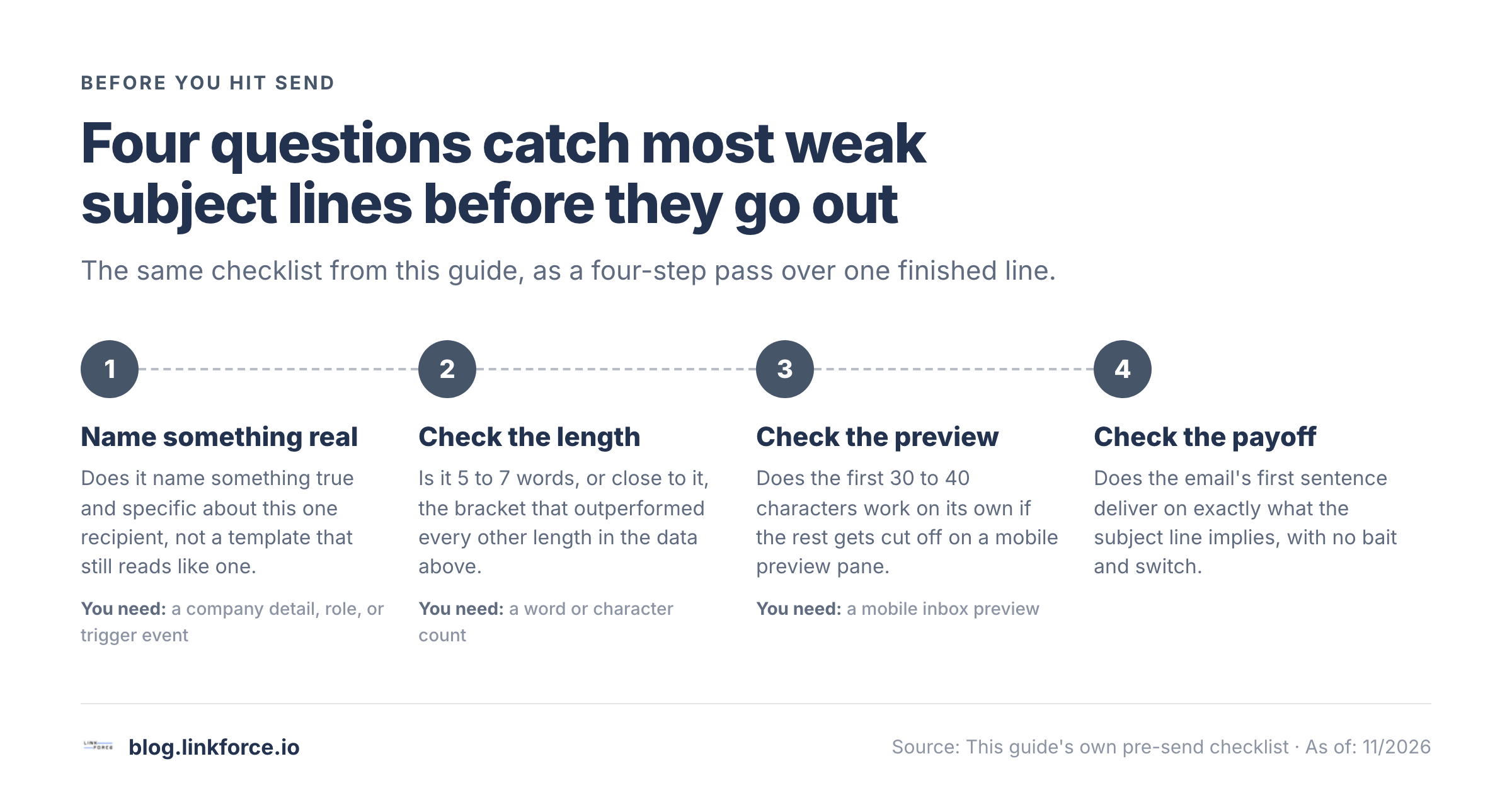
- Does it name something true and specific about this one recipient?
- Is it 5 to 7 words, or close to it?
- Does the first 30 to 40 characters work on its own if the rest gets cut off?
- Does the email's first sentence deliver on exactly what the subject line implies?
- Would you send this exact line to this exact person if they could see your other emails?
If any answer is no, that is the one line to fix before you send to a whole list.

Reach 800+ SaaS marketers who are open to partner and content links, no cold list needed.
FAQ: cold email subject lines
How long should a cold email subject line be?
5 to 7 words, around 36 to 50 characters. That's the Saleshandy 2026 benchmark number (30 million-plus cold emails), not a round-number guess.
Do personalized subject lines actually get more opens?
Yes, by a measurable margin: 20.79% versus 14.96% for generic lines, per Snov.io's own 2026 platform data. The gap only holds when the personalization is a real detail, not a bracketed name.
Should I put the recipient's name in the subject line?
It's fine, but it's not a shortcut. A name with nothing else specific attached reads as a mail-merge tag to most recipients and won't match the lift above on its own; pair it with a company detail, role, or trigger event.
Do emojis help cold email open rates?
No, and they occasionally hurt slightly: 17.63% versus 18.13% open rate without one, per Snov.io. They do lift click rate and reply rate once a thread is already warm, just not a stranger's first message.
Why does my subject line get cut off in Outlook or Gmail?
Every client previews a different character count, from roughly 33 on the tightest mobile apps to around 78 on some desktop clients. Front-load the recipient-specific part so the message survives whichever one truncates it.
Is open rate a reliable number to track?
Not on its own. Apple's Mail Privacy Protection pre-loads tracking pixels for a large share of inboxes regardless of whether a human opens the message, which inflates the number industry-wide. Reply rate and click rate hold up better.
Subject lines are one piece of a cold email that gets replies, not the whole system. For the rest of it, structure, follow-up cadence, and what separates a reply from a delete, see our full guide to writing a cold email that gets a response.