
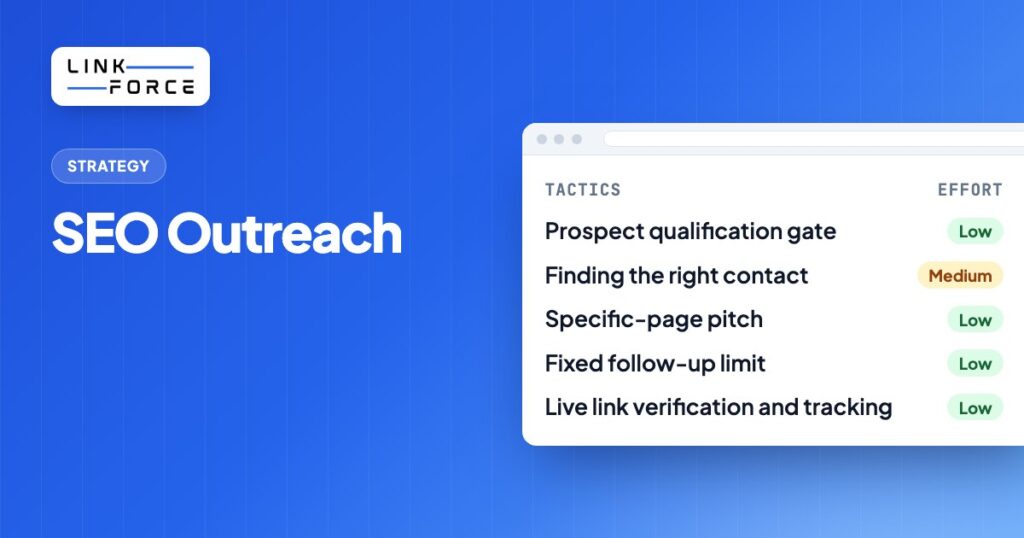
SEO outreach is the work of contacting relevant websites and editors to earn links that point back to your page. It runs in four steps: qualify the prospect, find the right contact, pitch a specific reason to link, and verify and track the link once it's live. A follow-up rule sits between the pitch and the verification. This guide walks through each step in that order so you can run a campaign this week.
What Is SEO Outreach?

SEO outreach is contacting site owners, editors, and writers to earn backlinks from pages that are relevant to your topic. A backlink from a page that already has an audience tells search engines that your page is worth pointing to, and outreach is the work of asking for that link in a way the other side can say yes to.
The process follows the same funnel every time. You build a list of prospects, find the person who decides whether a link goes in, send a message that explains why your page helps their readers, follow up a limited number of times, and then check that the link went live. Most prospects drop out before the last step, which is normal. The campaign works because the qualified prospects that remain are the ones worth the effort.
Outreach isn't the same as sending mass emails. It is definitely not:
- bulk sending one generic template to hundreds of sites that have no reason to link to you
- paying for placements or articles that carry links without a clear disclosure
- trading links in a loop of "link to me and I will link to you" with unrelated sites
- using software to create links to your site automatically
Google's link spam policy names several of these patterns as violations, including buying or selling links that pass ranking credit, excessive link exchanges, and automated link creation. Those are the boundaries your outreach should stay inside.
Is SEO Outreach Worth the Time?
Yes, when the site is relevant and the link would be genuinely useful to its readers. No, when the goal is volume for its own sake. You don't need hundreds of links; you need a few that actually help a reader. Is outreach better than guest posting? They are different tools. Outreach asks an editor to link to a page that already exists, while a guest post creates new content on someone else's site. Outreach is the better choice when a relevant article already exists and needs one more reference. A guest post is worth considering only when you are invited to contribute without payment and without a keyword-stuffed anchor, because Google's link spam policy covers paid guest posts that carry links with optimized anchor text.
A link from a site that has no connection to your topic does little for your reader and carries little weight. A link from an article that already covers the same question, and that would be improved by your page, is what outreach is for.
Before you contact anyone, run each prospect through three checks:
| Check | Worth doing if | Skip if |
|---|---|---|
| Site relevance | The site publishes on your topic or a close neighbour | The site is about something unrelated |
| Reason to link | Your page adds a fact, step, or example the article lacks | You can only say "please link to me" |
| Time per link | You can write a pitch that names the exact page in a few minutes | The only way to pitch is the same template for every site |
If a prospect passes all three, outreach is clearly worth your time. If it fails one, the pitch will read as spam, so spend the time on a better prospect. Rather than asking how many sites you can reach, ask how many you would be proud to point readers to.
Worth-it checklist
- The site would be a sensible place for a reader to find your page.
- You can name the exact page on the prospect's site where the link would sit.
- You can explain in one sentence what your page adds for that reader.
- You are willing to send at most one personalized pitch and one follow-up.
The free Email Permutator generates every common address format for a name and domain.
Step 1: Qualify Prospects Before You Write Anything
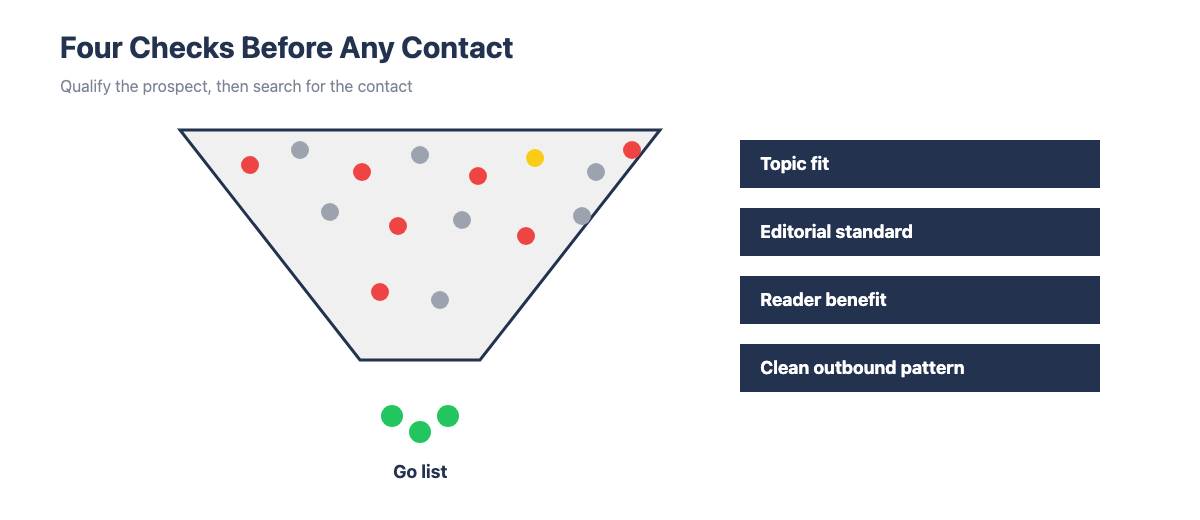
Most wasted outreach goes to sites that were never going to link, and that's the cheapest mistake to avoid. Qualify each prospect before you look for a contact, because a contact search costs more time than a quick check of the site itself. Build the list from topic searches and from the questions your readers ask. A backlink tool such as Ahrefs can show which pages already link to the sources your readers trust, which gives you a qualified starting list. Then run each candidate through four checks:
- Topic fit. The site publishes on your subject or a close neighbour, and its recent articles show it.
- Editorial standard. It publishes articles that explain and cite, not a page of paid placements or a link directory.
- Reader benefit. Your page would help its readers with something the existing article doesn't cover well.
- Clean outbound pattern. It links to other real sites from its articles, and it doesn't look like a sitewide block of unrelated links.
Most prospects fall into a few tactic types, and each type has its own qualifier:
- Resource pages that list useful links. Qualify on whether your page genuinely belongs in the list.
- Broken links on relevant articles. Offer your page as a replacement only if it covers the same topic as the dead link.
- Unlinked brand mentions. Ask for a link only when the mention already exists and the page is about your subject.
- Guest posts. Treat them as editorial only when the post is invited, unpaid, and uses a natural anchor. Google's link spam policy covers paid guest posts that carry links with optimized anchor text.
Go/no-go checklist
- Go: all four checks pass, and you can name the page where your link would go.
- No-go: any check fails. Drop the prospect, note the reason in your tracking sheet, and move on.
For example, if your page explains how to reconcile bank statements, a prospect that publishes practical finance guides for small businesses passes the topic check, while a general news site that mentions finance once does not. A short list of qualified prospects is worth more than a long list of unqualified ones. The gate is the step that most guides skip, and it's the one that protects your time for every step after it.
Step 2: Find the Right Contact
Once a prospect passes, find the person who decides whether the page gets a link. The editor, the writer of the closest article, and the site's partnerships contact are the usual candidates. Look in three places, in this order:
- The author page or byline of the article closest to your topic. The writer is often the person who can update the piece.
- The site's contact or editorial page, which often lists an editor or a partnerships address.
- A professional profile such as LinkedIn, to confirm the role of the person you found and that they still work at the site.
Confirm the address before you send. You shouldn't guess an address from a pattern such as first name at domain and send without checking, because a bounce or a message to the wrong person costs you the prospect. If you can't verify a contact, use the site's contact form or skip the prospect. Collect only the contact details the site publishes for that purpose, and stop there.
Step 3: Write a Pitch That Gives a Reason to Reply
A pitch works when it names the specific page, shows what you add to it, and asks for one clear action. Editors get many requests, and the message that could have gone to any site is the one they delete. Every pitch should have three parts:
- The specific page. The exact URL on their site, and why it's relevant to their readers.
- The addition. What your page adds, in one or two sentences, such as a missing step, a worked example, or a current source.
- The ask. One action. For example, asking whether they would consider linking from a named section, or offering a short summary if that's easier.
Here is a short example of how the three parts fit together. The names and pages are illustrative.
Subject: A missing step in your link building guide
Hi Sam, your guide on link building covers the outreach email well. The step it doesn't cover is what to do after a link goes live, so I wrote a short walkthrough of that at our page on verifying links. If it fits your readers, would you consider linking to it from the section on tracking links? I am happy to send a one-paragraph summary if that's easier.
Subject lines should name the page or the gap, not ask a vague question. A subject such as "A missing step in your link building guide" tells the editor what you want, while "Quick question" reads as a template and gets deleted.
The same structure works for other tactic types. For a broken link, name the dead link, point to your page as a replacement, and keep the ask to one line. For example: "Your article links to a page that no longer loads, and our page covers the same question in more depth. Would you consider swapping the link?" For a resource page, name the list and say in one sentence why your page belongs on it.
Personalization means one specific detail that only someone who read the page would know, such as a section they wrote or a claim they make and you can build on. A name and a city in the greeting is not personalization, and editors recognize the difference.
Is outreach email legal? In the United States, the CAN-SPAM Act covers commercial email, which the Federal Trade Commission defines as any message whose primary purpose is the advertisement or promotion of a commercial product or service. A request for a link to a free article may or may not fall under that definition, but a pitch that promotes a paid product does. The FTC requires accurate sender and routing information, a subject line that is not misleading, a clear disclosure that a message is an advertisement where it applies, and a clear way to opt out of future marketing email. Those habits cost nothing, so use them for every outreach message and include an opt-out line in every follow-up. Rules outside the United States differ, so check the rules for the country your prospect is in.
Keep the message short, write it by hand for each prospect, and send it from an address the editor can reply to. If you find you can't name the page or the addition, the prospect failed Step 1 and you should not send the pitch.
800+ SaaS marketers swap partner, integration and content links. Free plan, no credit card.
How Many Follow-Ups Should You Send?
Public guides on outreach don't agree on the right number of follow-ups, and Google doesn't publish a cadence for outreach messages. So this section doesn't give a number as a fact. Instead, it gives a rule you can apply and the reason for it.
Set a fixed limit before you send the first email, and keep it. Pick a small, fixed limit before you send, and close the thread when you reach it. Public guides differ on the exact number, so choose one you can defend and keep it. Each extra message costs goodwill with the person who decides, and a third or fourth message rarely changes a no into a yes. A limit you set in advance also keeps a campaign from drifting into the repeated messages that make editors stop reading your mail.
A follow-up should add something rather than repeat the pitch. Use it for a short reminder, a one-paragraph summary of the page, or a new reason the page matters now, such as an update to the article it would link from. If the answer is still no, close the thread, mark the prospect as declined in your tracking sheet, and move on. A declined prospect isn't a failure, because the qualification gate exists to find the ones that will say yes.
Step 4: Verify the Live Link and Track It
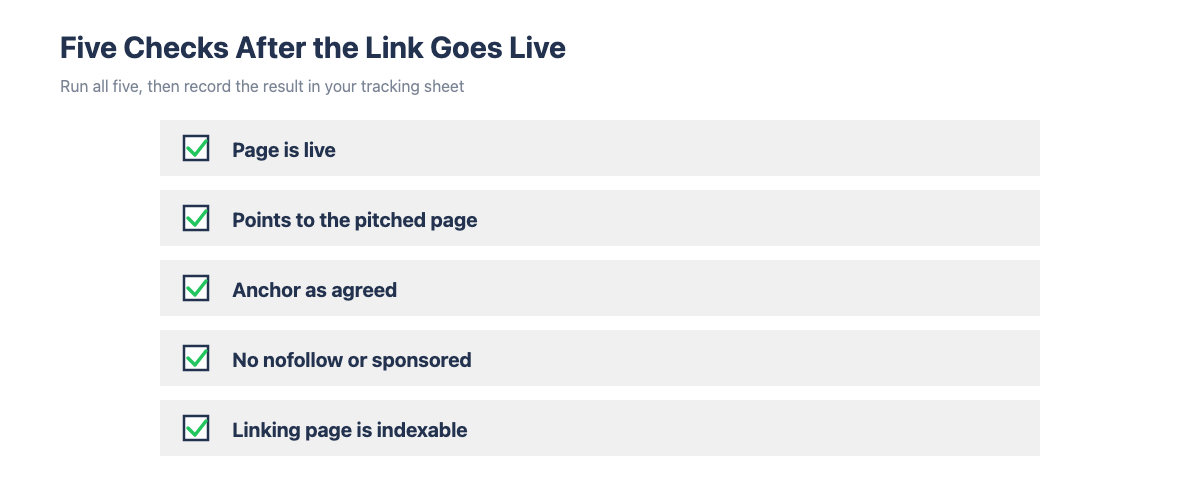
A link that was agreed isn't a link you have, however good the conversation was, and many campaigns lose value right here. After the page goes live, check five things:
- The page is live and reachable, not behind a login or a draft status.
- The link points to the exact page you pitched, not to the homepage or an older URL.
- The anchor text is the one you agreed on, or a natural, descriptive phrase.
- The link isn't marked nofollow, sponsored, or ugc unless you agreed to that. Google says links marked with these attributes generally won't be followed, so their value is different from a standard link.
- The linking page is indexable, meaning it doesn't carry a noindex instruction, so search engines can find the page that holds your link.
Then record the result in one tracking sheet, with these fields:
| Prospect | Page | Date sent | Status | Anchor | Link live |
|---|---|---|---|---|---|
| Example prospect | Example target page | Send date | Status (for example: agreed, declined) | Agreed anchor | Live (yes or no) |
Recheck every live link on a fixed schedule, for example once a month, because pages get edited, moved, or removed. A link that disappears without anyone noticing is the most common way a campaign loses value after it has finished.
Common SEO Outreach Mistakes and How to Fix Them
Most failed campaigns repeat the same few mistakes, and they're easy to fix once you can see them. Each one has a simple fix, and the fix matters more than the warning.
| Mistake | Why it fails | Fix |
|---|---|---|
| Sending a generic pitch to every site | Editors can tell a template from a reason to link, so the message is deleted | Name the specific page and the one addition your page makes |
| Skipping qualification | Time goes to sites that will never link, and the list fills with dead ends | Run the four-check gate before you search for any contact |
| Following up without a stop rule | Repeated messages cost goodwill and rarely change the answer | Set the follow-up limit before the first send, then close the thread |
| Never checking the live link | Links go missing, change their attributes, or point to the wrong page, and nobody notices | Run the five-point check after publication and recheck on a schedule |
Tools for SEO Outreach (Options, Not the Method)
Tools can speed up three jobs in the process, but the process works without them. Tool prices and features change often, so this section names the categories and doesn't compare vendors:
- Prospect research. Backlink tools such as Ahrefs, which show which pages already link to a topic's sources, and so give you a starting list of prospects.
- Contact finding. Tools that look up a contact address or a professional profile from a domain or a name.
- Sequencing. Tools that schedule and send a pitch and its single follow-up from one place.
- Tracking. A spreadsheet or a CRM that records each prospect, page, status, anchor, and live-link check.
Should you hire an agency? An agency makes sense when you need volume and have no time to qualify prospects yourself. Doing it in-house works better when your value depends on knowing your topic, because the qualification gate and the pitch both depend on that knowledge. Whichever route you choose, the same four checks and the same five-point live-link check should apply to every link the agency builds.
Pick the category that fixes your current bottleneck first. Many small campaigns run on a spreadsheet and a standard mail client, and they only add tools when the volume of prospects makes manual work slow.
Key Takeaways
- Qualify every prospect on topic fit, editorial standard, reader benefit, and outbound pattern before you search for a contact.
- Pitch a specific page with one clear addition and one clear ask, written by hand for each site.
- Set a follow-up limit before you send, and close the thread when the limit is reached.
- Verify every live link for the target page, the anchor, the link attributes, and indexability, then track it in one sheet.
- Measure the campaign by the relevant links that are live and stay live, rather than by the number of emails you sent.