


Blogger outreach is the process of contacting bloggers and content creators to earn a backlink, a brand mention, or a guest post placement on their site. One side gets a link or mention that supports search rankings and referral traffic, the other gets content, a product angle, or information their readers want.
This guide covers the full process: finding the right blogs, writing a pitch that gets a reply, following up without annoying anyone, handling paid placements correctly, and measuring whether a campaign worked. If you're comparing outreach software instead, see our blogger outreach tools roundup. If you want to compare outreach agencies, see our guide on guest post outreach.
What Is Blogger Outreach?
Blogger outreach is the practice of contacting bloggers and content creators directly to secure a backlink, a brand mention, or a guest post on their site. It sits inside the broader category of link building, but it doesn't target large media outlets or directories. It specifically targets independent blogs and creator-run sites.
A blogger outreach campaign usually produces one or more of three outcomes:
- An editorial backlink inside an existing or new article
- A brand or product mention, with or without a link
- Referral traffic from readers who already trust that blogger's recommendations
It's rarely all three at once. A single placement usually gives you one or two of these, and that's fine.
That's different from the software you use to run outreach (covered in our blogger outreach tools roundup), and it's different from paying an agency to run it for you (see the DIY-versus-agency section below). This guide is about the process itself: what to do, in what order, and with what words.
Why Blogger Outreach Still Works for SEO and Brand Growth
Blogger outreach still works because it produces links and mentions that other link-building tactics can't fake. Four mechanisms explain why:
- Editorial backlinks carry more weight than directory links. A link placed inside a relevant article, by an editor who chose to include it, signals relevance in a way a submitted directory listing just doesn't.
- Referral traffic arrives pre-qualified. A reader who clicks through from a blog post they already trust is closer to a buying decision than someone who found you through a generic search ad.
- Third-party mentions build credibility you can't buy with ads. A blogger's audience trusts that blogger's judgment, and some of that trust transfers to whatever they recommend.
- Repeat placements compound into real partnerships. A blogger who likes working with you once is far easier to pitch a second and third time, and that clearly lowers the cost of every future campaign.
How to Find and Vet the Right Bloggers
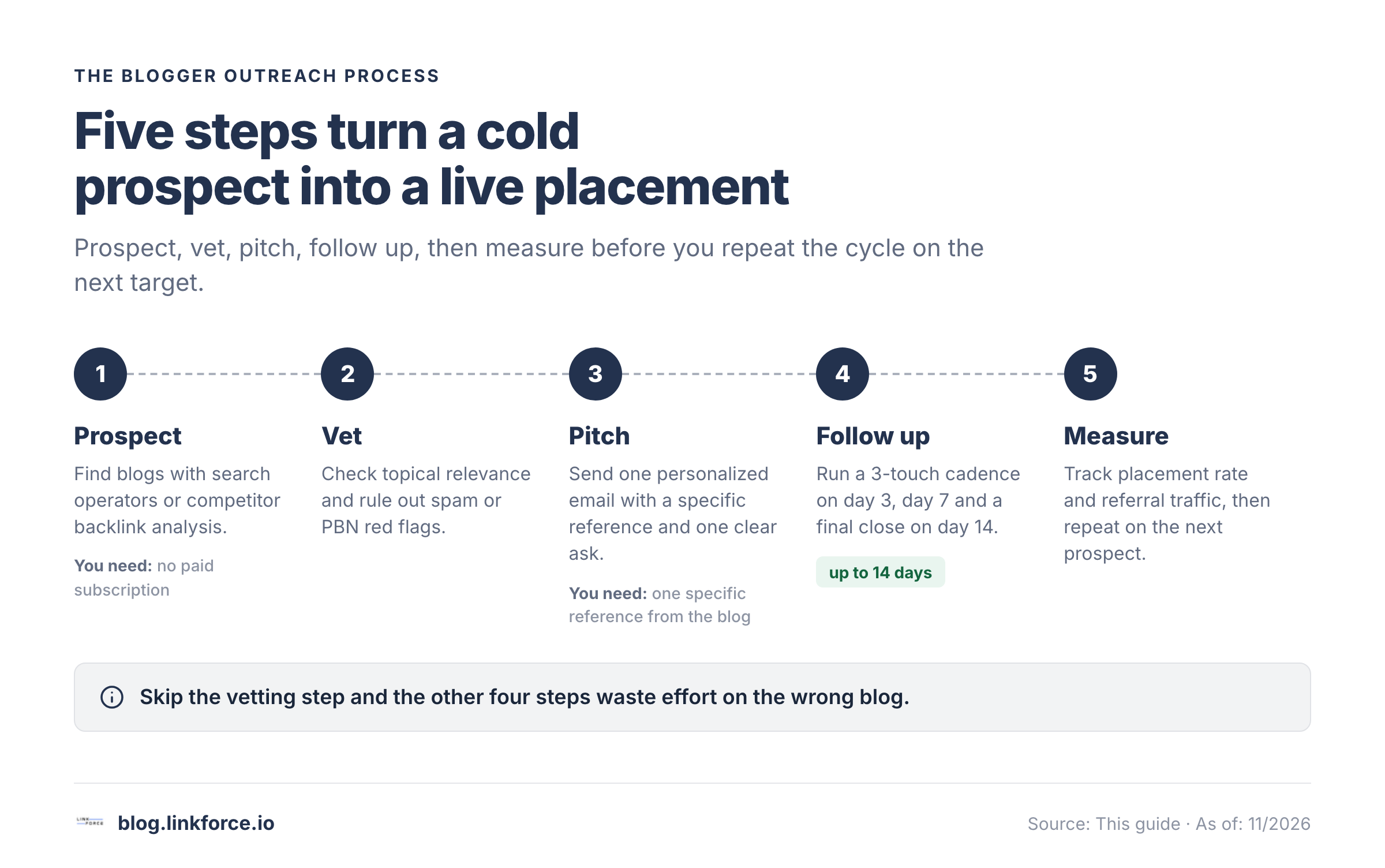
Finding the right bloggers means checking topical relevance and site health before you ever send a pitch, not after. Two things matter before you write a single email: is this blog actually read by people who care about your topic, and is it healthy enough that a link from it helps rather than hurts.
Where to Find Blogs Worth Pitching
Start by naming your industry or niche in one or two words, since that's what every prospecting method below searches on. "Project management software" and "SaaS" point you to different blogs than "running shoes" or "home coffee brewing" would. Three low-cost prospecting methods cover most campaigns, and none of them need a paid subscription to start:
- Search operators. Combine your topic with phrases editors actually use, such as
"guest post" AND "write for us"orintitle:"resources" your-topic. Our free search operator generator builds these strings for you, so you don't have to memorize the syntax. - Competitor backlink analysis. Check which blogs already link to a close competitor. While that link went to someone else, it shows the blogger covers your space and is open to this kind of mention.
- Niche directories and roundups. Blogs that publish "best of" or resource-list posts in your niche are actively looking for things to add, so they're usually faster yeses.
Red Flags That Mean Skip This Blog
Before pitching, check each candidate against this list, because skipping it is how a good campaign turns into a wasted week:
- No topical relevance. If the blog's last ten posts haven't touched your subject, a link from it looks manufactured rather than editorial.
- Weak or declining traffic signal. Thin comment counts, no social shares, and no recent posts are signs the blog's inactive or has lost its audience. Our free domain rating checker gives a quick authority read before you invest time in a pitch.
- A bloated outbound link profile. A sidebar or footer stuffed with unrelated links, or a pattern of paid-looking placements across unrelated niches, is a sign of a link farm, not an editorial blog.
- Private blog network (PBN) patterns. Near-identical templates across several "different" blogs, no real author bio, and no engagement anywhere on the site point to a PBN. Walk away from these, no matter how good their stated metrics look.
Build Google search operator queries for link prospecting with the free Search Operator Generator.
How to Write a Blogger Outreach Pitch That Gets Replies
A pitch gets a reply when it references something specific on the blog, states one clear benefit to the blogger's readers, and asks for exactly one thing. Generic templates fail because an editor can tell in one sentence that it's a copy-paste job.
Guest Post Pitch Template
Subject line: Idea for [Blog Name]: [specific angle, not just your topic]
Hi [First Name],
I read your post on [specific article title] and liked how you covered [specific detail from that post]. I write about [your topic] and had an idea that would fit [Blog Name]'s readers: [one-sentence pitch for the guest post angle].
I can have a draft, with original examples and no filler, ready within [a realistic number] days. Would that work for your editorial calendar?
[Your name]
Resource or Link-Insertion Pitch Template
Subject line: Small addition for your [specific page title] page
Hi [First Name],
Your page on [specific page title] covers [specific detail] well, but it doesn't mention [specific gap], which is something readers often ask about. We have a resource on this exact point: [one sentence describing what it covers and why it's useful, not promotional].
Would it be worth adding as one more resource on that page? I'm happy to send more detail either way.
[Your name]

800+ SaaS marketers swap partner, integration and content links. Free plan, no credit card.
How to Follow Up Without Being Annoying
A short, three-touch follow-up sequence gets most of the replies a pitch will ever get. Bloggers receive dozens of pitches a week, so silence after one email rarely means no. It usually just means your email is buried.
| When | Tone | Goal |
|---|---|---|
| Day 3 | Brief, friendly nudge | Surface the original email again, no new pitch |
| Day 7 | One new detail added | Give a reason to reconsider, such as a finished draft or an example |
| Day 14 (final) | Polite close, no pressure | Leave the door open, then stop and move the lead to your prospect list for a future campaign |
Stop after the third touch. Continuing to email past that point reads as pressure, not persistence, and it risks burning a blog you might want to pitch again later with a different angle.
Published sales-outreach benchmarks recommend a longer sequence of 4 to 7 follow-ups across 8 to 12 touchpoints for cold B2B sales, but blogger outreach isn't sales. A blogger you over-pursue remembers it the next time you pitch, so the shorter 3-touch version above fits the relationship better than a sales-style cadence would.
Handling Sponsored Posts, Disclosure, and Negotiation
A paid blogger placement must be disclosed to readers and marked with a nofollow or sponsored link attribute, with no exceptions, period. This protects the blogger from misleading their audience and keeps the link from passing undisclosed ranking signals it was never meant to carry.
When a blogger asks for payment instead of offering a placement editorially, don't accept the first number. Three points are worth negotiating directly:
- Scope. Confirm exactly what is included: a dedicated post, a mention inside an existing post, newsletter inclusion, or social promotion, since each carries a different fair price.
- Deliverable format. Ask whether the content's blogger-written, brand-provided, or co-edited, since brand-written posts that still pass an editorial review tend to read better to their audience.
- Timeline. Agree on a publish date in writing before payment, since "sometime this month" is the most common source of outreach disputes, and it's an easy one to avoid.
How to Measure a Blogger Outreach Campaign
Placement rate and referral traffic are the two numbers that tell you whether a campaign's working. Everything else in the table below explains why a result happened, not whether it happened.
| Metric | What it tells you | How to check it |
|---|---|---|
| Placement rate | Share of pitches that turned into a live link or mention | Placements won divided by pitches sent, tracked per campaign |
| Referral traffic | Whether the placement sends real readers, not just a link | Your analytics tool's referral-source report, filtered to the publishing blog's domain |
| Backlink quality | Whether the link is likely to help rankings | Topical relevance of the page, and whether the link sits in the body content rather than a sidebar or footer |
| Ranking movement | Whether the target page's position improved after placements landed | Position tracking on your target keyword over the weeks following publication |
A campaign that converts a minority of pitches into placements is normal, not a failure. Plan your prospect list size around that reality: pitching ten well-vetted blogs usually beats pitching a hundred poorly-vetted ones, because the follow-up and relationship work doesn't scale the same way the first email does.
Should You Do Blogger Outreach Yourself or Hire Help?
Do blogger outreach yourself when you've got the time to build relationships over several months and want full control over which blogs represent your brand. Hire an agency or freelancer when you need placements faster than your team can realistically prospect, vet, and pitch on its own.
Published pricing comparisons put outreach-focused services anywhere from roughly $1,000 a month for a smaller, custom-scoped program up to $10,000 or more a month for larger campaigns, though some providers price by the placement instead, in the roughly $35 to $75 range per single link. Treat any figure like this as a market estimate, not a quote. Scope, niche, and placement quality all change the number considerably.
- DIY fits when: you have in-house writing talent, a long runway before you need results, and want to build lasting blogger relationships your team keeps using for years.
- Hiring help fits when: you need placement volume this quarter, your team can't sustain weekly prospecting and follow-up, or you're entering a niche where you've got no existing blogger relationships at all.
If you decide you'd rather compare providers, see our guide on guest post outreach and our blogger outreach tools roundup for the software most agencies and in-house teams run on.
Common Blogger Outreach Mistakes to Avoid
Generic, unpersonalized pitches are the single biggest reason outreach campaigns fail. The mistakes below don't help.
- Pitching irrelevant blogs. A high-authority blog that never covers your topic is a wasted email. Fix: vet for topical relevance before checking any authority metric, not after.
- Sending the same template to everyone. Editors can tell it's a copy-pasted pitch within one sentence. Fix: reference something specific from that blog, as shown in the templates above.
- Giving up after one email. Most replies come from the follow-up, not the first message, yet most campaigns stop after a single attempt. Fix: run the three-touch cadence before writing a blog off.
- Skipping disclosure on paid placements. Undisclosed sponsored content risks the blogger's credibility and your own. Fix: always confirm a nofollow or sponsored attribute on paid links.
- Chasing volume over fit. Mass-pitching hundreds of loosely related blogs produces a low placement rate and a worse reputation. Fix: a shorter, well-vetted list consistently beats a long, unvetted one, so don't confuse a bigger list with a better one.
Frequently Asked Questions About Blogger Outreach
What is SEO outreach, and how is it different from blogger outreach?
SEO outreach is the broader category of contacting anyone, journalists, resource-page owners, partners, or bloggers, to earn a link or mention that supports search rankings. Blogger outreach is the specific sub-channel of that work aimed at independent blogs and content creators rather than news outlets or large publishers. Digital PR, HARO-style journalist pitching, and resource-page link building all fall under the same SEO outreach umbrella, but each one targets a different kind of publisher and needs its own pitch angle.
Do you need your own blog to do blogger outreach?
No, blogger outreach means contacting other people's blogs, not running one yourself. If you're trying to start your own blog and grow its readership, that's a separate project with its own learning curve, free platforms, and traffic tactics, and it isn't covered in this guide.
How long does blogger outreach take to show results?
Most campaigns need three to six months before placements translate into measurable ranking or traffic movement, based on published agency timelines for outreach-heavy link building. The first few weeks go into prospecting and the follow-up cadence, so early silence doesn't mean the campaign failed, though it's worth checking your pitch volume if you haven't landed anything by week four.
Do I need outreach software to do blogger outreach?
No, a spreadsheet and an email account are enough to run a small campaign, since you're relying on research, personalization, and follow-up discipline rather than automation. Outreach software becomes useful once you're managing dozens of prospects at once; see our blogger outreach tools roundup for what each tool actually adds at that point.
Is blogger outreach the same as guest posting?
No, guest posting is one possible outcome of blogger outreach, not a synonym for it. Outreach can also produce a brand mention, a link added to an existing page, or a product review, and none of those require writing a full guest article.