
Link baiting is content built specifically to attract backlinks from other websites and shares from readers, rather than links you have to ask for through SEO outreach one at a time. Done well, it's one of the few link-building tactics that keeps earning links from Google-indexed sites on its own, months or years after you publish it. This guide covers what link baiting actually is, the five content formats that reliably earn links, how to pick the right format for your site, and whether the tactic still holds up under today's search-spam rules.
What Is Link Baiting?
Link baiting is online content engineered to attract backlinks and shares because other site owners genuinely want to reference it, not because you requested or paid for the link. The mechanism is simple. You publish something inherently citation-worthy, such as original data, a free tool, or a uniquely useful resource, and other writers link to it the same way they'd link to any other source they trust.
That earned-versus-requested distinction matters more than it looks. Manual outreach (emailing a site owner and asking for a link) and link baiting both aim at the same outcome, a backlink, but they work through opposite mechanics: outreach persuades one link at a time, while a genuinely linkable asset gets referenced by people you never contacted. Most durable link-building programs use both, and that's fine. Only link baiting keeps producing links without ongoing outreach effort once the asset is live.
Think of it as one tactic inside link building, not a replacement for the whole discipline. It's also different from guest posting: a guest post places your content on someone else's site in exchange for a link, while link bait lives on your own site and earns the link because other site owners choose to point to it. If you're still building out a broader link-building program, pair these formats with proven backlink building strategies and a standing outreach process rather than treating any single format as the whole plan.
What Formats Work Best as Link Bait?
Five content formats show up again and again on the pages that actually earn links: original research and data studies, free tools and templates, infographics and visual assets, authoritative guides and resources, and opinionated or newsworthy takes. Each works through a different mechanism, so the right choice depends on what your site can credibly produce, not on which format happens to be trendiest this year.
| Format | Typical effort | Link potential | Best for |
|---|---|---|---|
| Original research / data studies | High (data collection, analysis) | High, and compounds over years | Sites with access to usage data, surveys, or industry relationships |
| Free tools and templates | High (design/dev time) | High, steady over time | Sites with in-house dev or design capacity |
| Infographics / visual assets | Medium | Medium, front-loaded then fades | Sites with existing data or a guide worth visualizing |
| Authoritative guides and resources | Medium to high (depth, upkeep) | High, grows slowly and compounds | Sites with deep subject-matter expertise willing to keep a page updated |
| Opinionated or newsworthy takes | Low to medium | Medium, fast but short-lived | Sites with a credible voice and fast turnaround on current events |
Original Research and Data Studies
Original research earns links because it gives other writers a number they can't get anywhere else. A widely cited example is Backlinko's search engine ranking factors study, which analyzed 11.8 million Google search results and still gets referenced by journalists and bloggers years after publication because it's a primary data source, not a summary of someone else's findings.
You don't need an industry-wide study to use this format. A smaller survey of your own customers, or an analysis of data you already collect internally, can earn the same kind of citation if the number is genuinely new and clearly sourced.
800+ SaaS marketers swap partner, integration and content links. Free plan, no credit card.
Free Tools and Templates
Free tools earn links because they solve an immediate problem without a signup wall, so people bookmark and reference them like a utility rather than a marketing page. Ahrefs' free backlink checker (which shows up to 1,000 backlinks per verified site at no cost) and HubSpot's free templates and generators are both long-running examples of this pattern: each gives away a scaled-down version of a paid capability, and other sites link to the free tool as the easiest way to point readers toward it.
A free tool costs more to build than most formats on this list, but that's the tradeoff. It also tends to keep earning links with almost no ongoing promotion once it's live.
Infographics and Visual Assets
An infographic earns links by taking data or a process that would otherwise live in a dense paragraph and making it scannable and shareable in one image. The format works best when it visualizes something you've already researched, such as a data study, a comparison, or a step-by-step process, rather than existing as a design exercise with no underlying data behind it. Infographics tend to earn links quickly after publication, then fade faster than the other formats on this list unless you keep distributing them to new audiences.
Authoritative Guides and Resources
A comprehensive, well-maintained guide earns links simply by being the resource people point beginners toward. Moz's Beginner's Guide to SEO is the clearest example in the SEO space itself. It's earned citations for years not because any single sentence is remarkable, but because it's kept current and covers the topic completely enough that writers can link to it instead of re-explaining the basics themselves.
This format rewards patience, so don't expect quick results. A guide earns few links in its first weeks and only grows into a link magnet after sustained updates and distribution.
Opinionated or Newsworthy Takes
A clearly argued, specific opinion earns links because it gives other writers something to agree with, disagree with, or quote in their own coverage. Moz's Whiteboard Friday series has run for years on exactly this format: a named expert taking a specific, sometimes contrarian position on a current SEO question, which other publications then cite or respond to directly. The same logic applies to commentary tied to breaking industry news. A specific, well-timed take earns far more citations than a vague or delayed one.
Build Google search operator queries for link prospecting with the free Search Operator Generator.
How to Choose the Right Link-Bait Format for Your Site
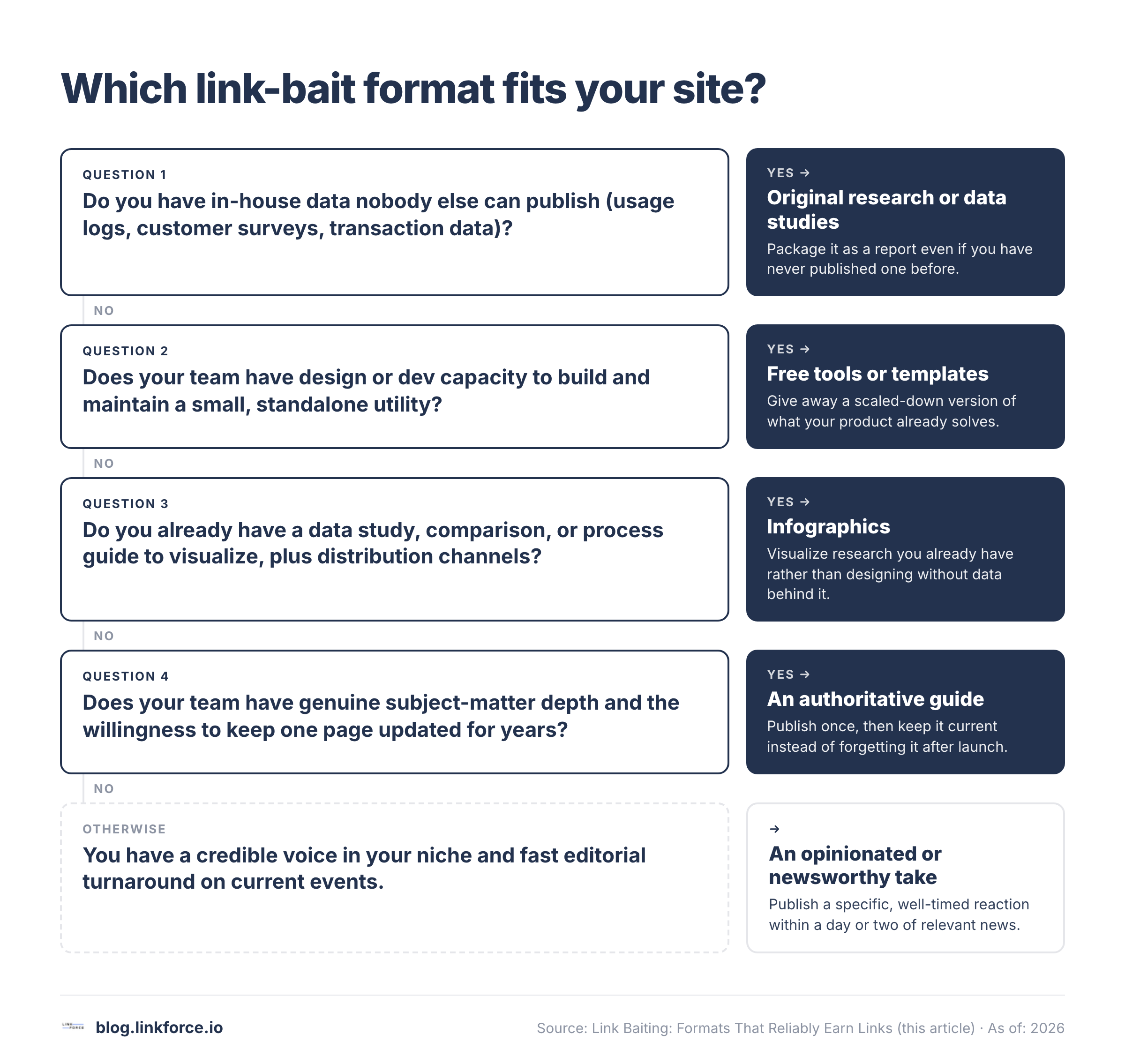
Match the format to what your site can actually produce, not to whatever performed best for someone else's team. Getting this choice wrong is the single biggest reason a link-baiting project doesn't produce any backlinks after months of work, and five questions below predict a good fit.
- Pick original research or data studies if you already have in-house data (usage logs, customer surveys, transaction data) that nobody else can publish, even if you've never packaged it as a public report before.
- Pick free tools or templates if your team has design or development capacity to build and maintain a small, standalone utility, and your product already solves a scaled-up version of the same problem.
- Pick infographics if you already have a data study, comparison, or process guide to visualize, plus distribution channels (social accounts, an email list, outreach contacts) to push it past the first week.
- Pick an authoritative guide if your team has genuine subject-matter depth and the willingness to keep one page updated for years rather than publishing it once and forgetting it.
- Pick an opinionated or newsworthy take if you have a credible voice in your niche and the editorial speed to publish a specific reaction within a day or two of relevant news, not weeks later.
One quick gut check before you commit: can you name the exact data, tool capability, or expertise behind this asset right now, in one sentence, without using the word "comprehensive" or "ultimate"? If you can't, the format isn't ready to build yet, no matter how well it worked for a competitor.
How to Make Any Format Actually Earn Links
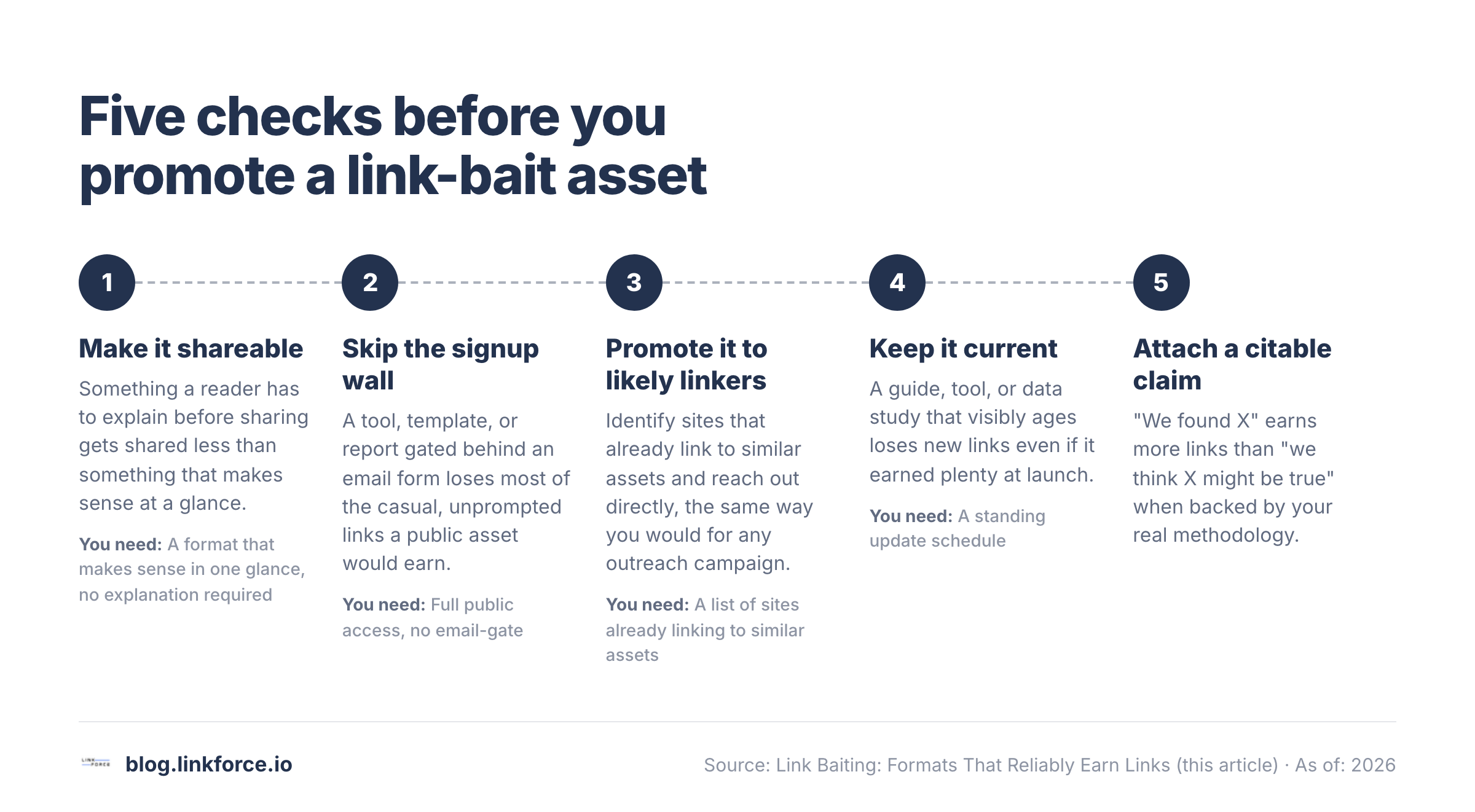
Choosing the right format only gets a project halfway there. Beyond that, the asset itself still has to clear a quality bar and reach the people who'd plausibly link to it, and that second half is where most teams quietly stop trying.
- Make it genuinely shareable, not just useful. Something a reader has to explain before sharing gets shared less than something that makes sense at a glance, whatever the format.
- Give it away without a signup wall. A tool, template, or report gated behind an email form loses most of the casual, unprompted links a fully public asset would earn.
- Promote it to the people most likely to link, not a general audience. After publishing, identify the sites that already link to similar assets (a competitor's data study or free tool is a good starting list) and reach out directly, the same way you'd approach any outreach campaign.
- Keep it current. A guide, tool, or data study that visibly ages (broken screenshots, outdated numbers, a "last updated 2019" stamp) loses new links even if it earned plenty when it launched.
- Attach a clear, citable claim to it. "We found X" earns more links than "we think X might be true." Back the claim with your actual methodology or data source so other writers can cite it with confidence.
Is Link Baiting Still Safe and Effective?
Yes, when the links are genuinely earned. No, if the intent is to manipulate rankings rather than to be useful. Google's own spam policies define link spam as links created primarily to manipulate a site's ranking, not links that happen to point to good content, so a free tool, a data study, or a well-maintained guide that other sites cite because it's useful falls outside that definition entirely.
The real risk sits with the tactics some people lump in with link baiting, not with the format itself. Paying for a mention, running excessive reciprocal link exchanges, or publishing content with a misleading headline designed purely to generate clicks can draw the kind of scrutiny genuine link bait never triggers.
Format fatigue is a more realistic risk than a policy violation, and it's one teams rarely plan for. If your niche already has 5 well-known infographics or 3 widely cited salary surveys, publishing a sixth near-identical version earns far fewer links than picking a format or angle your specific competitors haven't already saturated. The tactic itself hasn't gone out of style. What's changed is that a genuinely original asset now has to clear a higher bar against an AI-generated content flood than it did a few years ago, which is exactly why the format-selection step above matters more than it used to.
Frequently Asked Questions
Is link baiting the same as clickbait?
No. Link baiting earns links by being genuinely useful, well-researched, or citation-worthy, such as an original data study or a free tool, which is why other site owners link to it voluntarily. Clickbait earns clicks through a misleading or exaggerated headline, independent of whether the underlying content deserves the attention, and it doesn't reliably earn links at all, since readers who feel misled rarely link back.
Does link baiting still work in 2026?
Yes, for assets that are genuinely original, current, and useful. No, for a format your niche has already seen several near-identical versions of. The mechanism, other site owners linking to something they find worth citing, hasn't changed. What's changed is that a thin or recycled asset now competes against a much larger volume of AI-generated content, so the bar for "genuinely original" is higher than it used to be.
How many backlinks does a piece of link bait need to succeed?
There's no fixed number, and claims of a specific threshold (such as a set link count needed to rank in the top 10 for a given term) aren't reliable, since the number that matters varies by competition level, niche, and the quality of the links themselves. A more useful measure of success is whether the asset keeps earning new, relevant links months after publication without further outreach, not whether it hits a specific count.