
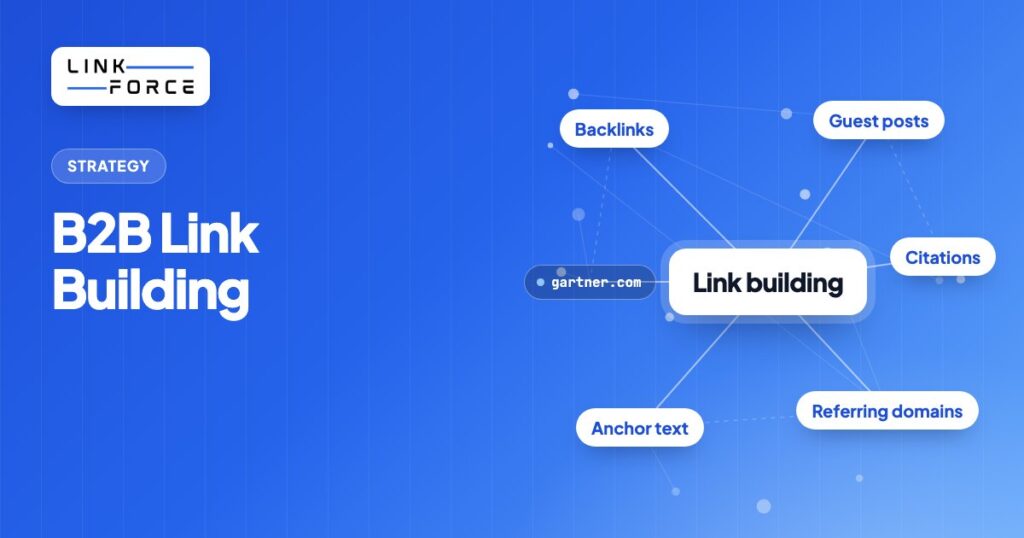
B2B link building is the practice of earning backlinks from other sites to support a sale that a single buyer rarely closes alone. A B2B buying committee of six to ten people, not one decision maker, usually has to agree before a deal moves forward, and that changes which links matter and when to pursue them. This guide covers what makes B2B link building different from B2C, how to time tactics to a long sales cycle, and the specific moves (account-based targeting, data PR, original research) that earn trust from a buying group instead of a single impulse buyer.
What Makes B2B Link Building Different From B2C
B2B link building differs from B2C mainly because the buyer is not one person. Gartner's B2B buying-journey research puts a typical committee at six to ten stakeholders for a complex purchase, each with a different concern: the economic buyer cares about budget and risk, the technical evaluator cares about integration and security, and the end user cares about day-to-day usability. A single backlink rarely sways all of them. What it can do is show up in the places each stakeholder already checks before they sign off: the trade publication the technical evaluator reads, the analyst roundup the economic buyer skims, the peer community the end user trusts.
That difference carries three consequences for how a link-building program should run.
- Trust compounds slowly. A B2C buyer can convert off one strong review; a B2B buying committee needs to see a vendor mentioned credibly across more than one source before any single stakeholder will vouch for it internally.
- Timing matters more than volume. A burst of links in week one does nothing for a deal that will not reach a decision for months; the same links spread across a buying cycle keep reinforcing credibility at each stage.
- Relevance to the account beats raw authority. A mid-tier trade publication the buying committee actually reads outperforms a high-authority general news site none of them opens.
Why Link Building Matters for B2B Pipeline, Not Just Rankings
Link building matters for B2B pipeline because it moves three things buying committees act on: referral traffic from people already evaluating the category, a domain's overall credibility signal, and visibility with the specific publications a target account follows. Ranking position is a side effect of these, not the main point.
- Referral traffic from relevant sources. A mention on an industry site sends visitors who already understand the category, not cold traffic that has to be educated from scratch.
- Domain-wide credibility. Tools such as Ahrefs and Moz track this as domain rating, and a stronger score lifts newer pages faster because the whole domain inherits some of that trust.
- Thought leadership with the buying committee. Being quoted or cited in a publication a prospect's economic buyer or technical evaluator already follows builds familiarity before a sales call ever happens.
None of these outcomes is instant, which is exactly why timing deserves its own plan.
Paste any domain into the free Domain Rating Checker by LinkForce.
Timing Your Link Building to a Long B2B Sales Cycle

Timing a B2B link-building program means matching link type to buying-cycle stage: awareness-stage links earn attention, consideration-stage links build comparative trust, and decision-stage links remove last doubts for the stakeholders who have to sign off. Independent buyer-behavior research shows how wide this window can get. TrustRadius and Pavilion's 2024 B2B Buying Disconnect study found 87% of B2B technology buyers closed their purchase within six months, while 6sense's 2026 Global B2B Buyer Experience Report put the average buying cycle at roughly ten months, with enterprise and higher-complexity deals often running longer still. The exact number varies by deal size and market, but the pattern holds everywhere: a link earned the week before a buying committee reconvenes works differently than one earned the week a prospect first searches for a solution.
| Cycle stage | What the buying committee is doing | Link tactic that fits | What it should accomplish |
|---|---|---|---|
| --- | --- | --- | --- |
| Awareness | Searching broadly, framing the problem | Guest posts and commentary on industry publications | Get the brand in front of stakeholders before they have a shortlist |
| Consideration | Comparing vendors, briefing colleagues | Digital PR and original research | Give stakeholders third-party proof to bring back to the committee |
| Decision | Finalizing budget, resolving internal objections | Case-study placements and partner/co-marketing links | Reassure the last holdouts with evidence specific to their use case |
The practical takeaway is sequencing, not frequency. A deal moving through a nine-month cycle gets more value from one guest post at month one, a data-backed PR placement at month four, and a partner mention at month eight than from the same three links fired off in the same week.
800+ SaaS marketers swap partner, integration and content links. Free plan, no credit card.
Core B2B Link Building Tactics
Guest posting, digital PR, partnerships, and niche directories are the four tactics that cover most of what works for B2B link building. Each earns links through a different mechanism, which is why pairing the right one to the right cycle stage matters more than running all four at once.
Guest Posting on Industry Publications
Guest posting means contributing an article to a publication your buying committee already reads, with a link back to a relevant page on your site. The value is not the link alone; it is appearing inside a publication the technical evaluator or economic buyer already trusts, which transfers some of that trust directly. A payroll software vendor, for example, gains more from a byline in a publication HR directors already subscribe to than from ten guest posts on generic marketing blogs. Pick publications by reader overlap with your actual buying committee, not by domain authority alone, and write something that publication's own editors would accept without a sales pitch attached.
Digital PR and Original Commentary
Digital PR means pitching journalists and industry writers original commentary, data, or a timely take tied to news in your category. It earns links because journalists need sources, not advertisers, and a well-timed, specific comment gets cited far more often than a generic press release. A vendor that comments within a day of a relevant regulatory change or industry report, with a specific number attached rather than a general opinion, has a real shot at a citation; a delayed or vague comment on the same news usually does not. This tactic pairs naturally with the consideration stage, when buying committees are actively looking for third-party validation.
Partnerships and Co-Marketing Links
Partnership links come from joint webinars, co-authored research, integration pages, and marketplace listings with complementary vendors. These links work for B2B specifically because a software buying committee already trusts its existing vendors' recommendations, so a credible partner mention carries weight a cold outreach link cannot.
Niche Directories and Associations
Industry-specific directories, trade associations, and vendor marketplaces still earn legitimate links in B2B, unlike general-purpose web directories. A listing in an industry association's member directory or a reputable software marketplace signals category legitimacy to exactly the stakeholders checking it.
Account-Based Link Building: Targeting What Your Buying Committee Actually Reads
Account-based link building means choosing link placements by what a specific target account's buying committee, procurement reviewer included, reads, not by generic domain-authority scores. Gartner's own research on B2B buyer time found that buyers spend only about 17% of their total purchase-process time meeting with potential suppliers, researching and learning independently for most of the rest. If a supplier only gets a sliver of a buying committee's direct attention, the content and publications that committee reads on its own carry more weight than any sales conversation, which is exactly what account-based link targeting is built to exploit. In practice, that means identifying which trade publications, analyst blogs, or communities the economic buyer, technical evaluator, and end user at your target accounts actually follow, then prioritizing placements there over a higher-authority site none of them opens. A link on a site your prospects never visit does nothing for that deal, no matter how strong its metrics look. Sales and marketing teams already profile buying committees for outreach; feeding that same profile into link-building targeting is the B2B-specific move most general link-building advice skips.
Data PR and Original Research as a Trust Signal for High-Consideration Buyers
Original research and survey data earn links from B2B buying committees because they give risk-averse stakeholders something to point to that is not a vendor's own claim. A buying committee member who has to defend a purchase internally needs more than a product description; a data point from an independent-looking study, even one a vendor commissioned and published transparently, gives them language to use in that internal defense. This is why B2B brands that publish original benchmarks, survey results, or industry-usage data tend to earn links from publications that would never cite a plain product announcement. The tactic takes longer to produce than a guest post, which is exactly why it fits a long sales cycle: it is built once and keeps earning citations across many buying committees' consideration stages.
Common Mistakes in B2B Link Building
The most common mistake in B2B link building is judging the program by B2C or short-cycle SEO standards, which rewards speed over the kind of durable trust a buying committee actually needs, leaving the same internal holdouts unconvinced no matter how many links go live.
- Over-optimizing anchor text. Repeating the same exact-match anchor across many links looks manipulative to both search engines and any stakeholder who clicks through.
- Chasing volume over relevance. A pile of low-relevance links does less for a buying committee than a handful of placements on the publications it actually reads.
- Expecting fast ranking wins. A program judged after 30 days against B2C benchmarks will look like it is failing, even when it is on track for a cycle that runs several months.
- Using templated outreach. Mass, generic pitches get ignored by the same editors whose publications matter most to a buying committee, and they burn relationships faster than they build them.
Measuring B2B Link Building Against a Long Sales Cycle
Measuring B2B link building against a long sales cycle, inside whatever reporting bandwidth the team already has, means tracking leading indicators before conversions arrive, since the links placed this quarter may not show up in closed deals for months. Referring-domain growth on the pages that support active deals, ranking movement on sales-enablement content a rep shares directly with prospects, and assisted-conversion data from marketing attribution all move earlier than final close rates. Treat a flat close-rate chart in month one as expected, not as proof the program failed; the right check is whether referring domains and content visibility are climbing for the accounts currently in the pipeline.
Should You Hire a B2B Link Building Agency or Do It In-House?
Whether to hire a B2B link building agency or keep it in-house depends on three things: team bandwidth, existing media relationships, and how complex your account-based targeting needs to be. An in-house team that already has relationships with relevant trade publications and the bandwidth to run a sustained program over months can do this well without outside help. A team that lacks those relationships, or needs to run account-based targeting across many named accounts at once, often moves faster with a specialized partner who already has standing relationships with the right publications. Either path works; the deciding factor is whether the relationships and time already exist internally, not whether link building itself is too complex to learn.
Frequently Asked Questions
How long does B2B link building take to show results?
B2B link building usually takes 3 to 10 months to show pipeline-level results, matching the sales-cycle ranges reported by TrustRadius/Pavilion and 6sense above rather than a fixed universal number. A new domain with little existing trust sits at the longer end of that range; a domain that already has editorial links sees referring-domain growth sooner.
Does link building help with B2B SEO rankings?
Backlinks are one of the inputs search engines weigh when deciding how much to trust a domain, alongside content quality and technical health; they are not the only lever. A B2B domain with few relevant backlinks typically needs more of them before its sales-enablement and comparison pages climb for competitive terms.
What is the difference between B2B and B2C link building?
B2B link building has to reach every seat on a buying committee, including the quiet holdouts who rarely speak up, over several months; B2C link building usually only has to move one buyer who decides faster. That is why a B2C brand can lean on volume while a B2B brand has to be selective about which publication earns the placement.
Can a small B2B company do link building without an agency?
Yes. A solo marketer or a two-person team can run an effective B2B link-building program without an agency as long as someone owns outreach consistently each week; the limiting factor is a dedicated owner and existing editor relationships, not company headcount.